
创新药

Search documents
任泽平:此轮牛市十年一遇
泽平宏观· 2026-03-19 16:05
Core Viewpoint - A new bull market, termed the "Confidence Bull," has emerged since September 2024, driven by significant policy easing, abundant liquidity, and a new wave of technological revolution, marking a historic opportunity for investors in China [3][4][9]. Group 1: Characteristics of the Current Bull Market - This bull market is described as a once-in-a-decade event, comparable to previous major bull markets in 2004-2007 and 2014-2015, with the current market driven by policy easing, liquidity, and technological advancements [4][5]. - The Shanghai Composite Index has seen a remarkable increase of 48% from its lowest point in 2024 to March 19, 2025, while the ChiNext Index surged by 116%, indicating significant market momentum [8]. - Trading volume has rebounded dramatically, with daily trading volumes exceeding 3 trillion yuan, compared to a few hundred billion prior to September 2024 [8]. Group 2: Driving Forces Behind the Bull Market - The bull market is supported by three main drivers: continuous policy easing, a new technological revolution, and abundant liquidity, collectively referred to as the "Confidence Bull" [9][10]. - Policy easing has included interest rate cuts, relaxed housing market restrictions, and substantial infrastructure investments, which have significantly boosted market risk appetite and lowered risk-free rates [10][11]. - The technological revolution is characterized by advancements in artificial intelligence, robotics, and semiconductor industries, which are leading the market's growth [11]. Group 3: Historical Missions of the Bull Market - The current bull market is seen as fulfilling three historical missions: supporting the development of new productive forces, aiding in major power competition, and repairing household balance sheets [13][14]. - The market's growth is crucial for financing new economy sectors, which struggle to secure funding through traditional banking systems, thus requiring robust capital market support [13]. - The bull market is also expected to help restore consumer confidence and spending, which have been adversely affected by the real estate market downturn [15]. Group 4: Future Prospects and Outlook - The sustainability of the bull market hinges on continued macroeconomic policy easing, including further interest rate cuts and fiscal measures to stimulate demand [17][18]. - There is a potential for a "slow bull" market if the current conditions persist, which would significantly benefit the development of hard technology and economic recovery [17]. - The capital market's ability to maintain a healthy development trajectory is essential for enhancing resident wealth effects and stimulating economic vitality [19].


海外限产+国内产能核减,Ta价值洼地凸显
摩尔投研精选· 2026-03-18 10:40
Group 1: Economic Outlook and Asset Allocation Strategy - The article discusses the rising concerns of stagflation due to the recent surge in oil prices, particularly in the U.S. market, influenced by potential monetary policy changes under Trump and Walsh [1] - The probability of stagflation in China is considered low, as the conditions of excessive monetary easing and rigid wages are not met [1] - Under stagflation, the recommended asset allocation is: Gold & Commodities > Real Estate & Cash > Bonds > Stocks, with sector preferences being: Energy & Resources > Manufacturing > Consumer Staples & Utilities > Technology & Finance & Discretionary [1] - The article highlights three main investment directions: high-growth cyclical sectors (non-ferrous metals, building materials, steel), undervalued high-dividend domestic financials (insurance, white goods, liquor, condiments), and sectors aligned with the 14th Five-Year Plan (innovative pharmaceuticals, nuclear fusion, deep space exploration) [1] Group 2: Coal Market Dynamics - The article notes that geopolitical conflicts in the Middle East have disrupted global natural gas supplies, leading East Asian and EU countries to shift their power generation demands towards coal [2] - China's coal consumption for chemical raw materials is increasing at a rate of 20-30 million tons annually, with new coal chemical projects under construction requiring approximately 243 million tons of coal [2] - Indonesia, as the world's largest coal exporter, plans to significantly reduce its coal production quota to around 600 million tons by January 2026, a decrease of over 24% from the actual production of 790 million tons in 2025, which may tighten China's coal supply [2] - It is estimated that Indonesia's coal exports to China could decrease by 2-4 million tons in 2026, accounting for 4%-8% of China's total imports in 2025 [2] - The coal sector is characterized by high profitability, strong cash flow, and high dividends, making it a valuable asset with a high safety margin [3]

申万宏源证券晨会报告-20260318
Shenwan Hongyuan Securities· 2026-03-18 00:43
Group 1: North Exchange New Stock Investment Strategy - The report emphasizes that the online subscription model is expected to yield thin profits but with accelerated expansion, leading to potential substantial profits in the future. The issuance volume is anticipated to increase significantly, with 5-6 companies expected to be issued monthly, and a total fundraising amount of 14.032 billion yuan from 38 projects awaiting issuance [4][13] - It highlights the expected narrowing of first-day price increases for new stocks, with initial valuations remaining low. The report suggests that the liquidity premium for new stock pricing is likely to decrease, returning to fundamentals [4][13] - The report also notes that 2026 is expected to be a year of high returns from the release of strategic placements, with 43 institutions having their placements released so far this year, achieving an overall floating return rate of +392.4% [4][13] Group 2: Textile and Apparel Industry Investment Strategy - The textile and apparel sector is expected to see a recovery in both domestic consumption and export demand in 2026, with a focus on upstream price increases and the recovery of sports manufacturing. The report suggests that the industry is undergoing a reshuffle, with stronger cycles leading to stronger growth [4][12] - It identifies that the price increase cycle for raw materials like Australian wool and American cotton is expected to drive prices upward, recommending high-quality wool spinning companies as potential investments [4][12] - The report also points out that the outdoor high-performance apparel market is still in its early stages, with significant growth potential, and suggests focusing on brands like Li Ning and Anta Sports [4][12] Group 3: Pharmaceutical and Biotechnology Industry Investment Strategy - The report discusses the emergence of new technology platforms in the global pharmaceutical sector, such as molecular glue and small nucleic acids, which Chinese companies are deeply involved in. These platforms are expected to have advantages in target druggability, research efficiency, and production costs, making them key investment areas [4][15] - It highlights the ongoing acceleration of AI in medical and drug development, suggesting that companies like RunDa Medical and Kangzhong Medical are worth monitoring [4][15] - The report also mentions several products expected to be launched in 2026, including KarXT for treating schizophrenia and TIVDAK for cervical cancer, indicating a rich pipeline of catalysts for the company [4][30] Group 4: Banking Industry Investment Strategy - The report indicates a positive outlook for bank valuations, focusing on two main lines: asset expansion and real estate improvement. It suggests that banks with strong credit resources will see revenue elasticity and that the recovery of the real estate sector will benefit certain banks [4][16] - It notes that the banking sector's dividend yield is currently at 4.7%, which is attractive for long-term investors, and emphasizes the importance of stock selection in 2026 [4][16] - The report also highlights that the banking sector is expected to see stable revenue performance in 2026, with improved asset quality and risk management supporting profitability [4][18]
2026年政府工作报告创新药相关内容解读:全链条支持创新药发展
Lian He Zi Xin· 2026-03-17 11:11
Group 1: Policy Support for Innovation Drugs - The 2026 Government Work Report elevates the biopharmaceutical industry to a "new pillar industry" alongside integrated circuits and aerospace[4] - Emphasis on the importance of commercial health insurance in supporting the development of innovative drugs and medical devices[4] - The introduction of a commercial health insurance innovative drug directory in December 2025 includes 19 innovative drugs for cancer and rare diseases[4] Group 2: Challenges and Solutions in Drug Development - Innovative drugs face long development cycles and high investment costs, creating pressure on basic medical insurance systems[5] - The increasing aging population intensifies the financial strain on basic medical insurance, necessitating reforms in payment methods[4] - Multi-level social medical commercial insurance is expected to alleviate financial pressures and support innovative drug companies[5] Group 3: Growth in Biopharmaceutical Industry - The biopharmaceutical industry is experiencing rapid growth, with a total transaction value of $53.276 billion in January-February 2026, nearing the total for the entire year of 2024[6] - The average upfront payment for BD agreements in January-February 2026 was $17.2 million, significantly up from $5.2 million in 2022[7] - The positioning upgrade of the biopharmaceutical industry is expected to be a key driver for China's industrial structure upgrade[7]
新兴产业周报20260317-20260317
Western Securities· 2026-03-17 07:28
Investment Rating - The report recommends an "Overweight" rating for solid-state batteries, innovative drugs, and humanoid robots, while maintaining a "Neutral" rating for commercial aerospace and other sectors [5][21]. Core Insights - The report highlights a "less loss for win" phase, suggesting a focus on sectors with potential growth despite current market pressures [5]. - Key themes include advancements in solid-state batteries, innovative pharmaceuticals, and humanoid robots, with specific mentions of Tesla's production plans and breakthroughs in battery technology [5][10]. Summary by Relevant Sections Solid-State Batteries - The sector is rated "Overweight" with a strong technical outlook, indicating a low position relative to historical averages and potential for growth [5]. - Recent developments include the second-generation semi-solid-state battery from Funeng Technology, which supports fast charging and has achieved small-scale production [5][10]. Innovative Drugs - Rated "Overweight," this sector shows strong fundamentals despite slight downward adjustments in profit expectations [5]. - Notable events include the acceptance of a clinical trial application by Yangli Pharmaceutical for a drug targeting hypertension, marking a significant step for Chinese innovative drugs in international markets [10]. Humanoid Robots - The humanoid robot sector is also rated "Overweight," with a strong technical outlook and ongoing developments, such as Tesla's announcement of mass production plans for its Optimus robot [5][10]. Commercial Aerospace - This sector is rated "Neutral," facing adjustment pressures despite recent successful satellite launches [5]. AI Applications and Computing Infrastructure - Both sectors are rated "Neutral," with moderate growth expectations and recent regulatory approvals for industry standards [5][10]. New Consumption - The new consumption sector is rated "Neutral+" with a strong technical outlook, indicating potential growth opportunities as new consumption enterprises prepare for IPOs [5][10]. Gaming - The gaming sector is rated "Neutral," with recent adjustments in commission rates by major platforms like Apple and Google providing a favorable environment for game developers [5][10]. Low-altitude Economy - This sector is rated "Neutral," with ongoing legislative efforts to support its development [5][10]. Deep Sea Economy - Rated "Underweight," this sector faces challenges despite significant contributions to national oil production [5][10]. Military and Defense - The military sector is rated "Neutral," with ongoing expansions and production commitments from major defense contractors [5][10]. Controlled Nuclear Fusion - This sector is rated "Neutral," with recent government initiatives highlighting its strategic importance for future energy solutions [5][10].
科创创新药连续反弹,百济神州涨超4%,荣昌生物涨近7%,多项重磅新药、专利来了!科创创新药ETF汇添富(589120)量价齐升涨超3%
Xin Lang Cai Jing· 2026-03-17 03:09
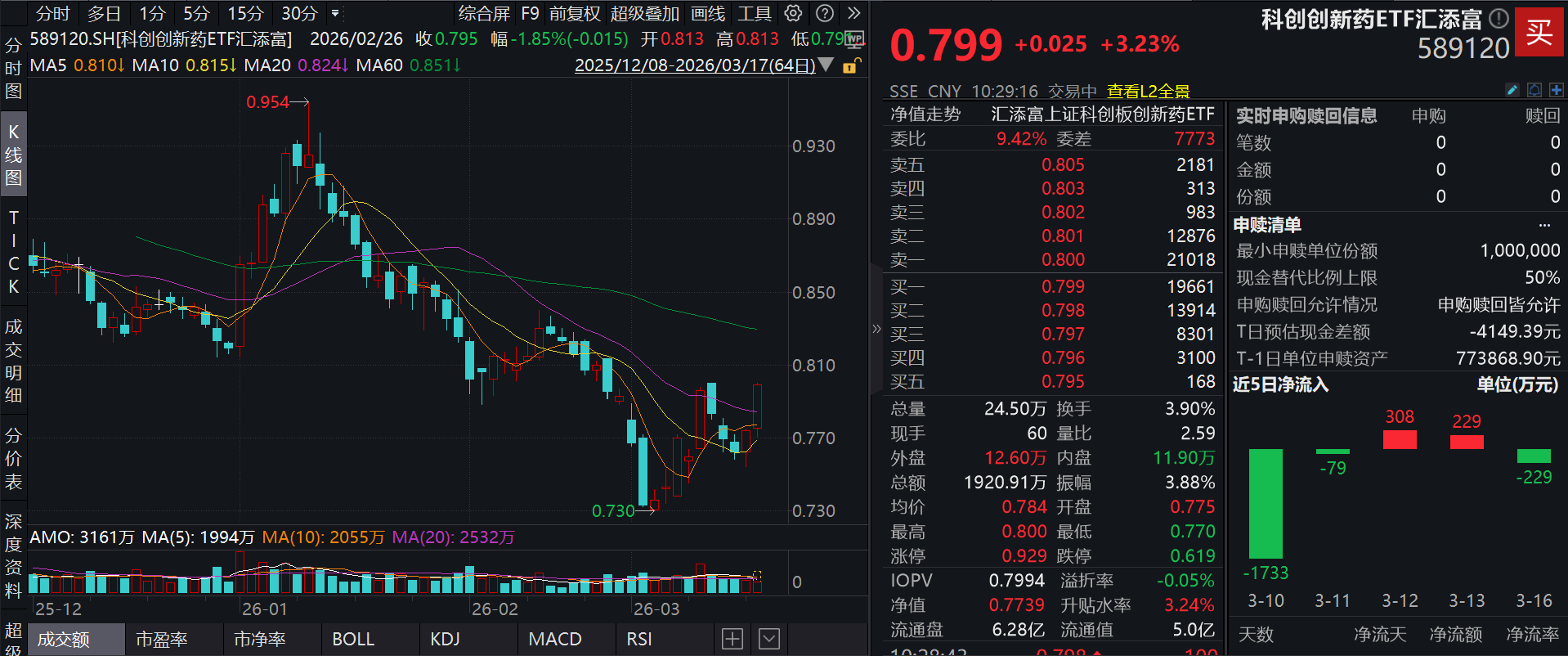
Core Viewpoint - The innovation drug sector in China is experiencing significant growth, driven by new drug approvals and favorable policy changes, with a focus on the performance of the ChiNext Innovation Drug ETF. Group 1: Market Performance - The ChiNext Innovation Drug Index rose by 3.42% as of March 17, 2026, with notable increases in constituent stocks such as Sangfor Biopharma (up 9.72%) and Yuandong Biotech (up 7.96%) [1] - The ChiNext Innovation Drug ETF (Huitianfu) increased by 3.23%, reaching a latest price of 0.8 yuan, and has seen a cumulative increase of 1.84% over the past week [1] - The ETF recorded a turnover rate of 3.90% with a trading volume of 19.21 million yuan, and an average daily trading volume of 33.78 million yuan over the past year [1] Group 2: Fund Growth and Inflows - The ChiNext Innovation Drug ETF saw a significant scale increase of 10.69 million yuan over the past two weeks, ranking in the top half among comparable funds [3] - The ETF's share count grew by 39 million shares in the past month, also placing it in the top half of comparable funds [3] - Despite a recent net outflow of 2.30 million yuan, the ETF experienced net inflows on 10 out of the last 15 trading days, totaling 30.51 million yuan [3] Group 3: Company Developments - Rongchang Biopharma's RC288 injection has received acceptance from the NMPA, showcasing promising anti-tumor activity and safety in preclinical studies [3] - Rongchang Biopharma is expected to enter a new growth phase starting in 2026, benefiting from new indications for RC18, RC48, and RC28, along with international sales starting in 2027 [4] - The company anticipates revenue from multiple asset authorizations beginning in 2025, which will enhance its financial statements [4] Group 4: Industry Trends - The new National Basic Medical Insurance Drug List has added 114 new drugs, including 50 innovative drugs, with a negotiation success rate of 88%, indicating a robust market for innovative drugs [5] - The commercialization of innovative drugs is accelerating, supported by improved payment systems and a green channel for insurance access [5] - The CXO industry is highlighted as a strong investment opportunity, with ongoing improvements in global pharmaceutical R&D and increasing collaboration between Chinese companies and multinational corporations [6]

国信证券晨会纪要-20260317
Guoxin Securities· 2026-03-17 01:11
Macro and Strategy - The macroeconomic monthly report indicates that the foundation for economic recovery is still to be solidified, with GDP growth reaching 5.2% year-on-year, a 0.5 percentage point increase from December 2025 [7] - Industrial production is recovering faster than the service sector, with industrial added value growing by 6.3% year-on-year in January-February, while the service production index only increased by 5.2% [7] - Demand is showing a comprehensive recovery, with fixed asset investment growth turning positive at 1.8% year-on-year, and retail sales of consumer goods increasing by 2.8% year-on-year, marking the highest month-on-month growth in nearly a decade [7] Industry and Company Social Services Industry - The social services sector saw a decline of 5.16% during the reporting period, underperforming the market by 4.28 percentage points [11] - The tourism market is experiencing a "not-so-dull off-season" post-Spring Festival, with policies stimulating demand, particularly among the elderly demographic [12] - Key companies in the sector, such as Huangshan Tourism and Jiuhua Tourism, showed positive stock performance during the reporting period [11][12] Home Appliances Industry - Home appliance exports grew by 9% year-on-year in January-February, with a significant improvement in both domestic and international sales [14] - Retail demand for major appliances is recovering, with a narrowing decline in retail sales across various categories, except for air conditioners, which faced a drop due to warm weather during the Spring Festival [15][16] - The export value of home appliances reached 119.2 billion yuan, with a 16% increase in export volume, indicating a positive trend in overseas markets [16] Pharmaceutical and Biotechnology Industry - The report emphasizes the ongoing clinical development of innovative drugs, with a focus on the CXO industry as a strong investment theme [19] - The domestic market for home medical devices is expected to grow significantly due to aging demographics and improved consumer sentiment [20] - Investment opportunities are highlighted in surgical robotics, with new pricing guidelines expected to enhance the clinical application of innovative products [20] Public Utilities and Environmental Protection Industry - The public utilities index rose by 3.07%, with significant gains in the renewable energy sector, particularly in new energy generation [22] - China has joined the "Triple Nuclear Declaration," promoting sustainable nuclear energy development [22] - The "14th Five-Year Plan" outlines key strategies for the public utilities and environmental protection sectors, emphasizing the need for investment in clean energy and waste management [23] Specific Company Insights - Guoquan's financial performance met expectations, with a 20.7% increase in revenue and a 48.2% rise in core operating profit for 2025 [26] - Sunlord Electronics reported a 14.39% increase in revenue, driven by strong growth in AI and IoT applications [28] - Lenovo Group achieved double-digit growth across all business segments, with a notable increase in AI server revenue [30]


港股创新药再迎反弹
第一财经· 2026-03-16 13:30
Core Viewpoint - The Hong Kong innovative drug sector is experiencing a rebound, with multiple innovative drug ETFs rising over 3%, indicating renewed market interest after a prolonged adjustment period [3][4]. Market Performance - On March 16, the Hong Kong market saw a collective rise in major indices, with the Hang Seng Index, Hang Seng Tech Index, and Hang Seng China Enterprises Index increasing by 1.45%, 2.69%, and 1.67% respectively [5]. - The Hang Seng Innovative Drug Index led the gains with a 3.18% increase, while 18 cross-border ETFs related to "innovative drugs" and "pharmaceuticals" collectively rose over 2%, averaging a 2.67% increase [5][6]. - Trading activity was robust, with the total trading volume of the mentioned ETFs exceeding 12.5 billion yuan, a 45% increase from the previous trading day [6]. Fund Flows - Since the fourth quarter of last year, approximately 22 billion yuan has flowed into innovative drug ETFs, with 4.93 billion yuan entering in 2023 alone [6][7]. - Notable inflows were seen in the Huatai-PB Hang Seng Innovative Drug ETF and the GF Hang Seng Innovative Drug ETF, which attracted 2.105 billion yuan and 1.578 billion yuan respectively [7]. Sector Analysis - The innovative drug sector has faced a significant adjustment, with the Hang Seng Innovative Drug Index dropping over 21.5% since the fourth quarter of last year [8]. - The recent adjustments are viewed as a normal market correction rather than a deterioration of the industry's fundamentals, with the sector's valuation returning to a reasonable range [8][9]. - The potential for profitable companies to emerge is highlighted, as many firms are expected to reach profitability between 2026 and 2028, which could lead to significant alpha generation [9]. Investment Outlook - The market is anticipated to shift from broad valuation reassessment to a focus on fundamental performance, with only companies demonstrating profitability and core competitiveness likely to thrive [9][10]. - Concerns remain regarding the impact of AI technology on the pharmaceutical industry, prompting some fund managers to adopt a cautious stance [9][10]. External Factors - Southbound capital has been a significant support for the Hong Kong market, with a cumulative net inflow exceeding 180 billion yuan in 2023 [10][11]. - The overall market dynamics are influenced by external liquidity conditions and the U.S. interest rate environment, which could affect the pace of valuation recovery [11][12]. - The rebound in the Hong Kong market is expected to be driven by corporate earnings realization, sustained southbound capital inflows, and marginal improvements in the domestic macroeconomic environment [12].

突传重磅,港股崛起!芯片、医药领衔,华宝基金港股信息技术ETF(159131)放量涨超3%!互联网龙头异动猛攻
Xin Lang Cai Jing· 2026-03-16 11:27
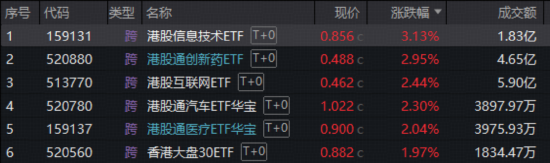
Core Viewpoint - The Hong Kong stock market experienced a significant surge, with the Hang Seng Index rising by 1.45% and the Hang Seng Tech Index increasing by 2.69%, driven by positive sentiment from Wall Street and returning Middle Eastern funds [22][23][31]. Group 1: Market Performance - The Hong Kong stock market saw a notable rally, with the Hang Seng Index closing up 1.45% and the Hang Seng Tech Index up 2.69% [22][23]. - The semiconductor sector is expected to experience a new wave of price increases, with chip stocks showing strong performance [23][27]. - Major internet companies such as Xiaomi and Tencent saw significant gains, contributing to the overall market rally [23][30]. Group 2: Sector Highlights - The pharmaceutical sector led the charge, with the Hong Kong Stock Connect Innovation Drug ETF (520880) and the Hong Kong Medical ETF (159137) both rising over 2%, ending a three-day decline [23][30]. - The Hong Kong Information Technology ETF (159131) surged by 3.13%, marking a strong performance in the semiconductor and hard technology sectors [27][30]. - The medical sector is gaining traction, with key players like Kangfang Biopharmaceutical and CSPC Pharmaceutical rising over 5% [30][33]. Group 3: Investment Insights - Analysts suggest maintaining a "barbell strategy" in the Hong Kong market, focusing on high-dividend stocks and energy operators for defensive positions, while targeting semiconductor equipment for growth [24][31]. - The valuation of Hong Kong chip stocks is considered attractive, with the latest P/E ratio for the Hong Kong Information Technology ETF at 32.88, indicating significant upside potential [28][30]. - The Hong Kong Medical ETF is positioned to benefit from the government's emphasis on the biopharmaceutical industry, which is now regarded as a pillar alongside other key sectors [34][35].

每日市场观察-20260316
Caida Securities· 2026-03-16 02:45
Market Overview - On March 16, 2026, A-shares experienced fluctuations around the previous day's closing position, with all three major indices closing down, each declining by less than 1%[1] - The total trading volume in the Shanghai and Shenzhen markets reached 2.42 trillion yuan, a decrease of over 430 billion yuan compared to March 12[1] - Only a few sectors, including food and beverage, construction, banking, and real estate, saw gains, while the majority of sectors declined[1] Sector Performance - Energy-related sectors such as chemicals, wind power, and lithium batteries showed resilience, supporting the market amid a weak overall performance[1] - Technology sectors (computing power, AI) and non-ferrous metals collectively retreated, negatively impacting the indices[1] - Approximately 1,500 stocks rose, with the proportion of rising stocks close to 30%, remaining stable compared to March 12[1] Investment Insights - The market's recent pullback confirms a weak market effect, prompting a defensive investment style among market participants due to geopolitical tensions and energy price fluctuations[1] - Investors are advised to focus on energy-related sectors, blue-chip stocks, and the pharmaceutical sector for potential opportunities[1] Fund Flow - On March 13, the Shanghai Composite Index saw a net outflow of 3.668 billion yuan, while the Shenzhen Composite Index experienced a net inflow of 6.444 billion yuan[5] - The top three sectors for net inflow were infrastructure, batteries, and agricultural chemicals, while IT services, software development, and consumer electronics faced the largest outflows[5] Private Fund Performance - As of the end of February 2026, the average return of private equity funds reached 6.89%, with 85.04% of the 12,270 products achieving positive returns[15]