农林牧渔

Search documents
就在今天|国泰海通 ·2025研究框架培训“洞察价值,共创未来”
国泰海通证券研究· 2025-08-17 22:48
Group 1 - The article outlines a comprehensive research framework training program titled "洞察价值,共创未来" (Insight Value, Co-create Future) scheduled for August 18-19 and August 25-26, 2025, focusing on various sectors including macroeconomics, consumption, finance, cycles, medicine, technology, and manufacturing [18][19]. - The training sessions will cover a wide range of topics, with specific time slots allocated for each area of research, such as food and beverage, internet applications, and renewable energy [14][15][16]. - The event will take place at the Guotai Junan Financial Bund Plaza in Shanghai, emphasizing the importance of in-depth analysis across all sectors [18]. Group 2 - The training program is designed to enhance the research capabilities of analysts and is led by various chief analysts specializing in different fields, ensuring a comprehensive approach to industry analysis [8][10]. - Participants will have the opportunity to engage with experts in macroeconomic research, strategy, fixed income, and various sector-specific studies, fostering a collaborative learning environment [14][15][16]. - The program aims to equip analysts with the necessary tools and insights to navigate the complexities of the financial markets and identify potential investment opportunities [18].


十大券商一周策略:这是一轮“健康牛”,A股仍有充足空间和机会
Zheng Quan Shi Bao· 2025-08-17 22:21
Group 1 - The combination of "anti-involution" and overseas expansion logic may provide investment clues, particularly in industries like rare earths, cobalt, phosphate fertilizers, and refrigerants, which have seen profit contributions surge due to export controls or quotas [1] - China's manufacturing value-added share globally has surpassed 30%, but profit margins are declining, indicating a shift from market share competition to profit realization [1] - Short-term investment focus should remain on innovative pharmaceuticals, resources, communications, military industry, and gaming sectors, while avoiding excessive high-cut low trades [1] Group 2 - The A-share market is experiencing a new stable state, with increased investor participation and a clear trend of reallocating household wealth towards financial assets [2] - Key sectors to watch include the upstream non-ferrous metals industry, midstream steel, machinery, and power equipment, as well as non-bank financials and agriculture [2] Group 3 - The current slow bull market is characterized by structural prosperity, limited short-term capital influx due to uncertainties, and a clear direction for bullish sentiment [3] - Recommended sectors for investment include dividend stocks, liquid cooling servers, AI, innovative pharmaceuticals, humanoid robots, personal care, electronics, non-bank financials, non-ferrous metals, and military industry [3] Group 4 - The market is undergoing a "healthy bull" phase, supported by national strategic direction and active capital inflow, with a steady upward trend in indices and declining volatility [4] - Focus areas include brokerage firms, AI expansion, military industry, and "anti-involution" themes [4] Group 5 - Current market concerns do not pose significant downside risks, with expectations for improved supply-demand dynamics in 2026 [5] - The market is anticipated to experience a fourth-quarter rally in 2025, characterized by a mix of momentum-driven sectors and broad-based rotation [5] Group 6 - Key sectors to focus on include brokers, insurance, military, and rare earths, with ongoing momentum in pharmaceuticals and overseas computing assets [6] Group 7 - The A-share market is currently in the second phase of a bull market, driven by risk preference recovery and valuation rebalancing [7] - Key sectors for mid-term investment include AI, pharmaceuticals, non-bank financials, semiconductors, non-ferrous metals, military industry, and internet [7] Group 8 - The technology and small-cap styles are expected to continue dominating the market, with increasing participation from retail investors and private funds [8] Group 9 - The A-share market has ample space and opportunities, supported by strong economic resilience and significant excess savings among residents [9] - Investment focus should be on new technologies and growth directions, as well as sectors benefiting from liquidity easing [9] Group 10 - The outlook for the market's upward potential remains cautiously optimistic, emphasizing the need for a transition from liquidity-driven growth to fundamental-driven growth [10] - Structural rotation among sectors is crucial, with a focus on undervalued assets [10] Group 11 - The current market environment presents opportunities for cyclical assets as profit expectations improve, particularly in upstream resources and capital goods [11][12] - Key sectors include industrial metals, engineering machinery, and consumer staples, with a focus on growth-oriented large-cap stocks [12]
机构论后市丨A股新稳态进一步确立;坚持“科技为先”
Di Yi Cai Jing· 2025-08-17 10:05
Group 1 - The market is expected to focus on five key industries: innovative pharmaceuticals, resources, communications, military industry, and gaming in the short term [3] - The A-share market has shown positive signals with increased trading volume and a shift of household wealth towards financial assets, indicating a new stable state [1] - The AI industry chain, anti-involution, and non-bank financial sectors are anticipated to experience rotation under active market conditions [2] Group 2 - The supply-side focus on anti-involution and demand-side profit extraction is identified as a significant medium to long-term investment theme [3] - The growth sectors are expected to show high prosperity due to the AI technology revolution and emerging industry trends [2] - The market is characterized by a dual driving force, with global technology growth providing strong elasticity and anti-involution leading to a recovery in cyclical and counter-cyclical trades [4]
短期慢牛持续,聚焦成长和补涨
Huajin Securities· 2025-08-17 06:32
Market Trends - The A-share market is expected to continue its slow bull trend due to strong fundamentals, loose policies, and liquidity conditions[6] - Since 2005, the Shanghai Composite Index's PE percentile has broken above 60% seven times, with six instances leading to further increases, averaging 2-4 months of upward movement[6][8] Economic Indicators - July's export growth rate was 7.2%, exceeding expectations, supported by a low base from the previous year[11] - The manufacturing PMI has shown improvements in five of the six instances where the market continued to rise after breaking the 60% PE threshold[6][12] Policy Environment - Recent policies aimed at promoting the healthy development of the private economy and consumer spending are being implemented, including personal consumption loan subsidies[15][19] - The geopolitical risk index has significantly decreased, indicating a more stable external environment for the market[16] Industry Focus - Short-term focus should be on growth and recovery sectors, particularly undervalued industries in technology, cyclical sectors, and large financials[26] - High-growth sectors currently include artificial intelligence, robotics, and consumer electronics, while undervalued sectors include transportation, coal, and petrochemicals[26][27] Investment Recommendations - It is advised to continue accumulating positions in sectors with upward policy and industry trends, such as robotics, electronics, and innovative pharmaceuticals[39] - The report suggests a balanced allocation towards sectors with improving expectations, including new energy, non-ferrous metals, and retail[39]
“反内卷”及近期经济专题深度报告:积极因素逐步积累,筑牢A股向好的根基
Caixin Securities· 2025-08-15 10:14
Group 1: Investment Rating - No investment rating information is provided in the report. Group 2: Core Viewpoints - "Anti - involution" will alleviate the dilemma of "increasing revenue without increasing profit", with a greater boost to PPI than CPI, and promote the nominal GDP growth rate to approach the real GDP growth rate [5][21]. - The US economy shows signs of weakness, and the market's expectation of the Fed's interest rate cut is rising, with an expected cumulative rate cut of 75bp in 2025 [5][83]. - China's economic growth rate in 2025 may be high in the first half and low in the second half, but it can achieve the 5% target for the whole year [5]. - The A - share market still has a certain degree of sustainability, and the bond market is likely to fluctuate narrowly, while the commodity market will enter a wide - range shock trend [5]. Group 3: Summary by Directory 1 "Anti - involution": Alleviate the Dilemma of "Increasing Revenue without Increasing Profit" and Improve Market Performance Expectations - **Overview**: "Anti - involution" aims to promote the economy to return from "scale expansion" to "high - quality growth", improve social overall efficiency, and is a key part of building a unified national market [10][11]. - **Approach**: Different from the previous supply - side reform, it focuses on downstream emerging industries, mainly private enterprises, with more moderate and gradual policies using market - based and legal means [18][19]. - **Impact**: It is expected to have a greater impact on PPI than CPI, and promote the nominal GDP growth rate to approach the real GDP growth rate, but there is uncertainty in the transmission of price increases from upstream to downstream [21][24]. - **Style**: From April to September, the market pays more attention to performance, and the "anti - involution" direction has performance release expectations [28]. - **Law**: It may be a key factor supporting the strength of the A - share market, and the current "anti - involution" market is in the policy - expectation stage [32][36]. - **Summary**: It can alleviate the dilemma of "increasing revenue without increasing profit" and improve market performance expectations [46]. 2 Global: The US Economy Shows Signs of Weakness, and the Fed's Interest Rate Cut Expectation is Rising - **Overseas Tariffs**: The US average effective tariff rate has reached the highest level since 1933, reducing global economic growth potential, and tariffs remain a key variable affecting China's exports [49]. - **Overseas Economy**: The global economy has short - term resilience, but the US economy shows signs of weakness in investment, and the Fed has lowered its economic growth forecast [55][60][66]. - **Overseas Inflation**: The short - term impact of tariffs on US inflation is emerging, and the medium - term inflation trend still faces great uncertainty [69][73]. - **Overseas Liquidity**: The inflection point of non - farm data may have arrived, and the market's expectation of the Fed's interest rate cut is rising, with an expected 75bp rate cut in 2025 [77][83]. - **Summary**: The global economy has short - term resilience but increasing uncertainty, and the expectation of the Fed's interest rate cut is rising [83]. 3 China: The Economic Growth Rate May be High in the First Half and Low in the Second Half, and the Spontaneous Recovery Momentum Needs to be Consolidated - **Economic Overview**: China's economic growth rate in 2025 may be high in the first half and low in the second half, with the GDP growth rate in Q3 and Q4 expected to decline compared with Q1 and Q2 [84]. - **Investment End**: The growth rate of fixed - asset investment continues to bottom out, and real estate investment is still the main drag [85]. - **Consumption End**: Consumption data still has resilience, and service consumption may be the key area of development [27]. - **Export End**: Attention should be paid to the impact of tariffs and export over - draw effects [5][28]. - **Liquidity**: The government sector is still the main force for increasing leverage, and the time for reserve requirement ratio and interest rate cuts is expected to be postponed [28]. - **Summary**: The annual economic growth rate is likely to be high in the first half and low in the second half [29]. 4 Market Strategy: Positive Factors are Gradually Accumulating to Strengthen the Foundation for the A - share Market to Improve - **General Trend Judgment**: The subsequent market is expected to have a certain degree of sustainability [30]. - **Policy Trends**: The economic policy in the second half of the year is expected to maintain its stance and act appropriately [32]. - **Allocation Framework**: Gradually increase the allocation of stock assets [33]. - **Investment Advice**: The equity index will run strongly, the bond market may fluctuate narrowly, and the commodity market will enter a wide - range shock trend [5][33].
社保基金,最新重仓股曝光
天天基金网· 2025-08-15 05:50
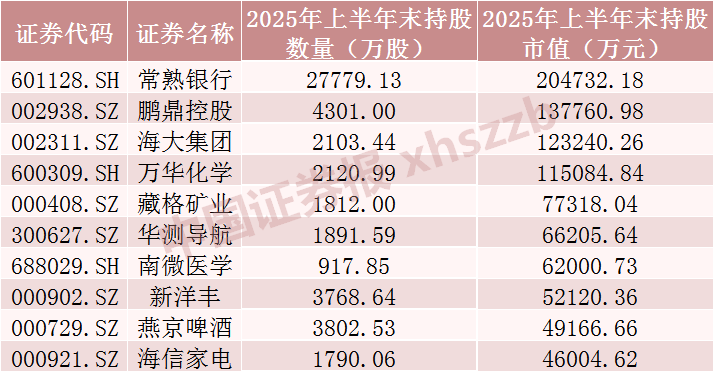
Core Viewpoint - The article highlights the significant presence of social security funds in the stock market, particularly focusing on their investments in various sectors and specific companies as of the first half of 2025 [1][3]. Group 1: Social Security Fund Holdings - As of August 13, 2025, 281 A-share listed companies have disclosed their mid-year reports, with 42 companies having social security funds among their top ten circulating shareholders [3][6]. - The total number of shares held by social security funds amounts to 789 million, with a market value of 14 billion yuan [3][9]. - The top three companies by market value held by social security funds are Changshu Bank (20.47 billion yuan), Pengding Holdings (13.78 billion yuan), and Haida Group (12.32 billion yuan) [3][4]. Group 2: Sector Analysis - Social security funds have significant holdings in the basic chemical and banking sectors, each exceeding 2 billion yuan, while holdings in the electronics and pharmaceutical sectors exceed 1.2 billion yuan [9][11]. - The total market value of social security fund holdings in the basic chemical sector is 23.97 billion yuan, and in the banking sector, it is 20.47 billion yuan [9][11]. Group 3: Changes in Holdings - In the second quarter of 2025, social security funds entered the top ten shareholders of 15 new stocks, with notable investments in Yanjing Beer, Chuanfeng Power, and Weixing Chemical, each exceeding 300 million yuan [6][9]. - The largest increase in holdings was seen in Changshu Bank, with an additional 23.8 million shares acquired, followed by Haida Group and Pengding Holdings with increases of 10.15 million shares and 6.51 million shares, respectively [8][9].





社保基金,最新重仓股曝光
Zhong Guo Zheng Quan Bao· 2025-08-14 08:35
近期,上市公司2025年半年报密集披露,上半年社保基金重仓股及持股变动情况"浮出水面"。 Wind数据显示,截至8月13日,已有281家上市公司披露了2025年半年报。其中,42家上市公司的前十大流通股东中出现了社保基金 的身影。社保基金在2025年二季度新进成为15只个股的前十大流通股东;同时,对另外10只个股的持股数量相比上季度有所增加。 行业方面,社保基金对基础化工、银行行业持仓市值均超过20亿元,对电子、医药生物、农林牧渔行业持仓市值均超过12亿元。 持仓常熟银行市值超20亿元 Wind数据显示,截至8月13日,共计281家A股上市公司披露了2025年中报。在已披露中报的上市公司中,有42家上市公司的前十大 流通股东中出现了社保基金的身影,社保基金合计持股数量达7.89亿股,持股市值为140亿元(以2025年上半年末收盘价计算)。 从社保基金持仓市值排名看,社保基金对常熟银行的持仓市值为20.47亿元,位居第一;对鹏鼎控股、海大集团的持仓市值分居第 二、第三位,分别为13.78亿元、12.32亿元。此外,社保基金对万华化学持仓市值超11亿元。 来源:Wind 从持股增加数量情况看,Wind数据显示,社 ...
沪指突破“924行情”高点 成交额突破2万亿元
Yang Shi Wang· 2025-08-13 11:17
Market Performance - A-shares saw all three major indices rise collectively, with total trading volume exceeding 2 trillion yuan, marking a significant increase in market activity [1] - The Shanghai Composite Index closed at 3683.46 points, surpassing its previous high of 3674.4 points set on October 8, 2024, and reaching its highest level since December 13, 2021 [1] Economic Insights - The chief economist of Qianhai Kaiyuan Fund, Yang Delong, indicated that the upward trend in A-shares is driven by liquidity, with a systemic decline in domestic risk-free interest rates and an influx of overseas dollar liquidity [1] - Yang Delong also suggested that the market is likely to maintain a strong performance due to the accumulation of favorable internal and external factors, potentially leading to a gradual bull market trend [1] Sector Performance - Various sectors showed positive performance, with electronic chemicals, small metals, bioproducts, non-ferrous metals, non-metallic materials, securities, and communication equipment leading the gains [3] - The chief strategy analyst of China Galaxy Securities, Yang Chao, noted that the market may experience a rotation of local hotspots, emphasizing the importance of focusing on sectors with strong earnings prospects [3] Insurance Sector Activity - Insurance institutions have made 22 equity stakes in listed companies this year, surpassing the total for the previous year, with five instances occurring just in July [4] - Notable recent activity includes Hongkang Life increasing its stake in Honghua Smart Energy, triggering a regulatory notice due to exceeding a 5% holding [4] Investment Trends - The insurance sector is increasingly focusing on companies with strong governance, solid performance, and stable cash flows, aligning with national strategic development directions [4] - Analysts predict that the demand for equity assets among insurance institutions will remain strong, with expectations of continued increases in both the number and scale of equity stakes in the second half of the year [5] Private Equity Expansion - The establishment of new private equity funds, such as the one approved for Taiping Asset, marks a significant expansion in the number of insurance-related private equity firms, now totaling six [7] - The advantages of insurance private equity funds include access to substantial capital reserves, independent management, and enhanced investment precision through professional teams [7]
上半年净融资超过1万亿元——银行间债市加码支持实体经济
Xin Hua Wang· 2025-08-12 06:20
Group 1 - The interbank market has increased support for the real economy, with debt financing instruments issued amounting to 4.73 trillion yuan in the first half of 2022, a year-on-year increase of 6%, resulting in a net financing scale of approximately 1.1 trillion yuan, an increase of about 500 billion yuan year-on-year [1] - The unified registration model for debt financing instruments (DFI, TDFI) allows qualified issuers to register once and issue multiple times, significantly facilitating corporate financing [1] - Major state-owned enterprises, such as China Merchants Group, issued 290 billion yuan in debt financing tools to optimize debt structure and reduce financing costs [1] Group 2 - In the logistics sector, the interbank market supported four private enterprises, including SF Express and Yunda, in issuing 5 billion yuan in debt financing tools to supplement operating funds and optimize debt structure [2] - The interbank market actively supports infrastructure construction and major project financing, with 151.5 billion yuan issued for water conservancy projects and 1.62648 trillion yuan for transportation, energy, and agriculture sectors [2] - Leading companies in various industries, such as China Merchants, State Grid, and Sinopec, have benefited from this financing support, contributing to economic stability and fulfilling social responsibilities [2] Group 3 - The aviation industry, significantly impacted by the pandemic, has received increased support from the interbank market, with companies like Air China and China Eastern Airlines registering 123 billion yuan in various debt financing tools [3] - The issuance target for bonds in the aviation sector is set at 200 billion yuan, with 120 billion yuan already provided by the interbank market [3] - As of June 2022, civil aviation companies have issued a total of 965.9 billion yuan in debt financing tools [3] Group 4 - The interbank market has implemented measures to waive transaction fees for private enterprises, further signaling support for them [4] - In 2022, membership fees for private enterprise issuers were waived, and additional fee reductions for bond issuance and financing services were introduced [4] - The interbank market aims to enhance information disclosure and registration efficiency to meet corporate financing needs and support macroeconomic stability [4]
年内A股公司耗资近290亿元回购 周期性行业回购金额居前
Xin Hua Wang· 2025-08-12 05:54
Core Viewpoint - The article discusses the recent trends in share buybacks among A-share listed companies in China, highlighting a significant increase in buyback activities despite a decrease in the number of new buyback plans compared to the previous year [1][2]. Group 1: Buyback Plans and Implementation - As of July 12, 2023, 183 A-share companies announced 187 buyback plans with a total proposed buyback limit of 36.805 billion yuan [1]. - A total of 450 A-share companies have spent 28.936 billion yuan on buybacks this year, with 73 companies exceeding 100 million yuan in buyback amounts [4]. - The sectors with the highest buyback amounts include machinery, basic chemicals, and agriculture, indicating a trend where companies are confident about future market conditions despite current cyclical downturns [4]. Group 2: Purpose and Impact of Buybacks - The primary reasons for buybacks include market value management, capital reduction, and employee stock incentive plans, with 161 out of 187 plans aimed at employee stock incentives, accounting for approximately 86% [2]. - Experts suggest that buybacks can signal positive market sentiment and bolster investor confidence, especially when companies are perceived to be undervalued [2][3]. Group 3: Regulatory Environment and Future Outlook - Since the introduction of supportive policies in November 2018, the regulatory framework for buybacks has been continuously optimized, with recent amendments aimed at easing buyback conditions [5][6]. - Following the expected implementation of revised buyback rules, it is anticipated that the number and scale of buybacks will increase, reflecting a more rational approach by companies [6].