
债券

Search documents
国债与企业债的风险差异是什么?
Sou Hu Cai Jing· 2025-12-21 06:52
Core Viewpoint - The article discusses the significant differences in risk characteristics between government bonds and corporate bonds, emphasizing the importance of understanding these differences for investors [1][2][3]. Credit Risk - Government bonds are backed by the national credit and have no default risk, as per the revised Budget Law of 2025, while corporate bonds depend on the issuing company's financial health, exposing investors to credit risk [1][3]. Interest Rate Risk - Government bonds are considered risk-free and their price fluctuations are primarily influenced by overall market interest rates. In contrast, corporate bonds are affected by both market interest rates and credit spreads, leading to higher price volatility [2]. Liquidity Risk - Government bonds have high liquidity due to their broad investor base and active trading, allowing for quick transactions at reasonable prices. Corporate bonds, however, face higher liquidity risk, particularly those from lower-rated or smaller issuers, which may take longer to sell or require discounts [2][3]. Payment Assurance and Priority of Claims - Government bonds have unconditional payment responsibility from the state, ensuring stability. Corporate bondholders, however, are prioritized after equity holders in bankruptcy scenarios, risking partial or total loss of principal if the company's assets are insufficient [3]. Policy Risk - Government bonds are less affected by policy changes, which typically aim to stabilize the economy. Corporate bonds are more susceptible to industry-specific regulations and policies, which can directly impact the issuing companies' operational and repayment capabilities, increasing credit risk [3].
中国减持118亿、加拿大减持567亿美债!为何各国近期狂抛美债?
Sou Hu Cai Jing· 2025-12-21 02:08
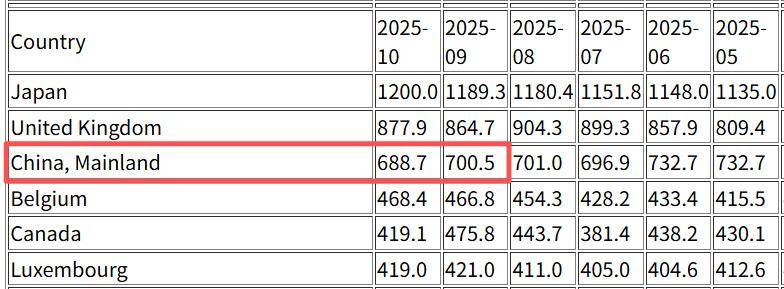
Core Viewpoint - The latest report from the U.S. Treasury reveals significant fluctuations in the holdings of U.S. Treasury securities by major global economies as of the end of October [1] Group 1: China's Actions - China reduced its holdings of U.S. Treasury securities from $700.5 billion at the end of September to $688.7 billion at the end of October, marking a decrease of $11.8 billion [2] - This reduction brought China's holdings below the $690 billion mark, indicating a rare level of selling activity [2] Group 2: Canada's Actions - Canada exhibited a more aggressive selling trend, reducing its holdings by $56.7 billion in October, making it the largest seller of U.S. Treasuries for that month [3] Group 3: Other Countries' Actions - In contrast to the selling trends, Japan and the United Kingdom increased their holdings of U.S. Treasuries by $10.7 billion and $13.2 billion, respectively, maintaining their positions as the top two foreign holders [4] - Overall, six of the top ten foreign holders of U.S. Treasuries reduced their positions, while four increased them [5] Group 4: Market Reactions - The fluctuations in Treasury holdings have raised concerns in the market, particularly in light of the U.S. government shutdown that lasted 43 days, raising fears about the U.S. government's ability to meet its debt obligations [6] - The increase in U.S. Treasury yields in October led to a decline in the market price of existing Treasuries, contributing to the observed selling behavior [8] Group 5: Future Outlook - Following the resumption of U.S. government operations in November, market concerns regarding Treasury defaults have eased, potentially leading to a return of global capital to the U.S. Treasury market [10] - China is expected to maintain its U.S. Treasury holdings within a range of $650 billion to $750 billion, reflecting a cautious approach to asset allocation [11]

美债迎来坏消息,中国抛售万亿美债,持仓量创17年新低
Sou Hu Cai Jing· 2025-12-20 18:50
Group 1 - China sold $25.7 billion in U.S. Treasury bonds in one month, reducing its holdings to $730.7 billion, the lowest level since 2009, and a decline of over 40% from the peak of $1.3 trillion in January 2013 [1] - A bipartisan delegation from the U.S. Congress visited Beijing on September 21, 2025, to discuss the possibility of China pausing or slowing down its bond sales, marking the first visit by a House delegation since 2019 [1] - China's bond reduction is part of a continuous trend since April 2022, with significant reductions of $173.2 billion in 2022, $50.8 billion in 2023, and $57.3 billion in 2024, with a cumulative net reduction of $53.7 billion in the first seven months of 2025 [3] Group 2 - In contrast to China's actions, Japan increased its U.S. Treasury holdings to a record $1.147 trillion in June-July 2025, while the UK also raised its holdings to $858.1 billion during the same period [3] - Japan's increase in Treasury holdings is driven by a trade surplus with the U.S. and the higher yields of U.S. bonds compared to its domestic rates, reinforcing economic ties under the U.S.-Japan alliance [3] - The UK's situation is influenced by its role as a global financial hub, with many hedge funds and institutions holding U.S. bonds through UK accounts, alongside the uncertainty post-Brexit and the higher yields of U.S. bonds compared to UK government bonds [5] Group 3 - China's ongoing reduction of U.S. Treasury bonds reflects deep concerns about the U.S. fiscal situation and the credibility of the dollar, especially after Moody's downgraded the U.S. credit rating from AAA to Aa1 in May 2025 [5] - The U.S. federal debt has reached $37 trillion, with annual interest payments exceeding $1 trillion, raising concerns about the sustainability of U.S. fiscal policy [5][6] - The U.S. government is increasingly reliant on borrowing to service its debt, leading to heightened repayment pressures, with interest payments surpassing defense spending for the first time in fiscal year 2024 [6] Group 4 - Concurrently, the People's Bank of China has been increasing its gold reserves for ten consecutive months, reaching 74.02 million ounces by the end of August 2025, as gold serves as a hedge against dollar risk [8] - Global central banks are also increasing their gold reserves, with a reported increase of 166 tons in Q2 2025, indicating a structural shift in the global reserve system [8] - The internationalization of the renminbi is progressing, with cross-border settlement exceeding 500 billion yuan in 2025 and significant growth in the renminbi's share of cross-border payments [10] Group 5 - China's significant bond sales have impacted global markets, with the 30-year U.S. Treasury yield surpassing 5%, leading to forced liquidations in hedge funds and affecting approximately $800 billion in related transactions [12] - During the U.S. delegation's visit, former President Trump indicated a willingness to negotiate on various issues, but China emphasized the need for the U.S. to take concrete actions to resolve longstanding issues before financial cooperation could be considered [12] - The U.S. national debt has surpassed $38 trillion, with projections indicating that interest payments alone could reach $14 trillion over the next decade, highlighting the deteriorating fiscal situation [12]

债市策略思考:年内债市三轮调整差异对比
ZHESHANG SECURITIES· 2025-12-20 11:36
Core Insights - The third round of bond market adjustments in 2025 may not be over yet, but there is potential for a delayed cross-year market rally if monetary easing expectations increase in January-February 2026 [1][3][27] Group 1: Understanding Recent Adjustments - The current bond market adjustment shows a structural characteristic where ultra-long-term bonds lead the decline, with the 30-year treasury bond reaching a peak yield of 2.28% on December 16, while the 10-year bond primarily experienced a corrective trend [1][11] - The adjustment in ultra-long-term bonds reflects weakened both allocation and trading power, with a significant increase in the supply of bonds over 10 years, reaching 1.86 trillion yuan by December 19, 2025, accounting for 11.66% of total bond issuance [13][19] - The adjustment pattern indicates that the third round may still be ongoing, potentially mirroring the structure of the second round, with the 10-year bond yield fluctuating in an adjustment-recovery-adjustment manner [24][25] Group 2: Comparison of Adjustment Rounds - In 2025, there have been three notable rounds of adjustments, with the first round driven by unexpected tightening of the funding environment, leading to a significant rise in short-term rates [2][19] - The second round was characterized by a simultaneous rise in stock prices and a decline in bond prices, indicating a shift in investor sentiment and a reduction in bullish sentiment towards bonds [22] - The third round, starting from November 3, 2025, has shown a different driving force, primarily influenced by institutional behavior and the resumption of bond trading, rather than the funding and stock-bond dynamics that characterized the previous rounds [2][22] Group 3: Cross-Year Market Trends - Historically, the bond market has exhibited a calendar effect around the New Year, often showing upward trends before the Spring Festival, with notable increases in bond yields observed in 2022, 2024, and 2025 [3][26] - The 2025 cross-year market saw a decline of approximately 50 basis points in the 10-year bond yield from T-60 to T-18 days before the Spring Festival, followed by a period of consolidation [3][26] - If the third round of adjustments continues, the potential for a delayed cross-year rally remains, contingent on favorable monetary policy developments [27]
政府债券与金融债券有何区别?
Sou Hu Cai Jing· 2025-12-20 09:05
Group 1 - The primary difference between government bonds and financial bonds lies in their issuers, with government bonds issued by various levels of government and financial bonds issued by approved financial institutions [1] - Government bonds are backed by government credit, resulting in a very low default risk, while financial bonds depend on the creditworthiness of the issuing financial institution, which carries a higher risk level [1] - The funds raised from government bonds are primarily used for public services and infrastructure, whereas financial bonds are used for the issuing institution's business development needs [2] Group 2 - Government bonds typically offer lower yields but have strong liquidity, making them easily tradable, while financial bonds generally provide higher yields to match their higher credit risk [2] - Government bonds are suitable for low-risk investors seeking stable returns, while financial bonds cater to investors with moderate risk tolerance looking for higher yields [2]
东方大抛美债,全球不少国家和地区以及投资者也跟进持续抛售美债,美国压力巨大。
Sou Hu Cai Jing· 2025-12-20 04:24
当地时间12月18日,美国财政部公布的数据引发全球关注。数据显示,10月某主要持有国减持118亿美 元美债,其持有规模降至6887亿美元,为2008年以来最低水平。尽管同期日本、英国选择增持,但这一 主要持有国的大量减持动作,还是让市场神经紧绷。 如今的美债早已风光不再。美国联邦政府债务总额已突破38万亿美元,这个数字令人咋舌。据美国联合 经济委员会估算,过去一年,美国国债总额每秒以69713.82美元的速度增长,距离突破37万亿美元仅过 去两个多月,债务激增速度如滚雪球般难以遏制。 在全球经济格局深刻调整的当下,美债的吸引力持续下降。各国都在根据自身经济战略和风险考量,调 整外汇储备结构。抛售美债的举动,不仅是经济层面的选择,更是对美国经济现状和未来走向的谨慎判 断。抛售多少无关紧要,主要是还有多少? 债务激增带来的利息压力也愈发沉重。2025财年,美国联邦政府国债利息支出将高达1.2万亿美元,这 可不是个小数目,相当于不少中等规模国家一年的财政收入。如此庞大的债务规模和利息支出,让美国 政府财政压力巨大,也让全球投资者对美债信心下降,纷纷选择抛售。 ...

美联储现在巴不得东方能早点抛售美债?为啥他们一直不降息,因为他们很清楚
Sou Hu Cai Jing· 2025-12-20 03:40
Group 1 - The core viewpoint is that the Federal Reserve appears to be waiting for a specific moment regarding the sale of U.S. Treasury bonds by certain economies, which may influence its decision on interest rates [1] - A specific economy previously held over $1.3 trillion in U.S. Treasuries, but this amount is projected to decrease to approximately $68.9 billion by October 2025, indicating a gradual optimization trend [1] - U.S. Treasuries are a crucial global asset, often used by countries as a preferred reserve, helping manage reserves and maintain international balance of payments [3] Group 2 - The dynamics of the U.S. Treasury market are complex, requiring attention not only to the reduction of holdings but also to the phenomenon of increased purchases by other buyers [3] - If more countries begin to reduce their holdings of U.S. Treasuries without new buyers to fill the gap, the market landscape will change significantly [5] - The Federal Reserve's balance sheet will become a critical factor in addressing any funding gaps left by the reduction of U.S. Treasuries [5][7]

高波动环境中的策略转向
SINOLINK SECURITIES· 2025-12-19 15:37
Group 1: Investment Ratings - No information provided on the report's industry investment rating Group 2: Core Views - As of December 12, controlling drawdown is the main strategic goal recently. In a market with slow rises and sharp falls in the past month, the focus is on drawdown control rather than achieving excess returns through duration + band operations [2][12] - Last week (December 8 - December 12), bond - type ETFs had a net inflow of 2.95 billion yuan, with credit - bond ETFs having a net inflow of 5.37 billion yuan, while interest - rate bond ETFs and convertible - bond ETFs had net outflows of 960 million yuan and 1.46 billion yuan respectively. Bond ETF net values are marginally recovering [3][16] - As of December 15, 2025, compared with the previous week, more than half of the non - financial and non - real - estate industrial bonds saw their yields rise, real - estate bond yields generally increased, and financial bond yields showed differentiation among bond types [4][18] - The trading preference for ultra - long - term credit bonds has not improved. The number of transactions of general credit bonds with a maturity of over 7 years remains at a low level, and the lack of spread protection space weakens investors' motivation [5][20] - In terms of the issuance pricing of local government bonds, the average issuance rate of 10 - year local bonds in the latest week was 2.05%, slightly up from the previous week. The average coupon rates of new 20 - year and 30 - year local bonds were above 2.45%, at a relatively high level within the year. The long - end spreads remain high [6][23] Group 3: Summary of Each Section Quantitative Credit Strategy - As of December 12, the cumulative excess returns of the short - end sinking strategy for urban investment bonds, the bullet strategy for commercial financial bonds, and the sinking strategy for securities firm bonds reached 5bp, 4.4bp, and 1.5bp respectively, while those of other medium - and long - term strategies were less than 5bp. The cumulative excess return of the urban investment dumbbell portfolio, which performed well in the previous two months, dropped to a low of - 25.7bp in the past four weeks. The sinking strategy of the financial bond heavy - position portfolio outperformed the corresponding duration strategy by more than 12bp in cumulative returns [2][12] ETF Strategy - Last week (December 8 - December 12), bond - type ETFs had a net inflow of 2.95 billion yuan. Credit - bond ETFs, interest - rate bond ETFs, and convertible - bond ETFs had net inflows of 5.37 billion yuan, net outflows of 960 million yuan, and net outflows of 1.46 billion yuan respectively. Compared with the previous week, their cumulative unit net value weekly growth rates were + 0.05%, + 0.08%, and + 0.20% respectively [3][16] Coupon Asset Heat Map - As of December 15, 2025, compared with the previous week, more than half of the non - financial and non - real - estate industrial bonds saw their yields rise. Except for private - placement bonds of private enterprises within 1 year, the yield adjustments of other varieties were less than 4BP. Real - estate bond yields generally increased, with the yields of non - perpetual bonds within 1 year rising by more than 5BP. Financial bond yields showed differentiation among bond types, with the yields of commercial financial bonds within 3 years mainly rising, bank sub - debt valuations generally recovering, and the performance of securities firm sub - debt being better than that of ordinary bonds [4][18] Ultra - long Credit Bond Tracking - The trading preference for ultra - long - term credit bonds has not improved. This week (December 8 - December 12, 2025), the number of transactions of general credit bonds with a maturity of over 7 years remained at a relatively low level of around 300. The spread between the most actively traded 7 - 10 - year industrial bonds and 20 - 30 - year treasury bonds is only 19.9bp, which further weakens investors' motivation [5][20] Local Government Bond Supply and Trading Tracking - In the latest week, the average issuance rate of 10 - year local bonds was 2.05%, slightly up from the previous week. The average coupon rates of new 20 - year and 30 - year local bonds were above 2.45%, at a relatively high level within the year. The long - end spreads of local government bonds remain high, with the average spread of bonds with a maturity of 10 years and above being higher than 20bp [6][23]
绿债扩容强根基 “双碳”赋能开新局
Xin Lang Cai Jing· 2025-12-19 15:20
登录新浪财经APP 搜索【信披】查看更多考评等级 (来源:经济参考报) 在"双碳"目标持续深化推进的背景下,绿色债券作为衔接绿色产业与金融资源的核心工具,2025年在中 国市场实现了规模与影响力的双重突破。 可以看到,截至11月末,中国绿债市场不仅在全球市场中占据了核心地位,更呈现出从"增量扩 张"向"提质增效"转型的鲜明特征。政策体系的不断完善为市场发展注入了强劲动力,但发行主体覆盖 不足、中外标准衔接不畅等短板仍待攻克。 规模领跑全球 记者观察发现,2025年以来,国内绿债市场呈现出了两大特征。一是资金投向高度聚焦核心绿色领域。 安永大中华区ESG可持续发展主管合伙人李菁指出,当前绿色债券募集资金主要集中于清洁能源产业、 基础设施绿色升级及节能环保产业三大板块,合计占比高达83%,累计投入规模已达3.6万亿元,与中 国能源结构优化、工业低碳转型等国家战略高度契合。 二是融资成本优势凸显,市场吸引力持续增强。中证鹏元绿融高级分析师王鼎表示,绿色债券融资成本 较普通债券低0.5至1个百分点,叠加ESG投资理念的普及,投资者基础正不断扩大。 市场亮点纷呈 不可否认,中国绿债市场的快速发展,离不开政策体系的持续完 ...
法国30年期国债收益率升至2009年以来最高水平
Xin Lang Cai Jing· 2025-12-19 12:18
Core Viewpoint - The yield on French 30-year government bonds has reached its highest level since 2009, influenced by a report from the German central bank predicting stronger economic performance in Germany, which negatively impacted long-term bond performance [1] Group 1: Bond Yield Changes - The yield on French 30-year government bonds increased by 7 basis points to 4.525% [1] - The yield on French 10-year government bonds rose by 6 basis points to 3.614%, nearing a nine-month high [1] - The yield on German 30-year government bonds climbed by 6 basis points to 3.55%, marking the highest level since 2011 [1] Group 2: Economic and Political Context - The increase in bond yields follows a statement from French Prime Minister Sébastien Lecornu indicating that the budget proposal will not be voted on before the end of the year [1]