电力

Search documents
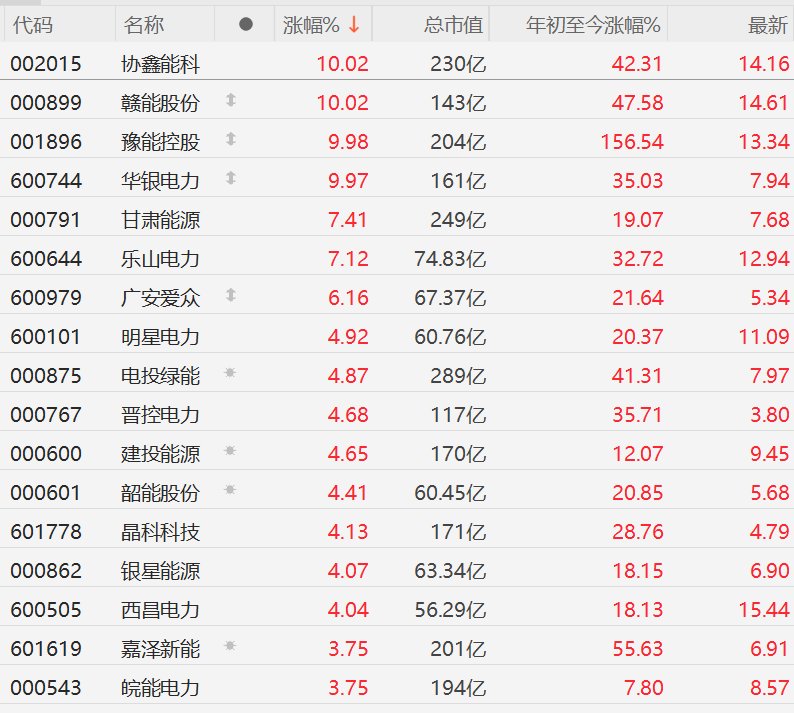
电力股表现强势,华银电力等多股涨停
Ge Long Hui· 2026-02-27 05:31
Core Viewpoint - The A-share market has seen a strong performance in the power sector, with several stocks hitting the daily limit up and others showing significant gains [1] Group 1: Stock Performance - Companies such as Xiexin Energy Technology, Gan Energy, Henan Energy Holding, and Huayin Power all reached the daily limit up of 10% [1] - Gansu Energy and Leshan Power increased by over 7%, while Guang'an Aizhong rose by over 6% [1] - Other notable performers include Mingxing Power, Electric Investment Green Energy, Jinkong Power, and others, which all saw gains exceeding 4% [1] Group 2: Market Data - Xiexin Energy Technology (002015) had a market cap of 23 billion with a year-to-date increase of 42.31% [2] - Gan Energy (000899) reported a market cap of 14.3 billion and a year-to-date increase of 47.58% [2] - Henan Energy Holding (001896) had a market cap of 20.4 billion and a year-to-date increase of 156.54% [2] - Huayin Power (600744) had a market cap of 16.1 billion with a year-to-date increase of 35.03% [2] - Other companies like Leshan Power, Guang'an Aizhong, and Jinkong Power also showed significant market caps and year-to-date performance [2]


三月策略及节后策略:节后主线将更加清晰
SINOLINK SECURITIES· 2026-02-27 05:09
Group 1: Core Insights - The report emphasizes a clearer investment strategy post-Spring Festival, highlighting a global asset rebalancing with industrial, financial, and energy sectors gaining favor while technology stocks show internal differentiation [3][8] - The focus has shifted from whether AI is a bubble to understanding its macroeconomic impacts and identifying key supply-demand dynamics in various industries [3][9] - The report indicates that the U.S. GDP growth for Q4 2025 was below expectations, primarily due to government spending, but investment in AI remains strong, suggesting a broader recovery in manufacturing [9][10] Group 2: Industry and Company Recommendations - **Aluminum Sector**: Yun Aluminum (000807.SZ) is recommended due to favorable export demand driven by overseas monetary easing and structural growth in energy storage and grid sectors, with a positive outlook on aluminum prices [14] - **Petrochemical Sector**: Rongsheng Petrochemical (002493.SZ) is highlighted for its significant scale and integration in refining, with potential for improved margins as product prices recover [15] - **Machinery Sector**: Yingliu Technology (603308.SH) is expected to benefit from a surge in global gas turbine demand, with potential for exceeding client expectations [16] - **Non-Banking Financials**: Guotai Junan (601211.SH) is positioned well for growth due to market activity and expected strong performance in Q1 [17] - **Public Utilities**: Sheneng Co. (600642.SH) is noted for its diversified energy portfolio and stable profitability, with ongoing projects expected to enhance performance [18] - **Aerospace and Defense**: AVIC Heavy Machinery (600765.SH) is recognized for its comprehensive supply capabilities in aviation and military sectors, with growth potential in new engine orders [19] - **Textiles and Apparel**: HLA Corp (600398.SH) is recommended for its strong domestic market position and growth in international collaborations [20] - **Transportation**: China Southern Airlines (1055.HK) is expected to benefit from improving industry supply-demand dynamics and a large fleet size [21] - **Biopharmaceuticals**: Innovent Biologics (1801.HK) is highlighted for its rapid sales growth and international collaborations, with significant revenue potential from new product approvals [22] - **Electronics**: Lante Optics (688127.SH) is positioned to benefit from strong demand in automotive and smart imaging sectors, with growth expected from new product launches [24] Group 3: ETF Recommendations - The report suggests focusing on ETFs such as the Oil ETF (561360.OF), Grid ETF (561380.OF), and Chemical ETF (516220.OF) based on their recent performance and growth potential [13]





001896,7连板
Xin Lang Cai Jing· 2026-02-27 04:53
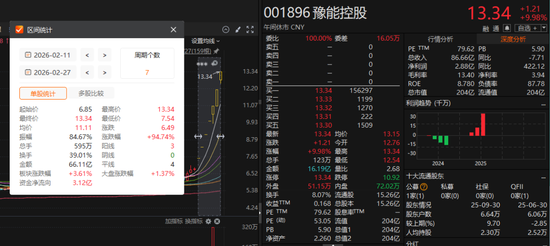
Market Overview - On February 27, major A-share indices collectively declined in the morning session, with the Shanghai Composite Index down 0.17%, Shenzhen Component Index down 0.68%, and ChiNext Index down 1.46% [1][9] - The total trading volume in the Shanghai and Shenzhen markets was 15,966 billion CNY, a decrease of 532 billion CNY compared to the previous day [1][9] - Over 2,300 stocks in the market experienced gains [1][9] Company Highlights - YN Holdings (豫能控股) saw its stock price surge, hitting the daily limit after opening, and achieved a total of seven consecutive trading days of limit-up, with the price rising from 6.85 CNY to 13.34 CNY, nearly doubling in value [2][10] - The company announced plans to acquire a controlling stake in Zhengzhou Heying Data Co., which specializes in large-scale data center operations, with an IT capacity exceeding 1GW [12][4] - The investment amount for this acquisition is expected to be no more than 1.4 billion CNY, with a stake of up to 49% [4][12] Industry Trends - The tungsten sector experienced a significant rally, with companies like Zhangyuan Tungsten (章源钨业) achieving five limit-up days in seven trading sessions [5][14] - Tungsten prices have been rising, with black tungsten concentrate and white tungsten concentrate prices increasing by 6,000 CNY per ton, and ammonium paratungstate (APT) increasing by 10,000 CNY per ton compared to the previous month [7][16] - As of February 26, tungsten powder prices reached 1,850 CNY per kilogram, up 71.3% since the beginning of the year, while the price of 65% black tungsten concentrate rose by 65.2% [7][16]

19世纪,全中国发电量不足美国一座水电站,如今怎么成为世界第一
Sou Hu Cai Jing· 2026-02-27 04:51
Core Insights - The historical context of China's electricity development shows a significant gap compared to the West, particularly in the early 20th century, where by 1912, China had only about 80 power stations generating a total of 1/500 of the electricity produced in the United States [7] - China's electricity sector has undergone a remarkable transformation, achieving 100% electricity coverage and supporting a vast array of industries, including manufacturing and transportation [3][5] - The establishment of a unified national power system and the transition to market-oriented reforms have been crucial in addressing the challenges of electricity supply and demand [10][16] Historical Development - The first hydroelectric power station was built in the U.S. in 1881, with a capacity of 147,000 kWh, which was 3.2 times greater than China's total electricity generation at that time [1] - By 1949, the total installed capacity in China was 184.82 million kW, a significant increase from the 8.06 million kW in 1921 [17] - The establishment of the People's Republic of China marked a turning point, with a focus on industrialization and the development of a self-sufficient electricity system [9] Key Milestones - In the early years after 1949, China's annual electricity generation surpassed 5.7 billion kWh, doubling the historical maximum from the Republic era by 1953 [11] - The introduction of the first 6000 kW gas turbine generator in 1955 marked a shift towards reducing reliance on Soviet technology [13] - By 2011, China's total electricity generation exceeded that of the United States, making it the world's largest producer of electricity [16] Current Status and Comparison - As of 2020, China's per capita electricity consumption reached 5,365 kWh, a dramatic increase from just 0.5 kWh in 1921 [17] - China has become a global leader in ultra-high voltage technology, establishing international standards and addressing regional electricity imbalances through projects like the West-East Electricity Transmission [19] - In contrast, India's electricity development faces significant challenges, with a quarter of its population still lacking access to electricity as of 2012, highlighting the unique achievements of China's electricity sector [19]

华能新能源取得海上风电场多能互补运行系统与方法专利
Sou Hu Cai Jing· 2026-02-27 04:36
Group 1 - The State Intellectual Property Office of China has granted a patent titled "Multi-Energy Complementary Operation System and Method for Offshore Wind Farms" to Huaneng New Energy Co., Ltd. and Beijing Huaneng New Energy Control Technology Co., Ltd., with the authorization announcement number CN114172197B and an application date of November 2021 [1] - Huaneng New Energy Co., Ltd., established in 2002 and based in Beijing, primarily engages in electricity and heat production and supply, with a registered capital of 1,243,121.4343 million RMB. The company has invested in 725 enterprises and participated in 5,000 bidding projects, holding 1 trademark and 815 patents, along with 32 administrative licenses [1] - Beijing Huaneng New Energy Control Technology Co., Ltd., founded in 2003 and also located in Beijing, focuses on technology promotion and application services, with a registered capital of 90 million RMB. The company has participated in 987 bidding projects, holds 1,063 patents, and has 9 administrative licenses [1]
晶科能源取得太阳能电池制作方法专利
Jin Rong Jie· 2026-02-27 04:32
Group 1 - Jinko Solar (Haining) Co., Ltd. and Zhejiang Jinko Solar Co., Ltd. have obtained a patent for "Method for Manufacturing Solar Cells," with authorization announcement number CN115148586B, applied for on July 2022 [1] - Jinko Solar (Haining) Co., Ltd. was established in 2017, located in Jiaxing City, primarily engaged in power and heat production and supply, with a registered capital of 3.57 billion RMB [1] - Jinko Solar (Haining) Co., Ltd. has participated in 55 bidding projects and holds 963 patent records, along with 74 administrative licenses [1] Group 2 - Zhejiang Jinko Solar Co., Ltd. was established in 2006, also located in Jiaxing City, primarily engaged in the manufacturing of electrical machinery and equipment, with a registered capital of approximately 2.71 billion RMB [1] - Zhejiang Jinko Solar Co., Ltd. has invested in 9 companies, participated in 97 bidding projects, and holds 2,686 patent records, along with 35 administrative licenses [1]

国家能源局公布新型电力系统建设能力提升试点第一批名单
Cai Jing Wang· 2026-02-27 04:31
2月26日,为加快建设新型能源体系、构建新型电力系统,国家能源局发布《关于公布新型电力系统建 设能力提升试点名单(第一批)的通知》。 通知中提到,决定将安徽省淮南市风光热储融合系统友好型新能源电站项目等43个项目、河北省张家口 市等10个城市列为新型电力系统建设能力提升试点(第一批)。 通知中要求,各试点单位要按照试点方案扎实做好试点建设,依托试点项目应用新技术、新模式,依托 试点城市开展系统集成,同步完善配套政策机制。 (国家能源局官网) ...
午评:沪指震荡微跌,半导体等板块走低,算力概念爆发
Sou Hu Cai Jing· 2026-02-27 04:18
Market Overview - The Shanghai Composite Index experienced a slight decline of 0.17%, closing at 4139.53 points, while the Shenzhen Component fell by 0.68% and the ChiNext Index dropped by 1.46% [1] - Over 2900 stocks in the A-share market were in the red, indicating a broad market weakness [1] - The total trading volume across the Shanghai, Shenzhen, and North markets reached approximately 1.6 trillion yuan [1] Sector Performance - Sectors such as paper, semiconductors, and building materials saw declines, while power, coal, non-ferrous metals, steel, and agriculture sectors experienced gains [1] - Emerging sectors like computing power, AI applications, and rare earth concepts showed active performance [1] Economic Outlook - Dongguan Securities highlighted that by 2026, macroeconomic policies will focus on the "14th Five-Year Plan" with an emphasis on fiscal and financial collaboration to expand domestic demand [1] - The coordinated efforts in monetary policy, fiscal policy, import-export regulation, and the real estate market aim to stabilize short-term growth while fostering long-term momentum [1] - The implementation of structural monetary policy tools and direct fiscal subsidies is expected to continuously release domestic demand potential, laying a solid foundation for qualitative and reasonable quantitative economic growth in the first year of the "14th Five-Year Plan" [1] Investment Recommendations - Key sectors to focus on include dividends, TMT (Technology, Media, and Telecommunications), and power equipment [1]
明星电力股价涨5.01%,广发基金旗下1只基金位居十大流通股东,持有171.12万股浮盈赚取90.69万元
Xin Lang Cai Jing· 2026-02-27 04:02
Group 1 - The core point of the news is that Sichuan Mingyang Power Co., Ltd. experienced a stock price increase of 5.01%, reaching 11.10 CNY per share, with a trading volume of 465 million CNY and a turnover rate of 7.81%, resulting in a total market capitalization of 6.081 billion CNY [1] - Sichuan Mingyang Power was established on April 29, 1988, and listed on June 27, 1997. The company's main business includes electricity, tap water, and comprehensive energy services [1] - The revenue composition of the company is as follows: 88.59% from product sales, 9.22% from installation projects, 1.87% from services provided, and 0.32% from other sources [1] Group 2 - From the perspective of the top ten circulating shareholders, GF Fund's ETF, Guangfa CSI All Share Power ETF (159611), increased its holdings by 119,300 shares, totaling 1.7112 million shares, which represents 0.31% of the circulating shares [2] - The Guangfa CSI All Share Power ETF (159611) was established on December 29, 2021, with a current size of 3.69 billion CNY. Year-to-date returns are 6.11%, ranking 2660 out of 5574 in its category; the one-year return is 13.17%, ranking 3334 out of 4326; and since inception, the return is 6.12% [2] - The fund manager of Guangfa CSI All Share Power ETF is Lu Zhiming, who has a cumulative tenure of 14 years and 274 days, managing total assets of 25.098 billion CNY, with the best fund return during his tenure being 119.61% and the worst being -63.28% [2]

A股午评:创业板指半日跌1.46%再失3300点,算力租赁及AI编程概念股走高,有色金属板块活跃
Jin Rong Jie· 2026-02-27 03:43
Core Viewpoint - The A-share market is experiencing a volatile and differentiated trend, with significant movements in various sectors, particularly in rare metals and space photovoltaic concepts, while some hardware stocks related to computing power are facing declines [1][2][6]. Market Dynamics - Rare metal stocks have become the market's focal point, with companies like Xiamen Tungsten, Zhongtung High-tech, and Jiangxi Tungsten Equipment reaching historical highs. The small metal sector index has risen over 40% this year, driven by supply-demand tensions and strategic pricing restructuring [2]. - The space photovoltaic concept remains strong, with stocks like Jun Da and Double Good Energy hitting their limits, supported by the dual catalysts of Elon Musk's strategy and accelerated domestic satellite internet construction [3]. - The electric power and grid equipment sector is active, with companies like Gan Energy and Huayin Power achieving consecutive gains, bolstered by the National Energy Administration's new power system construction pilot list [4]. - The gas turbine and quantum technology concepts are also on the rise, with stocks like Feiwo Technology and Geer Software showing significant gains [5]. Hardware Sector Performance - In contrast, computing power hardware stocks, including CPO and optical fiber, are mostly experiencing declines, influenced by the overnight drop in Nvidia and concerns over the sustainability of the AI bubble [6]. Institutional Insights - Orient Securities notes that the market is experiencing accelerated rotation among sectors, indicating a potential decrease in risk appetite. However, there is still potential for index growth, suggesting a focus on mid-term industry trends and cyclical price increases [7]. - Qianhai Open Source Fund's chief economist highlights technology and resources as key investment themes, emphasizing the need for in-depth exploration of sectors with rising prosperity or technological breakthroughs [8]. - CITIC Construction emphasizes the opportunity for heavy asset industries to reverse their challenges, driven by rising inflation expectations and improved profitability in sectors like chemicals and construction materials [8]. - Everbright Securities points out that assets with low or negative carbon attributes will gain green premiums as the domestic assessment mechanism shifts towards carbon emission controls [8].