
水泥

Search documents
水泥板块11月17日跌0.67%,塔牌集团领跌,主力资金净流入6315.12万元
Zheng Xing Xing Ye Ri Bao· 2025-11-17 08:53
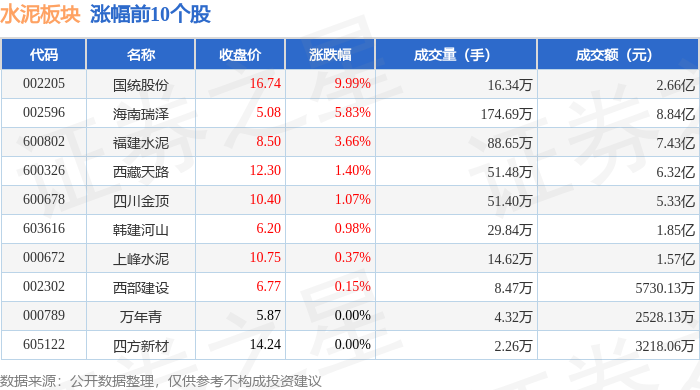
Market Overview - The cement sector experienced a decline of 0.67% on November 17, with Ta Pai Group leading the drop [1] - The Shanghai Composite Index closed at 3972.03, down 0.46%, while the Shenzhen Component Index closed at 13202.0, down 0.11% [1] Individual Stock Performance - Notable gainers in the cement sector included: - Guotong Co., Ltd. (002205) with a closing price of 16.74, up 9.99% on a trading volume of 163,400 shares and a turnover of 266 million [1] - Huan Zhi Wu Shi (002596) with a closing price of 5.08, up 5.83% on a trading volume of 1,746,900 shares and a turnover of 884 million [1] - Fujian Cement (600802) with a closing price of 8.50, up 3.66% on a trading volume of 886,500 shares and a turnover of 743 million [1] - Conversely, Ta Pai Group (002233) saw a decline of 2.16% with a closing price of 8.62, trading 114,200 shares for a turnover of 98.77 million [2] - Other notable decliners included: - Huaxin Cement (600801) down 2.00% to 22.53 [2] - Conch Cement (600585) down 1.56% to 23.32 [2] Capital Flow Analysis - The cement sector saw a net inflow of 63.15 million from institutional investors, while retail investors experienced a net outflow of 10.57 million [2] - Key stocks with significant capital flow included: - Guotong Co., Ltd. (002205) with a net inflow of 91.54 million from institutional investors, representing 34.38% of its trading volume [3] - Huan Zhi Wu Shi (002596) with a net inflow of 18.09 million from institutional investors, representing 2.05% [3] - Ta Pai Group (002233) had a net outflow of 45.46 million from retail investors, representing -17.07% [3]






建筑材料行业跟踪周报:就业数据改善,期待政策托底-20251117
Soochow Securities· 2025-11-17 07:21
Investment Rating - The report maintains an "Overweight" rating for the construction materials industry [1] Core Views - Employment data shows improvement, and there are expectations for policy support [1] - The construction materials sector has shown resilience with a weekly increase of 0.97%, outperforming the Shanghai and Shenzhen 300 Index by 2.05% [3] - The cement market is experiencing a slight recovery in demand, particularly in southern regions, while prices are expected to remain stable [5][10] - The glass market is under pressure with high inventory levels and weak demand, but medium-term supply-side adjustments are anticipated [41][43] - The fiberglass sector is expected to see improved profitability due to supply constraints and increasing demand from new applications [5] Summary by Sections 1. Bulk Construction Materials Fundamentals and High-Frequency Data - **Cement**: The national average price for high-standard cement is 352.3 RMB/ton, up 1.2 RMB/ton from last week but down 74.8 RMB/ton from the same period last year. The average cement inventory level is 69.8%, with an average shipment rate of 46.2% [11][18] - **Glass**: The average price for float glass is 1195.4 RMB/ton, down 1.9 RMB/ton from last week and down 258.4 RMB/ton year-on-year. Inventory levels are at 5962 million heavy boxes, a decrease of 54 million from last week [43][45] - **Fiberglass**: Prices for fiberglass remain stable, with a focus on high-end products. The market is expected to see improved profitability as supply constraints persist [5] 2. Industry Dynamics Tracking - The construction materials sector is expected to benefit from policy support and improving economic indicators, with a focus on companies involved in the export supply chain and home renovation [3][5] - The report highlights the importance of technological advancements and domestic semiconductor development, recommending companies in the cleanroom engineering sector [5] 3. Weekly Market Review and Sector Valuation - The construction materials sector has shown a positive trend compared to broader market indices, indicating potential for further growth [3] - The report suggests that the cement industry is at a historical low in terms of price-to-book ratios, presenting opportunities for investment as policies are expected to support recovery [5][10]


华龙证券:前三季度水泥及玻纤盈利大幅提升 高端材料有望带动相关行业估值修复
Zhi Tong Cai Jing· 2025-11-17 07:08
Core Viewpoint - The construction materials industry is experiencing a slight decline in revenue in the first three quarters of 2025, but profitability is improving, particularly in the cement and fiberglass sectors [1] Cement Industry - The 12 listed cement companies achieved revenue of 261.27 billion yuan, a year-on-year decline of 8.98%, while net profit attributable to shareholders reached 7.20 billion yuan, a year-on-year increase of 134.64% [2] - Despite entering the peak demand season in Q4, cement demand is expected to see only a slight increase due to market funding shortages [2] - The industry is anticipated to enhance self-discipline and staggered production efforts to raise prices and improve profitability [2] - Long-term supply-side reforms are expected to improve the supply-demand balance in the cement industry [2] - Key stocks to watch include Huaxin Cement, Shangfeng Cement, and Conch Cement [2] Glass Industry - The glass industry saw a revenue decline in the first three quarters of 2025, with 12 listed companies reporting revenue of 88.52 billion yuan, down 2.92%, and net profit of 7.69 billion yuan, down 9.65% [3] - In Q3 2025, the glass industry showed signs of improvement, with revenue of 31.69 billion yuan, up 10.31%, and net profit of 2.27 billion yuan, up 50.06% [3] - Float glass demand remained weak, with prices declining; however, Q4 is expected to be a traditional peak season [3] - The photovoltaic glass market experienced stable fluctuations, with supply-demand factors influencing prices; the industry is expected to maintain price stability in Q4 [3] - Key stocks to monitor include Qibin Group for float glass and Fuyao Glass for photovoltaic glass [3] Fiberglass Industry - The five listed fiberglass companies reported revenue of 40.17 billion yuan, a year-on-year increase of 24.22%, and net profit of 4.46 billion yuan, up 81.25% [4] - The improvement in profitability is attributed to rising fiberglass prices, with an average gross margin of 25.09%, up 2.18 percentage points year-on-year [4] - Continued demand for high-end fiberglass is expected to further enhance industry profitability [4] - Key stocks to focus on include China Jushi, Zhongcai Technology, and Honghe Technology [4] Consumer Building Materials Industry - The four tracked waterproofing companies reported revenue of 47.03 billion yuan, down 4.05%, and net profit of 3.44 billion yuan, down 23.78% [5] - The six tracked pipe industry companies achieved revenue of 12.75 billion yuan, down 6.16%, and net profit of 0.45 billion yuan, down 50.63% [5] - The seven tracked other major consumer building materials companies reported revenue of 29.64 billion yuan, down 8.93%, but net profit increased by 12.40% to 1.37 billion yuan [5] - Recent government policies aimed at stabilizing the market and easing restrictions are expected to gradually alleviate inventory pressure and improve industry fundamentals [5] - Key stocks to watch include Weixing New Materials, Beixin Building Materials, Sankeshu, Dongfang Yuhong, and Jianlang Hardware [5]
非洲水泥行业专家交流
2025-11-16 15:36
Summary of African Cement Industry Conference Call Industry Overview - The African cement market is expected to grow at an average annual rate of 5%-7% over the next three years, surpassing the global average of 3% [1][2] - East and West Africa are highlighted as regions with particularly strong growth due to political stability and accelerated industrialization [1][2] Cost Structure and Profitability - There is significant variation in limestone costs across Africa, generally higher than domestic costs, with coal resources concentrated in South Africa and Mozambique [1][8] - Fuel costs account for 60% of total production costs, directly impacting profitability [1] - Cement prices vary significantly by region, with gross margins of approximately $40-$60 per ton and net profits of $15-$30 per ton [1][17] Market Dynamics - The competitive landscape is shifting, with local companies like Dangote expanding aggressively while international giants like Holcim are gradually exiting the market [1][12][13] - The North African market is experiencing overcapacity and slower growth, while Sub-Saharan Africa, particularly populous countries like Nigeria, Ethiopia, and Tanzania, is seeing robust demand [2][4] Company Insights - Huaxin Cement has a broad presence in Africa with a total capacity of nearly 40 million tons, while West China Cement has a smaller scale [1][10] - Huaxin's production capacity is expected to reach close to 40 million tons by the end of 2025 or early 2026 [10] - Local companies like Dangote are the largest producers, with plans to expand capacity to 100 million tons [12] Regional Economic Conditions - East Africa's rapid economic development is attributed to political stability and industrial growth, with countries like Ethiopia and Kenya leading the way [3] - Central Africa, including countries like the Central African Republic and the Democratic Republic of the Congo, faces economic challenges due to conflict and resource scarcity [5] Challenges in the Market - Operating in Africa presents challenges such as policy risks, weak infrastructure, market fragmentation, cultural differences, and reliance on imported supply chains [21] - Chinese companies often adopt joint venture models, holding approximately 80% of shares in local operations [20] Pricing and Profitability Analysis - Cement prices in North Africa range from $90 to $150 per ton, while prices in Sub-Saharan Africa are generally higher, with Nigeria averaging around $120 per ton [16] - Huaxin's profitability varies by country, with net profits in Malawi reaching up to 250-300 RMB per ton despite significant currency depreciation [26][30] Future Outlook - The overall market environment is expected to remain stable, with Huaxin and other companies gradually increasing their market share and profitability despite challenges like currency fluctuations [28] - The Nigerian cement market is projected to demand around 35 million tons, with major players like BOA, BUA, and Huaxin dominating the landscape [29] Conclusion - The African cement industry presents significant growth opportunities, particularly in East and West Africa, but companies must navigate a complex landscape of costs, competition, and local market dynamics to succeed [1][2][21]
周期论剑- 跨年行情布局确定性及弹性
2025-11-16 15:36
Summary of Key Points from Conference Call Records Industry Overview - The conference call discusses the Chinese market, focusing on various sectors including technology, manufacturing, aviation, oil shipping, chemicals, and consumer goods [1][4][5][6]. Core Insights and Arguments 1. **Market Outlook**: The index is expected to rise to 4,200-4,300 points from December to February, driven by product structure adjustments and increased capital inflow, alongside supportive policies from the upcoming "15th Five-Year Plan" [1][3]. 2. **Valuation Expansion**: The Chinese market is currently in a valuation expansion phase, with reduced fears of sanctions due to changing perceptions of US-China relations and rationalized economic policies [4][6]. 3. **Sector Recommendations**: - **Technology Sector**: Focus on AI, internet, new energy vehicles, electronic semiconductors, and media communications [5]. - **Manufacturing**: Global expansion in power equipment, machinery, and auto parts [5]. - **Aviation**: Strong fundamentals with record high passenger load factors and low ticket prices, indicating a potential super cycle [10]. - **Oil Shipping**: Record high freight rates expected to lead to the highest profits in a decade due to OPEC production increases and geopolitical factors [11]. - **Chemicals**: Optimism for leading companies benefiting from supply-side optimization and cost advantages [3][16]. - **Consumer Goods**: Opportunities in food, beverages, and retail sectors, particularly for companies with low stock and strong fundamentals [7][30]. Additional Important Insights 1. **Economic Recovery**: The upcoming year is expected to show a high probability of economic recovery, particularly in traditional sectors like cyclical and consumer goods [6]. 2. **Investment Strategies**: Investors are advised to focus on companies with low stock prices and strong fundamentals, especially in the consumer goods sector [7][9]. 3. **Brokerage Role**: Brokerages are anticipated to play a crucial role in market advancement, especially as capital market reforms progress [8]. 4. **Metal Industry Outlook**: Positive expectations for the metal sector, with industrial metals likely to benefit from global liquidity and emerging demands from AI infrastructure and new energy vehicles [18][19]. 5. **Chemical Industry Trends**: The chemical sector has seen significant supply-side optimization, with leading companies expected to benefit from a recovery in demand and pricing [13][14][16]. 6. **Oil Market Dynamics**: Current oil market conditions show a supply surplus, but OPEC's cautious production increases are expected to support prices in the medium term [24]. Conclusion The conference call highlights a generally optimistic outlook for the Chinese market across various sectors, with specific recommendations for investment opportunities in technology, aviation, oil shipping, chemicals, and consumer goods. The anticipated economic recovery and supportive policies are expected to drive market performance in the coming months.
海螺水泥20251114
2025-11-16 15:36
Summary of Conference Call for Conch Cement Industry Overview - In the first three quarters of 2023, national cement production decreased by 5.2% year-on-year, with cement prices showing a trend of high at the beginning and low later on. The average market price for PO 42.5 cement was 372 RMB/ton, a decrease of 0.5% year-on-year, indicating a market environment characterized by declining demand and increasing supply-demand contradictions [2][3]. Company Performance - Conch Cement achieved a non-tax revenue of 61.3 billion RMB in the first three quarters, a decline of 10.1% year-on-year. However, the net profit attributable to shareholders was 6.304 billion RMB, an increase of 21.3%, primarily due to cost control and improved gross margin [2][5]. - Despite a 0.4% year-on-year decrease in net sales volume of self-produced cement clinker, Conch Cement managed to reduce the comprehensive cost of cement clinker by 18 RMB/ton (a decrease of 9.7%), leading to a gross margin increase of 5.8 percentage points [2][5]. Business Expansion and Strategy - Conch Cement is actively expanding its domestic and international business layout, including the successful delivery and consolidation of the Xinjiang Yaobo project, steady expansion of aggregate and ready-mixed concrete businesses, and advancement of new energy projects to enhance market layout and achieve industrial chain synergy [2][6]. - The company is focusing on digital industrial development to improve overall operational efficiency and competitiveness, while accelerating the implementation and expansion of overseas projects [4][6]. Market Challenges and Future Outlook - The demand for cement is expected to continue declining in the fourth quarter, although it is anticipated to be better than the third quarter, with an overall demand decrease projected at around 7% for the year. The industry faces challenges in profitability, necessitating measures such as staggered production to stabilize prices [2][7]. - Conch Cement plans to focus on policy guidance, leverage opportunities from industry self-discipline and capacity replacement, enhance market cultivation, and continue cost reduction efforts to strengthen competitiveness in response to market challenges [4][7].
扬帆非洲 - 非洲水泥十问十答
2025-11-16 15:36
Summary of Key Points from the Conference Call on African Cement Industry Industry Overview - **Cement Consumption Disparity**: Significant differences in per capita cement consumption across Africa, with North Africa being much higher than other regions, indicating substantial growth potential in urbanization, especially in East, Central, and Southern Africa where demand could increase by over three times [1][2] - **Low Capacity Utilization**: The cement market in Africa operates at a low capacity utilization rate of 50%-60%, yet prices remain high at $100-$200 per ton due to uneven resource distribution, poor infrastructure, high logistics costs, and sparse capacity distribution [1][4] Market Dynamics - **Chinese Companies' Market Share**: Chinese companies, such as Huaxin and Western Cement, hold less than 10% market share in Africa. Their entry has not triggered price wars but has maintained rational competition, with local prices in Mozambique remaining high [1][5] - **Local Leaders' Expansion Limitations**: Nigerian cement giants Dangote and BUA are nearing the end of their expansion phase and are diversifying into other sectors, facing high debt levels and financing costs that limit further large-scale expansion in cement [1][6][7] Competitive Landscape - **European Companies Exiting**: European firms like LafargeHolcim and Heidelberg are exiting the African market, shifting focus to new building materials and decarbonization, which presents opportunities for Chinese companies to fill the market gap through improved efficiency and cost reduction [3][9] - **Profitability of Chinese Firms**: Chinese companies in Africa exhibit strong profitability, with a stable demand growth rate of approximately 4% per year, contrasting with declining domestic demand in China. They benefit from superior cost control and operational efficiency [11] Operational Insights - **Huaxin and Western Cement Operations**: Huaxin Cement has a total clinker capacity of about 20 million tons, while Western Cement has around 10 million tons. Both companies face uncertainties in profitability due to exchange rate fluctuations and regional price volatility [1][8] - **Ethiopian Market Potential**: Ethiopia's economy is growing rapidly at 5-7% annually, with a low urbanization rate of 20-30%, indicating significant future demand. Western Cement holds a 40% market share in Ethiopia, but currency depreciation has affected pricing and margins [15][16] Financial Implications - **Impact of Currency Fluctuations**: Currency volatility in Africa has impacted Chinese companies, with estimated losses of 100-150 million yuan in Q1 2025. However, measures such as financial hedging have been implemented to mitigate these risks, leading to a positive outlook for future financial performance [17] Conclusion - The African cement market presents substantial growth opportunities driven by urbanization and demand disparities. Chinese companies are well-positioned to capitalize on these opportunities, especially as European competitors exit the market. However, challenges such as currency fluctuations and local competition remain critical factors to monitor.
非金属建材行业周报:关注西部陆海新通道,关注内需建材4个关键点-20251116
SINOLINK SECURITIES· 2025-11-16 12:36
Investment Rating - The report does not explicitly state an investment rating for the industry Core Insights - The report emphasizes the importance of the Western Land-Sea New Corridor, with Chongqing as a key node, facilitating global access through various transportation methods. The cargo volume and value from January to October reached 272,300 TEUs and 48.962 billion yuan, respectively, marking increases of 33% and 27% year-on-year. The network has expanded to 581 ports across 127 countries and regions, covering over 1,300 product types [1][11] - In the construction materials sector, four key points are identified for addressing the downturn: low market share and high growth potential, discovering new demands for existing products, developing second business lines, and fostering innovation to create high-barrier business models. The report highlights that the difficulty of these points increases, particularly in innovation [2][12] - The report identifies several companies as potential investment opportunities, including Keda Manufacturing, Huaxin Cement, and China National Building Material, among others, focusing on both domestic and overseas markets [13] Summary by Sections Weekly Discussion - The report discusses the Western Land-Sea New Corridor and its significance in enhancing trade and logistics, with a focus on the expected completion by 2025 and the ongoing construction of the Pinglu Canal [1][11] Cyclical Linkage - Cement prices averaged 352 yuan/ton, down 74 yuan/year-on-year, with a national average shipment rate of 46.2%. Glass prices were reported at 1,195.35 yuan/ton, with a slight decrease. The report also covers trends in concrete, fiberglass, aluminum, and steel, indicating a mixed outlook for these materials [3][14] Market Performance - The construction materials index showed a performance of -0.97%, with specific segments like glass manufacturing and fiberglass experiencing declines, while consumer building materials and pipe materials saw positive growth [17][18] Price Changes in Construction Materials - Cement prices showed a slight increase of 0.3% week-on-week, with regional variations. The report notes a general upward trend in prices due to seasonal demand and efforts to enhance profitability [20][23] - The floating glass market is described as stable but weak, with prices slightly declining. The report indicates that inventory levels are increasing, and market sentiment is cautious [32][47]


建筑材料行业研究周报:10月固投数据承压,关注海外布局核心标的-20251116
HUAXI Securities· 2025-11-16 11:51
Investment Rating - The industry rating is "Recommended" [5] Core Views - October domestic fixed asset investment data is under pressure, with a focus on companies benefiting from overseas business growth, such as Huaxin Cement, which saw a 76.01% year-on-year increase in net profit [6] - The cement price is marginally rising, while the decline in float glass prices is narrowing [2] - The real estate market remains under pressure, with significant year-on-year declines in new and second-hand housing transactions [3] Summary by Sections Investment Recommendations - Recommended companies include Huaxin Cement, Conch Cement, and others benefiting from domestic demand recovery and tariff disruptions [6] - Companies in the waterproofing sector like Oriental Yuhong and Keshun Co. are recommended due to frequent price increases [6] - The solar glass sector is also highlighted, with companies like Qibin Group and Xinyi Solar expected to benefit from price adjustments [6] Cement Market Analysis - National cement prices increased by 0.3% week-on-week, with price rises mainly in Hebei, Fujian, Henan, Hunan, and Guangxi [2] - The average price of float glass decreased slightly, with a 0.16% decline [2] - The market for photovoltaic glass remains stable, with no significant changes in prices [2] Real Estate Market Insights - In the 46th week, new housing transaction area in 30 major cities was 1.6452 million square meters, down 26% year-on-year [3] - Second-hand housing transactions in 15 monitored cities showed a year-on-year decline of 8% [3] Company Performance Highlights - Huaxin Cement's net profit for the first three quarters reached 2.004 billion yuan, up 76.01% year-on-year, driven by overseas business growth [6] - Keda Manufacturing reported a 47.19% increase in revenue, with net profit rising by 63.49% [6] - The company Three Trees achieved a revenue of 9.39 billion yuan, with a net profit increase of 81.2% year-on-year [6]
——每周高频跟踪20251116:淡季影响,投资节奏逐步放缓-20251116
Huachuang Securities· 2025-11-16 09:47
1. Report Industry Investment Rating No relevant content provided. 2. Core Views In the second week of November, as the temperature dropped in the north, the scope of construction stoppages gradually expanded, leading to a slight weakening in the demand for cement and rebar. New home sales remained seasonally low year-on-year. In terms of inflation, the increase in food prices narrowed, and pork prices turned from rising to falling. In exports, the SCFI index weakened while the CCFI continued to rise, and the year-on-year and month-on-month growth rates of port transportation volume both narrowed. The dry bulk index was boosted by the increased winter coal storage purchases. In investment, with the expansion of construction stoppages in the north, cement prices declined, and the apparent demand for rebar and asphalt shipments weakened month-on-month, being lower than the seasonal average year-on-year, indicating the gradual emergence of the off-season effect. In the real estate sector, both new and second-hand home sales improved month-on-month. New home sales maintained a relatively low year-on-year negative growth, while the year-on-year decline in second-hand home sales narrowed and was better than the same period in 2023. For the bond market, the traditional off-season effect in November accelerated, and there was no "broad credit" inflection point in terms of physical work volume. The economic data for October verified that domestic demand needed further stimulation, and the "broad credit" impact of policy tools was temporarily limited. Seasonal factors and the pace of tool deployment might constrain the release of tool effects. The State Council executive meeting on November 14 emphasized the need to reasonably arrange project construction and fund allocation, actively leverage long-term loans and policy-based finance, and guide more private capital to participate, which might be a requirement for the "broad credit" effect of the tools. Attention should be paid to the verification of loan data from November to December [36]. 3. Summary by Relevant Catalogs (1) Inflation-related: Food prices continued to rise slightly - Food price increases continued to narrow. From November 10 - 14, the average national wholesale price of pork decreased by 0.19% month-on-month, and the month-on-month increase in vegetable prices was 0.54%. The 200-index of agricultural product wholesale prices and the wholesale price index of basket products increased by 0.37% and 0.43% month-on-month respectively, with the increases narrowing [10]. (2) Import and export-related: The export container shipping index generally continued to rise - The CCFI continued to rise, while the SCFI weakened. This week, the CCFI index increased by 3.4% month-on-month, and the SCFI decreased by 2.9% month-on-month. The export container shipping market was generally stable this week, and the freight rates in the ocean shipping routes continued to diverge, with a slight decline in the SCFI. Among them, the transportation demand in the North American routes lacked support, and the spot booking prices weakened. The shipping rates from Shanghai Port to the West and East Coasts of the United States decreased by 17.6% and 8.7% respectively compared to last week [12]. - In terms of port transportation volume, from November 3 - 9, the container throughput and cargo throughput of ports increased by 1.4% and decreased by 4.3% month-on-month respectively. This week, the year-on-year increases were 6.5% and 4.2% respectively, with the month-on-month and year-on-year growth rates significantly narrowing compared to last week [12]. - The increases in the BDI and CDFI indexes expanded. This week, the BDI and CDFI indexes increased by 3.2% and 1.2% month-on-month respectively, with the increases expanding compared to the previous week. Among them, the iron ore import transportation market was sluggish, and the freight rates in the Capesize vessel market weakened. With the increase in winter coal storage purchases, the freight rates in the Panamax and Supramax vessel markets rose [12]. (3) Industry-related: The month-on-month changes in the operating rates were mixed - The increase in coal prices continued to expand. This week, the price of thermal coal (Q5500) at Qinhuangdao Port increased by 4.2% month-on-month, with the increase continuing to be higher than that of the previous week. In terms of demand, the daily coal consumption of power plants remained at an off-season level, and the pressure to replenish inventory was relatively small. The market mainly purchased imported coal and only maintained necessary purchases for high-priced coal. This week, the daily coal consumption of eight coastal provinces' power plants was 1.803 million tons, a decrease of 40,000 tons month-on-month. In terms of price, the supply in the production areas continued to tighten. Some coal mines completed their annual production tasks ahead of schedule, and with overproduction control and environmental inspections, the production capacity release was limited, leading to continuous increases in coal prices [15][17]. - The price of rebar turned from falling to stable, and the apparent demand weakened. The spot price of rebar (HRB400 20mm) increased by 0.2% month-on-month, turning from falling to rising. In terms of inventory, the social inventory of rebar decreased by 2.34% month-on-month this week, accelerating compared to the previous week, but the inventory was still at a high level year-on-year, with a large pressure to reduce inventory. As the demand for steel was in the off-season, downstream buyers maintained a just-in-time purchasing rhythm this week, and the apparent demand weakened slightly [17]. - The operating rate of asphalt declined marginally. This week, the operating rate of asphalt plants decreased by 0.7 percentage points month-on-month to 29.0%, a year-on-year decrease of 2.0%. As the temperature continued to drop in the northern regions, infrastructure projects were gradually winding down, and the rigid demand significantly contracted. Although there was still some construction support in the southern regions, the overall project increment was limited, and the market demand generally remained weak [17]. - The price of copper turned from falling to rising. This week, the average prices of Yangtze River non-ferrous copper and LME copper increased by 0.9% and 1.2% month-on-month respectively. Overseas, the disagreement within the Federal Reserve regarding interest rate cuts cooled the expectations of monetary easing, but the global supply shortage situation persisted, still supporting the copper price [20]. - The glass futures continued to weaken. This week, the market was dominated by a wait-and-see sentiment. Many manufacturers continued to lower prices to sell goods, the market transaction prices declined, and the production and sales decreased compared to the previous period. Fundamentally, the supply exceeded the demand, and there was still pressure to sell in many areas. This week, the market inventory turned from decreasing to increasing, and the glass price might still have room for further decline in the short term [20]. (4) Investment-related: Real estate sales improved month-on-month but remained low year-on-year - The cement price turned down month-on-month. This week, the weekly average of the cement price index decreased by 0.23% month-on-month. Recently, the demand in the concrete market was poor. As the market entered the traditional off-season, the temperature dropped in the north, and most projects in the Northeast and Northwest entered the construction stoppage stage, leading to an overall contraction in demand. In the North China region, project funds were tight, and the shipping rate remained low. The East China market was significantly differentiated, with insufficient demand support in major areas and weak price increases [24]. - New home sales turned from falling to rising month-on-month. From November 7 - 13, the transaction area of new homes in 30 cities was 1.581 million square meters, an increase of 0.7% month-on-month and a decrease of 31% year-on-year. The sales were marginally stable but still at the lowest level in the same period in the past five years [26]. - Second-hand home sales improved month-on-month, and the year-on-year negative growth narrowed. From last Friday to this Thursday, second-hand home sales increased by 5.5% month-on-month and decreased by 14.4% year-on-year. The sales improved marginally, and the transaction volume was between the same period in 2023 and 2024, with the year-on-year decline narrowing [26]. (5) Consumption: The sales of passenger cars turned negative in the first week of November - The sales momentum of new cars weakened marginally at the beginning of the month. According to the Passenger Car Association, from November 1 - 9, the retail sales of the national passenger car market were 4.15 million units, a year-on-year decrease of 19% compared to the same period in November last year and a 4% decrease compared to the same period last month. The high base formed by the continuous sales growth in the market in November last year affected this year's readings, but the sales still maintained a growth of about 7% compared to the same period in 2023 [29]. - The weekly average price of crude oil increased month-on-month. As of November 14, the prices of Brent crude oil and WTI crude oil increased by 1.2% and 0.6% month-on-month respectively, showing a trend of first falling and then rising within the week. In the first half of the week, the OPEC and EIA monthly reports showed relatively high supply pressure, and the increase in Middle Eastern crude oil supply suppressed the oil price. In the second half of the week, the less-than-expected production increase by OPEC and the uncertainty of Russian energy supply were beneficial to the oil price [29].