汽车制造

Search documents
长城汽车董事长魏建军道歉:的确抄袭了,向大家道歉
Ju Chao Zi Xun· 2026-03-07 03:08
Group 1 - The chairman of Great Wall Motors, Wei Jianjun, publicly apologized for the plagiarism incident regarding the Wei brand V9X spokesperson poster, acknowledging the responsibility for insufficient oversight and welcoming public supervision [2] - Wei brand CEO Zhao Yongpo also issued an apology, admitting that the poster released on March 5 bore a high resemblance to a design from the Land Rover brand, describing it as a serious oversight without any excuses [4] - In recent years, it has been rare for executives in the automotive industry to apologize for their mistakes, with many opting for legal actions instead [5] Group 2 - The Wei brand V9X is the first model built on Great Wall Motors' new "Guiyuan S" platform, which is the world's first native AI all-powertrain automotive platform, designed to meet diverse user needs through standardized hardware interfaces and AI integration [5] - The V9X has dimensions of 5299mm in length, 2025mm in width, and 1825mm in height, with a wheelbase of 3150mm, featuring a "2+2+2" six-seat layout suitable for both family travel and high-end business scenarios [5] - The V9X is expected to officially launch in the second quarter of 2026, directly competing with high-end models such as the AITO M9 and Li Auto L9 [5]


轩辕大漠戈壁行第2季招募|敦煌68公里,还原那个本真的自己
汽车商业评论· 2026-03-06 23:05
Core Viewpoint - The article emphasizes the importance of personal growth and collaboration within the automotive industry, highlighting a unique journey that combines physical endurance with self-discovery and community building [4][5][11]. Group 1: Event Overview - The event is a 68-kilometer trek through diverse terrains including Gobi, canyons, and deserts, designed to foster personal and professional connections among participants [5][15]. - The journey spans five days, starting from April 27 to May 1, 2026, with various activities planned each day, including a welcome dinner, campfire gatherings, and a closing celebration [5][14]. Group 2: Daily Activities - Day 1 involves gathering in Dunhuang, followed by a welcome dinner [5][13]. - Day 2 features a 24-kilometer hike starting from the Xuanzang statue, with a campfire event in the evening [5][13]. - Day 3 continues with another 24-kilometer trek, culminating in a night of stargazing and discussions [5][13]. - Day 4 includes a 20-kilometer hike to the final destination, where participants receive awards and celebrate their achievements [5][14]. - Day 5 concludes with a return journey after breakfast [5][14]. Group 3: Participant Engagement - The event targets professionals from various sectors of the automotive industry, including manufacturing, technology development, marketing, and supply chain [15][20]. - It aims to build trust and cooperation among participants through shared challenges and experiences [5][11]. Group 4: Inspirational Themes - The article conveys themes of resilience, self-discovery, and the importance of stepping out of comfort zones to achieve personal and collective growth [4][9][10]. - The imagery of the desert and night sky serves as a metaphor for the journey towards a brighter future and the realization of one's potential [4][10].

比亚迪的守擂之年
2 1 Shi Ji Jing Ji Bao Dao· 2026-03-06 23:04
Core Insights - BYD is facing increasing competition and challenges in maintaining its market share as competitors like Geely are rapidly closing the technology gap [2][3][10] - The company is undergoing a strategic shift from aggressive market expansion to focusing on product adaptation and customer retention [3][4][12] Sales Performance - In January and February 2026, BYD's sales dropped to 210,000 and 190,200 units, representing year-on-year declines of 30% and 41.1% respectively [2] - Geely's sales during the same period were 270,000 and 206,000 units, indicating a competitive threat to BYD's market position [2] Product Strategy - BYD is focusing on the 100,000 to 200,000 yuan market segment, which is under pressure from competitors like Geely and Wuling [3][14] - The company plans to launch new models to reclaim market share in the budget electric vehicle segment [3][14] Technological Innovation - BYD's internal strategy involves a cycle of mass production, reserve, and pre-research for technological advancements [4][12] - The company aims to introduce significant technological upgrades by 2026, as indicated by its leadership [4][12] Market Dynamics - The competitive landscape is shifting, with traditional Japanese brands losing market share from 20.6% to below 10% between 2021 and 2025 due to slow electrification [7] - BYD's growth has been supported by favorable government policies, including tax exemptions for electric vehicles [9] Pricing and Cost Strategy - BYD has successfully positioned itself in the entry-level market by offering competitive pricing and superior fuel efficiency compared to traditional gasoline vehicles [5][6] - The company has implemented a strategy of price reductions and enhanced configurations to maintain its market position [6][11] High-End Market Strategy - BYD is focusing on high-end market segments, with plans to launch new brands and models to compete with luxury vehicles [18][20] - The company has seen significant growth in its high-end brands, with total sales reaching 396,500 units in 2025, doubling their market share [18][19] International Expansion - BYD's overseas sales surpassed 100,000 units in February 2026, marking a 41.4% increase and accounting for 52.6% of total sales [21] - The company aims to achieve 1.3 million overseas sales in 2026, reflecting a strategic pivot towards international markets [21]

比亚迪公布国际专利申请:“机库的舱盖机构、机库及车辆”
Sou Hu Cai Jing· 2026-03-06 21:55
Group 1 - BYD has announced an international patent application titled "Hatch Cover Mechanism of Hangar, Hangar and Vehicle," with application number PCT/CN2025/094835, and the international publication date set for March 5, 2026 [1] - In 2023, BYD has filed a total of 455 international patent applications, representing a significant increase of 461.73% compared to the same period last year [1] - For the first half of 2025, BYD invested 29.596 billion yuan in research and development, which is a year-on-year increase of 50.84% [1]

比亚迪公布国际专利申请:“快拆组件、板卡模组以及电子设备”
Sou Hu Cai Jing· 2026-03-06 21:55
Core Viewpoint - BYD has filed an international patent application for a "quick-release component, board module, and electronic device," with the application number PCT/CN2025/076895, set to be published internationally on March 5, 2026 [1] Group 1: Patent Application - The patent application reflects BYD's ongoing innovation efforts in the electronic device sector [1] - The company has filed a total of 455 international patent applications this year, representing a significant increase of 461.73% compared to the same period last year [1] Group 2: R&D Investment - In the first half of 2025, BYD invested 29.596 billion yuan in research and development, which is a year-on-year increase of 50.84% [1]
比亚迪公布国际专利申请:“电池盖、电池、电池包及用电设备”
Sou Hu Cai Jing· 2026-03-06 21:55
Group 1 - BYD has filed an international patent application for a battery cover, battery, battery pack, and electric equipment, with the application number PCT/CN2025/078345 and an international publication date of March 5, 2026 [1] - In 2023, BYD has announced a total of 455 international patent applications, representing an increase of 461.73% compared to the same period last year [1] - For the first half of 2025, BYD invested 29.596 billion yuan in research and development, which is a year-on-year increase of 50.84% [1]
比亚迪公布国际专利申请:“充电控制方法”
Sou Hu Cai Jing· 2026-03-06 21:55
Group 1 - BYD has filed an international patent application for a "charging control method" with application number PCT/CN2025/076425, published internationally on March 5, 2026 [1] - In 2023, BYD has announced a total of 455 international patent applications, representing a 461.73% increase compared to the same period last year [1] - For the first half of 2025, BYD invested 29.596 billion yuan in research and development, which is a year-on-year increase of 50.84% [1]
魏建军,紧急道歉!
证券时报· 2026-03-06 15:49
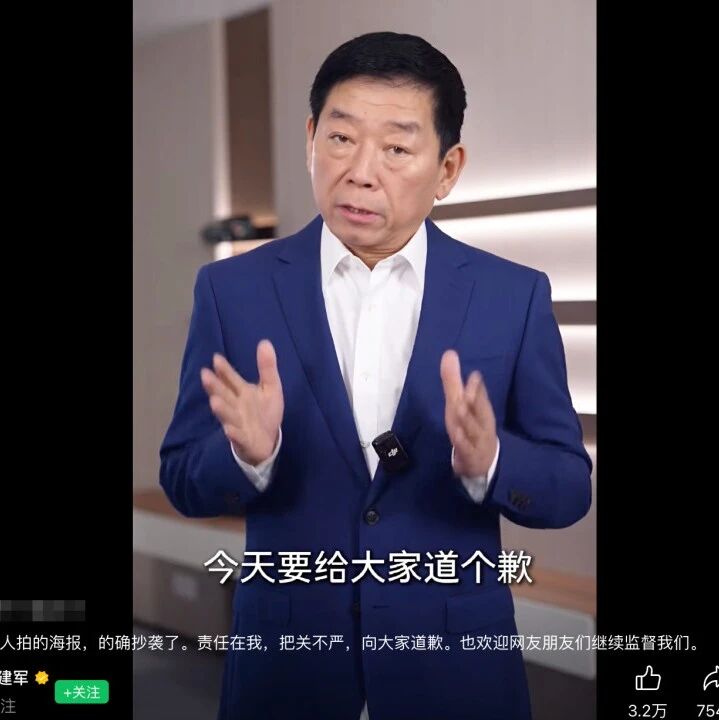
Core Viewpoint - The article discusses the recent apology from Wei Jianjun, the chairman of Great Wall Motors, regarding a plagiarism issue related to a promotional poster for the new V9X model, emphasizing the company's commitment to originality and accountability [3][5]. Group 1: Company Overview - Great Wall Motors, established its premium brand "Wei" in November 2016, named after its founder Wei Jianjun [6]. - The company reported a revenue of 222.79 billion yuan for 2025, a year-on-year increase of 10.19%, while net profit decreased by 21.71% to 9.912 billion yuan [6]. Group 2: Sales Performance - In 2025, Great Wall Motors sold 1.3237 million new vehicles, marking a 7.33% year-on-year increase, with 403,700 of those being new energy vehicles, reflecting a 25.44% growth [6]. - The brand "Wei" achieved sales of 102,000 units in 2025, a significant increase of 86.29% [6]. - For January to February 2026, the company reported cumulative sales of 162,900 vehicles, a 2.58% increase year-on-year, including 30,800 new energy vehicles sold [7].
魏建军道歉
券商中国· 2026-03-06 15:05
Core Viewpoint - The recent controversy surrounding the Wei brand's new car poster, which was accused of plagiarism, led to public apologies from both the chairman of Great Wall Motors, Wei Jianjun, and the CEO of Wei brand, Zhao Yongpo, acknowledging the issue and committing to improvements in internal management and oversight [1][2]. Group 1: Apologies and Accountability - Wei Jianjun, the chairman of Great Wall Motors, publicly admitted that the Wei brand V9X promotional poster was indeed plagiarized, taking full responsibility for the oversight and apologizing to the Land Rover brand and the original creator [1]. - Zhao Yongpo, the CEO of Wei brand, also issued an apology on social media, acknowledging the serious oversight and emphasizing the importance of respecting original creative work [2]. Group 2: Internal Measures and Future Commitment - Following the incident, Great Wall Motors plans to reflect deeply and optimize its internal management and review processes to prevent future occurrences of plagiarism [1]. - Both Wei Jianjun and Zhao Yongpo reiterated the company's commitment to originality and expressed a willingness to accept public scrutiny moving forward [1][2].

魏建军承认海报抄袭
21世纪经济报道· 2026-03-06 14:32
Core Viewpoint - The chairman of Great Wall Motors, Wei Jianjun, publicly apologized for the alleged plagiarism of a promotional poster for the WEY brand V9X, which closely resembles a previous advertisement for the Land Rover Range Rover Sport, acknowledging the issue and committing to take full legal and financial responsibility [1][3][6]. Group 1: Incident Overview - The WEY brand officially announced the launch of the V9X flagship model on March 5, 2023, with Wei Jianjun as the spokesperson. The promotional poster was quickly criticized by netizens for its similarities to Land Rover's advertising, leading to a significant online discussion [6]. - Wei Jianjun admitted the poster was indeed plagiarized and expressed a commitment to prevent such incidents in the future, emphasizing the importance of originality in the company's work [3][6]. Group 2: Sales and Production Data - In February 2023, Great Wall Motors reported total sales of 72,594 units, a year-on-year decrease of 6.79%, and a production total of 64,811 units, down 13.42% year-on-year [6][7]. - The sales breakdown showed that the Haval brand sold 43,660 units, a slight increase of 0.83% year-on-year, while the WEY brand saw a significant increase of 54.13% year-on-year with 5,615 units sold [7]. - The company's overseas sales in February reached 42,700 units, and the sales of new energy vehicles were 12,700 units for the same month [7]. Group 3: Financial Performance - Great Wall Motors reported a revenue of 222.79 billion yuan for the year 2025, reflecting a year-on-year growth of 10.19%. However, the net profit attributable to shareholders decreased by 21.71% to 9.91 billion yuan, with a significant drop in the net profit excluding non-recurring items by 36.48% [8].