交通

Search documents
服务消费再迎重磅政策利好,哪些亮点值得关注
Di Yi Cai Jing· 2026-01-30 07:58
Core Viewpoint - The State Council has issued a plan to accelerate the cultivation of new growth points in service consumption, focusing on optimizing service supply and enhancing consumer experience across various sectors [1][2]. Group 1: Key Areas of Service Consumption - The plan identifies key service consumption areas including transportation, housekeeping, online audio-visual services, travel, automotive aftermarket, inbound consumption, performance services, sports event services, and emotional experience services [1][2]. - The growth rate of service consumption is expected to exceed that of goods consumption during the 14th Five-Year Plan period, with emerging sectors like culture, education, sports, health, and travel driving significant growth [1][2]. Group 2: Policy Measures to Stimulate Growth - The plan outlines 12 policy measures aimed at stimulating development in key areas, including the integration of railway and tourism services, enhancing cruise consumption, and improving the overall service quality in transportation [2][3]. - The Ministry of Commerce emphasizes the importance of service consumption in driving domestic demand and improving the quality of life, highlighting its high frequency, strong multiplier effect, and sustainable growth potential [2]. Group 3: Inbound Consumption and Tourism - The plan aims to boost inbound consumption by extending visa-free policies and enhancing the convenience of entry for foreign visitors, which is expected to significantly increase consumer spending [3]. - The focus on creating immersive consumption experiences and promoting high-quality international events and services is intended to attract more foreign tourists and enhance their spending in China [3]. Group 4: Sports Events and Economic Impact - The rise of sports events across the country is recognized as a key driver for upgrading local consumption, with initiatives to improve safety management and increase the supply of quality sports events [4][5]. - The economic impact of sports consumption is significant, contributing to growth in tourism, dining, accommodation, and retail sectors, thereby supporting sustainable economic development [5]. Group 5: Emotional Consumption Trends - Emotional consumption is emerging as a new trend, with the market expected to grow from 2.31 trillion yuan in 2024 to over 4.5 trillion yuan by 2029, indicating a shift towards personalized and quality-driven consumer demands [5][6]. - The plan encourages the development of emotional and experiential services while promoting a regulatory framework that supports innovation and protects consumer rights [5][6].
地产下游季节性回调,上游价格改善
Hua Tai Qi Huo· 2026-01-30 05:52
Industry Overview Upstream - International oil prices improved compared to last week, and prices of eggs, palm oil, copper, and zinc continued to rise [2] Midstream - PX and urea prices remained high, power plant coal consumption was low, and road asphalt construction was at a low level [3] Downstream - Commercial housing sales in first, second, and third-tier cities declined seasonally, while domestic flight frequencies increased [3] Industry Events Production Industry - The Commercial Spacecraft and Application Industry Chain Co-chain Action Conference announced that China will layout more "space +" future industries, and China Aerospace Science and Technology Group will implement five major projects during the 15th Five-Year Plan period [1] Service Industry - The State Council issued a work plan to support service consumption, focusing on key and potential areas, and encouraging the improvement of infrastructure for residential services [1] Key Price Indicators | Industry | Indicator | Price | Change | | --- | --- | --- | --- | | Agriculture | Spot price of eggs | 8.5 yuan/kg | 4.28% | | Agriculture | Spot price of palm oil | 9296.0 yuan/ton | 5.30% | | Non-ferrous metals | Spot price of copper | 103206.7 yuan/ton | 2.97% | | Non-ferrous metals | Spot price of zinc | 25280.0 yuan/ton | 4.05% | | Energy | Spot price of WTI crude oil | 63.2 dollars/barrel | 4.27% | | Energy | Spot price of Brent crude oil | 67.4 dollars/barrel | 3.26% | | Chemical | Spot price of PTA | 5314.8 yuan/ton | 4.24% | | Chemical | Spot price of polyethylene | 6905.0 yuan/ton | 3.11% | [34]
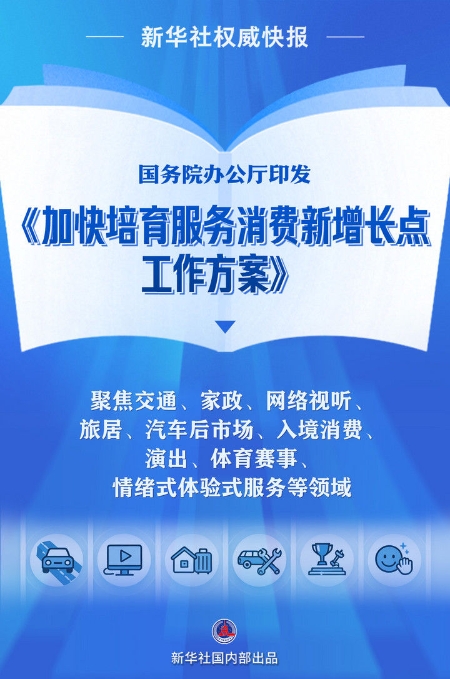
新华鲜报|加快培育服务消费新增长点!国办出台12条政策举措
Xin Hua She· 2026-01-30 04:36
Core Viewpoint - The State Council of China has released a work plan to accelerate the cultivation of new growth points in service consumption, focusing on enhancing service supply and promoting quality improvements for consumer benefits [1][7] Group 1: Key Service Consumption Areas - The plan identifies key service consumption sectors including transportation, housekeeping, online audio-visual services, travel, automotive aftermarket, and inbound consumption [3] - Specific measures include developing policies to promote the integration of railways and tourism, enhancing the tourism transformation of train stations and trains, and improving yacht infrastructure and services [3][4] Group 2: Inbound Consumption Initiatives - The plan outlines initiatives for inbound consumption, such as extending the trial period for unilateral visa-free countries, expanding the scope of visa policies, and increasing the number of tax refund shops for departing tourists [4] - It aims to create a more convenient and comfortable consumption environment for foreign visitors [4] Group 3: Service Sector Development - The plan proposes actions for various sectors, including specialized training for housekeeping services, support for private capital in online audio-visual services, and the development of travel destination cities [4] - It emphasizes the importance of optimizing service supply, promoting pilot programs, innovating consumption scenarios, and enhancing talent cultivation [4] Group 4: Entertainment and Sports Services - In the entertainment sector, the plan suggests optimizing performance management, setting reasonable safety capacity limits, and exploring the adjustment of certain performance groups to public welfare units [4][5] - For sports events, it encourages the introduction of foreign sports events and supports local mass sports activities while ensuring safety management [5] Group 5: Experience Consumption Challenges - The plan acknowledges challenges in experience consumption, such as the wide range of involved fields, difficulty in quantifying standards, and complexities in consumer rights protection [6] - It proposes innovative regulatory approaches for new business models and supports the inclusion of relevant professions in the national occupational classification system [6] Group 6: Support and Guarantee Measures - The plan includes measures to improve standard systems, strengthen credit construction, and enhance financial support [7] - It aims to align consumer demands for service experiences with industrial transformation, thereby stimulating consumption and contributing to high-quality development [7]

中信建投:顺周期板块边际改善 公募REITs总体表现超预期
智通财经网· 2026-01-30 03:33
Core Viewpoint - The report from CITIC Securities indicates that 77 REITs have disclosed their Q4 2025 results, showing marginal improvements in cyclical sectors and growth potential in counter-cyclical sectors [1][2]. Group 1: Performance Summary - 42 newly listed REITs exceeded performance expectations in Q4, with average achievement rates for revenue, EBITDA, and distributable amounts at 103.7%, 92.4%, and 104.1% respectively [1][2]. - Existing REITs showed overall marginal performance improvement, with year-on-year average changes in the three key metrics being 5.2%, 6.2%, and 17.2% [1][2]. Group 2: Sector Analysis - The consumption and rental housing sectors performed exceptionally well, while the municipal environmental sector experienced significant seasonal fluctuations. The transportation infrastructure sector underperformed expectations, and there was a mixed performance in energy, industrial parks, and warehousing logistics [3]. - Industrial parks continued to face year-on-year pressure but showed improved rental rates quarter-on-quarter, with factory REITs outperforming research and development office REITs [3]. - The warehousing and logistics sector saw marginal improvements in volume, while prices continued to decline, with stable whole leases and related contracts [3]. - The rental housing sector maintained high occupancy rates with slight fluctuations, and rental prices for policy-based rental housing increased steadily [3]. - The consumption sector benefited from strong operations and seasonal demand, leading to impressive performance, with operational and positioning factors driving differentiation [3]. - Data centers maintained stable performance due to large clients and long-term agreements [3]. - New transportation projects performed well, but performance differentiation continued due to network structure and cargo composition [3]. - The municipal sector is supported by demand stability, with a focus on actively improving operational projects [3]. - The energy sector experienced performance differentiation accelerated by resource endowments and regional electricity reform policies [3]. Group 3: Investment Recommendations - The strategy for new listings and strategic placements has shifted from "general selection" to "careful selection," with concentrated policy benefits expected to be released. The outlook for the REITs market in the first half of 2026 is positive, focusing on three main lines: counter-cyclical, high prosperity, and strong fundraising [4]. - The first line includes sectors with strong counter-cyclical attributes, such as consumption infrastructure, policy-based rental housing, and municipal environmental sectors [4]. - The second line includes sectors aligned with national strategic directions and high prosperity, such as data centers, as well as some warehousing logistics and highway projects showing marginal recovery [4]. - The third line benefits from the strategic value of public REITs as "asset listing platforms," with strong fundraising demands from original equity holders and high-quality asset reserves [4].

服务消费迎来“国家级”增长图谱,六大重点领域撬动内需新支点
Jin Rong Jie· 2026-01-30 03:25
Core Viewpoint - The release of the "Work Plan for Accelerating the Cultivation of New Growth Points in Service Consumption" marks a strategic shift in China's economic vitality, focusing on optimizing supply, nurturing potential, and strengthening guarantees for service consumption growth [1][2]. Policy Background - Service consumption is becoming a key engine for China's economic transformation, with its contribution to consumption growth reaching significant levels. The Ministry of Commerce reported that service consumption's contribution rate has been notably increasing [2]. - In September 2025, the government introduced measures to expand service consumption, laying a solid foundation for the current work plan [2]. Key Areas - The work plan emphasizes six key areas: transportation services, housekeeping services, online audio-visual services, travel and accommodation services, automotive aftermarket services, and inbound consumption. Each area targets specific industry upgrades and innovative consumption scenarios [3]. - In transportation services, the plan proposes developing special policies for the integration of railways and tourism, promoting the transformation of train stations and trains into tourism-oriented experiences [3]. - Inbound consumption is identified as a significant growth point, with plans to expand visa-free policies and optimize international payment environments [3]. Potential Areas - The plan identifies three potential areas for future growth: performance services, sports event services, and emotional experience services, aiming to cultivate long-term development momentum [4]. - For performance services, the plan suggests establishing long-term mechanisms and regulating the ticketing market to combat scalping [4]. - Emotional and experiential services are recognized as emerging sectors, receiving support for inclusion in the national occupational classification system [4]. Implementation Path - The work plan outlines a clear implementation path characterized by "internal liberalization and external openness." This includes removing unreasonable restrictions that hinder consumption upgrades and enhancing high-level openness in the service industry [5]. - Specific pilot programs will be launched in select cities to explore graded management of automotive modifications and to stimulate market vitality [5]. Support System - A robust support system is essential for the effectiveness of the policy, focusing on standards, credit, and finance. The plan aims to guide financial institutions to increase credit investments and innovate financial products [6][7]. - The credit system will concentrate on key consumption areas such as elderly care, housekeeping, and tourism, enhancing information collection and public disclosure [7]. Local Implementation - The effectiveness of the policy will depend on local innovative implementation, with a requirement for regions to design specific support policies. A nationwide pilot program for new consumption formats is already underway [8]. Market Opportunities - The release of the work plan signifies a transition from spontaneous growth to a policy-driven phase for service consumption, presenting clear structural opportunities for various enterprises in the industry [9]. - Companies in housekeeping, online audio-visual content, cultural tourism, and automotive modification sectors are expected to benefit from a more favorable regulatory environment and expanded market space [9].
组织消费促进活动超400场,开展文体活动600余场,赠送新就业群体暖“新”礼包……
Nan Jing Ri Bao· 2026-01-30 02:33
Group 1: Core Initiatives - The Nanjing government has introduced ten measures to support citizens and businesses during the 2026 Spring Festival, focusing on enhancing service quality and boosting economic development [1] Group 2: Consumer Benefits and Activation - Five initiatives are aimed at stimulating consumer spending, including special promotional events, support for trade-in programs, and a variety of cultural and tourism activities [2] - The city plans to host over 400 promotional events and offer more than 50 million yuan in discounts through e-commerce platforms [2] - Consumers can receive subsidies of up to 20,000 yuan for vehicle trade-ins and 15,000 yuan for other consumer goods [2] - A series of over 600 cultural and tourism events will be organized to cater to diverse visitor needs, emphasizing local traditions and attractions [2] - Special discounts on tickets and services will be available for visitors arriving in Nanjing during the festival [2] Group 3: Support for Enterprises - Three measures are designed to encourage businesses to increase production and expand markets, including transportation subsidies for non-local workers returning to Nanjing [3] - Support will be provided for foreign trade companies to participate in key international trade exhibitions during the festival [3] - A campaign to honor city builders will be launched, showcasing their contributions through public displays [3] Group 4: Employment Services and Efficiency - Two initiatives focus on enhancing employment services and providing robust support, including the operation of 900 employment service stations during the festival [3] - The city will offer various support packages, including housing for new workers' families and community engagement activities [3] - Transportation services will be reinforced to ensure adequate supply during peak travel times [3]
新华鲜报丨加快培育服务消费新增长点!国办出台12条政策举措
Xin Hua Wang· 2026-01-30 01:55
Group 1 - The core viewpoint of the article emphasizes the need to accelerate the cultivation of new growth points in service consumption, with the State Council issuing a work plan that includes 12 policy measures aimed at enhancing service supply and improving consumer benefits [1][6] Group 2 - The plan identifies key service consumption areas such as transportation, housekeeping, online audio-visual services, travel, automotive aftermarket, and inbound consumption, proposing specific measures to support these sectors [2] - For transportation, the plan suggests developing policies to promote the integration of railways and tourism, enhancing the tourism transformation of stations and trains, and improving infrastructure for yacht services [2] - The plan anticipates a record high in inbound travel by 2025, with measures to facilitate foreign tourists' consumption, including extending visa-free policies and enhancing the online visa application process [2] Group 3 - The plan outlines initiatives for housekeeping services, online audio-visual services, travel destinations, and automotive aftermarket services, focusing on optimizing service supply and fostering innovation [2] - In the realm of performance services, the plan proposes optimizing management, setting safety capacity limits, and establishing incentive mechanisms for performing arts organizations [3] - For sports events, the plan emphasizes improving safety management and encouraging the introduction of international sports events [3] Group 4 - The plan addresses challenges in experience-based services, proposing innovative regulatory approaches and supporting the inclusion of relevant professions in the national classification system [4] Group 5 - A series of support measures are proposed to enhance the standard system, strengthen credit construction, and reinforce financial support for service consumption [5]
早盘速递-20260130
Guan Tong Qi Huo· 2026-01-30 01:33
Report Summary 1. Report Industry Investment Rating - Not provided in the given content 2. Core Views - The State Council General Office issued a work plan to foster new growth points in service consumption, identifying key service - consumption areas such as transportation, household services, online audio - visual, sojourn, automotive aftermarket, and inbound consumption [2] - The Ministry of Industry and Information Technology emphasized that "anti - involution" is the main contradiction in the photovoltaic industry's governance and will use various means to promote its healthy development [2] - Trump stated that Putin agreed to a one - week suspension of air strikes on Ukraine, plans to announce the nomination for the next Fed Chair next week, and the US plans to reopen Venezuelan airspace [2] - As of the week ending January 29,螺纹产量 increased by 0.14% to 199.83 million tons, total inventory reached 475.53 million tons with a weekly increase of 23.43 million tons, and the apparent demand decreased by 4.92% to 176.40 million tons [2] - In 2025, global gold demand reached a record high of 5002 tons, with central banks net - buying 230 tons in Q4 (a 6% increase from the previous quarter) and 863 tons for the whole year [2] 3. Summary by Related Catalogs Hot News - The State Council General Office issued a work plan with 12 policy measures in three aspects to boost service consumption, targeting specific key areas [2] - The Ministry of Industry and Information Technology held a symposium on the photovoltaic industry, highlighting the need for "anti - involution" and using market - and law - based means for regulation [2] - Trump made statements about the Ukraine situation, Fed Chair nomination, and Venezuelan airspace [2] - Steel data shows changes in production, inventory, and demand for rebar as of January 29 [2] - The World Gold Council reported record - high global gold demand in 2025 and significant central - bank gold purchases [2] Key Focus - The report focuses on urea, synthetic rubber, polysilicon, crude oil, and PP [3] Night - session Performance - Different commodity sectors had various night - session performance, with the precious metals sector having a 39.21% increase, followed by the non - ferrous metals sector with 26.56%, and the coal - coke - steel - ore sector with 7.90% [3] Plate Position - The chart shows the changes in the positions of different commodity futures sectors in the past five days [4] Performance of Major Asset Classes - Different asset classes had different daily, monthly, and annual returns. For example, the Shanghai Composite Index had a daily increase of 0.16%, a monthly increase of 4.77%, and an annual increase of 4.77% [5] Main Commodity Trends - The report presents the trends of major commodities such as the Baltic Dry Index, CRB Spot Index, WTI crude oil, London spot gold, LME copper, etc., as well as the risk premium of the stock market [6]
长三角一体化示范区“十四五”期间GDP年均名义增速达7.3%
Su Zhou Ri Bao· 2026-01-30 01:27
昨天(1月29日),长三角生态绿色一体化发展示范区新闻发布会在沪举行。据悉,示范区经过6年 多建设,在"十四五"期间重点推进,GDP年均名义增速达7.3%,2025年GDP达5716亿元,两区一县各自 增速均位居所在省市前列,示范区规上工业总产值、工业投资增速均高于长三角平均水平。 做好重大建设项目三年行动计划(2024—2026年)评估,启动编制新一轮三年行动计划,谋划储 备、启动实施一批具有前瞻性、牵引性的重大项目。聚焦项目用地需求,编制重大项目用地保障清单, 盘活存量建设用地,提升土地利用效率。 其中,方厅水院建成后已承办全球环境与可持续发展大会、太湖世界文化论坛、世界赛艇锦标赛开 幕式等国际性会议活动;创智引擎一期、浦港路大桥、雪落漾大桥等工程相继竣工;沪苏嘉城际铁路全 线开工,通苏嘉甬高铁加速建设,"轨道上的示范区"框架基本形成。 2026年聚焦重点区域和重点领域,示范区将同步推进项目建设和功能培育,提升示范区高质量发展 新动能。 聚焦重点区域功能培育,示范区将完善方厅水院重大活动一体化保障机制,加强周边餐饮、住宿、 商贸等配套业态发展,提升方厅水院的会议、会展承载能力。协同推进方厅水院运营,做强会 ...
上海涉外经济创新高,北证50下跌1.69%
Soochow Securities· 2026-01-30 00:46
证券研究报告·北交所报告·北交所定期报告 北交所定期报告 20260130 执业证书:S0600520090004 zhujieyu@dwzq.com.cn 证券分析师 易申申 执业证书:S0600522100003 yishsh@dwzq.com.cn 证券分析师 余慧勇 执业证书:S0600524080003 yuhy@dwzq.com.cn 研究助理 武阿兰 执业证书:S0600124070018 wual@dwzq.com.cn 研究助理 陈哲晓 执业证书:S0600124080015 sh_chenzhx@dwzq.com.cn 上海涉外经济创新高,北证 50 下跌 1.69% 2026 年 01 月 30 日 证券分析师 朱洁羽 相关研究: 《沪深北交易所提高融资保证金最低 比例,北证 50 上涨 0.98%》 2026-01-14 《工信部印发<推动工业互联网平台 高质量发展行动方案(2026—2028 年)>,北证 50 下跌 2.50%》 2026-01-13 东吴证券研究所 1 / 8 请务必阅读正文之后的免责声明部分 [Table_Tag] [Table_Summary] ◼ 资本市场新 ...