晶圆代工

Search documents
台积电(TSM):AI需求真实不虚,晶圆供应仍是瓶颈
HTSC· 2026-01-16 06:10
Investment Rating - The report maintains a "Buy" rating for the company with a target price raised to $440 from $370 [7]. Core Insights - The management expressed strong confidence in AI demand, stating it is "real" and that silicon supply remains a bottleneck [1][29]. - The company has raised its long-term revenue growth target from a CAGR of 15%-20% to 25% [1]. - Capital expenditures (CapEx) for 2026 are projected to surge to $52-56 billion, significantly higher than the previous year's $41 billion, indicating a robust response to structural AI demand growth [3][14]. - The company expects revenue growth of nearly 30% year-over-year in 2026, with a long-term revenue CAGR for AI server processors adjusted to mid-to-high 50% for 2024-2029 [1][2]. Summary by Relevant Sections Investment Rating - The investment rating is maintained as "Buy" with a target price of $440 [7]. AI Demand - AI server processor revenue growth guidance has been raised to a CAGR of mid-to-high 50% for 2024-2029, reflecting strong growth confidence [2]. - Customer feedback indicates positive ROI from investments in AI infrastructure, with demand remaining strong due to insatiable computational needs [2][29]. Capital Expenditures and Expansion - The company forecasts 2026 CapEx at $52-56 billion, with 70-80% allocated to advanced processes, particularly 2nm and A16 technologies [3][14]. - Global expansion includes the ramp-up of facilities in Arizona, Japan, and Germany, with significant capacity increases planned [3][30]. Profitability - The gross margin for Q4 2025 reached 62.3%, exceeding guidance, driven by high capacity utilization and cost improvements [4][28]. - The company anticipates further gross margin improvement to 64% in Q1 2026, despite potential short-term dilution from new technologies [4][28]. Earnings Forecast and Valuation - Revenue forecasts for 2026-2027 have been increased by 9.8% and 19.7%, respectively, with net profit estimates raised by 22.8% and 29.2% [5][25]. - The company is expected to achieve a net profit of $2.412 billion in 2026, with a projected PE ratio of 30x based on 2026 EPS of 93 New Taiwan Dollars [5][25].

中信证券:近期电子行业多个细分板块相关公司发布涨价通知,建议关注受益确定性最高的环节
Zheng Quan Shi Bao Wang· 2026-01-16 00:33
人民财讯1月16日电,中信证券研报称,近期电子行业多个细分板块相关公司发布涨价通知,涉及存 储、CCL、BT载板、晶圆代工、封测等多细分领域,其背景是2025年以来因上游金属成本大幅提升, 叠加AI高景气对整体需求的拉动。考虑到本轮涨价周期的背景是AI超高景气,消费电子、汽车电子等 需求阶段性承压,建议关注存储、CCL、BT载板、晶圆代工、封装等在涨价趋势中受益确定性最高的 环节。 ...

晚报 | 1月16日主题前瞻
Xuan Gu Bao· 2026-01-15 14:22
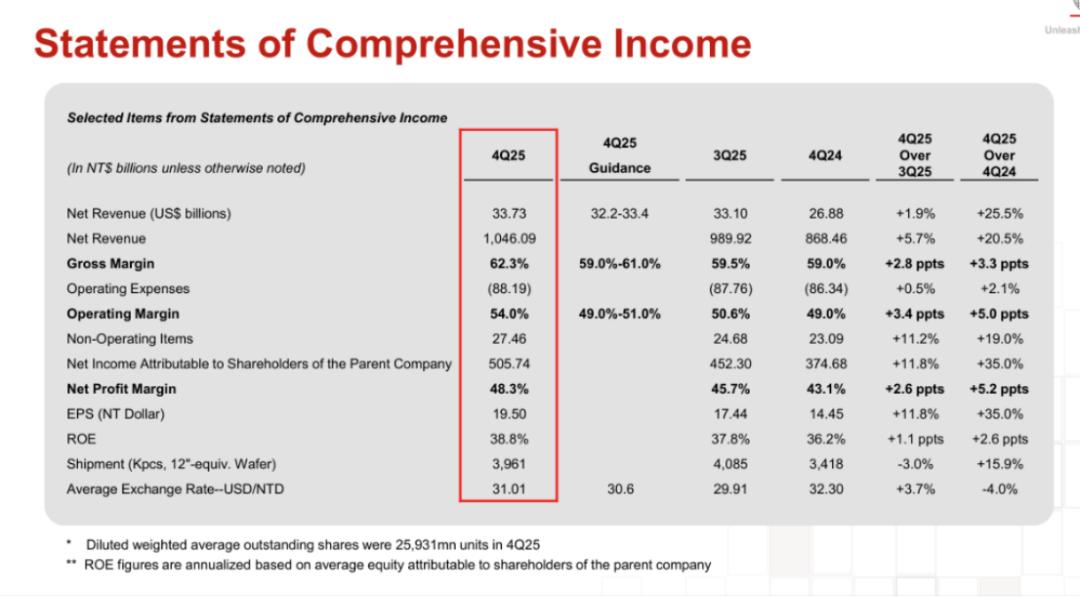
Semiconductor Industry - TSMC reported Q4 2025 revenue of $33.73 billion, a 25.5% year-over-year increase and a 1.9% quarter-over-quarter increase, with a gross margin of 62.3%, driven by strong demand for high-end chips due to the AI computing wave [1] - TSMC's capital expenditure is expected to reach $52-56 billion in 2026, exceeding market expectations, indicating robust future AI computing demand [1] Tungsten Industry - Domestic prices for tungsten products have increased, with black tungsten concentrate and ammonium paratungstate prices rising by 5,000 yuan/ton and tungsten iron by 10,000 yuan/ton [1] - Global tungsten supply growth is limited, with a projected compound annual growth rate of 2.57% from 2023 to 2028, while demand is expected to grow at 2.61% during the same period, driven by emerging industries [2] Commercial Aerospace - Beijing's Rocket Street project has completed its construction and will serve as China's first commercial aerospace research and production base, offering various shared services for the entire commercial aerospace development chain [3] - The U.S. aims to produce 10,000 Starship spacecraft annually, and the FCC has approved SpaceX's deployment of an additional 7,500 second-generation Starlink satellites, totaling 15,000 [3] Power Grid Equipment - The State Grid's investment plan for the 14th Five-Year Plan is set at 4 trillion yuan, a 40% increase from the previous plan, focusing on green transformation and new power system construction [4] - This investment is expected to lead to significant upgrades in China's power system, enhancing energy security and global competitiveness [4] Carbon Fiber Industry - A breakthrough in domestic T1000-grade high-performance carbon fiber has been achieved, with each fiber having 12,000 filaments and a tensile strength exceeding 6,600 MPa, marking a significant advancement in high-end materials [5] - By 2030, China's carbon fiber production capacity is expected to exceed 250,000 tons, with demand in the new energy vehicle sector projected to rise significantly [6] GaN Power Products - Onsemi has signed a collaboration agreement with GlobalFoundries to develop advanced GaN power products, starting with 650V devices, to meet the growing power demands in various sectors [6] - GaN technology is expected to enhance efficiency and reduce costs in applications such as AI data centers and electric vehicles [7]

美股前瞻 | 三大股指期货齐涨 油价跳水 台积电绩后走高
Zhi Tong Cai Jing· 2026-01-15 12:30
Market Movements - US stock index futures are all up, with Dow futures rising by 0.12%, S&P 500 futures up by 0.39%, and Nasdaq futures increasing by 0.80% [1] - European indices show mixed results, with Germany's DAX down by 0.23%, UK's FTSE 100 up by 0.43%, France's CAC40 down by 0.32%, and the Euro Stoxx 50 up by 0.53% [1] Commodity Prices - WTI crude oil has decreased by 3.42%, trading at $59.90 per barrel, while Brent crude oil is down by 3.37%, priced at $64.28 per barrel [2] Market News - The US Senate Banking Committee has postponed the discussion on a key cryptocurrency regulatory proposal after Coinbase withdrew its support, indicating ongoing bipartisan negotiations [3] - PIMCO, managing $2.2 trillion in assets, is reducing its US asset holdings due to the unpredictable policies of the Trump administration, aiming to diversify its investment strategy [3] - President Trump has indicated a delay in responding to Iran, which has led to a drop in Brent crude oil prices below $65, reducing the risk of military action and oil supply disruptions [3] Precious Metals - Analysts from ANZ predict that geopolitical tensions and loose monetary policies will support gold prices, potentially exceeding $5,000 per ounce in the latter half of the year [4] - Silver prices experienced a significant drop of over 7% due to Trump's announcement to delay tariffs on key mineral imports, leading to a panic sell-off among speculative investors [5] Company News - TSMC reported Q4 net profit significantly exceeding expectations, with revenue of NT$1,046.09 billion (approximately $33.67 billion), a year-on-year increase of 20.5% and a gross margin of 62.3% [6][7] - BlackRock's Q4 earnings surpassed expectations, with revenue growing by 23% to $7 billion and assets under management reaching a record $14 trillion [7] - ASML's market capitalization surpassed $500 billion following TSMC's strong 2026 capital expenditure guidance, reflecting optimism in AI-related spending [8] - Ericsson plans to cut approximately 1,600 jobs in Sweden as part of a broader cost-cutting initiative to improve profit margins in a challenging telecom equipment market [9] - Google is enhancing its AI tool Gemini by integrating it with its suite of applications, aiming to provide personalized services and differentiate itself from competitors like OpenAI [10]
首次破万亿,台积电,炸裂财报来了
3 6 Ke· 2026-01-15 11:38
Core Viewpoint - TSMC's Q4 2025 financial report shows record revenue and profit, highlighting strong demand in the semiconductor industry, particularly driven by AI applications, although revenue from the new 2nm process is not yet included [1][2][4]. Financial Performance - TSMC reported revenue of $33.67 billion (NT$1,046.09 billion) for Q4 2025, a year-on-year increase of 25.5% and a quarter-on-quarter increase of 5.7% [2][3]. - Net profit reached NT$505.74 billion, a significant year-on-year increase of 35%, marking the eighth consecutive quarter of profit growth [2][3]. - The gross margin was 62.3%, and the net profit margin was 48.3% [3]. Product Segmentation - In Q4 2025, 3nm process shipments accounted for 28% of wafer sales, while 5nm and 7nm processes represented 35% and 14%, respectively. Advanced processes (including 7nm and above) contributed to 77% of total wafer sales [2][3]. Market Trends - The demand for AI continues to drive chip demand across the server industry, with expectations for a significant increase in AI server demand in 2026 [4]. - TSMC plans capital expenditures of $52 billion to $56 billion for 2026, following $40.9 billion in 2025, aligning with industry trends for advanced process capacity expansion [4]. Capacity and Production - TSMC's 2nm technology is set to begin mass production in Q4 2025, with expectations for it to become a leading process node due to high demand and pricing [8][7]. - The company is expanding its 2nm production capacity, with plans for multiple new facilities to support increased output [8]. Pricing Trends - The global average capacity utilization rate for major foundries reached 90% in Q4 2025, driven by strong demand from AI applications and recovery in automotive and industrial sectors [9]. - Price increases are anticipated in the 12-inch foundry segment, particularly for advanced processes, with expected price hikes of 3% to 10% in 2026 [10]. Industry Dynamics - The semiconductor foundry market is evolving, with TSMC maintaining a dominant position, while non-TSMC foundries are experiencing slower growth [14][15]. - The demand for storage chips is expected to remain strong, with significant price increases projected for DRAM and NAND in 2026 due to AI-driven demand [16].
最高涨 20%!8 英寸晶圆代工开启全行业涨价
是说芯语· 2026-01-14 03:30
Core Viewpoint - The global 8-inch wafer foundry capacity is expected to decrease by 2.4% in 2026 due to TSMC and Samsung Electronics reducing their production capacity, while demand for AI-driven power management chips remains strong, leading to an anticipated increase in capacity utilization rates to 90% this year [2][8]. Group 1: Company-Specific Insights - TSMC plans to gradually exit the 6-inch wafer manufacturing business within two years and continue to reduce 8-inch wafer capacity, with a current monthly capacity of approximately 528,000 wafers [4]. - Samsung Electronics will also reduce its 8-inch wafer production starting in the second half of 2025, aiming to allocate more resources to the 12-inch wafer market, with a similar monthly capacity of 528,000 wafers [4]. - UMC's 8-inch wafer monthly capacity was previously over 360,000 wafers, with a current utilization rate of about 70%, and the company is optimistic about continued growth in 2026 [5]. - SMIC has a monthly capacity of approximately 355,000 8-inch wafers, with a utilization rate of 95.8% as of Q3 2025, and has raised prices by about 10% due to high demand [5]. - Hua Hong Semiconductor's 8-inch wafer foundry utilization rate reached 109.5%, indicating overcapacity, and the company is expanding its production capacity [6]. - Powerchip's 8-inch wafer monthly capacity is around 120,000 wafers, benefiting from the tight supply of memory chips and the recovery of logic process products [6]. - GlobalFoundries is focusing on expanding its 12-inch wafer production, with a projected decline of about 0.3% in global 8-inch wafer foundry capacity in 2025 [7]. Group 2: Market Trends and Projections - The average capacity utilization rate for global 8-inch wafer foundries is expected to rise to 85% to 90% in 2026, significantly better than the 75% to 80% range in 2025 [8]. - Some foundries are notifying customers of price increases ranging from 5% to 20% due to tightening capacity, marking a shift from previous selective price adjustments [8].

八英寸晶圆厂,酝酿涨价!
半导体芯闻· 2026-01-13 10:21
Core Insights - The recent changes in the 8-inch wafer supply-demand landscape are driven by TSMC and Samsung's gradual production cuts, alongside robust growth in AI-related power IC demand and preemptive inventory stocking by customers due to concerns over rising IC costs in the second half of the year [1][2] Group 1: Supply and Demand Dynamics - TSMC has officially begun to reduce its 8-inch capacity starting in 2025, with plans for some facilities to cease operations by 2027, while Samsung is also adopting a more aggressive reduction strategy [1] - TrendForce forecasts a 0.3% decline in global 8-inch capacity in 2025, entering a negative growth phase, with a further expected reduction of 2.4% in 2026 despite minor expansions from companies like SMIC and Vanguard [1] - The demand side is bolstered by increased orders for AI server power ICs and a trend towards localizing IC production in China, leading to higher capacity utilization rates among Chinese wafer foundries [1] Group 2: Price Adjustments and Market Outlook - In 2026, the demand for power-related ICs driven by AI applications is expected to support an increase in global 8-inch average capacity utilization rates to 85-90%, significantly higher than the 75-80% in 2025 [2] - Some wafer foundries anticipate a tightening of 8-inch capacity in 2026 and have notified customers of planned price increases ranging from 5% to 20% across all customer segments and process platforms [2] - The actual price increase for 8-inch wafers may be moderated due to concerns in consumer electronics and rising costs from memory and advanced process technologies [2] Group 3: TSMC's Capacity Reallocation - TSMC is adjusting its mature process capacity configuration, which reflects a shift towards advanced processes and packaging resources, benefiting 8-inch platforms and long-term customers in automotive and industrial control sectors [4] - The company has begun transferring equipment to its subsidiary, World Advanced, in preparation for the anticipated demand shift in mature processes, with a transaction value of approximately $20-23 million [5] - TSMC's exit from the high-voltage GaN foundry market has released capacity and customer demand, allowing other companies like Powertech to step in and capitalize on the AI power supply chain [6]

研报 | 受AI相关功率需求增长与大厂减产推动,晶圆厂正酝酿调涨八英寸代工价格
TrendForce集邦· 2026-01-13 06:18
Core Viewpoint - The article discusses the adjustments in foundry prices and the changing dynamics of the eight-inch wafer supply and demand, highlighting the impact of AI-related Power IC demand and the reduction in production capacity by major players like TSMC and Samsung [2][4][6]. Supply Side Summary - TSMC and Samsung have begun to reduce eight-inch wafer production capacity, with TSMC aiming for partial shutdowns by 2027. This reduction is expected to lead to a global capacity decline of approximately 0.3% in 2025 and an estimated 2.4% in 2026 [3][4]. - The reduction in capacity by TSMC and Samsung is anticipated to result in a 2.4% year-on-year decrease in global eight-inch wafer capacity for 2026 [4][6]. Demand Side Summary - In 2025, the demand for AI Server Power ICs and the trend of localizing IC production in China have led to increased utilization rates for eight-inch capacity, prompting some manufacturers to raise foundry prices in the latter half of the year [5][6]. - The demand for Power-related ICs is expected to continue growing in 2026 due to increased computational power and energy efficiency requirements from AI applications, which will support the utilization rates of eight-inch wafers [5][6]. Price Adjustment Insights - Some foundries are planning to increase foundry prices by 5% to 20% due to the anticipated tightening of eight-inch capacity in 2026. This price adjustment is expected to be comprehensive across all customers and process platforms [6]. - Despite the planned price increases, actual price hikes may be moderated due to concerns in consumer markets and rising costs in memory and advanced processes affecting peripheral IC costs [6].
群智咨询发布2026年Q1晶圆代工价格风向标:预计55/90nm将迎来普涨
智通财经网· 2026-01-12 09:19
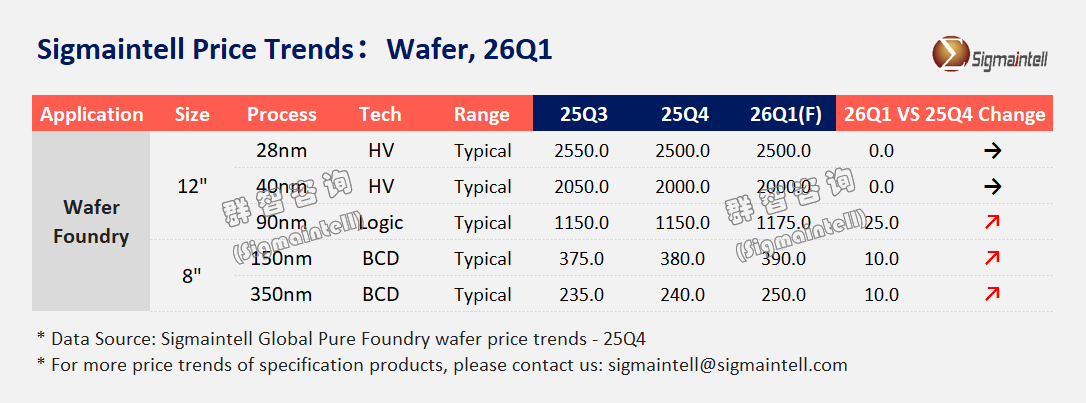
Core Insights - The global average capacity utilization rate of major foundries is expected to rebound to 90% by Q4 2025, a year-on-year increase of approximately 7 percentage points, driven by growth in AI applications and recovery in automotive and industrial control sectors [1] Group 1: Price Trends by Process Node - For 12-inch (28/40nm), prices are stable with robust demand, primarily from MCU, Wi-Fi, and OLED driver chips, showing resilience during market downturns, but growth is expected to slow during the AI demand surge [2] - In the 12-inch (55/90nm) segment, supply-demand tightness is anticipated, with price increases expected in 2026 as many foundries express intentions to raise prices, although some price hikes may not materialize until Q2-Q3 due to capacity expansion constraints [3] - The 8-inch wafer market is experiencing widespread price increases, with an expected rise of 5%-10% starting Q1 2026, driven by AI and automotive applications, and supply tightness is likely to become the norm [4] Group 2: Capacity and Demand Dynamics - The 8-inch process is facing supply constraints due to equipment limitations, and as demand for AI and automotive applications grows, the transition from 8-inch to 12-inch processes is expected to accelerate [4] - The anticipated reduction in 8-inch foundry capacity starting in 2027 will further tighten supply for 12-inch processes, leading to a gradual increase in prices for these nodes [3]
芯片制程“破2进1” “1.4纳米”2027年或试产
Xin Lang Cai Jing· 2026-01-09 19:44
Core Insights - TSMC has officially announced the mass production of its 2nm process in Q4 2025 and has begun research and development on the next-generation 1.4nm process, with risk trial production expected to start in 2027 [3][4][5] - TSMC's advancements solidify its dominant position in the semiconductor foundry market, marking the industry's transition into the 1nm era, with competitors like Samsung and Intel striving to catch up [3][4][7] TSMC's 2nm and 1.4nm Processes - The 2nm process (N2) utilizes the first-generation nanosheet transistor architecture, showing significant improvements over the previous 3nm process, including a 10%-15% performance increase at the same power consumption and a 25%-30% reduction in power consumption for the same performance [5][6] - TSMC's CEO stated that the 2nm process is expected to ramp up production significantly by 2026, driven by demand from smartphones and AI/HPC [5][6] - The 1.4nm process is seen as a strategic continuation of TSMC's "incremental smaller nodes" approach, with plans to optimize the N2 process while preparing for the next generation [5][6] Competitive Landscape - Samsung and Intel are TSMC's main competitors, with Samsung having achieved 3nm GAA process mass production and planning to launch its 1.4nm process around 2027 [7][8] - Intel aims to regain its manufacturing leadership with its 18A and 14A processes, leveraging significant investments to expand domestic production capacity [9][10] Market Potential and Applications - The transition to 1.4nm is expected to drive growth in the semiconductor industry, particularly in AI chips, smart driving, and high-end consumer electronics [10][11] - The global advanced process foundry market is projected to exceed $120 billion by 2030, with 1.4nm and below nodes expected to account for over 40% of high-end logic chip value [10][11] Pricing and Profitability - Initial foundry prices for the 1.4nm process are expected to be approximately 50% higher than those for the 3nm process, indicating high R&D costs but potentially significant long-term profits [11][12] - TSMC's ability to quickly improve yield rates and secure major clients could further enhance its competitive advantage in the high-end market [11][12] Chinese Market Dynamics - Chinese companies, represented by SMIC, are increasing their production capacity in mature processes while investing in advanced technology R&D, with projections suggesting that China could hold 30% of global wafer foundry capacity by 2030 [12]