
银行等

Search documents
收评:沪指跌0.73%失守4000点,煤炭、券商等板块走低,锂电概念逆市活跃
Zheng Quan Shi Bao Wang· 2025-10-30 07:48
Core Viewpoint - The stock market experienced a decline, with major indices falling below key levels, indicating a challenging environment for investors and sectors [1] Market Performance - The Shanghai Composite Index fell by 0.73% to 3986.9 points, the Shenzhen Component Index decreased by 1.16% to 13532.13 points, and the ChiNext Index dropped by 1.84% to 3263.02 points [1] - Over 4000 stocks in the market were in the red, reflecting widespread selling pressure [1] - The total trading volume in the Shanghai and Shenzhen markets reached 246.46 billion yuan [1] Sector Analysis - Sectors such as coal, brokerage, semiconductors, oil, real estate, and pharmaceuticals saw declines, while steel and non-ferrous metals sectors performed positively [1] - The banking sector showed an upward trend, and sectors related to lithium batteries and quantum technology were active [1] Economic Outlook - Dongguan Securities noted that the current macroeconomic environment remains favorable for emerging growth sectors, supported by ongoing economic recovery, accelerated technological iteration, and policy emphasis on innovation [1] - Policies related to mergers, acquisitions, and IPOs continue to favor technology innovation enterprises [1] - The weight of large-cap emerging growth companies has increased, leading to a more balanced impact on market styles compared to the past [1] Future Market Expectations - The market is expected to continue the oscillating upward trend observed since September, with a relatively gentle slope of ascent [1] - The inflow of incremental capital remains steady, providing crucial support for stable upward movement in the market [1]
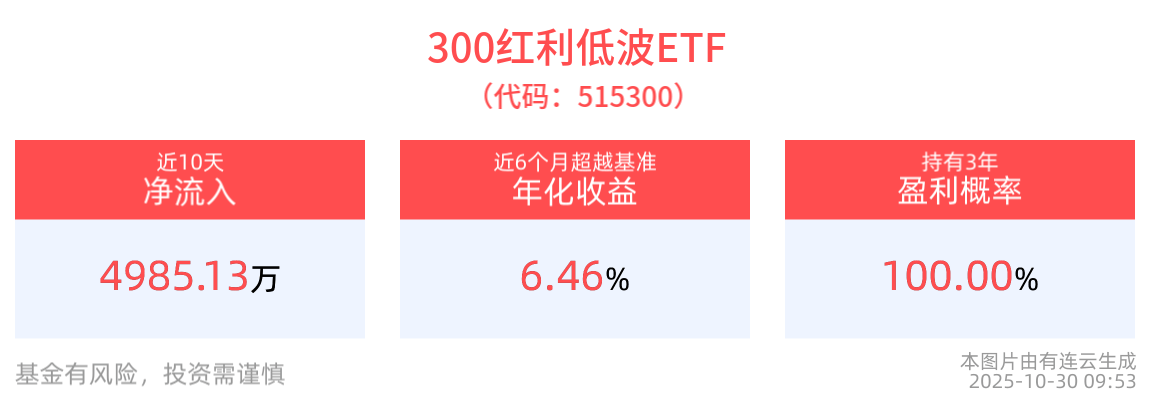
红利资产市场关注度提升,300红利低波ETF(515300)盘中涨近1%,近10日“吸金”近5000万元
Sou Hu Cai Jing· 2025-10-30 02:19
Core Insights - The CSI 300 Dividend Low Volatility Index has shown a positive performance, with a rise of 0.74% as of October 30, 2025, and notable increases in constituent stocks such as Huayu Automotive (4.87%) and Baosteel (1.98%) [1][3] Market Performance - The CSI 300 Dividend Low Volatility ETF (515300) increased by 0.75%, with an intraday turnover of 0.68% and a total transaction value of 32.5842 million yuan [3] - Over the past month, the ETF has averaged daily transactions of 150 million yuan, with a current scale of 4.743 billion yuan [3] - In the last ten trading days, there were net inflows on six days, totaling 49.8513 million yuan [3] Historical Returns - The CSI 300 Dividend Low Volatility ETF has seen a net value increase of 60.06% over the past five years, ranking 103 out of 1031 index equity funds, placing it in the top 9.99% [3] - Since its inception, the ETF's highest monthly return was 13.89%, with the longest consecutive monthly gains being five months and a maximum increase of 14.56% [3] - The average return during rising months is 3.57%, and the annualized return over the past six months has exceeded the benchmark by 6.46% [3] Institutional Investment Trends - Insurance funds have accelerated their allocation to dividend stocks in the first half of 2025, with an increase of nearly 320 billion yuan in allocations, surpassing the total for the previous year [4] - Despite rising valuations, the opportunity for concentrated investments in dividend stocks is diminishing, with an estimated under-allocation of 800 billion to 1.6 trillion yuan across the industry [4] - It is suggested to focus on companies with resilient balance sheets and balanced growth [4] Top Holdings - As of September 30, 2025, the top ten weighted stocks in the CSI 300 Dividend Low Volatility Index include China Shenhua, Shuanghui Development, Gree Electric Appliances, Sinopec, Huayu Automotive, Daqin Railway, Midea Group, China State Construction, Baosteel, and China Mobile, collectively accounting for 35.84% of the index [4][6]







今日21.38亿元主力资金潜入国防军工业
Zheng Quan Shi Bao Wang· 2025-10-28 09:10
Core Insights - The defense and military industry saw the largest net inflow of capital today, amounting to 2.138 billion yuan, with a price change of 1.07% and a turnover rate of 3.47% [1] - The electronics industry experienced the largest net outflow of capital, totaling 12.127 billion yuan, with a price change of -0.37% and a turnover rate of 3.61% [2] Industry Summary - **Defense and Military**: - Trading volume: 3.070 billion shares - Change in trading volume: +26.98% - Turnover rate: 3.47% - Price change: +1.07% - Net capital inflow: 2.138 billion yuan [1] - **Electronics**: - Trading volume: 10.058 billion shares - Change in trading volume: -6.08% - Turnover rate: 3.61% - Price change: -0.37% - Net capital outflow: -12.127 billion yuan [2] - **Other Notable Industries**: - **Construction Materials**: - Net inflow: 0.286 billion yuan, price change: +0.01% [1] - **Banking**: - Net outflow: -1.074 billion yuan, price change: -0.17% [2] - **Healthcare**: - Net outflow: -1.898 billion yuan, price change: -0.72% [2] - **Utilities**: - Net outflow: -3.948 billion yuan, price change: -0.34% [2]
A股市场大势研判:沪指高开高走涨超1%,再创10年新高
Dongguan Securities· 2025-10-27 23:34
Market Overview - The Shanghai Composite Index closed at 3996.94, up 1.18%, marking a new 10-year high [1] - The Shenzhen Component Index rose by 1.51% to 13489.40, while the ChiNext Index increased by 1.98% to 3234.45 [1] Sector Performance - The top-performing sectors included Communication (up 3.22%), Electronics (up 2.96%), and Non-ferrous Metals (up 2.39%) [2] - Conversely, sectors such as Media (-0.95%), Food and Beverage (-0.20%), and Real Estate (-0.11%) lagged behind [2] Market Sentiment and Technical Analysis - The market showed a strong upward trend with a total trading volume of 2.34 trillion, an increase of 365.9 billion from the previous trading day [5] - The market sentiment is stabilizing, with active funds' reduction nearing its end, indicating a gradual recovery in investor confidence [5] Future Outlook - The report anticipates that despite potential supply and demand pressures in the spring of next year, the resonance between economic and market bottoms will strengthen, potentially driving a new market rally [5] - Key sectors to focus on include dividends, TMT (Technology, Media, and Telecommunications), Non-ferrous Metals, and New Energy [5] Upcoming Events - The 2025 Financial Street Forum will take place from October 27 to 30 in Beijing, focusing on global financial development under the themes of innovation, transformation, and reshaping [4]
股市牛人实战大赛丨10月23日十大热股出炉!继峰股份登顶买入榜榜首(明细)
Xin Lang Zheng Quan· 2025-10-23 08:52
Core Insights - The "Second Golden Unicorn Best Investment Advisor Selection" event is currently ongoing, with over 3,000 professional investment advisors participating in simulated trading competitions aimed at enhancing the wealth management industry in China [1]. Group 1: Top Stocks by Purchase Frequency - The top ten stocks purchased by frequency on October 23 are led by Jifeng Co., Ltd. (stock code: sh603997) and include notable companies such as XWANDA (sz300207) and Agricultural Bank of China (sh601288) [1]. Group 2: Top Stocks by Purchase Amount - The top ten stocks by purchase amount on October 23 include Three Gorges New Materials (sh600293) and Guangku Technology (sz300620), with significant investments also seen in companies like Bright Real Estate (sh600708) and Shenghong Technology (sz300476) [2]. Group 3: Event Structure and Data Explanation - The event features a competitive evaluation of investment capabilities across three categories: stock simulation group, on-market ETF simulation group, and public fund simulation configuration group, with specific trading rules regarding holding proportions, maximum drawdown rates, and rebalancing frequency [4]. - The data presented reflects simulated trading activities and is not indicative of actual trading scenarios, serving solely as a reference [4].






1020A股日评:Taco再交易,硬科技反弹-20251020
Changjiang Securities· 2025-10-20 13:42
Core Insights - The A-share market opened high and maintained a high-level fluctuation, with a slight increase in trading volume. The communication sector led the gains, while technology sectors such as batteries, robotics, and circuit boards experienced a general rebound [6][10]. Market Performance - The Shanghai Composite Index rose by 0.63%, the Shenzhen Component Index increased by 0.98%, the ChiNext Index surged by 1.98%, the SSE 50 Index gained 0.24%, the CSI 300 Index rose by 0.53%, the STAR 50 Index increased by 0.35%, and the CSI 1000 Index rose by 0.75%. The total market turnover was 1.75 trillion yuan, with 4,064 stocks rising [10][10]. Sector Performance - On October 20, 2025, within the primary sectors of A-shares, the telecommunications sector led with a gain of 3.15%, followed by coal (+2.96%), power and new energy equipment (+1.53%), and transportation (+1.40%). Conversely, sectors such as metal materials and mining (-0.99%), agricultural products (-0.87%), and banking (-0.13%) saw declines. Notably, concepts like cultivated diamonds (+13.43%), superhard materials (+9.59%), optical modules (+5.07%), and lithium battery electrolytes (+4.75%) led the gains, while gold jewelry, rare earths, nickel ore, and feed concepts declined [10][10]. Market Drivers - The market's upward movement was attributed to a temporary alleviation of overseas uncertainties, with a rebound in hard technology sectors. Notable gains were seen in computing hardware stocks such as optical modules and optical communications. A leading humanoid robot company secured a significant order exceeding 100 million yuan, boosting the robotics sector. Additionally, coal entered its seasonal peak, attracting capital inflows into defensive sectors like coal and natural gas. The emergence of the world's largest cultivated diamond in Henan also spurred a surge in related stocks [10][10]. Future Outlook - The report maintains a bullish outlook on the Chinese stock market, particularly for October, anticipating favorable policies following the 20th Central Committee's Fourth Plenary Session. The report supports the views outlined in previous strategies, emphasizing that the key macroeconomic theme for 2025 is "the liquidity of monetary policy." It expects a gradual recovery in the fundamentals, predicting a bullish market trend, drawing parallels with bull markets in 1999, 2014, and 2019 [10][10]. Investment Strategy - The report suggests focusing on the technology sector and value-oriented sectors that are gradually recovering. Specific areas of interest include: 1. Technology growth sectors, particularly "double innovation" and the Hang Seng Technology Index, with attention to lithium batteries, military industry, and Hong Kong internet stocks. 2. Value sectors, particularly those with consecutive increases in revenue growth and gross margins over the past two quarters, including fiberglass, cement, paper, fine chemicals, oil services, and medical services. 3. In the medium to long term, attention should be given to the non-bank sector within a slow bull market context [10][10].
粤开市场日报-20251020
Yuekai Securities· 2025-10-20 07:44
Market Overview - The A-share market showed a positive trend today, with major indices mostly rising. The Shanghai Composite Index increased by 0.63% to close at 3863.89 points, while the Shenzhen Component rose by 0.98% to 12813.21 points. The ChiNext Index saw a gain of 1.98%, closing at 2993.45 points. Overall, 4064 stocks rose, 1248 fell, and 121 remained unchanged. The total trading volume in the Shanghai and Shenzhen markets was 17376 billion, a decrease of 2005.11 million from the previous trading day [1][2]. Industry Performance - Among the Shenwan first-level industries, sectors such as telecommunications, coal, power equipment, machinery, electronics, and transportation showed significant gains. Conversely, industries like non-ferrous metals, agriculture, beauty care, food and beverage, and banking experienced declines [1][2]. Concept Sector Performance - The top-performing concept sectors today included cultivated diamonds, superhard materials, optical modules (CPO), lithium battery electrolytes, selected coal mining, aviation transportation, germanium-gallium-antimony ink, optical chips, optical communications, ice and snow tourism, oil and gas extraction, RF and antennas, 6G, and natural gas [2].
港股央企红利50ETF(520990)涨0.79%,成交额1.44亿元
Xin Lang Cai Jing· 2025-10-15 11:17
Core Viewpoint - The Invesco Great Wall CSI National New Hong Kong Stock Connect Central Enterprise Dividend ETF (520990) has shown positive performance with a closing increase of 0.79% and a trading volume of 1.44 billion yuan on October 15, 2024 [1] Fund Overview - The fund was established on June 26, 2024, with an annual management fee of 0.50% and a custody fee of 0.10% [1] - As of October 14, 2024, the fund's total shares stood at 4.590 billion, with a total size of 4.591 billion yuan, reflecting a year-to-date increase of 22.53% in shares and 31.12% in size compared to December 31, 2024 [1] Liquidity Analysis - Over the last 20 trading days, the cumulative trading amount reached 2.616 billion yuan, with an average daily trading amount of 131 million yuan [1] - Year-to-date, the cumulative trading amount for 188 trading days is 23.616 billion yuan, with an average daily trading amount of 126 million yuan [1] Fund Management - The current fund managers are Gong Lili and Wang Yang, with returns of 16.19% and 2.79% respectively during their management periods [2] Top Holdings - Major holdings include China Mobile (10.83%), China Petroleum (10.55%), COSCO Shipping Holdings (9.66%), and China National Offshore Oil Corporation (9.03%) among others, with their respective market values and share counts detailed [3]
【金工】股票ETF资金大幅净流入,周期主题基金净值表现优势显著——基金市场与ESG产品周报20251013(祁嫣然/马元心)
光大证券研究· 2025-10-13 23:07
Market Overview - After the National Day holiday, gold prices surged, while equity market indices showed mixed performance, with the Shanghai Composite Index closing higher [4] - In terms of industries, non-ferrous metals, coal, and steel sectors saw the highest gains, while media, electronics, and electrical equipment sectors experienced the largest declines [4] Fund Issuance - Four new funds were established in the domestic market this week, totaling 1.13 billion units issued. This includes two equity funds, one bond fund, and one FOF fund [5] - A total of 24 new funds were issued across the market, comprising 11 equity funds, 6 bond funds, 4 mixed funds, 2 FOF funds, and 1 international (QDII) fund [5] Fund Performance Tracking - Long-term thematic fund indices showed that cyclical theme funds outperformed, while pharmaceutical theme funds continued to decline. As of October 10, 2025, the weekly performance of various thematic funds was as follows: cyclical (3.31%), financial real estate (0.22%), consumption (-1.23%), industry rotation (-1.29%), defense and military (-1.33%), balanced industry (-1.53%), TMT (-3.00%), new energy (-3.01%), and pharmaceuticals (-3.96%) [6] - Passive index funds saw significant performance from cyclical theme products such as non-ferrous metals and coal [6] ETF Market Tracking - Domestic stock ETFs experienced substantial net inflows, with major investments in TMT, new energy, and cyclical industry ETFs, while large-cap theme ETFs saw reductions in holdings. The median return for stock ETFs this week was -0.74%, with a net inflow of 37.626 billion yuan [7] - Hong Kong stock ETFs had a median return of -3.06% and a net inflow of 5.332 billion yuan, while cross-border ETFs had a median return of 1.74% with a net inflow of 0.269 billion yuan. Commodity ETFs had a median return of 2.96% and a net inflow of 3.128 billion yuan [7] - Notably, the Sci-Tech Innovation Board theme ETFs saw significant inflows totaling 5.599 billion yuan, and TMT theme ETFs also experienced substantial inflows of 12.205 billion yuan [7] Fund Positioning - The estimated position of actively managed equity funds increased by 0.07 percentage points compared to the previous week. In terms of industry allocation, sectors such as social services, real estate, and banking received increased funding, while coal, telecommunications, and pharmaceutical sectors faced reductions [8] ESG Financial Products Tracking - One new green bond was issued this week, with a scale of 13.5 billion yuan. The domestic green bond market has steadily developed, with a cumulative issuance scale of 4.87 trillion yuan and a total of 4,185 bonds issued as of October 10, 2025 [9] - In terms of fund performance, the median weekly return for actively managed equity, passive index equity, and bond ESG funds was -2.40%, 0.22%, and 0.06%, respectively. Thematic funds focusing on low-carbon economy, Belt and Road Initiative, and green electricity showed significant outperformance [9] - As of October 10, 2025, there are 215 ESG funds in the domestic market, with a total scale of 167.335 billion yuan [9]

“2025ESG中国·京津冀国有企业社会责任发布会”在天津召开
Zheng Quan Ri Bao Wang· 2025-09-30 08:25
Core Viewpoint - The "2025 ESG China · Beijing-Tianjin-Hebei State-Owned Enterprises Social Responsibility Release Conference" emphasizes the importance of social responsibility among state-owned enterprises (SOEs) in the Beijing-Tianjin-Hebei region, aligning with national strategies for high-quality development and sustainable growth [1][2]. Group 1: Conference Overview - The conference was attended by representatives from various provincial and municipal state-owned asset supervision and administration commissions, as well as central enterprises in the Beijing-Tianjin-Hebei area [1]. - The event serves as a platform for SOEs to share experiences and achievements in fulfilling social responsibilities, marking a significant review of their efforts in the context of the "14th Five-Year Plan" [1]. Group 2: ESG Reporting and Evaluation - The "Beijing-Tianjin-Hebei ESG Action Report (2025)" evaluated 1,145 listed companies, selecting 241 from the region for assessment, ultimately identifying the "China ESG Listed Companies Beijing-Tianjin-Hebei Pioneer 50 (2025)" [2]. - Notable companies included in the top 50 are China Mobile, Sinopec, and Agricultural Bank of China, highlighting their strong governance and effective practices in ESG [2]. Group 3: Blue Papers and Future Directions - The conference released three blue papers focusing on the ESG practices of state-owned enterprises in Beijing, Tianjin, and Hebei, providing insights into current conditions, characteristics, and future trends [3]. - These documents aim to offer a reference for enhancing social responsibility and optimizing ESG governance within state-owned enterprises, contributing to China's modernization efforts [3]. Group 4: Additional Reports - A total of 102 ESG reports from state-owned enterprises in the Beijing-Tianjin-Hebei region were also published during the conference, further promoting transparency and accountability in their social responsibility initiatives [4].