
可再生能源

Search documents
印度承诺不将中国稀土出口至美国
Zhong Guo Qing Nian Bao· 2025-10-16 11:34
Core Insights - India has assured China that rare earth materials imported from China will not be exported to the United States, highlighting India's dependence on China's rare earth industry and its delicate balancing act between the US and China [1][2] Group 1: Industry Dependence - India's electric vehicle and renewable energy sectors are heavily reliant on stable supplies of rare earth magnets, particularly critical elements like dysprosium and terbium, essential for electric motors and wind turbines [2] - In the fiscal year 2024-2025, India is expected to import approximately 870 tons of rare earth magnets, with a total value exceeding 3 billion rupees [2] - An executive from an Indian electric vehicle company stated that there is currently no alternative to China's supply chain, as other countries like Australia and the US cannot meet the demand [2] Group 2: Strategic Moves - China has restored exports of light rare earth magnets to India following the Shanghai Cooperation Organization summit in September, but shipments of heavy rare earth permanent magnets are pending formal usage guarantees [2] - China's recent expansion of export controls on rare earths is framed as a national security measure to prevent sensitive technologies from being used for military purposes [2][3] - Indian officials acknowledge that the country's manufacturing sector cannot afford to risk supply disruptions from China, indicating a reliance on Chinese support in critical areas [3]

阿根廷矿业部长强调该国在全球能源转型中的重要作用
Wen Hua Cai Jing· 2025-10-16 08:17
Core Insights - Argentina aims to become a key supplier of critical minerals for global energy transition, expanding beyond lithium to include copper, liquefied natural gas (LNG), uranium, and renewable energy [1] - The country possesses a diverse resource base, including the lithium triangle and Patagonia's wind and solar potential, providing a unique platform to support global clean energy transition [1] - Argentina's resource strategy extends beyond lithium, with significant shale gas reserves positioning it as an important LNG exporter and government-supported small modular reactor projects promoting nuclear energy development [1] Industry Environment - Argentina has excellent geological conditions, a mature mining rights legal system, a skilled workforce, and relatively low community conflicts compared to other regions [2] - The approval process for mining projects is reasonable, and societal acceptance of the mining industry is continuously improving [2] - While infrastructure remains a challenge, Argentina's solid fundamentals and transparent regulatory framework provide stability for long-term investments [2] Investment Appeal - The country is actively seeking investment and aims to become one of the most business-friendly nations, allowing companies to operate without unnecessary interference [3] - Argentina welcomes commercial cooperation and is eager to partner with responsible investors committed to advancing global energy transition [3]
可再生能源发展迎来制度性突破,碳中和ETF泰康(560560)盘中涨超1%,阳光电源领涨超6%
Xin Lang Cai Jing· 2025-10-16 06:23
Core Viewpoint - The recent policy changes by the National Development and Reform Commission (NDRC) in China are expected to significantly boost the renewable energy sector, particularly in hydrogen and ammonia production, while the carbon-neutral ETF is showing strong performance driven by key stocks in the clean energy space [1][2][4]. Group 1: Policy Changes and Market Impact - The NDRC's new draft policy includes mandatory assessments for renewable energy non-electric consumption, marking a shift towards multi-energy collaborative consumption [2]. - The policy aims to create a structured market space by setting non-electric consumption targets for provinces and key energy-consuming enterprises, enhancing the long-term outlook for the industry [2]. Group 2: Performance of Carbon Neutral ETF - The carbon-neutral ETF, 泰康 (560560), has seen a significant increase in scale, growing by 164.20 million yuan over the past year, ranking first among comparable funds [1]. - The ETF tracks the 中证内地低碳经济主题指数, which reflects the performance of companies involved in clean energy generation, energy conversion and storage, and waste management [4]. Group 3: Key Companies in the Sector - 宁德时代 (CATL) leads globally in energy storage battery shipments and has secured a major order for a 19GWh storage project in the UAE [3][4]. - 阳光电源 (Sungrow) is a leader in the global solar inverter market and is expanding its storage systems into emerging markets [3][4]. - 亿纬锂能 (EVE Energy) is experiencing high demand for its energy storage batteries, indicating a supply shortage [3][4]. - 隆基绿能 (LONGi Green Energy) is the largest manufacturer of monocrystalline silicon wafers and solar components, continuously improving its solar cell efficiency [3][4]. - 通威股份 (Tongwei) is a leading supplier of high-purity silicon and solar cells, with significant cost and technology advantages [3][4]. Group 4: Industry Trends - The wind power industry is showing a recovery trend, with total revenue increasing by 29.35% year-on-year and net profit rising by 16.19% in the first half of 2025 [2]. - The tower segment is benefiting from concentrated offshore project deliveries, with revenue and net profit growth of 59.13% and 43.60% respectively [2].

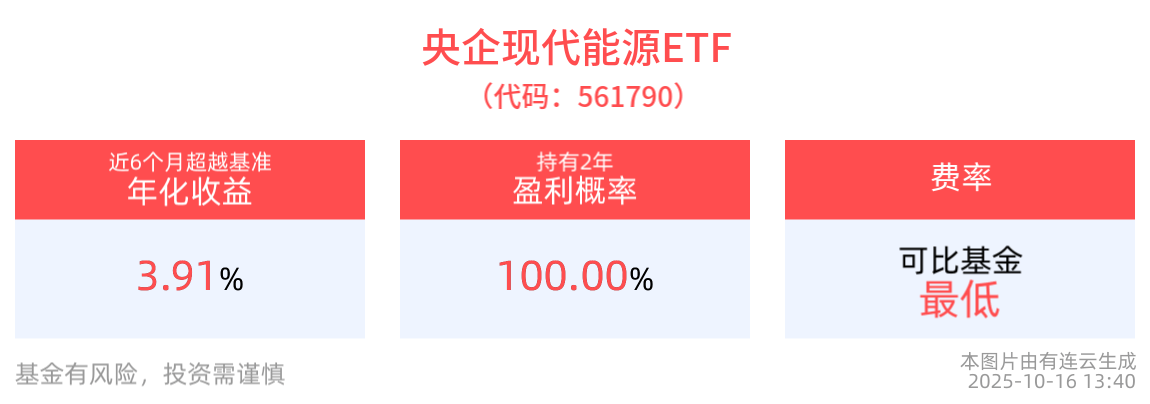
可再生能源消纳政策出台,央企现代能源ETF(561790)回调蓄势,中煤能源领涨
Sou Hu Cai Jing· 2025-10-16 05:59
Group 1 - The China Securities Index for Central Enterprises Modern Energy decreased by 0.33% as of October 16, 2025, with mixed performance among constituent stocks [3] - Among the leading stocks, China Coal Energy rose by 5.49%, followed by Dingsheng Technology at 3.68%, and China Shenhua at 2.35%. Conversely, China Nuclear Construction fell by 7.27%, with Huadian Technology down 4.50% and China Rare Earth down 4.26% [3] - The Central Enterprises Modern Energy ETF (561790) decreased by 0.25%, with a latest price of 1.21 yuan, while it saw a cumulative increase of 4.39% over the past week as of October 15, 2025 [3] Group 2 - The National Development and Reform Commission (NDRC) and five other departments released a plan to double the service capacity of electric vehicle charging facilities by 2027, aiming to establish 28 million charging facilities nationwide and provide over 300 million kilowatts of public charging capacity [3] - The recent policy from the NDRC includes mandatory assessments for renewable energy consumption, incorporating non-electric renewable energy into the compliance framework, which is expected to enhance the development certainty and market expectations for the green hydrogen and ammonia industry [4] - The introduction of the minimum renewable energy consumption target reflects a shift towards a comprehensive approach to emissions control, covering various greenhouse gases and supporting the development of renewable energy sources like wind and solar [4] Group 3 - The Central Enterprises Modern Energy ETF closely tracks the China Securities Index for Central Enterprises Modern Energy, which includes 50 listed companies involved in green energy, fossil energy, and energy distribution [5] - As of September 30, 2025, the top ten weighted stocks in the index accounted for 47.72% of the total, with major companies including Yangtze Power, Guodian NARI, and China Nuclear Power [5]


可再生能源消费最低比重目标的提出,有助于绿色氢氨醇提升在国内市场的需求 | 投研报告
Zhong Guo Neng Yuan Wang· 2025-10-16 02:14
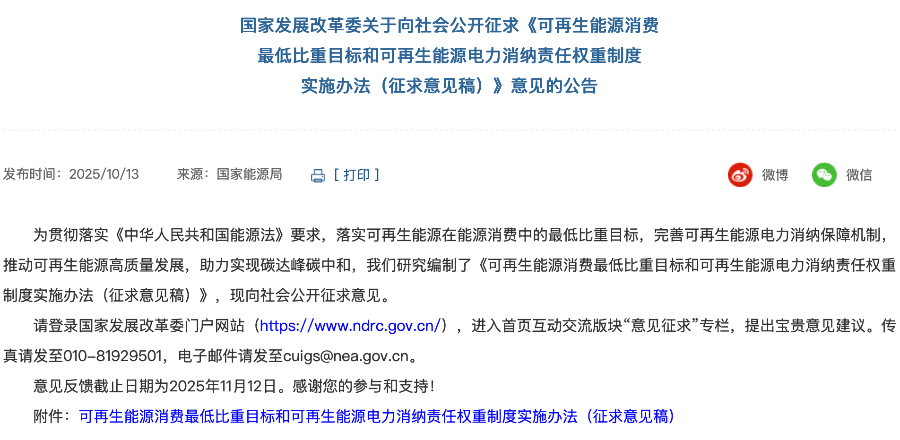
Core Insights - The National Development and Reform Commission (NDRC) released a draft on October 13, 2025, regarding the minimum consumption ratio targets for renewable energy and the responsibility weight system for renewable energy power consumption [1][2]. Group 1: Renewable Energy Consumption Targets - The draft introduces minimum consumption ratio targets for renewable energy, aimed at addressing the increasing pressure on renewable energy consumption across the country [3]. - The targets are divided into two categories: minimum consumption ratio for renewable energy electricity and minimum consumption ratio for non-electric consumption [3]. - The electricity consumption target encompasses all types of renewable energy generation, while the non-electric consumption target includes renewable energy heating (cooling), hydrogen production, and biofuels [3]. Group 2: Industry Implications - The government supports key energy-consuming industries to enhance their renewable energy consumption ratios beyond the established minimum targets [3]. - Regions with the capability are encouraged to set minimum renewable energy consumption targets for government departments, public institutions, and state-owned enterprises [3]. - The demand for green hydrogen and ammonia is expected to increase, driven by both domestic and international markets, suggesting investment opportunities in companies like Goldwind Technology and Jilin Electric Power [4].
【环球财经】全球可再生能源增长创新高,但还不够
Xin Hua She· 2025-10-15 14:19
Core Insights - The International Renewable Energy Agency (IRENA) reported that global renewable energy growth is set to reach a historic high in 2024, but it still falls short of established targets [1][2] - In 2023, the new installed capacity of renewable energy, including solar, wind, and hydropower, reached approximately 582 GW, marking a year-on-year increase of about 15% [1] - To meet the target set at the 2023 UN Climate Conference in Dubai, global renewable energy capacity must increase by 1,122 GW annually starting in 2025, requiring a growth rate of 16.6% over the next decade [1] - IRENA's Director-General, Francesco La Camera, indicated that while challenges exist, the renewable energy growth targets are achievable, with new installations potentially reaching 750 GW by 2025 [1] - The report highlighted that global energy efficiency only improved by 1% in 2024, significantly below the required annual growth rate of 4% to meet set goals [1] Investment Needs - There is an urgent need for large-scale investments in the grid, supply chains, and clean technologies such as solar, wind, batteries, and hydrogen production [2] - From 2025 to 2030, renewable energy investments must expand to at least $1.4 trillion annually, more than doubling from the $624 billion projected for 2024 [2]
美国能源部和陆军公布新计划,旨在三年内在国内军事基地部署商用微反应堆
Sou Hu Cai Jing· 2025-10-15 13:48
Technology Strategy - The U.S. Department of Energy and Army announced a plan to deploy commercial micro-reactors at domestic military bases within three years, aiming to enhance nuclear infrastructure for energy and defense [3] - The U.S. Department of Energy has consolidated six specific advisory committees into a single Scientific Advisory Committee Office to adapt to the evolving scientific landscape [3] Information - Broadcom launched a new network chip, Thor Ultra, designed to support large-scale AI computing systems, doubling the bandwidth compared to its predecessor, with expectations for the AI chip market to reach $60 billion to $90 billion by 2027 [4] - OpenAI and Broadcom entered a strategic partnership to design and deploy a total of 10 gigawatts of custom AI chips, with the first systems expected to be operational by late 2026 [4] Energy - Google plans to invest $15 billion in building its first AI center in India, which will include powerful AI infrastructure and data center capacity, marking the largest data center hub outside the U.S. [5] - Apple is expanding its renewable energy projects in Europe, supporting 650 megawatts of renewable energy projects to reduce its carbon footprint [10] - India and Canada signed a new cooperation framework focusing on energy, committing to increase bilateral trade in natural gas and liquefied petroleum gas [11] - Shell made a final investment decision on the HI gas project offshore Nigeria, expected to produce 350 million standard cubic feet of gas per day by 2030 [16] Aerospace - Boeing is developing a next-generation single-aisle aircraft to replace the 737 MAX, which has faced operational challenges since its launch [17] - The U.S. and South Korea are collaborating to develop and produce the Gray Eagle drone, with plans for the first flight in 2027 [18] - SpaceX successfully completed the 11th test flight of its Starship spacecraft, validating several key technologies for future missions [21] Advanced Manufacturing - The Canadian government is funding Qubic to develop advanced quantum amplifier technology, which aims to address thermal challenges in quantum computing [24]


生态环境部部长黄润秋:我国可再生能源新增装机规模达86%
2 1 Shi Ji Jing Ji Bao Dao· 2025-10-15 12:33
Core Viewpoint - The forum emphasizes the importance of a comprehensive green transition and the harmonious coexistence of humans and nature, highlighting China's commitment to accelerating green transformation and addressing climate change as it marks the 10th anniversary of the Paris Agreement [1] Group 1: Achievements in Green Development - Significant progress in green low-carbon development has been made, with 1.12 billion kilowatts of coal power units and 950 million tons of crude steel capacity undergoing ultra-low emissions transformation [2] - Nearly 50 million high-emission vehicles have been eliminated, and by 2024, renewable energy will account for 86% of new power installations in China, surpassing half of the global new installations [2] - The establishment of the world's largest carbon trading market covers over 60% of national carbon emissions, with the steel, cement, and aluminum industries included in carbon market management [2] Group 2: Improvement in Ecological Environment Quality - The average concentration of PM2.5 in key cities has decreased by 56% compared to ten years ago, with heavy pollution days reduced by 92% and good air quality days increased to 87.2% [2] - The proportion of surface water with good quality has exceeded 90% for the first time, and the water quality of major rivers like the Yangtze and Yellow Rivers has consistently maintained Class II standards [2] - Public satisfaction with the ecological environment has remained above 90% for four consecutive years, indicating a significant enhancement in people's perception of environmental quality [2] Group 3: Enhancements in Ecosystem Quality - Over 30% of land area has been designated as ecological protection red lines, with 90% of terrestrial ecosystem types and 74% of key wildlife populations effectively protected [3] - China's forest coverage has surpassed 25%, with forest stock exceeding 20 billion cubic meters, contributing to a quarter of the world's new green area [3] Group 4: Strengthening Environmental Governance - The introduction of the "Ecological Environment Protection Supervision Work Regulations" and the establishment of a comprehensive ecological environment monitoring network have improved governance [3] - The implementation of a unified management system for over 3.86 million fixed pollution sources has been initiated [3] Group 5: Global Environmental Engagement - China actively participates in global climate governance, contributing to significant international agreements and initiatives, including the "Kuwait Consensus" and the "Kunming-Montreal Global Biodiversity Framework" [4] - The establishment of the Kunming Biodiversity Fund supports projects in 15 developing countries, enhancing global cooperation in green development [4] Group 6: Future Directions and Recommendations - The ecological environment department aims to align with the goal of building a beautiful China, focusing on high-quality development and high-level protection [5] - Recommendations include enhancing research on low-carbon energy transition, promoting global environmental governance, and fostering international cooperation for a just green transition [6]
可再生能源消费新规划重点:供热、制氢等非电领域也需达标
2 1 Shi Ji Jing Ji Bao Dao· 2025-10-15 09:46
Core Viewpoint - The National Development and Reform Commission has released a draft proposal to establish minimum renewable energy consumption targets and responsibilities for renewable energy power consumption, aiming to promote a green energy transition in China [1][3]. Group 1: Renewable Energy Consumption Targets - The draft introduces minimum renewable energy consumption targets for key energy-consuming industries and provincial regions, with a focus on green certificate trading, self-use of renewable energy, and direct green electricity connections as primary consumption methods [1][5]. - The proposal aims to create clear market demand for various renewable energy sources, including geothermal and biomass energy, thereby assisting companies in complying with international carbon regulations [1][3]. Group 2: Implementation Mechanism - The draft outlines a systematic and detailed approach, including accounting methods, assessment targets, and penalties for non-compliance, indicating a long-term and stable execution mechanism for renewable energy policies [4][5]. - The policy emphasizes the need for monitoring and assessment of renewable energy consumption responsibilities at the provincial and energy consumption entity levels, providing a foundational method for societal participation in renewable energy consumption [5][8]. Group 3: Green Certificate Market - The green certificate system, established in 2017, has matured but previously suffered from low trading volumes due to voluntary participation. The draft now links mandatory consumption responsibilities to green certificate purchases, potentially increasing trading volumes and prices [6][8]. - This change is expected to activate the green certificate market, providing a clear value for compliance and driving demand for green certificates [6]. Group 4: Non-Electric Renewable Energy Applications - The draft includes minimum consumption targets for non-electric renewable energy applications, such as heating and hydrogen production, creating significant market opportunities for industries like solar thermal utilization and biomass heating [8][9]. - The policy provides a pathway for recognizing the environmental value of "green heat," which is crucial for industries reliant on thermal energy, helping them comply with international carbon regulations [8][9].
可再生能源消费最低比重目标的提出,有助于绿色氢氨醇提升在国内市场的需求
China Post Securities· 2025-10-15 06:44
Investment Rating - The industry investment rating is "Outperform the Market" and is maintained [2] Core Viewpoints - The report highlights the introduction of minimum renewable energy consumption targets by the National Development and Reform Commission, which aims to alleviate the pressure of renewable energy consumption in the country [5][6] - The report emphasizes the need for expanding downstream demand to address the increasing curtailment of wind and solar energy, with utilization rates for wind and solar at 94.1% and 94.9% respectively from January to August 2025 [6] - The report suggests that the demand for green hydrogen and ammonia is expected to increase, driven by both domestic and international markets, and recommends focusing on companies like Goldwind Technology and Jidian Co., Ltd. [7] Summary by Sections Industry Overview - The closing index for the industry is 9661.64, with a 52-week high of 10428.72 and a low of 6107.84 [2] Renewable Energy Consumption Targets - The newly proposed targets include both electricity and non-electric consumption minimums for renewable energy, which encompass various forms of renewable energy utilization [6] - The government encourages key energy-consuming industries to enhance their renewable energy consumption ratios based on these targets [6] Investment Recommendations - The report advocates for a combination of policy tools to boost the demand for green hydrogen and ammonia, highlighting the alignment of chemical properties between renewable and coal-based hydrogen production [7]