
贵金属

Search documents
综合晨报-20260204
Guo Tou Qi Huo· 2026-02-04 02:21
Report Industry Investment Ratings - Not provided in the content Core Views of the Report - The overall commodity market is affected by multiple factors such as geopolitical risks, supply - demand fundamentals, and macroeconomic conditions. Different commodities show various trends, including price fluctuations, supply - demand imbalances, and potential investment opportunities and risks [2][3][4] Summary by Commodity Categories Energy - **Crude Oil**: The prospect of US - Iran negotiations is uncertain. Current conflicts mainly involve sanctions and local military frictions, with the situation controllable. Oil prices are affected by both geopolitical factors and inventory pressure, and are expected to continue to fluctuate [2] - **Fuel Oil & Low - Sulfur Fuel Oil**: Fuel oil follows the bearish sentiment of the crude - oil market. High - sulfur fuel oil has a relatively tight supply, while low - sulfur fuel oil faces continuous supply pressure. The high - sulfur > low - sulfur pattern may continue [21] - **Asphalt**: Supply pressure is limited. Consumption has improved year - on - year. The second - quarter refineries may face rising raw - material costs. Near - month contracts are supported by cost [22] Precious Metals - **Precious Metals**: Overnight, precious metals rebounded. The narrative of the US dollar credit crisis and global order reshaping remains unchanged, but it is currently mainly a capital game. Precious metals are in a high - level consolidation phase, and investors should wait for volatility to decline [3] Base Metals - **Copper**: US strategic metal stockpiling plans and industry suggestions for commercial discount stockpiling have attracted re - allocation in the copper market. Copper prices are likely to oscillate at high levels, but there is downward pressure around the Spring Festival [4] - **Aluminum**: Overnight, Shanghai aluminum fluctuated slightly. There is adjustment pressure around the Spring Festival due to weak fundamentals and large spot discounts [5] - **Zinc**: After the decline in Shanghai zinc, short - selling sentiment was released, but capital congestion remains high. Zinc is in a situation of weak supply and demand, with seasonal inventory - accumulation pressure during the Spring Festival. The price is expected to oscillate at a high level [7] - **Nickel and Stainless Steel**: Shanghai nickel had a weak rebound, and stainless - steel downstream demand is weak. Spot prices are supported by low inventory and strong price - holding intentions of traders [9] - **Tin**: Overnight, LME tin recovered its previous decline. Some point - price buying emerged after the decline in tin prices. After closing the option strategy, investors should wait and see [10] Chemicals - **Carbonate Lithium**: Carbonate lithium rebounded sharply. The futures price is in a high - level oscillation, with high short - term uncertainty [11] - **Polysilicon**: Polysilicon prices rebounded. After the production cut by leading enterprises, the market expects a slight supply - demand gap in February. The price may test the previous high in the short term and may oscillate near the key level if the progress is less than expected [12] - **Industrial Silicon**: Industrial silicon continued to oscillate. The supply may be reduced due to planned production cuts by leading enterprises, and downstream demand is weak. The short - term price is expected to be slightly strong [13] Steel and Iron Ore - **Steel (Rebar & Hot - Rolled Coil)**: Steel prices oscillated at night. Rebar demand is in the off - season, while hot - rolled coil demand and production increased slightly. Overall demand is weak, and the price rebound is restricted [14] - **Iron Ore**: The iron - ore market oscillated. Supply increased slightly but was lower than last year. Demand is at a low level. The overall supply - demand is relatively loose, and the price is expected to oscillate in the short term [15] Coal - Related - **Coke**: Coke prices oscillated. Coking profits are average, and inventory increased slightly. The price is likely to oscillate within a range [16] - **Coking Coal**: Coking - coal prices oscillated. Total inventory increased significantly. The price is expected to oscillate within a range [17] Other Metals and Alloys - **Silicon Manganese**: The price corrected. Supply is in excess, and the price is affected by the "anti - involution" policy [18] - **Silicon Iron**: The price corrected. Supply changed little, and demand has some resilience. The price is affected by supply excess and policy [19] Shipping - **Container Shipping Index (Europe Line)**: The resumption of major Asia - Europe routes by leading shipping companies may put pressure on far - month contracts. The spot price may decline slightly before the Spring Festival and may be under pressure again after the festival. The 04 contract is expected to enter an oscillatory pattern [20] Agricultural Products - **Soybeans and Soybean Meal**: The soybean - meal inventory may decline after the Spring Festival. The short - term trend of US soybeans and Dalian soybean meal is expected to be weak and oscillatory [35] - **Edible Oils (Soybean Oil & Palm Oil)**: US policies are beneficial to North American raw - material demand. The prices of soybean and palm oils are affected by macro factors and are giving back the macro premium [36] - **Rapeseed and Rapeseed Oil**: The supply of rapeseed and rapeseed oil is expected to ease in the first quarter. The short - term trend is expected to be oscillatory [37] - **Soybean No.1**: Policy - led soybean auctions increased market supply. The price is affected by macro factors, and short - term policy and market sentiment should be monitored [38] - **Corn**: The overall corn - selling progress is close to 60%. The price is expected to be weak and oscillatory in the short term, and the post - festival market should be followed [39] - **Livestock and Poultry Products** - **Pigs**: Pig futures are weak. The short - term supply is increasing, and the long - term price is expected to have a low point in the first half of next year [40] - **Eggs**: Egg futures oscillated. The short - term spot price is weak, but there is upward - repair power in the first half of 2026. After the spot price reaches a low point around the Spring Festival, a long - position strategy for the first - half 2026 futures contracts can be considered [41] - **Cotton**: Zhengzhou cotton rose slightly. The short - term trend may be oscillatory. The domestic cotton market shows strong supply and demand. Spinning mills' raw - material demand is resilient, but downstream orders are average. Investors should wait and see for now [42] - **Sugar**: International sugar production varies by country. In China, the market focuses on the production - volume expectation gap. The short - term sugar price faces upward pressure [43] - **Apples**: Apple futures oscillated. The Spring Festival stocking peak has increased cold - storage sales. The market focuses on demand, and the de - stocking speed may be affected [44] - **Wood**: The wood - futures price is at a low level. Low inventory provides some support, and investors should wait and see [45] - **Paper Pulp**: Paper - pulp futures oscillated narrowly. Port inventory continued to increase, and demand support is weak. The price may continue to decline to find support [46] Financial Instruments - **Stock Index**: A - share indexes rose, and index - futures contracts also increased. The short - term market focuses on geopolitical and liquidity factors, and the performance of sectors with performance support should be monitored [47] - **Treasury Bonds**: Treasury - bond futures showed mixed trends. Unilateral trading may have limited short - term market movements, with a box - type oscillation. Opportunities in curve trading should be noted [48]
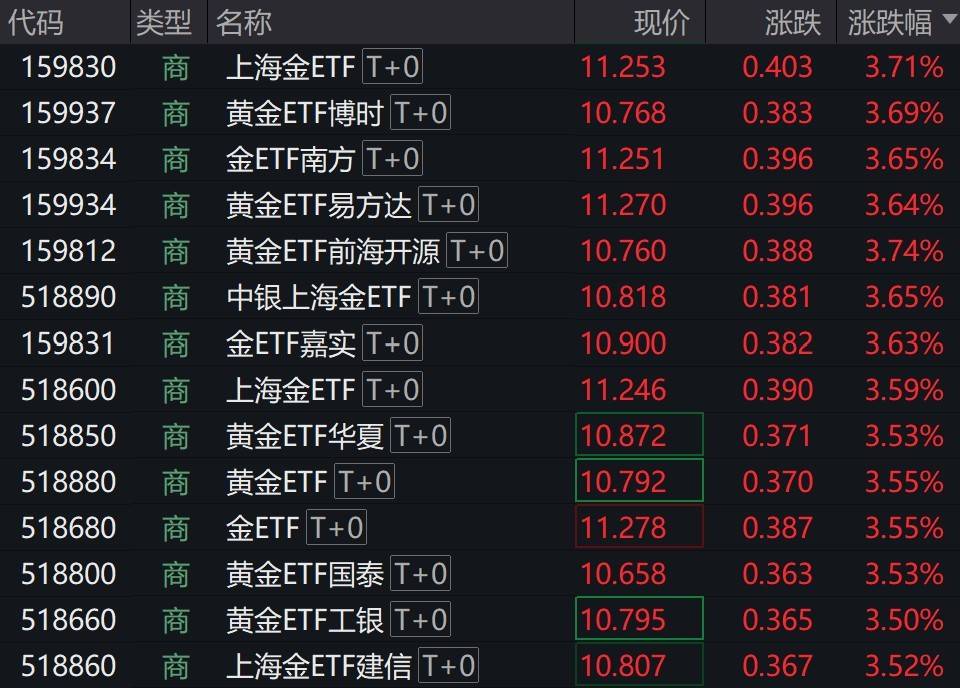
现货黄金反弹,商品黄金相关ETF大涨超3%
Sou Hu Cai Jing· 2026-02-04 02:20
多家国际投行的分析指出,黄金市场的需求基本面没有改变,全球央行购金、私人投资者增持黄金从而多元化资产配置仍是推高金价的 主要力量,白银价格继续受到工业端持续增长的生产需求支撑,机构因此继续看好金银价格的反弹空间。 每日经济新闻 2月4日,现货黄金日内涨幅扩大至2%,场内商品黄金相关ETF大涨超3%。 | 代码 | 类型 | 名称 | 现价 | 涨跌 | V 涨跌幅 | | --- | --- | --- | --- | --- | --- | | 159830 | 商 | 上海金ETF T+0 | 11.253 | 0.403 | 3.71% | | 159937 | 商 | 黄金ETF博时 T+0 | 10.768 | 0.383 | 3.69% | | 159834 | 商 | 金ETF南方 T+0 | 11.251 | 0.396 | 3.65% | | 159934 | 商 | 黄金ETF易方达 T+0 | 11.270 | 0.396 | 3.64% | | 159812 | 商 | 黄金ETF前海开源 T+0 | 10.760 | 0.388 | 3.74% | | 518890 | 商 | 中银 ...

2月4日金市早评:金价强势反弹站上5048 后市面临“三重门”
Jin Tou Wang· 2026-02-04 02:03
Group 1 - The US dollar index is trading around 97.363, while spot gold opened at $4944.54 per ounce and is currently trading at approximately $5048.82 per ounce [1] - The previous trading day saw the US dollar index rise by 0.06% to 97.445, and spot gold increased by 6.15% to $4945.74 per ounce [1] - Other precious metals also experienced price increases, with spot silver rising by 7.48% to $85.07 per ounce, platinum up by 4.18% to $2214.00 per ounce, and palladium increasing by 0.78% to $1741.50 per ounce [1] Group 2 - As of February 3, COMEX gold inventory increased by 4.05 tons to 1112.12 tons, while COMEX silver inventory rose by 57.24 tons to 12561.37 tons [2] - SPDR gold ETF holdings decreased by 3.72 tons to 1083.38 tons, and SLV silver ETF holdings fell by 108.89 tons to 16437.70 tons [2] - The payment direction for deferred compensation fees indicates that for gold (Au t+d), longs are paying shorts, while for silver (Ag t+d), shorts are paying longs [2]
**黄金暴涨突破5000美元!三大推手曝光,普通人如何理性布局?**
Sou Hu Cai Jing· 2026-02-04 01:51
Group 1 - The core point of the article is the unprecedented surge in gold prices, which reached $5,093 per ounce on January 26, 2026, driven by various factors including geopolitical tensions, changes in U.S. Federal Reserve policies, and sustained central bank gold purchases [1][3][5][7]. Group 2 - Three main engines are driving the historic rise in gold prices: 1. Geopolitical "black swan" events, such as the Greenland sovereignty dispute and increased military tensions in the Middle East, have highlighted gold's safe-haven attributes. Historical data shows that a 1% increase in the global risk index (VIX) correlates with an average 0.3% rise in gold prices [3]. 2. Expectations of a shift in Federal Reserve policy due to a weakening U.S. labor market may lead to unexpected monetary easing, contributing to a 1.6% drop in the Bloomberg Dollar Index, the largest weekly decline in eight months, which in turn supports gold prices [5]. 3. Continued central bank gold purchases, with the People's Bank of China increasing its reserves for 14 consecutive months, and Poland's central bank planning to buy an additional 150 tons, are providing long-term support for gold prices [7]. Group 3 - Historical comparisons indicate that the current gold price surge is significantly different from the 2008 financial crisis, where gold prices only increased by 25%. In contrast, the cumulative increase from 2024 to 2026 has exceeded 150%. Additionally, the simultaneous decline of gold, U.S. Treasuries, and the dollar suggests a market re-evaluation of risk [9]. Group 4 - For ordinary investors, three types of participation strategies are suggested: 1. Physical gold is suitable for long-term allocation but requires consideration of storage costs and liquidity constraints. 2. Gold ETFs, such as SPDR Gold Shares (GLD), have seen a recent increase in holdings by 6.87 tons, making them suitable for medium-term holding. 3. Gold-related stocks in the A-share market have recently experienced a surge, but their volatility is at the 90th percentile historically, indicating potential for correction [10][12]. Group 5 - As Bank of America raises its gold price target to $6,000, it is essential to recognize that this market trend reflects a restructuring of the global economic order. Systemic risk premiums are being permanently factored into gold prices due to the U.S. potentially undermining its own trade rules [11].
A股开盘速递 | A股三大股指集体低开 贵金属板块表现活跃
智通财经网· 2026-02-04 01:39
申万宏源:春季行情结束后,新的上涨阶段开启前,大概率会有休整阶段 申万宏源表示,春季行情结束后,新的上涨阶段开启前,大概率会有休整阶段。这个阶段核心是等待产 业趋势下阶段线索清晰,等待业绩消化估值和缓和性价比和筹码结构矛盾。2026年下半年还有新的上行 阶段,核心逻辑是基本面周期性改善+科技产业趋势新阶段+居民资产配置向权益迁移+中国影响力提升 显性化等多种积极因素共振。2025年强结构行情是周期Alpha和AI算力领涨的行情,第二阶段的上涨, 周期Alpha仍有机会,顺周期投资的延伸可能是先进制造和出海链困境反转。而AI产业链行情可能逐步 向应用端过渡。所以,中长期仍看好景气科技和周期Alpha。景气科技关注海外算力链、AI应用(AI应用 产业趋势兑现阶段,港股互联网可能重新成为领涨方向,港股好于A股的特征也可能回归)、半导体、 储能、机器人、商业航天等。周期Alpha关注有色金属和基础化工。 东方证券:外围流动性持续衰减势头企稳,但地缘变数仍在,影响国内投资情绪 东方证券表示,短期来看,外围流动性持续衰减势头暂时企稳,但地缘变数仍在,影响国内市场投资情 绪;考虑到长假将至,主动做多动能有所不足,市场可能会 ...
A股早评:三大指数集体低开,贵金属板块再度活跃
Ge Long Hui· 2026-02-04 01:33
A股开盘,三大指数集体低开,沪指低开0.08%报4064.68点,深证成指低开0.39%,创业板指低开 0.8%。盘面上,现货黄金重新站上5000美元大关,贵金属板块再度活跃;AI应用、半导体板块调整。 ...
短期过热风险有所释放,铂钯显著反弹
Zhong Xin Qi Huo· 2026-02-04 01:00
Report Summary 1. Report Industry Investment Rating No information provided. 2. Core Viewpoints - After a significant correction in the precious metals market, the short - term overheating risk has eased, and the prices of platinum and palladium have rebounded. As of the close on February 3, 2026, the closing price of the GFEX platinum main contract was 572.95 yuan/gram, with a gain of 3.54%; the closing price of the GFEX palladium main contract was 450.55 yuan/gram, with a gain of 8.62% [1]. - For platinum, the short - term overheating risk has been alleviated, and it is expected to be oscillating upward. The long - term supply - demand structure and macro - logic remain unchanged, and there are low - buying opportunities. In the future, South Africa may face power supply and extreme weather risks in supply, while the demand in the automotive catalyst field is stable, and the hydrogen energy industry is a growth point [2]. - For palladium, due to the expected tariff and tight spot supply, it has significantly rebounded. In the medium - short term, it is supported by tight spot supply, US tariff - increasing expectations, and potential sanctions on Russian palladium. The Fed's interest - rate cut also has a positive impact [3]. 3. Summary by Related Catalogs Precious Metals Market Performance - As of February 3, 2026, the GFEX platinum main contract closed at 572.95 yuan/gram, up 3.54%; the GFEX palladium main contract closed at 450.55 yuan/gram, up 8.62% [1]. Platinum Analysis - Main logic: After the correction, the overheating risk has been released, and the long - term supply - demand and macro - logic remain unchanged. Although short - term price fluctuations may be large, the long - term view is bullish. - Supply: South Africa, the main supplier, may face power supply and extreme weather risks. - Demand: The automotive catalyst demand is stable, the hydrogen energy industry is a growth point, and jewelry and investment demand are expanding. The "interest - rate cut + soft landing" combination will increase price elasticity. - Outlook: Oscillating upward [2]. Palladium Analysis - Main logic: In the short term, the overheating risk has been released. In the medium - short term, it is supported by tight spot supply, US tariff - increasing expectations, and potential sanctions on Russian palladium. The Fed's interest - rate cut is positive. - Outlook: Oscillating upward [3]. Commodity Index - On February 3, 2026, the comprehensive index was 2374.28, down 1.93%; the commodity 20 index was 2707.14, down 2.40%; the industrial products index was 2290.30, down 0.97% [50]. Non - ferrous Metals Index - On February 3, 2026, the non - ferrous metals index was 2678.30, with a daily decline of 1.15%, a 5 - day decline of 7.34%, a 1 - month decline of 5.65%, and a year - to - date decline of 0.29% [52].
贵金属反弹:申万期货早间评论-20260204
申银万国期货研究· 2026-02-04 00:30
Group 1 - The central government's new policy document aims to anchor agricultural modernization and promote rural revitalization, focusing on enhancing agricultural production capacity and quality, implementing targeted assistance, and ensuring stable income growth for farmers [1] - The document outlines six key areas: improving agricultural production capacity, implementing regular precise assistance, promoting stable income growth for farmers, advancing rural construction tailored to local conditions, strengthening institutional innovation, and enhancing the Party's leadership over agricultural work [1] Group 2 - Precious metals experienced a rebound influenced by two main factors: the nomination of Kevin Warsh as the next Federal Reserve Chair, which boosted the dollar index, and a significant short-term increase in precious metals prices, particularly silver, leading to profit-taking and increased market volatility [2][20] - The long-term support factors for gold remain intact, and it is expected to return to a steady upward trend after market adjustments, while silver prices are anticipated to remain under pressure in the short term [21] Group 3 - The crude oil market saw a 1.78% increase, influenced by geopolitical tensions involving U.S. military actions against Iranian drones and concerns over increased Venezuelan oil exports exacerbating supply surplus fears [3][15] - The domestic retail prices for refined oil have increased, with gasoline and diesel prices rising by 205 yuan and 195 yuan per ton, respectively, reflecting ongoing market adjustments [10] Group 4 - The U.S. stock market indices experienced a decline, with significant fluctuations in the military and banking sectors, while the overall market outlook for February remains positive due to seasonal trends and policy support [4][12] - The financing balance decreased by 6.009 billion yuan, indicating a cautious market sentiment ahead of the Spring Festival [12] Group 5 - The international shipping index for European routes increased by 5.22%, with expectations of continued downward pressure on spot freight rates leading up to the holiday season [34]

金价剧烈震荡!刚买的金饰能退吗?
Yang Shi Xin Wen· 2026-02-04 00:24
Core Viewpoint - The recent significant decline in international gold prices has led to volatility in the domestic precious metals market, prompting banks and exchanges to issue investment risk warnings. The ability of consumers to return gold jewelry to mitigate losses is contingent on various factors, including the purchase channel and merchant policies [1][2]. Group 1: Consumer Rights and Return Policies - The ability to return gold jewelry primarily depends on the purchase channel, type of purchase, and merchant regulations. Online purchases may qualify for a 7-day no-reason return policy if the product is intact, unworn, and undamaged, although some merchants may charge a return fee of 1%-5% [1]. - Some consumers have reported that certain gold brands refuse returns based on price drops, stating that a flat fee of 500 yuan will be deducted for any return, which may be excessive for small purchases [1]. - Legal experts indicate that penalties for returns should not exceed 30% of the product price, suggesting that a flat fee of 500 yuan could be disproportionately high for small gold jewelry purchases [1]. Group 2: Market Dynamics and Expert Opinions - Legal professionals warn that returning gold products solely due to price declines is likely to be challenging, as the prices of gold coins and bars fluctuate in real-time. Courts may not support claims for a 7-day no-reason return due to potential abuse of the policy by consumers and merchants alike [2]. - Experts attribute the recent volatility in the international precious metals market to a combination of macroeconomic policy changes, technical corrections, and leveraged fund liquidations, highlighting the inherent high-risk and high-reward nature of the precious metals market [2][3].
有色钢铁行业周观点(2026年第5周):风物长宜放眼量-20260204
Orient Securities· 2026-02-04 00:12
Investment Rating - The report maintains a "Positive" investment rating for the non-ferrous metals industry in China [5] Core Views - The report emphasizes a long-term perspective on the market, suggesting that despite short-term volatility in precious metals, the long-term bull market remains intact due to unresolved U.S. debt issues [7][12] - The zinc sector is highlighted as an overlooked material benefiting from the re-industrialization in Asia, Africa, and Latin America, with expectations for price increases due to supply tightness [7][13] - The copper sector is viewed positively, with the gold-to-copper ratio reaching historical highs, indicating potential for copper price increases amid supply constraints [7][14] - For precious metals, investors are advised to wait for price stabilization before increasing positions, as significant price fluctuations have been observed recently [7][15] Summary by Sections 1. Non-Ferrous Metals - The report discusses the dynamics of precious metals, noting significant price drops in gold and silver, with gold prices reaching $4,880 per ounce and silver prices at $85 per ounce during a recent week [7][12] - The zinc market is expected to benefit from increased demand driven by infrastructure projects in developing regions, with a noted decrease in zinc smelting fees indicating supply constraints [7][13] - The copper market is projected to maintain upward momentum due to a high gold-to-copper ratio and ongoing supply challenges from major mining companies [7][14] - The report suggests a cautious approach to precious metals, recommending that investors wait for market stabilization before making new investments [7][15] 2. Steel Industry - The steel industry is experiencing a weak fundamental outlook as it approaches the seasonal low around the Spring Festival, with a slight decrease in iron output and weakening demand for rebar [16][21] - Inventory levels show a divergence between social and steel mill stocks, with total steel inventory at 891 thousand tons, reflecting a 2.56% weekly increase [23] - Steel prices have generally declined, with the overall steel price index down by 0.20%, and specific products like cold-rolled steel experiencing a 0.44% decrease [35][36] 3. New Energy Metals - Lithium carbonate production in December 2025 saw a significant year-on-year increase of 69.09%, indicating strong supply growth in the new energy sector [39] - The demand for new energy vehicles remains robust, with December 2025 production reaching 1.5858 million units, a 9.02% increase year-on-year [43] - Lithium prices have shown a notable decline, with the average price for battery-grade lithium carbonate at 159,500 yuan per ton, reflecting a 5.62% decrease [48][49]