生猪养殖

Search documents
天域生物:本次罗卫国解除冻结的股份数量为225万股
Mei Ri Jing Ji Xin Wen· 2025-11-26 09:37
Group 1 - The actual controller of Tianyu Biological, Mr. Luo Weiguo, holds 37,251,829 shares, accounting for 12.84% of the total share capital of the company [1] - Mr. Luo has released 2,252,977 shares from freezing, which is 6.05% of his holdings and 0.78% of the total share capital [1] - After the release, approximately 12.12 million shares remain frozen, representing 4.18% of the total share capital [1] Group 2 - For the year 2024, the revenue composition of Tianyu Biological is as follows: pig farming accounts for 72.29%, landscaping ecological engineering for 19.78%, red yeast product manufacturing for 3.89%, photovoltaic new energy for 3.17%, and other businesses for 0.87% [1] - As of the report, the market capitalization of Tianyu Biological is 2.4 billion yuan [1]

ETF盘中资讯 | 继续上攻!罗牛山大涨超5%,农牧渔ETF(159275)持续红盘震荡!机构:或可考虑左侧布局生猪养殖企业
Sou Hu Cai Jing· 2025-11-26 02:47
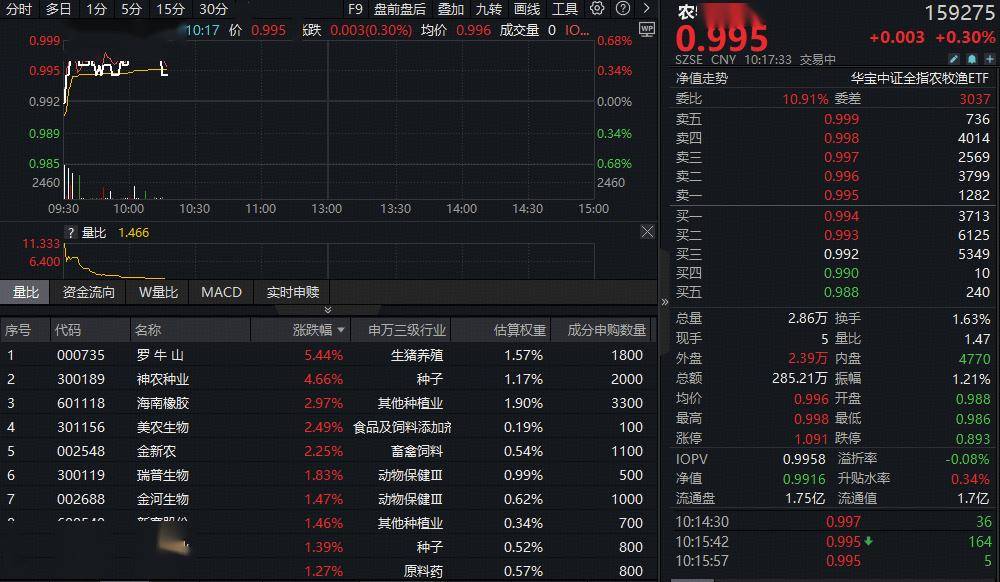
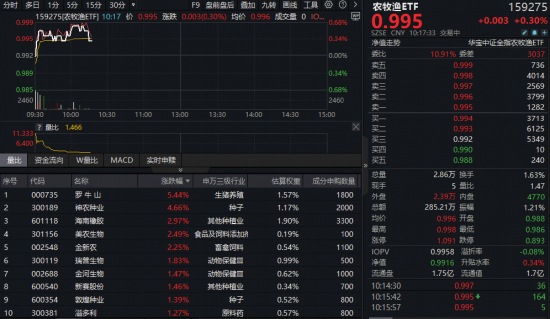
Core Viewpoint - The agricultural, animal husbandry, and fishery sector continues to rise, with the only agricultural ETF (159275) showing a slight increase of 0.3% as of the report time, driven by gains in specific stocks within the sector [1]. Market Performance - The agricultural ETF (159275) opened with a positive trend, maintaining a red market fluctuation, and recorded a 0.3% increase by the time of reporting [1]. - Key stocks in the sector, such as Luo Niu Shan, Shen Nong Seed, and Hainan Rubber, saw significant gains, with increases of over 5%, 4%, and 2% respectively [1]. Price Trends - The price of live pigs has been declining, leading to losses for breeding companies. As of November 24, 2025, the average price of live pigs was 11.6 CNY/kg, down from 12.25 CNY/kg on September 30, 2025, indicating a decrease of 0.65 CNY/kg [2][3]. - The price of piglets also fell to 21.21 CNY/kg, down 1.01 CNY/kg from 22.22 CNY/kg on September 30, 2025 [2][3]. Industry Outlook - Jiang Hai Securities suggests that due to policy adjustments and production cuts, the industry may experience accelerated capacity reduction, presenting an opportunity for investment in the pig breeding sector [3]. - The agricultural sector is currently at a favorable valuation point, with the agricultural ETF's price-to-book ratio at 2.56, which is at the 28.91% percentile of the last decade, indicating a strong long-term investment potential [3]. Investment Opportunities - The agricultural ETF (159275) is highlighted as the highest "pig content" ETF in the market, tracking the CSI Agricultural Index, which includes leading stocks in pig breeding and other related sectors [4][5]. - Investors can also consider the agricultural ETF linked funds (A class 013471/C class 013472) for exposure to the agricultural sector [4].


建信期货生猪日报-20251126
Jian Xin Qi Huo· 2025-11-26 02:33
行业 生猪日报 日期 2025 年 11 月 26 日 021-60635740 期货从业资格号:F3055047 021-60635732 yulanlan@ccb.ccbfutures.com 期货从业资格号:F0301101 021-60635727 期货从业资格号:F0230741 研究员:洪辰亮 021-60635572 hongchenliang@ccb.ccbfutures.co m 期货从业资格号:F3076808 021-60635570 liuyouran@ccb.ccbfutures.com 期货从业资格号:F03094925 农业产品研究团队 研究员:林贞磊 linzhenlei@ccb.ccbfutures.com 研究员:余兰兰 研究员:王海峰 wanghaifeng@ccb.ccbfutures.com 研究员:刘悠然 请阅读正文后的声明 #summary# 每日报告 一、行情回顾与操作建议 数据来源:涌益,建信期货研究中心 生猪行情: 期货方面,25 日生猪主力 2601 合约小幅低开后探底回升震荡走高,尾盘收 阳,最高 11445 元/吨,最低 11300 元/吨,收盘报 1 ...
继续上攻!罗牛山大涨超5%,农牧渔ETF(159275)持续红盘震荡!机构:或可考虑左侧布局生猪养殖企业
Xin Lang Ji Jin· 2025-11-26 02:31
Core Viewpoint - The agricultural, animal husbandry, and fishery sector continues to rise, with the only agricultural ETF (159275) showing a slight increase of 0.3% as of the report time, driven by gains in specific stocks within the sector [1][3]. Market Performance - The agricultural ETF (159275) opened with a steady upward trend, maintaining a price increase of 0.3% [1]. - Key stocks in the sector, such as Luo Niu Shan, Shen Nong Seed, and Hainan Rubber, have seen significant gains, with Luo Niu Shan rising over 5% and Shen Nong Seed increasing over 4% [1][2]. Price Trends - The price of live pigs has been declining, leading to losses for breeding companies. As of November 24, the average price of live pigs was 11.6 CNY/kg, down from 12.25 CNY/kg on September 30, marking a decrease of 0.65 CNY/kg [1][4]. - The price of piglets also fell to 21.21 CNY/kg, down 1.01 CNY/kg from 22.22 CNY/kg on September 30 [1]. Industry Outlook - Jiang Hai Securities suggests that due to policy adjustments and production cuts, the industry may experience accelerated capacity reduction, presenting potential investment opportunities in the pig breeding sector [3]. - The agricultural sector is currently at a favorable valuation point, with the agricultural ETF's price-to-book ratio at 2.56, which is at the 28.91% percentile over the past decade, indicating a good long-term investment opportunity [3]. Future Expectations - Zhongyou Securities anticipates that as the deadline for capacity reduction approaches, the pressure on breeding companies will increase, and the industry will continue to face losses, leading to a passive reduction in capacity [4]. - There is an expectation for a new upward trend in pig prices by the second half of next year, driven by various factors including seasonal impacts and policy adjustments [4]. Investment Opportunities - The agricultural ETF (159275) is highlighted as the only ETF tracking the agricultural index, with a significant focus on the pig breeding sector, which constitutes 40.25% of its holdings [5]. - Investors can also consider agricultural ETF linked funds to gain exposure to the agricultural sector [5].


供给压力逐步缓解 春节前猪价预计温和回升
Zheng Quan Shi Bao· 2025-11-25 18:38
Core Viewpoint - The recent data from the Ministry of Agriculture and Rural Affairs indicates that the national breeding sow inventory has fallen below 40 million heads, signaling a gradual alleviation of the previous overcapacity in the pig industry, which had led to persistently low pork prices [1][2]. Group 1: Inventory and Price Trends - As of the end of October, the national breeding sow inventory is reported to be below 40 million heads, which is a significant reduction from previous levels [1]. - Experts predict that the reduction in inventory will contribute to a gradual recovery in pork prices, especially as the peak consumption season approaches during the Spring Festival [1][3]. - The average price of pork has decreased by 0.7% week-on-week and 25.9% year-on-year during the week of November 14-20, indicating ongoing price pressures despite the inventory adjustments [2]. Group 2: Regulatory Measures and Industry Adjustments - The Ministry of Agriculture has implemented measures to guide a reduction of approximately 1 million breeding sows, in collaboration with other governmental departments [2]. - A recent meeting emphasized the need for comprehensive capacity regulation and the establishment of a high-quality development framework for the pig industry, focusing on supply-demand dynamics and industry chain collaboration [3]. - The Ministry aims to enhance the competitiveness of the pig industry by improving breeding systems, optimizing processing layouts, and ensuring effective disease control measures [3].

能繁母猪加速去化,关注生猪养殖左侧布局机会
Jianghai Securities· 2025-11-25 12:06
Investment Rating - The industry investment rating is "Overweight" (maintained) [1] Core Viewpoints - The report highlights that the national breeding sow inventory has fallen below 40 million heads as of the end of October, indicating a significant adjustment in the pig farming sector [4] - The report notes a continuous decline in pig prices, with the average price dropping to 11.6 yuan/kg by November 24, down from 12.25 yuan/kg at the end of September, leading to widespread losses among farming enterprises [4] - The report suggests that the industry may enter a period of accelerated capacity reduction due to policy adjustments and ongoing losses, presenting potential investment opportunities in the pig farming sector [4] Summary by Sections Recent Industry Performance - Over the past 12 months, the industry has shown a relative return of 0.83% and an absolute return of 15.89% [2] Key Events and Data - The report mentions that the breeding sow inventory decreased by 0.8% in October, marking a continuous decline for two months [4] - The average price of three-way piglets reached a new low of 24.14 yuan/kg as of November 20, indicating a pessimistic outlook for prices in 2026 [4] Investment Recommendations - The report recommends a left-side layout in the pig farming sector, focusing on leading companies such as Muyuan Foods, DeKang Agriculture (Hong Kong), Wens Foodstuff Group, and Shennong Group, while also considering investment opportunities in the fishery sector [4]
京基智农(000048) - 000048京基智农投资者关系管理信息20251125
2025-11-25 11:50
Group 1: Company Performance - In the first three quarters of 2025, the company achieved an operating income of approximately CNY 3.67 billion and a net profit attributable to shareholders of about CNY 298 million [2] - The livestock segment generated approximately CNY 2.90 billion in revenue and a net profit of around CNY 308 million during the same period [2] - The company's production operations are stable, with a focus on cost reduction and improving production performance in the pig farming business [2] Group 2: Business Models and Strategies - The pig farming business primarily adopts a self-breeding and self-raising model, which has strong risk resistance despite the current low pig price market [2] - The IP business is being developed through a light asset model, with plans to complete the core industry chain by the end of the year [3] - The real estate business is currently focused on selling existing inventory, with recent improvements in property sales positively impacting cash flow [2] Group 3: Financial Health - As of the end of Q3 2025, the company's debt-to-asset ratio was 59.2%, a decrease of 1.05% from the end of the previous year [3] - The company maintains a positive cash flow from its livestock operations, which supports healthy financial development [3] Group 4: Shareholder Relations - The controlling shareholder holds a significant stake of 52.82% as of November 22, 2025, and plans to continue supporting the company's development [2] - The recent share reduction plan by the controlling shareholder is based on personal funding needs and does not affect the stability of company control [2] - According to new regulations, the buyer of shares from a major shareholder through block trading cannot sell those shares within six months [3]

国投期货打造生猪“保险+期货”滑县样本
Zheng Quan Ri Bao Wang· 2025-11-25 11:42
本报讯 (记者王宁)近日,随着大连商品交易所"农民收入保障计划"生猪"保险+期货"项目推介会圆满 落幕,由国投期货联合民生银行北京分行、中国太平洋产险河南分公司共同推动的金融助农"滑县模 式"第一期项目已正式完结。该项目在生猪价格深度回调的行业困境中,实现总赔付84.04万元,赔付率 达373.61%,为当地养殖产业筑起一道坚实的风险屏障。 国投期货"保险+期货"业务负责人曹亚表示,该项目既是期货服务实体经济的生动注脚,更是金融赋能 乡村振兴的创新实践。未来国投期货将持续深化与政府、交易所及金融机构的战略合作,以专业能力为 产业高质量发展注入金融动能。 "'保险+期货'不是终点,而是新征程的起点。"滑县人民政府副县长徐继峰表示,县政府牵头积极探 索,联合金融机构借助"保险+期货"风险管理新模式,持续完善补贴机制,优化财政资金使用效率,让 更多中小养殖户享受到政策红利。希望大商所、期货公司、保险公司聚焦生猪产业所需、聚焦群众所 盼,科学指导项目稳步有序推进,切实为滑县生猪养殖插上金融的翅膀。 为此,国投期货联合民生银行北京分行启动专项帮扶,依托"保险+期货"这一成熟金融工具,为滑县量 身定制风险管理方案。国投期 ...


Mhy20251125生猪晚评:减产已开启,能否加速进行?
Xin Lang Cai Jing· 2025-11-25 10:09
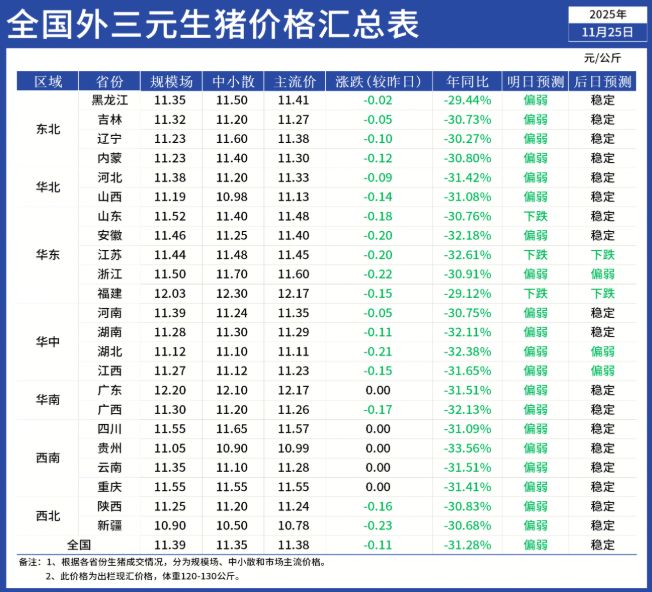
Market Overview - As of November 21, the profit from self-bred pigs is a loss of 135.90 CNY per head, compared to a loss of 114.81 CNY the previous week. The profit from purchased piglets is a loss of 234.63 CNY per head, up from a loss of 205.64 CNY the previous week [1] - The Ministry of Agriculture and Rural Affairs held a meeting on November 18-19, indicating that the livestock industry has maintained steady development this year, with the total number of breeding sows falling below 40 million heads by the end of October [1] - The national pig price as of November 19 is 12.24 CNY per kilogram, down 1.61% from November 12, while the corn price has increased by 0.88% to 2.28 CNY per kilogram [1] Daily Market Prices - The average price of pigs in various provinces shows a downward trend, with prices in regions like Heilongjiang at 11.35 CNY/kg, down 0.02 CNY from the previous day, and a year-on-year decrease of 29.44% [1] - The pig-to-grain ratio is reported at 5.37, a decrease of 2.36% from November 12 [1] Industry Dynamics - The number of breeding sows has rapidly decreased to 39.90 million heads, leading to a divergence in market opinions regarding capacity reduction. Some advocate for accelerated capacity reduction to prevent further losses, while others with strong financial backing may seek to capitalize on the exit of smaller producers [2] - There are concerns that some companies may have inflated their actual breeding stock numbers to qualify for subsidies [2]
农林牧渔行业2026上半年投资策略:关注产能去化把握边际改善
Dongguan Securities· 2025-11-25 09:21
Group 1 - The SW Agricultural, Forestry, Animal Husbandry, and Fishery industry outperformed the CSI 300 index, with an overall increase of 16.36% from January to November 2025, surpassing the index by approximately 3.18 percentage points [12][13][14] - All sub-sectors within the industry recorded positive returns, with significant increases in animal health (36.27%), fishery (35.22%), agricultural product processing (21.88%), feed (12.48%), breeding (11.53%), and planting (8.49%) [13] - Approximately 83% of stocks in the industry achieved positive returns, with around 5% of stocks increasing by over 100%, and 17% recording negative returns [14][17] Group 2 - The breeding industry is experiencing a gradual reduction in the number of breeding sows, with a current stock of 40.35 million heads, which is 1.1% lower than the previous year [23][24] - The price of live pigs has shown a downward trend in 2025, with an average price of 11.65 yuan/kg as of November 24, down 26% from the beginning of the year, but is expected to gradually recover in 2026 [26] - The profitability of pig farming has turned negative, with self-breeding losses at 135.9 yuan per head and external piglet purchases at 234.63 yuan per head, but a recovery is anticipated in 2026 [31] Group 3 - The meat chicken breeding sector faced challenges in profitability during 2025, with the average price of broiler chicks fluctuating and a significant decline in profitability [33][35] - The supply of yellow feathered chickens is expected to remain relatively abundant in 2026, with a high stock of breeding chickens [45][47] - The overall feed production in China is projected to continue its recovery, with a total production of 15.85 million tons in the first half of 2025, reflecting a year-on-year increase of 7.7% [50] Group 4 - The prices of feed raw materials such as corn and soybean meal have shown fluctuations, with corn prices recovering from a low of 2115.59 yuan/ton to around 2300.88 yuan/ton by late November 2025 [52][53] - The global supply of corn is expected to remain ample, with a projected production of 128.6 million tons for the 2025/26 season, indicating limited price recovery potential [55] - The overall market for pet food in China is anticipated to grow, with an increase in exports and a rising domestic market [38][40]