建筑业

Search documents
制造业PMI低于荣枯线 国常会部署贴息政策促消费
Di Yi Cai Jing· 2025-07-31 13:51
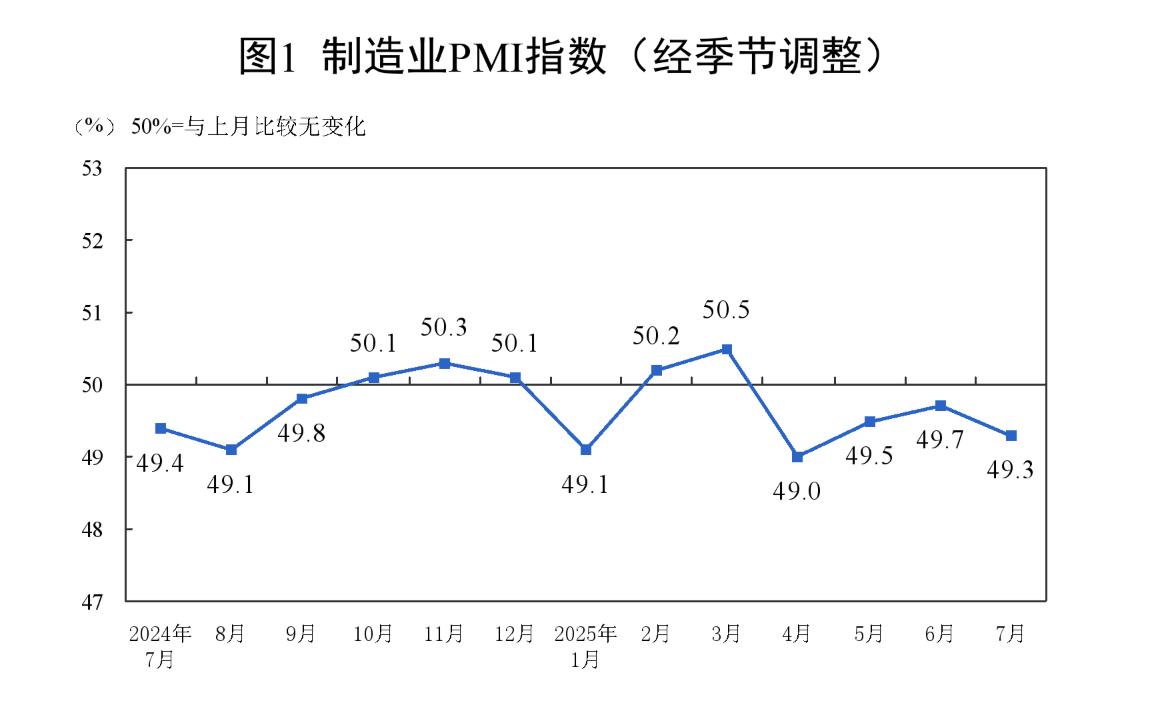
Economic Overview - The Central Political Bureau emphasized the need to enhance macroeconomic policy effectiveness and stimulate internal economic growth [1] - The State Council reiterated the implementation of personal consumption loan interest subsidy policies to better stimulate consumption potential [1][7] Manufacturing Sector - The manufacturing Purchasing Managers' Index (PMI) for July was reported at 49.3%, a decrease of 0.4 percentage points from the previous month, marking the fourth consecutive month below the growth threshold [1][4] - The new orders index for manufacturing fell to 49.4%, down 0.8 percentage points, indicating a contraction in market demand [6] - Despite the decline in demand, the production index remained at 50.5%, indicating continued expansion in manufacturing activities [6] Price Trends - The manufacturing raw material purchase price index rose to 51.5%, an increase of 3.1 percentage points, indicating a recovery in raw material prices [6] - The ex-factory price index increased to 48.3%, up 2.1 percentage points, marking the second-highest point this year [6] Business Confidence - The production and business activity expectation index rose to 52.6%, reflecting increased confidence among manufacturing enterprises regarding market development [8] - Large enterprises maintained a PMI of 50.3%, while medium-sized enterprises improved to 49.5%, indicating a mixed outlook across different enterprise sizes [8] Non-Manufacturing Sector - The non-manufacturing business activity index was reported at 50.1%, a decrease of 0.4 percentage points, but still within the expansion range [10] - The construction business activity index fell to 50.6%, influenced by seasonal weather conditions, while infrastructure-related activities continued to show robust growth [10] Consumer Behavior - The summer consumption effect began to show, with retail and postal service indices rising above 50%, indicating strong consumer spending intentions [11] - However, the accommodation and catering sectors remained below 50%, suggesting that summer consumption has not yet significantly impacted these areas [11][12] Policy Implications - The Central Political Bureau's meeting highlighted the importance of releasing internal demand potential and implementing consumption-boosting actions [12] - The focus on service consumption is expected to play a crucial role in meeting public needs and driving consumption industry upgrades [12]

制造业PMI低于荣枯线,国常会部署贴息政策促消费
Di Yi Cai Jing· 2025-07-31 13:22
Economic Policy and Measures - The State Council emphasizes the need to anchor annual development goals and enhance the effectiveness of macroeconomic policies, focusing on stimulating internal economic momentum [1][4] - Implementation of personal consumption loan interest subsidy policies and service industry loan interest subsidy policies aims to better stimulate consumption potential [1][7] Manufacturing Sector Performance - In July, the manufacturing Purchasing Managers' Index (PMI) was 49.3%, a decrease of 0.4 percentage points from the previous month, remaining below the expansion threshold for four consecutive months [1][4] - The new orders index for manufacturing was 49.4%, down 0.8 percentage points, indicating a contraction in market demand [6] - Despite weak demand, manufacturing production activities expanded, with a production index of 50.5%, although it decreased by 0.5 percentage points from the previous month [6][9] Price Trends - The manufacturing raw material purchase price index rose to 51.5%, an increase of 3.1 percentage points, indicating a recovery in raw material prices [6] - The ex-factory price index for manufactured goods was 48.3%, up 2.1 percentage points, marking the second-highest point this year [6] Business Confidence and Expectations - The production and business activity expectation index for July was 52.6%, reflecting an increase in confidence among manufacturing enterprises regarding market development [8] - Large enterprises maintained a PMI of 50.3%, while medium-sized enterprises improved to 49.5%, indicating a mixed outlook across different enterprise sizes [8] Non-Manufacturing Sector Insights - The non-manufacturing business activity index was 50.1%, a decrease of 0.4 percentage points, but still within the expansion range [10] - The construction industry index was 50.6%, indicating a slowdown in construction activities due to seasonal weather impacts [10] Consumer Behavior and Seasonal Trends - Summer consumption effects began to show, with retail and postal service indices rising above 50%, indicating strong consumer spending intentions [11] - However, the accommodation and catering sectors remained below 50%, suggesting that summer spending was more focused on outdoor and entertainment activities rather than dining [13] Future Economic Outlook - The Central Political Bureau meeting highlighted the need to effectively release internal demand potential and implement actions to boost consumption [14] - The focus on service consumption is expected to play a crucial role in meeting public needs and driving consumption industry upgrades [14]
宏观点评:7月PMI超季节性回落的背后-20250731
GOLDEN SUN SECURITIES· 2025-07-31 11:33
Group 1: PMI Trends - July manufacturing PMI decreased to 49.3%, down 0.4 percentage points from the previous value, indicating a contraction for the fourth consecutive month[2] - Non-manufacturing PMI fell to 50.1%, a decline of 0.4 percentage points, with service and construction sectors dropping by 0.1 and 2.2 percentage points respectively[2] - Composite PMI output index decreased by 0.5 percentage points to 50.2%, suggesting a slowdown in overall economic expansion[2] Group 2: Supply and Demand Signals - July PMI production index was 50.5%, down 0.5 percentage points, indicating continued expansion but with weakening demand[3] - New orders index fell by 0.8 percentage points to 49.4%, entering contraction territory, with new export orders down by 0.6 percentage points[3] - New export orders index dropped to 47.1%, remaining in contraction, while import orders held steady at 47.8%[3] Group 3: Price and Employment Insights - Price indices rebounded, with raw material and factory price indices rising by 3.1 and 2.1 percentage points respectively, indicating a narrowing decline in PPI[4] - Employment pressure eased slightly, with manufacturing, service, and construction employment indices increasing by 0.1, 0.0, and 1.0 percentage points respectively[4] - Service sector PMI fell to 50.0%, while construction PMI dropped 2.2 percentage points to 50.6%, the second-lowest this year[6] Group 4: Economic Outlook - The July Politburo meeting indicated a focus on policy implementation, with potential new policies expected but not strong stimulus measures[6] - Economic pressures are anticipated to increase in the second half of the year, particularly in August and September, due to prior "export rush" effects and short-term contraction[6] - Continued monitoring of US-China trade negotiations is advised, as potential developments may impact market conditions[6]
2025年7月PMI分析:7月PMI为什么下降?
Yin He Zheng Quan· 2025-07-31 11:28
Group 1: PMI Overview - In July 2025, the manufacturing PMI decreased to 49.3%, down 0.4 percentage points from the previous month, indicating a decline in manufacturing activity[1] - The construction business activity index was at 50.6%, down from 52.8%, while the services business activity index remained stable at 50.0%, slightly down from 50.1%[1] Group 2: Production and Demand Factors - The production index for July was 50.5%, down from 51%, while the new orders index fell to 49.4% from 50.2%, indicating a contraction in new orders[2] - Extreme weather events in July, including heavy rains and heatwaves, impacted outdoor construction activities, contributing to the decline in production and new orders[2] - Passenger car sales dropped by 21.9% month-on-month in July, reflecting weakened consumer demand post the June shopping festival[2] Group 3: Price Indices and Inventory - The PMI output price index rose by 2.1 percentage points to 48.3%, and the raw material purchase price index increased by 3.1 percentage points to 51.5%, indicating rising input costs[3] - The gap between raw material prices and finished product prices widened to 3.2 percentage points, up from 2.2 percentage points, which is detrimental to corporate profit recovery[3] - The inventory indices for finished goods and raw materials both declined, with finished goods at 47.4% and raw materials at 47.7%, indicating a contraction in inventory levels[4] Group 4: Business Sentiment and Future Outlook - Small enterprises faced significant pressure, with their PMI dropping to 46.4%, while large and medium enterprises saw slight increases[4] - The outlook for future demand remains cautious, with businesses responding primarily to short-term orders and maintaining low inventory levels[5] - The political bureau meeting emphasized consolidating economic recovery and addressing prominent issues, with a focus on nurturing emerging industries and avoiding debt-driven growth[5]
第2季澳门总体失业率为1.9%
智通财经网· 2025-07-31 11:27
Group 1 - The overall unemployment rate in Macau for Q2 2025 remains at 1.9%, while the local resident unemployment rate is stable at 2.5% compared to Q1 2025 [1][2] - The total employment population is reported at 372,700, with local residents employed at 281,600, showing a slight increase of 900 and 1,400 respectively from Q1 2025 [1] - The median monthly income for the total employment population decreased by 1,000 MOP to 17,800 MOP, while the local residents' median monthly income fell by 1,500 MOP to 20,000 MOP, attributed to high comparative bases from bonuses in Q1 2025 [1] Group 2 - The employment population decreased by 300 and local residents' employment decreased by 600 compared to the previous period, with a total of 37,270 and 28,160 respectively [2] - Among the unemployed residents, 7,300 individuals were primarily from the retail, construction, and gaming sectors, with new job seekers increasing their share of the unemployed to 11.0% [2] - The total labor force, including residents working in Macau and those residing outside, is estimated at 486,700, reflecting an increase of 200 from the previous period [2]
7月PMI:反内卷的“悖论”?
申万宏源宏观· 2025-07-31 10:58
Core Viewpoint - The "anti-involution" policy has boosted prices, but supply and demand performance is counterintuitive [2][7][67] - The manufacturing PMI decreased by 0.4 percentage points to 49.3%, exceeding the average decline since 2017 [2][67] - The increase in commodity prices is reflected in the raw material purchase price index (+3.1 percentage points to 51.5%) and the factory price index (+2.1 percentage points to 48.3%) [2][67] Manufacturing Sector - The manufacturing PMI has marginally declined, with production and new order indices both decreasing [4][70] - The production index fell by 0.5 percentage points to 50.5%, while the new order index dropped by 0.8 percentage points to 49.4% [4][70] - The new export order index decreased by 0.6 percentage points to 47.1%, indicating a slowdown in market demand [4][70][35] Key Industries - High-energy-consuming industries are showing production strength despite price increases, with the steel industry PMI rising by 4.6 percentage points to return to the expansion zone [3][18][69] - The equipment manufacturing and consumer goods industries saw PMIs decline by 1.1 and 0.9 percentage points to 50.3% and 49.5%, respectively [3][18][69] - Investment demand weakened significantly, contrasting with the strong production performance in high-energy-consuming sectors [21][69] Non-Manufacturing Sector - The non-manufacturing PMI decreased by 0.4 percentage points to 50.1%, primarily due to a significant drop in the construction PMI [42][70] - The construction PMI fell by 2.2 percentage points to 50.6%, with the new order index dropping sharply by 2.2 percentage points to 42.7% [5][58][70] - The service sector PMI slightly declined, with the new order index remaining weak at 46.3% [5][46][70] Future Outlook - The political bureau meeting in July emphasized the need for further implementation of the "anti-involution" policy, focusing on the effects in downstream sectors and marginal changes in domestic demand [27][69] - The current situation indicates that the "anti-involution" policy in the upper reaches still requires further advancement, while high-energy-consuming industries are undergoing significant transformations [27][69]
中采PMI点评(25.07):7月PMI:反内卷的“悖论”?
Shenwan Hongyuan Securities· 2025-07-31 10:43
Group 1: PMI Data Overview - In July, the manufacturing PMI decreased by 0.4 percentage points to 49.3%, while the non-manufacturing PMI fell by 0.4 percentage points to 50.1%[6][28] - The decline in manufacturing PMI is greater than the average drop of 0.1 percentage points since 2017[7][28] - The purchasing price index for major raw materials rose by 3.1 percentage points to 51.5%, marking the first increase above the critical point since March[7][18] Group 2: Sector Performance - The production index in July remained in the expansion zone at 50.5%, despite a 0.5 percentage point decline[2][13] - The new orders index fell into the contraction zone, decreasing by 0.8 percentage points to 49.4%[2][14] - High-energy-consuming industries, particularly the steel sector, saw a PMI increase of 4.6 percentage points, returning to the expansion zone at 48%[18][21] Group 3: Investment and Demand Trends - Investment demand weakened significantly in July, contrasting with the strong performance of high-energy-consuming industries[21] - The construction PMI dropped by 2.2 percentage points to 50.6%, with new orders falling sharply to 42.7%[21][42] - The business activity expectation index for the construction sector decreased by 2.3 percentage points to 51.6%[21] Group 4: Future Outlook - The political bureau meeting in July emphasized the need for further implementation of "anti-involution" policies, particularly focusing on mid- and downstream sectors[23] - The report suggests that the effectiveness of "anti-involution" policies in stimulating domestic demand will be crucial for future manufacturing performance[23]
7月PMI数据点评:“反内卷”逐步向现实传导
Huachuang Securities· 2025-07-31 09:48
1. Report Industry Investment Rating No relevant information provided. 2. Core Viewpoints of the Report - In July 2025, extreme weather affected the release of downstream demand, causing a decline in new orders and production, with demand sub - items returning to the contraction zone. However, there were also increasing positive factors such as rising price indicators and improved macro - confidence. For the bond market, attention should be paid to the seesaw effect between data verification and risk - preference boosting, and the transmission effect of "strong expectations" to reality after August [4][10][11]. 3. Summary by Related Catalogs 3.1 Manufacturing PMI: Weather Factors Disturb, and the Boom Declines Temporarily 3.1.1 Supply and Demand: Demand Declines More Than Production - Production slowed down, with a month - on - month decrease of 0.5 pct to 50.5%. Factors included the weakening of the June rush - to - deliver effect, extreme high - temperature weather affecting demand and restocking, and industry "anti - involution" measures [2][16]. - New orders fell into the contraction zone, with a month - on - month decrease of 0.8 pct to 49.4%. The gap between new orders and new export orders narrowed to 2.3 pct, and domestic demand orders slowed more than export orders due to extreme weather [2][19]. 3.1.2 Foreign Trade: The Marginal Effect of "Rushing to Export" Weakens - New export orders declined month - on - month by 0.6 pct to 47.1%, and imports remained flat at 47.8%. The concentrated release of previous back - logged export orders in May - June weakened in July [2][22]. 3.1.3 Price: The Expectation of "Anti - Involution" and Rising Commodity Prices Lead to Accelerated Price Repair - The purchase price of raw materials and the ex - factory price increased by 3.1 pct and 2.1 pct month - on - month to 51.5% and 48.3% respectively. The increase was larger than in June, and it was expected that the PPI in July would improve marginally [2][27]. 3.1.4 Inventory: The De - stocking Rhythm Accelerates Relatively - Raw material inventory decreased by 0.3 pct month - on - month to 47.7%, and finished - product inventory decreased by 0.7%. Production restocking slowed down, and enterprises de - stocked faster [2][30]. 3.2 Non - manufacturing PMI: Construction Slows Down, and Service Consumption Differentiates Widely - In July, the non - manufacturing PMI was 50.1%, a month - on - month decrease of 0.4 pct. The service industry PMI decreased by 0.1 pct to 50.0%, and the construction industry PMI decreased by 2.2 pct to 50.6%. - The construction industry PMI declined due to the influence of the rainy season, with housing construction activities falling below the boom - bust line and civil engineering construction remaining above 55%. After the rainy season, there may be a rush - to - work effect, and the PMI is expected to recover. - The service industry PMI dropped to the boom - bust line. Retail and transportation industries were boosted by summer consumption, while the accommodation and catering industries had relatively weak demand growth [3][37].
49.3%!
Jing Ji Wang· 2025-07-31 09:28
Core Insights - The Purchasing Managers' Index (PMI) for July indicates a slight decline in China's manufacturing and non-manufacturing sectors, reflecting economic pressures [1][2][4] Manufacturing Sector - The manufacturing PMI for July is reported at 49.3%, a decrease of 0.4 percentage points from the previous month, indicating contraction [1][2] - Factors contributing to the decline include seasonal production slowdowns and extreme weather conditions such as heatwaves and floods, which have impacted market demand [4] - The production index and new orders index are at 50.5% and 49.4%, respectively, showing a decrease of 0.5 and 0.8 percentage points, while the overall production activity remains in expansion territory [4] - Despite challenges, the high-tech manufacturing and equipment manufacturing sectors continue to show resilience, with PMIs remaining above the critical point [4] Non-Manufacturing Sector - The non-manufacturing business activity index stands at 50.1%, down 0.4 percentage points from the previous month, but still above the critical threshold [5] - The construction sector has experienced a slowdown due to rainy season impacts, although it remains in expansion territory with a business activity index of 50.6% [5][6] - The summer holiday effect has positively influenced service-related sectors, with indices for transportation and entertainment exceeding 60.0%, indicating robust growth [5] Economic Outlook - Analysts suggest that the July PMI fluctuations are primarily influenced by short-term factors, and the foundation for economic recovery remains solid [3] - There is an expectation for construction activities to rebound as the rainy season concludes, with infrastructure-related demands anticipated to grow in the second half of the year [6]
非制造业延续扩张态势:暑期消费强劲,服务业景气度维持高位
Yang Shi Wang· 2025-07-31 09:03
Group 1 - The non-manufacturing sector is experiencing a slowdown in growth but remains in the expansion zone [1][7] - The non-manufacturing business activity index for July is at 50.1%, a decrease of 0.4 percentage points from the previous month [3] - The construction industry is facing a slowdown, with the business activity index at 50.6%, down 2.2 percentage points from last month [5] Group 2 - The service industry business activity index remains stable, with sectors related to travel and consumption showing strong performance, with indices above 60% [3][5] - The business activity expectation index for the service industry is above 55%, indicating optimism among most service enterprises regarding market prospects [5] - The overall expectation for non-manufacturing remains stable, with a business activity expectation index of 55.8%, an increase of 0.2 percentage points from the previous month [7]