算力

Search documents
A股开盘速递 | 三大股指集体高开 贵金属、算力、半导体、稀土永磁等板块涨幅居前
智通财经网· 2025-08-25 01:36
Group 1 - A-shares opened higher with the Shanghai Composite Index rising by 0.59% and the ChiNext Index increasing by 1.41%, driven by sectors such as precious metals, computing power, semiconductors, and rare earth permanent magnets [1] - Everbright Securities maintains a bullish outlook post-3800 points, expecting the market to continue its upward trend in the medium to long term, supported by favorable policies and improved market sentiment [1] - Everbright Securities highlights three main investment themes for the medium to long term: technological self-reliance, domestic consumption, and dividend stocks, with a focus on AI, robotics, semiconductor supply chains, and defense industries [1] Group 2 - Huatai Securities indicates that after recent market highs, there may still be room for growth, emphasizing AI, innovative pharmaceuticals, military industry, and large financial institutions as strategic investment focuses [2] - Huatai Securities notes that improvements in domestic liquidity and fundamentals are key pillars for the market's upward trend, suggesting that even if adjustments occur, they are unlikely to be significant [2] - Dongfang Securities asserts that despite major indices reaching new highs, the market is not overheated overall, with many sectors still at lower price levels, indicating potential for catch-up gains in a "slow bull" market [3]
中国算力大会落幕,七城中心接入超算互联网;英伟达启封机器人大脑,Jetson边缘计算热浪袭来——《投资早参》
Mei Ri Jing Ji Xin Wen· 2025-08-25 00:07
Important Market News - The People's Bank of China will conduct a 600 billion yuan Medium-term Lending Facility (MLF) operation on August 25, with a one-year term, resulting in a net injection of 300 billion yuan for August, marking the sixth consecutive month of increased operations [1] - Federal Reserve Chairman Jerome Powell indicated an openness to interest rate cuts in response to risks in employment growth and economic slowdown, despite ongoing inflationary pressures [1] Industry Insights - The 2025 China Computing Power Conference highlighted that by June 2025, the number of operational computing power centers in China is expected to reach 10.85 million, with intelligent computing power scaling up to 788 EFLOPS, indicating a significant increase in computing demand driven by AI advancements [2] - The upcoming 2025 China Operating System Industry Conference will showcase the latest applications of Chinese operating systems across various sectors, with the new version of the domestic operating system, Galaxy Kirin V11, set to be released [3] - NVIDIA announced the launch of a new AI computing platform, Jetson Thor, designed for humanoid robots, featuring a performance of up to 2070 TOPS, which is expected to drive advancements in the humanoid robotics industry [4] - The market for embodied intelligence is projected to exceed one trillion yuan by 2026, driven by rapid advancements in AI models and technology [5] Stock Movements - Tiancheng Technology announced that a shareholder plans to reduce their stake by up to 0.1% through market transactions [6] - Elon Technology's major shareholder intends to reduce their holdings by up to 1.69% through market transactions [6] - Juguang Technology reported multiple shareholders planning to reduce their stakes, totaling up to 3.48% of the company's total shares [6]


【早知道】今年我国智能算力规模增长将超40%;2025年暑期档电影总票房突破110亿元
Sou Hu Cai Jing· 2025-08-24 23:53
Group 1 - The construction of integrated computing networks is accelerating, with seven cities' computing power centers connecting to the national supercomputing internet [1] - The China Photovoltaic Industry Association firmly opposes engaging in vicious competition by pricing below cost [1] - The Ministry of Industry and Information Technology is soliciting public opinions on the "Interim Measures for Total Control Management of Rare Earth Mining and Separation" [1] Group 2 - The total box office for the summer 2025 film season has surpassed 11 billion yuan [1] - The National Energy Administration reports that the national electricity market transaction volume increased by 3.2% year-on-year from January to July [1] - The China Securities Regulatory Commission has issued a decision to amend the "Regulations on the Classification Supervision of Securities Companies" [1] Group 3 - During the summer transportation period, the national railway has sent over 800 million passengers [1] - The scale of intelligent computing power in China is expected to grow by over 40% this year [1]
中信建投:DeepSeek V3.1发布标志国产大模型与芯片生态突破 继续推荐国产算力板块
Zhi Tong Cai Jing· 2025-08-24 23:29
Group 1 - The release of DeepSeek V3.1 signifies a breakthrough in the domestic large model and chip ecosystem, utilizing the UE8M0FP8 format specifically designed for next-generation domestic chips, addressing compatibility issues with NVIDIA's FP8 standard, and promoting the autonomy of the domestic computing power ecosystem [1] - The urgent demand for domestic computing power is driven by the discontinuation of NVIDIA's H20 chip, leading to a recommendation for the domestic computing power sector [1] - A joint statement from the US and EU on August 21, 2025, outlines a trade agreement framework covering various sectors, including agricultural products, automobiles, semiconductors, and digital trade barriers, indicating a reduction in global trade risks and a release of overseas computing power demand [1] Group 2 - The solar industry is undergoing optimization with a focus on supply and demand stimulation, as multiple ministries convened to regulate competition and promote industry self-discipline, aiming to curb low-price competition and enhance product quality [2] - The logistics and delivery sectors are also pushing for a shift from low-price competition to high-quality development, with industry associations advocating for compliance with relevant laws to prevent malicious competitive practices [2] - Current market conditions in the takeaway delivery sector remain relatively stable regarding subsidies [2] Group 3 - Key sectors to focus on include computing power, rare earths, Hong Kong securities, and the internet [3]

“煤炭之都”变身“算力之城” “瓦特×比特”开辟产业转型新局
Zhong Guo Zheng Quan Bao· 2025-08-24 22:14
Core Perspective - The city of Datong is undergoing a transformation from a coal-centric economy to a data and computing power-driven economy, aiming to become a "computing power city" by leveraging its resources and infrastructure [1][2]. Group 1: Transition from Coal to Computing Power - Datong, once known as a coal city, is now focusing on sustainable development by shifting its economic model from "coal and electricity" to "computing power and services" [2][7]. - The transformation began seven years ago, with the establishment of the first large-scale computing power project in 2018, driven by favorable local conditions such as climate and energy supply [2][3]. Group 2: Investment and Infrastructure Development - Datong has attracted significant investments in computing power infrastructure, with over 282 billion yuan invested in various projects, including data centers and computing power bases [3][5]. - The city has established a robust computing power ecosystem, with a total of 32.6 million standard racks and 736,000 operational servers, achieving a computing power scale of nearly 25,000 P and an IT capacity exceeding 810 MW [3][5]. Group 3: Economic Impact and Future Goals - The computing power industry is projected to generate 46.7 billion yuan in revenue by 2024, with a target of exceeding 100 billion yuan by 2027 [5]. - The integration of computing power into various sectors, including traditional industries like coal mining, is expected to enhance efficiency and promote high-quality economic growth [6][7]. Group 4: Ecosystem Development - Datong is focusing on building a complete computing power industry chain, including local production of servers and related equipment, to strengthen its industrial base [4][5]. - The city aims to leverage its geographical advantages to serve as a hub for computing power demand from the Beijing-Tianjin-Hebei region, enhancing its role in the national computing power landscape [3][4]. Group 5: Cultural and Historical Integration - The digitalization of cultural heritage, such as the Yungang Grottoes, is being supported by the computing power infrastructure, providing data for archaeological research and preservation [6][7]. - The integration of computing power into cultural tourism is seen as a key area for growth, showcasing the multifaceted benefits of this transformation [6][7].


资源品牛市,继续看好
2025-08-24 14:47
Summary of Key Points from Conference Call Records Industry Overview - The conference call discusses the Chinese stock market and its driving forces, particularly focusing on the impact of economic transformation, capital market reforms, and the decline of risk-free returns on investment behavior [1][2][3][7]. Core Insights and Arguments 1. **Market Drivers**: The main drivers for the Chinese stock market this year include the decline in risk-free returns and capital market reforms, which have increased investor interest in stocks and diversified assets [2][4]. 2. **Investor Composition**: Most new market entrants are ultra-high-net-worth individuals, high-net-worth individuals, and industrial capital, shifting their focus from struggling businesses to stable or transformative assets [2][4][6]. 3. **Economic Transformation**: Progress in sectors like artificial intelligence, integrated circuits, and innovative pharmaceuticals has reduced economic uncertainty and boosted market confidence [1][3]. 4. **Future Market Outlook**: The market is expected to continue rising through 2025, driven by accelerated economic transformation, lower risk-free returns, and ongoing capital market reforms [1][7]. 5. **U.S. Federal Reserve's Impact**: The anticipated interest rate cuts by the U.S. Federal Reserve may lead to a synchronized easing period between the U.S. and China, potentially benefiting cyclical investment opportunities in China [1][8]. 6. **Sector Recommendations**: Recommended sectors for investment include finance (brokerage, banking, insurance), growth stocks (Hong Kong internet media, innovative pharmaceuticals, national defense, computing power, and domestic brands), retail cosmetics, and cyclical goods (non-ferrous metals, chemicals, steel, and building materials) [1][9][10]. Additional Important Insights 1. **Non-Ferrous Metals**: Copper and tin are highlighted as key focus areas within the non-ferrous metals sector, benefiting from the liquidity resonance between China and the U.S. during the technology cycle [11]. 2. **Rare Earth Regulations**: New regulations in the rare earth sector are expected to strengthen supply-side controls, favoring separation and smelting companies [12]. 3. **Petrochemical Industry**: Policies aimed at reducing excess capacity in the petrochemical sector are anticipated to improve supply-demand dynamics, with a focus on leading companies like Hualu Hengsheng [15][16]. 4. **Chemical Sector Trends**: The chemical price index is at a five-year low, but the anti-involution trend may signal a bottoming out, with potential for recovery in the next two to three years [18]. 5. **Building Materials**: The building materials sector is seeing a shift in focus towards consumption materials and cement, with specific companies recommended for their growth potential [31]. This summary encapsulates the key points discussed in the conference call, providing insights into the current state and future outlook of various sectors within the Chinese market.
国产算力行情还会持续吗?
2025-08-24 14:47
Summary of Conference Call Records Industry Overview - The conference call primarily discusses the **domestic computing power industry** in China, particularly focusing on the developments and future prospects of **AI and large models** [1][3][4]. Key Points and Arguments 1. **Increased Capital Expenditure**: Major companies are showing enhanced confidence in investing in AI and large models, with expectations of capital expenditure growth in 2026, which is likely to boost domestic computing power demand [1][3]. 2. **Core Operating Data Disclosure**: Companies like Tencent and Kuaishou have begun to disclose key operational data, such as token consumption, improving market sentiment towards domestic computing power [1][3]. 3. **Model and Application Updates**: Companies including Minimax and Kuaishou have released updates to their models and applications, such as Deepsec V3.1, positively impacting market sentiment [1][3]. 4. **Supply Chain Changes**: Major companies have started to accept domestic chips, with widespread application in the internet sector since Q3, indicating positive changes on the supply side [1][3]. 5. **Export Control Uncertainties**: Recent uncertainties regarding H20 export controls and potential halts in production provide domestic computing power with time and space for product iteration and capacity enhancement [1][4]. 6. **Upcoming Product Launches**: A new wave of domestic computing power products is expected to be launched in 2026, with performance comparable to NVIDIA's H100 and H800, allowing for increased market share due to trade friction limiting overseas chip procurement [1][4]. Additional Important Insights 1. **Long-term Growth Prospects**: The future outlook for the domestic computing power sector is optimistic, with anticipated new product releases and enhanced competitiveness [4][8]. 2. **Technological Adaptation**: The introduction of U18M 0 data representation is expected to improve performance and efficiency in both domestic and NVIDIA cards, indicating a significant engineering optimization [5][6]. 3. **Market Position of Shengke Communication**: Shengke Communication holds a unique position in the domestic computing power supply chain, with a product range that spans from 100G to 25.6T switching capacity, and is well-positioned to benefit from the increasing demand for domestic chips [2][10][12]. 4. **Server Sector Dynamics**: The server sector is experiencing high demand, driven by the growth of domestic AI chips and the increasing acceptance of these chips by operators, suggesting a positive outlook for companies like Inspur and Ziguang [16][18]. Conclusion The domestic computing power industry is poised for growth, driven by increased investments in AI, positive market sentiment from key operational disclosures, and significant technological advancements. Companies like Shengke Communication are strategically positioned to capitalize on these trends, while the server sector remains robust amid rising demand for AI capabilities.

国泰海通 · 晨报0825|宏观、策略、海外策略、传媒
国泰海通证券研究· 2025-08-24 13:35
Group 1: Macroeconomic Insights - The Federal Reserve, led by Powell, has indicated a shift towards a dovish stance, suggesting a potential preventive interest rate cut in September 2025, with expectations of two cuts within the year, totaling around 50 basis points [3][5]. - Powell's speech at the Jackson Hole conference highlighted three key points: a reassessment of the labor market indicating a risk of job deterioration, the ongoing impact of tariffs on inflation without triggering a wage-price spiral, and a greater risk of employment decline compared to inflation rise [3][5]. - The revised monetary policy framework reflects minor adjustments aimed at addressing current employment and inflation dynamics, providing more flexibility for future policy adjustments [4]. Group 2: Technology Sector Trends - The technology sector is experiencing a surge, with AI emerging as a dominant theme, leading to significant capital inflows and market activity, particularly in domestic GPU and server markets [9][10]. - The launch of DeepSeek's V3.1 model demonstrates advancements in AI capabilities, enhancing efficiency and performance in various applications, indicating a robust growth trajectory for AI-related companies [21][24]. - The robotics industry is transitioning from exploration to commercial scale, with significant advancements expected by 2025, positioning it as a key area for investment [11]. Group 3: Hong Kong Market Outlook - Despite underperforming compared to A-shares, the Hong Kong market is expected to benefit from three positive factors: potential technological breakthroughs in the tech sector, a favorable shift in foreign capital flows due to anticipated interest rate cuts, and continued inflows from southbound capital [16][18][19]. - The valuation of the Hang Seng Index remains attractive, with significant upside potential compared to historical peaks, suggesting a recovery in the second half of the year [18][19]. Group 4: Consumer and Equipment Investment - The government is enhancing fiscal and financial support to stimulate consumption, with specific focus on sectors like new consumption and high-end equipment, which are expected to see substantial investment [12][14]. - The release of special bonds to support equipment upgrades is projected to drive over 1 trillion yuan in total investment across various sectors, indicating strong government backing for industrial growth [12].


恒润股份:2025上半年营业收入增长223.44% “风电+算力”发展动能强劲
Sou Hu Wang· 2025-08-24 12:32
Core Viewpoint - Hengrun Co., Ltd. reported significant growth in its first half of 2025, driven by the recovery in the wind power sector and the rapid growth in computing power demand, showcasing a strong dual-driven business model of "wind power + computing power" [1][2] Group 1: Financial Performance - The company achieved operating revenue of 2.073 billion yuan, a year-on-year increase of 223.44% [1] - Net profit attributable to shareholders reached 40.1665 million yuan, marking a turnaround from losses [1] - Gross margin improved to 8.21%, reflecting significant year-on-year enhancement [2] Group 2: Wind Power Sector - The recovery in the wind power sector contributed to increased orders and sales margins, with full subsidiaries showing improved capacity utilization [2] - New high-value products such as large megawatt flanges and main shaft bearings have begun mass production, contributing to performance [2] - The wind power industry is on the verge of a profitability reversal, with market expectations for improved competition and demand reflected in stock prices [2] Group 3: Computing Power Sector - The computing power segment saw significant revenue growth, with Shanghai Runliuchu achieving operating revenue of 1.039 billion yuan and net profit of 22.4573 million yuan, a substantial increase from the previous year [2] - The demand for computing power is expected to rise due to the continuous upgrade of AI models and improved chip performance [3] Group 4: Strategic Initiatives - The company is focused on cost reduction and efficiency improvement, achieving a decrease in sales and management expense ratios to 0.26% and 2.79%, respectively [4] - Research and development investment reached 41.8965 million yuan, a year-on-year increase of 62.51%, enhancing the company's R&D capabilities [4] - Strategic partnerships, such as the one with Tiandun Data, aim to advance the construction of an intelligent computing power ecosystem [4] Group 5: Industry Outlook - The Global Wind Energy Council predicts that global wind power installed capacity will reach 138 GW in 2025, with a compound annual growth rate of 8.8% from 2025 to 2030 [5] - The national "14th Five-Year Plan" includes computing power as a core area of new infrastructure, with policies promoting the integration of AI and computing power [5] - The company is expected to benefit from the synergy of wind power and AI computing power industries, entering a new rapid growth cycle [5]

豪赌“寒王”,牛散章建平日赚超12亿
Feng Huang Wang· 2025-08-24 08:48
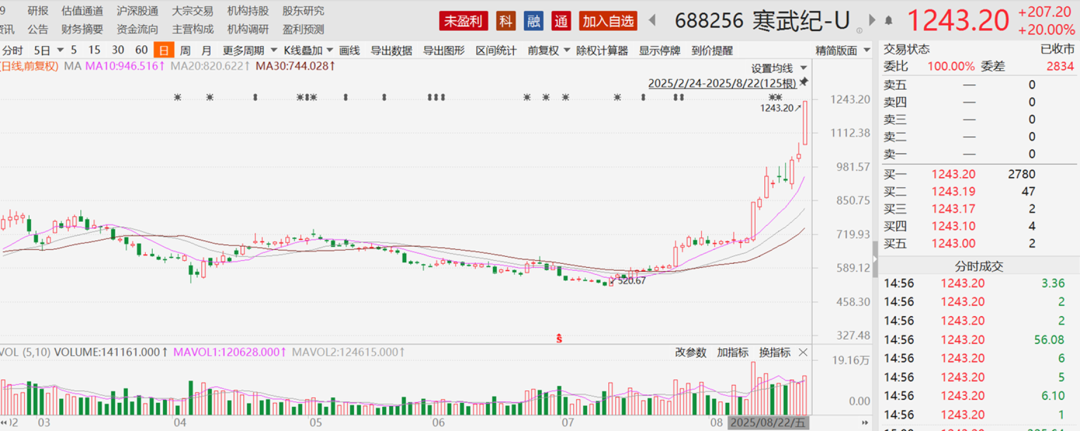
Core Viewpoint - The surge in A-share semiconductor and computing power stocks, led by companies like Cambricon, Haiguang Information, and Zhongke Shuguang, was triggered by a comment from DeepSeek on August 22, resulting in significant price increases and trading halts for these stocks [1][2]. Company Performance - Cambricon's stock price broke through the 1100 yuan and 1200 yuan marks, closing at 1243.20 yuan with a total market capitalization of 520 billion yuan [2]. - Year-to-date, Cambricon's stock has increased by nearly 90%, with significant gains attributed to major shareholder Zhang Jianping, who has seen substantial profits from his holdings [4]. - In Q1, Cambricon reported a revenue of 1.11 billion yuan, a year-on-year increase of over 420%, and a net profit of 355 million yuan [4]. Shareholder Activity - Zhang Jianping increased his holdings in Cambricon by 14% in Q1, bringing his total to over 6 million shares, with a reference market value of approximately 3.79 billion yuan [4]. - In addition to Cambricon, Zhang Jianping also invested heavily in four other "AI+" stocks, totaling nearly 6 billion yuan across five stocks [5]. - Zhang Jianping's recent activities include a significant reduction in his holdings in Hangang Co., where he decreased his stake by over 82% in Q2 [11]. Market Trends - The AI and computing power sectors are experiencing rapid growth, with companies like Hainan Huatie and Zhongjian Technology also seeing substantial stock price increases [7][15]. - Hainan Huatie signed a major computing power service agreement worth 3.69 billion yuan, contributing to its stock price surge of nearly 85% in Q1 [7]. - The Chinese computing power market is expected to grow significantly, with projections indicating a growth rate exceeding 40% by 2025 [18].