
军工

Search documents
白宫突发大动作!9国联手签协议,竟想废掉中国稀土王牌
Sou Hu Cai Jing· 2025-12-16 11:44
Core Viewpoint - The signing of the rare earth supply chain agreement by the U.S. and its allies is primarily a strategic move to challenge China's dominance in the rare earth sector, rather than a simple resource cooperation initiative [1][3][8]. Group 1: Political Intentions - The agreement is seen as a U.S.-led action aimed at weakening China's advantages in resources, technology, and supply chains [3][8]. - The U.S. is anxious about China's overwhelming control over the global rare earth industry, with 91% of rare earth refining and separation capacity concentrated in China [3][10]. - The U.S. aims to establish a supply chain that bypasses China, laying the groundwork for future competition in AI [8][10]. Group 2: Implications for AI and Technology - The U.S. government links the rare earth supply chain to the AI industry, indicating that control over rare earth resources is crucial for competing in AI [10][13]. - The U.S. recognizes that without a stable supply of rare earths, advancements in AI technology cannot be realized [13][15]. - The agreement is expected to benefit U.S. mining, military, and tech sectors, ensuring a stable supply chain for high-tech industries over the next decade [17][20]. Group 3: Global Supply Chain Dynamics - The agreement signifies a shift in global technology dynamics, where control over core resources will be as important as technological advancement [20][21]. - The U.S. is attempting to create a closed-loop supply chain with like-minded allies, injecting political factors into the industry chain [22][26]. - China's response emphasizes the importance of market principles and cooperation, highlighting its critical role in stabilizing the global rare earth supply chain [23][25]. Group 4: Future Competition - The competition between the U.S. and China in key minerals and AI is expected to continue, with China's rare earth advantages stemming from years of industrial accumulation [26][28]. - The outcome of this geopolitical struggle will depend on the strength and completeness of each country's supply chain rather than the size of their political alliances [28].



二连板航天电子:公司股票存在市场情绪过热的情形
Zheng Quan Shi Bao Wang· 2025-12-16 10:15
人民财讯12月16日电,二连板航天电子(600879)12月16日披露股票交易异动公告称,公司股票自2025 年11月27日以来收盘价格累计上涨幅度为62.31%,同期申万军工行业涨幅8.07%,上证指数涨 幅-1.3%,公司股票短期涨幅严重高于同期行业及上证指数涨幅,但公司基本面未发生重大变化,存在 市场情绪过热的情形。截至目前,控股股东及实际控制人不存在对公司应披露而未披露的重大信息。 ...

方正燕翔:2026增长稳、科技强、内需进,价格回升引盈利修复
2 1 Shi Ji Jing Ji Bao Dao· 2025-12-16 09:21
Group 1 - The core viewpoint is that if the "anti-involution" policy in 2026 successfully promotes re-inflation, corporate profits are expected to recover rapidly, providing strong momentum for the market, similar to the successful logic of supply-side structural reforms in 2016-2017 [1] - The economic outlook for 2026 is analyzed through three dimensions: stable GDP growth, increasing share of the "three new" economy (including automotive and AI industries), and marginal improvement in consumption and investment, with domestic demand becoming the core driving force [1] Group 2 - In the A-share market, there is a strong correlation between A-share profits and PPI, with over 70% of the 5,400 A-share listed companies being manufacturing enterprises, indicating significant price elasticity [2] - As of October 2025, PPI is still at -2.1% year-on-year, and corporate profits are in a bottoming phase. If the "anti-involution" policy leads to a rebound in commodity prices, corporate profits could improve significantly, providing strong support for the market [2] - Concerns regarding the AI bubble in the US stock market are raised, with the S&P 500 index showing significant valuation risks, but the adjustment is expected to be relatively mild compared to the 2000 internet bubble [2] Group 3 - A risk warning is issued regarding the "policy expectation reversal risk," highlighting the potential conflict if both PPI and CPI rise unexpectedly, which could challenge the assumption of continued US interest rate cuts [3] - The year 2026 is seen as crucial for the success of the "anti-involution" policy in promoting re-inflation. If PPI turns positive year-on-year, A-shares could experience a rapid recovery in profits similar to the supply-side structural reform period, making this a key market driver [3]
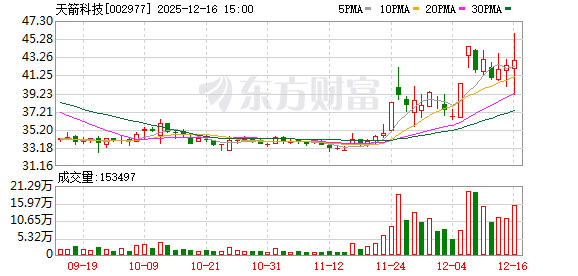
天箭科技振幅17.56%,龙虎榜上机构买入6698.06万元,卖出5166.96万元
Zheng Quan Shi Bao Wang· 2025-12-16 09:21
Group 1 - Tianjian Technology's stock increased by 1.30% with a turnover rate of 23.04% and a trading volume of 645 million yuan, showing a price fluctuation of 17.56% throughout the day [2] - Institutional investors net bought 15.31 million yuan, while brokerage seats collectively net sold 9.22 million yuan [2] - The stock was listed on the Shenzhen Stock Exchange due to its daily price fluctuation reaching 17.56%, with institutional specialized seats net buying 15.31 million yuan [2] Group 2 - The top five trading departments accounted for a total transaction volume of 152 million yuan, with a buying amount of 78.99 million yuan and a selling amount of 72.90 million yuan, resulting in a net buying of 6.09 million yuan [2] - Among the trading departments, five institutional specialized seats were involved, with total buying amounting to 66.98 million yuan and selling amounting to 51.67 million yuan, leading to a net buying of 15.31 million yuan [2] - The stock experienced a net inflow of 18.29 million yuan from major funds, including a net inflow of 16.38 million yuan from large orders and 1.91 million yuan from medium orders, with a total net inflow of 23.17 million yuan over the past five days [2]

方正燕翔:2026增长稳、科技强、内需进 价格回升引盈利修复
2 1 Shi Ji Jing Ji Bao Dao· 2025-12-16 09:08
Core Insights - The success of the "anti-involution" policy in 2026 could lead to a re-inflation, similar to the successful logic of the supply-side structural reforms in 2016-2017, which may result in a rapid recovery of corporate profits and inject strong momentum into the market [1] Economic Outlook - The economic outlook for 2026 is analyzed through three dimensions: stable growth with GDP growth remaining in a stable range, strengthening technology with the "three new" economy's share continuing to rise, and improving domestic demand with significant recovery expected from the low base in 2025 [1] A-Share Market Insights - A-share profitability is highly correlated with PPI, with over 70% of the 5,400 A-share listed companies being manufacturing firms, indicating significant price elasticity [2] - As of October 2025, PPI was down 2.1% year-on-year, with corporate profits in a bottoming phase; if the "anti-involution" policy leads to a rebound in commodity prices, corporate profits could improve significantly, providing strong market support [2] U.S. Market Analysis - Concerns regarding the AI bubble in the U.S. stock market are noted, with the S&P 500 index showing significant valuation risks, as both PE and PB ratios are at the 99th percentile historically; however, the potential adjustment is expected to be relatively mild compared to the 2000 internet bubble [2] Risk Warnings - A key risk identified is the "policy expectation reversal risk," particularly if both PPI and CPI rise unexpectedly, which could conflict with the assumption of continued U.S. interest rate cuts [3] - The year 2026 is critical as it marks the beginning of the "14th Five-Year Plan," with the success of the "anti-involution" policy being pivotal for driving re-inflation and corporate profit recovery, which is essential for market momentum [3]
泓德基金:11月国内出口数据保持韧性
Xin Lang Cai Jing· 2025-12-16 07:35
Market Overview - The domestic equity market continued to experience high-level fluctuations, with the Wind All A index showing a weekly increase of approximately 0.2%. Trading volume on Monday and Friday exceeded 2 trillion yuan, indicating a concentration of market interest in certain thematic sectors [1][4] - Key sectors that saw significant gains included telecommunications, military industry, and electronics, while traditional sectors such as coal, oil and petrochemicals, and textiles and apparel experienced notable declines [1][4] Economic Policy Insights - The Central Economic Work Conference was held last week, summarizing economic work for 2025 and analyzing the current economic situation while deploying strategies for 2026. The conference emphasized the importance of economic work in the first year of the "14th Five-Year Plan" and provided guiding principles through the "Five Musts" [4] Trade Data Analysis - According to data released by the General Administration of Customs, China's exports in November (in USD) increased by 5.9% year-on-year, rebounding from a previous decline of 1.1%. Imports grew by 1.9%, compared to a prior increase of 1%. The trade surplus reached 111.68 billion USD, up from 90.07 billion USD [2][4] - Cumulatively, from January to November, exports increased by 5.4% year-on-year, with a projected growth of 5.8% for 2024. Despite facing new tariff challenges from the U.S. since 2025, the resilience of exports has been a significant highlight of China's economy this year, driven by strong product competitiveness and a boost in re-export trade [2][4] Bond Market Dynamics - Since late November, there has been a noticeable adjustment in the ultra-long bond market. The number of institutions able to include ultra-long bonds in their portfolios remains limited. Increased supply has led to a rise in allocation by previously underserved institutional investors, while trading institutions have also increased their participation, maintaining a monthly average of 30-40% in interest rate trading [3][5] - The widening yield spread between ultra-long bonds and 10-year government bonds since June reflects a gradual adjustment in investor expectations regarding long-term economic recovery, which corresponds with the performance of large-cap growth stocks in the equity market [3][5]
金融养分滋润黑土地 孕育产业振兴“龙江之花”
Zheng Quan Shi Bao· 2025-12-16 06:01
Core Viewpoint - The capital market in Heilongjiang has become an essential driving force for regional economic development during the "14th Five-Year Plan" period, effectively integrating with national strategies and local industrial characteristics [2][3]. Group 1: Capital Market Development - Heilongjiang's capital market has actively engaged in direct financing, optimizing the structure of listed companies, and facilitating mergers and acquisitions to address funding challenges for enterprises [2][3]. - During the "14th Five-Year Plan" period, Heilongjiang's listed companies achieved a total of 35.723 billion yuan in equity financing and 32.37 billion yuan in debt financing, highlighting direct financing as a key engine for economic growth [3]. - The financing structure is characterized by a predominance of refinancing, with 27.964 billion yuan raised through refinancing methods, approximately three times the amount raised through initial public offerings (IPOs) [3][4]. Group 2: Structural Optimization - The period saw a dynamic adjustment in the structure of listed companies, with 5 companies delisting and 6 new companies listed, achieving full coverage across various market segments [4]. - Notable mergers and acquisitions include the acquisition of Harbin Aircraft and Changhe Aircraft by Zhongzhi Co. for 5.078 billion yuan, exemplifying successful asset securitization in the military sector [4]. Group 3: Quality and Innovation - The capital market in Heilongjiang has not only expanded in scale but also improved in operational quality and technological content, with a 50% increase in the number of companies listed on the Growth Enterprise Market and the Sci-Tech Innovation Board compared to the "13th Five-Year Plan" period [6][7]. - R&D investment by listed companies reached 5.183 billion yuan in 2024, a more than 52% increase from 2020, indicating a strong focus on core technology development [7]. Group 4: Regulatory Environment - The regulatory framework has been strengthened, with nearly 20 cases of legal violations addressed, including issues related to information disclosure and insider trading [8]. - The Heilongjiang Securities Regulatory Bureau has implemented over 150 administrative measures to correct non-compliant behaviors, ensuring a more robust market environment [8][9]. Group 5: Future Outlook - Looking ahead to the "15th Five-Year Plan," Heilongjiang's capital market aims to enhance its service capabilities for national strategies and continue to support high-quality development through a multi-layered capital market and diverse financial tools [5][9].

军工ETF(512660)回调超2%,同类规模第一,军工行业长期向好,回调或可布局
Mei Ri Jing Ji Xin Wen· 2025-12-16 05:48
Group 1 - The article emphasizes the increasing complexity and severity of the international environment, highlighting the need for advanced military equipment such as fighter jets and missiles, as well as cost-effective munitions and reliable communication systems to support modern warfare [1] - It suggests focusing on the development of aerospace equipment and satellite internet as key areas for investment, given the long-term trend of great power competition [1] - The military industry is expected to experience long-term growth, driven by the 2027 centenary military goal and the "14th Five-Year Plan" aimed at addressing shortcomings in the sector [1] Group 2 - The military ETF (512660) tracks the CSI Military Industry Index (399967), which selects listed companies in the military sector from the Shanghai and Shenzhen markets, primarily covering the ten major military groups [1] - The index reflects the overall performance of listed companies in China's military industry, with a focus on aerospace equipment and military electronics, showcasing the growth potential and prosperity of the sector [1]
午评:创业板指跌超2%,有色、军工等板块走低,零售板块逆市活跃
Sou Hu Cai Jing· 2025-12-16 04:20
Core Viewpoint - The A-share market experienced a decline across major indices, with the Shanghai Composite Index dropping over 1% while the North Stock 50 Index rose against the trend, indicating mixed market sentiment and sector performance [1] Market Performance - As of the midday close, the Shanghai Composite Index fell by 1.22% to 3820.85 points, the Shenzhen Component Index decreased by 1.88%, and the ChiNext Index dropped by 2.35%. In contrast, the North Stock 50 Index increased by 1.1% [1] - The total trading volume across the Shanghai, Shenzhen, and North Stock markets reached 1.1397 trillion yuan [1] Sector Analysis - Sectors such as non-ferrous metals, military industry, coal, oil, and pharmaceuticals all experienced declines, while retail and food & beverage sectors showed resilience with gains [1] - Concepts related to duty-free shopping and autonomous driving were notably active in the market [1] Policy Outlook - According to Everbright Securities, a new round of policy deployment is expected to support the A-share market's year-end performance, with domestic economic policies likely to continue to strengthen, maintaining economic growth within a reasonable range [1] - The release of policy dividends is anticipated to boost market confidence and attract various types of capital inflows [1] - Historically, the A-share market has performed well in the opening years of the 13th and 14th Five-Year Plans, suggesting a positive outlook for 2026 [1] Investment Strategy - Industry allocation should focus on TMT (Technology, Media, and Telecommunications) and advanced manufacturing sectors [1] - In the event of short-term market fluctuations due to external factors, defensive and consumer sectors may be worth monitoring [1]

A股开盘速递 | 指数弱势震荡!零售板块反复活跃 乳业概念再度走强
智通财经网· 2025-12-16 02:03
Group 1: Market Overview - The market showed weakness with the Shanghai Composite Index down 0.51%, Shenzhen Component down 0.58%, and ChiNext down 0.66% as of 9:38 AM on December 16 [1] - Retail concepts were active, with Baida Group achieving four consecutive trading limits, and other companies like Hongqi Chain and Dongbai Group also seeing gains [1] - The dairy industry saw a resurgence, with Huangshi Group hitting a trading limit and achieving two consecutive trading limits, while companies like Huanlejia and Sunshine Dairy also rose [1] Group 2: Institutional Perspectives - Everbright Securities anticipates a favorable cross-year market for A-shares due to new policy deployments, which are expected to support economic growth and attract capital inflows [2] - Huaxi Securities notes that recent meetings have supported market risk appetite, with expectations for increased trading activity and investment in growth sectors like domestic substitution and innovative pharmaceuticals [3] - Oriental Securities emphasizes the importance of core technology sectors that are trending upwards, while also noting the market's structural volatility as it approaches the end of the year [4]


