
农产品加工

Search documents
重庆九湾河农产品加工有限公司成立 注册资本2万人民币
Sou Hu Cai Jing· 2025-12-16 21:14
天眼查App显示,近日,重庆九湾河农产品加工有限公司成立,法定代表人为徐国兴,注册资本2万人 民币,经营范围为许可项目:食品生产;食品销售;食品小作坊经营;食品互联网销售;小餐饮、小食 杂、食品小作坊经营。(依法须经批准的项目,经相关部门批准后方可开展经营活动,具体经营项目以 相关部门批准文件或许可证件为准) 一般项目:食用农产品初加工;农产品的生产、销售、加工、运 输、贮藏及其他相关服务;农副产品销售;食用农产品批发;初级农产品收购;农业专业及辅助性活 动;蔬菜种植;食用农产品零售;机械设备销售;日用品销售;金属材料销售。( 除依法须经批准的 项目外,凭营业执照依法自主开展经营活动)。 ...

“百千万工程”赋能广东,57县(市)GDP增速连续两年超全省均值
2 1 Shi Ji Jing Ji Bao Dao· 2025-12-16 14:28
(原标题:"百千万工程"赋能广东,57县(市)GDP增速连续两年超全省均值) 第七场 "' 十四五 ' 广东成就 " 系列主题新闻发布会,张梦琦摄 南方财经记者张梦琦 广州报道 推动城乡区域协调发展,关系到广东走好中国式现代化之路的全局和成色。近年来,广东举全省之力推 进实施"百千万工程",抓住县域这个发力点,推进强县促镇带村,加快农文旅体融合发展,推动城乡区 域协调发展取得阶段性重要进展。 12月16日,广东省人民政府新闻办召开第七场"'十四五'广东成就"系列主题新闻发布会,主题为"城乡区 域协调发展",邀请相关部门负责人介绍"十四五"时期广东推进乡村全面振兴、促进城乡区域协调发展 等情况。 南方财经记者从会上获悉,实施"百县千镇万村高质量发展工程"三年来,广东57个县(市)GDP增速 连续两年快于全省平均水平,县城人口实现整体净流入,县域常住人口城镇化率由44.72%提升至 46.48%,全省城乡居民收入比从2.41∶1缩小至2.31∶1。 广东省委常务副秘书长,省委改革办、省"百千万工程"指挥办常务副主任许志晖表示,广东坚持以县域 为切入点,因地制宜、一县一策,"五级书记"一起抓,县镇村一体推进,推动" ...
(走进中国乡村)陇南珍品“链”全球:深山货郎变“全球卖手”
Zhong Guo Xin Wen Wang· 2025-12-16 12:53
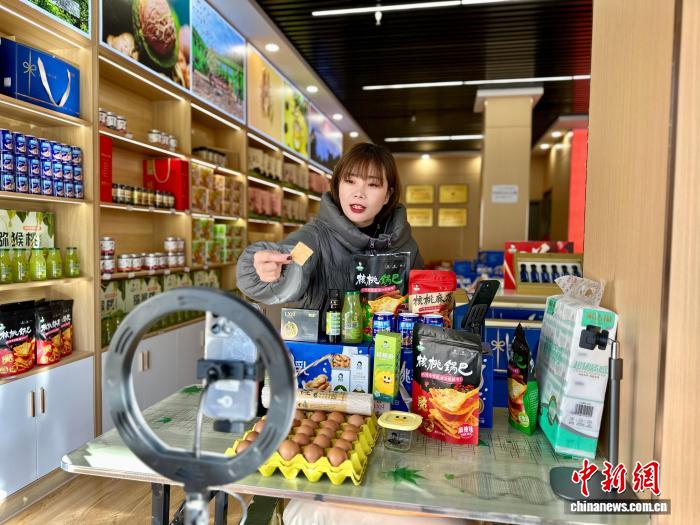
Core Insights - The article highlights the transformation of rural commerce in Longnan, Gansu, where local products, particularly walnuts, are being marketed globally through e-commerce platforms, significantly boosting local economies and employment [1][3]. Group 1: E-commerce Development - Longnan's e-commerce sector has evolved from individual attempts to a comprehensive system covering production, processing, packaging, logistics, and marketing, becoming a model for e-commerce poverty alleviation in China [3][4]. - As of October 2023, Longnan's e-commerce has generated a total sales revenue of 564 billion RMB, creating over 340,000 jobs in the industry [1][3]. Group 2: Product Diversification and Innovation - Local entrepreneurs are innovating traditional walnut products, introducing items like walnut milk, walnut snacks, and skincare products, with projected sales of over 40 million RMB in 2024 for one brand [5]. - The e-commerce sector is expanding its product range to include various local specialties such as apples, garlic, and wild vegetables, with annual sales reaching 120 million RMB [4]. Group 3: Global Market Reach - Longnan's products are exported to over 30 countries and regions, including Russia, Kyrgyzstan, and the United States, facilitated by 76 registered cross-border e-commerce companies [4]. - The local government is supporting businesses in establishing overseas warehouses and stores, enhancing their international presence [4].

油粕日报:偏弱震荡-20251216
Guan Tong Qi Huo· 2025-12-16 11:49
Report Industry Investment Rating - The report does not explicitly provide an overall industry investment rating, but it indicates that the oil and粕 market is in a weak and volatile state [1][4] Core Viewpoints - The soybean meal market shows a marginal destocking trend but remains at a relatively high level in the same period of history. The near - month futures of soybean meal have strong support for auction transactions, while the far - month contracts are expected to remain volatile. The oil market is in a weak trend, and after the negative factors of palm oil and rapeseed oil are gradually realized, the market may enter a volatile phase again. The delay of the US biofuel policy may prolong the period of weak and volatile oil prices, and there is no upward driving factor in the short term [2][4] Summary by Related Content Soybean Meal - NOPA data shows that the US soybean crushing volume in November decreased by 5.1% from the record high in October but increased by 11.8% compared with the same period in 2024. As of last Thursday, the sown area of soybeans in the 2025/26 season in Brazil reached 97% of the expected area, with good rainfall in most producing areas [1] - As of December 12, 2025, the domestic main oil mills' soybean meal inventory was 110.36 million tons, a decrease of 5.73 million tons from the previous week. The second batch of imported soybean auctions in China sold 513,883 tons today, with a transaction rate of 62.88% and a transaction volume of 323,118 tons. The premium level in Shandong and Tianjin regions decreased significantly compared with last week [2] Oils Palm Oil - From December 1 - 15, 2025, Malaysia's palm oil exports decreased by 15.89% compared with the same period last month, and the production decreased by 2.97% compared with the same period last month. Palm oil is in a stage of strong supply and weak demand in the short term and will maintain a weak trend [3][4] Rapeseed Oil - Due to the strong foreign production increase expectation and the arrival of Australian rapeseed, the premium of rapeseed oil has significantly retreated. After continuous decline, the market has returned to rationality. Future attention should be paid to rapeseed purchases in the next quarter and the possibility of restarting purchases of Canadian rapeseed [3] Soybean Oil - The domestic soybean oil market is in a period of loose supply and demand, with no obvious driving force. The US biofuel policy has been postponed to the first quarter of next year, and the buying power of US soybean oil will remain weak before the policy is implemented [3]
圣农发展:拟为全资孙公司提供不超1500万元原料采购货款担保
Xin Lang Cai Jing· 2025-12-16 10:55
Core Viewpoint - The company announced that its board approved a guarantee of up to 15 million yuan for its wholly-owned subsidiary, Sun Valley Foods, for feed raw material purchase contracts with Bunge (Shanghai) Management Co., Ltd. and its affiliates, to be signed by December 31, 2026 [1] Financial Performance - Sun Valley Foods is projected to generate revenue of 1.695 billion yuan and a net profit of -1.0443 million yuan in 2024 [1] - For the first nine months of 2025, the revenue is reported at 1.307 billion yuan with a net profit of 18.9559 million yuan [1] Guarantee and Risk Assessment - As of the announcement date, the total external guarantee amount provided by the company and its subsidiaries is 33 million yuan, which accounts for 0.32% of the audited net assets attributable to the parent company for 2024 [1] - There are no overdue or litigated guarantees reported [1]

玉米淀粉日报-20251216
Yin He Qi Huo· 2025-12-16 10:06
研究所 农产品研发报告 玉米淀粉日报 2025 年 12 月 16 日 玉米淀粉日报 第一部分 数据 收盘价 涨跌 涨跌幅 成交量 增减幅 持仓量 增减幅 2220 -8 -0.36% 353,327 -10.99% 455,962 -7.17% 2238 -6 -0.27% 86,476 -3.96% 436,006 -0.62% 2265 -2 -0.09% 8,896 19.62% 36,497 5.69% 2502 -11 -0.44% 92,011 11.00% 138,662 -5.45% 2545 -10 -0.39% 6,605 35.69% 25,827 8.96% 2594 -14 -0.54% 206 34.64% 1,217 2.79% 期货盘面 C2601 C2605 C2509 玉米&玉米淀粉数据日报 CS2605 CS2509 现货与基差 CS2601 青冈 松原嘉吉 诸城兴贸 寿光 锦州港 南通港 广东港口 2070 2160 2310 2290 2300 2390 2440 0 0 0 0 -20 -10 -10 -195 -105 45 25 62 125 175 龙凤 中 ...
农产品加工板块12月16日跌2.28%,中粮糖业领跌,主力资金净流入6841.12万元
Zheng Xing Xing Ye Ri Bao· 2025-12-16 09:10
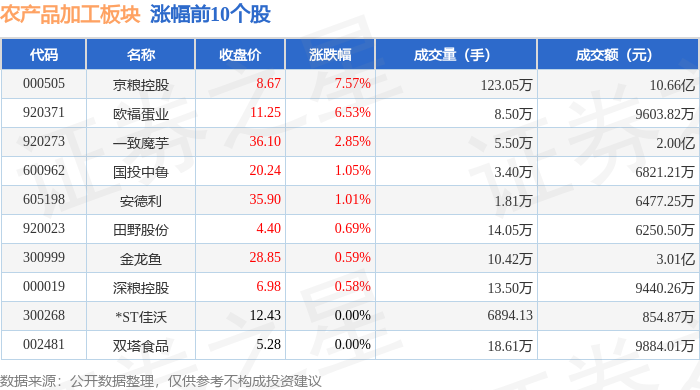
Market Overview - The agricultural processing sector experienced a decline of 2.28% on December 16, with COFCO Sugar leading the drop [1] - The Shanghai Composite Index closed at 3824.81, down 1.11%, while the Shenzhen Component Index closed at 12914.67, down 1.51% [1] Stock Performance - Key stocks in the agricultural processing sector showed varied performance, with Jingliang Holdings rising by 7.57% to close at 8.67, and COFCO Sugar falling by 7.84% to close at 17.04 [2][1] - Other notable performers included Oufujieye, which increased by 6.53%, and Yichis Magic Hand, which rose by 2.85% [1] Trading Volume and Capital Flow - The trading volume for Jingliang Holdings was 1.23 million shares, with a transaction value of 10.66 billion yuan [1] - The agricultural processing sector saw a net inflow of 68.41 million yuan from institutional investors, while retail investors experienced a net outflow of 16.49 million yuan [2][3] Individual Stock Capital Flow - Jingliang Holdings had a net inflow of 15.5 million yuan from institutional investors, while COFCO Sugar saw a significant net outflow of 74.76 million yuan from retail investors [3] - Other stocks like Jinlongyu and Oufujieye also experienced mixed capital flows, with Jinlongyu having a net inflow of 30.04 million yuan from institutional investors [3]

十年再出发!中新互联互通项目促合作深化
Xin Hua Wang· 2025-12-16 02:44
Core Insights - The China-Singapore Connectivity Project has successfully deepened cooperation over the past decade, facilitating trade and collaboration between China's western regions and ASEAN countries [1][2] Group 1: Project Overview - The project was officially launched in November 2015 as the third government-to-government collaboration between China and Singapore, following the Suzhou Industrial Park and Tianjin Eco-City [1] - Over ten years, the project has developed 33 innovative institutional open results, enhancing face-to-face cooperation between China’s western regions and ASEAN countries [1][2] Group 2: Achievements and Developments - The project has established five key channels: the New Land-Sea Corridor, the China-Singapore Cross-Border Financing Channel, the China-Singapore (Chongqing) International Internet Data Dedicated Channel, the Chongqing-New Singapore Air Corridor, and a cultural exchange channel [2] - As of October 2023, the New Land-Sea Corridor has reached 127 countries and regions, connecting 581 ports [2] - The project has successfully facilitated the entry of Chongqing's agricultural products into the Singapore market, achieving a trade volume exceeding 250 million yuan [4] Group 3: Future Directions - The project aims to deepen cooperation in areas such as digital trade, cross-border computing power, artificial intelligence, and green development, with a goal to create a new model for international cooperation by 2030 [7] - The initiative is expected to enhance regional economic development and provide new support for multilateral cooperation [7]

综合晨报-20251216
Guo Tou Qi Huo· 2025-12-16 02:34
1. Report Industry Investment Ratings No relevant content provided. 2. Core Views of the Report - Global crude oil supply and demand are becoming more relaxed, and the progress of the peace talks led by the US has increased concerns about the release of Russian oil supply, causing oil prices to drop to their lowest level this year [1] - Precious metals continued to be strong overnight. The loose trading continued after the Fed meeting, and gold is approaching its historical high. If it breaks through, the strong performance of precious metals is expected to continue [2] - The prices of various metals and commodities are affected by factors such as supply - demand relationships, policy changes, and cost factors, showing different trends of rise, fall, or shock [3][4][5] 3. Summary by Relevant Catalogs Energy Commodities - **Crude Oil**: EU sanctions on Russia and US sanctions on Venezuela have affected the global oil market. Under the background of loose supply and demand, the potential release of Russian oil supply after the peace talks has put pressure on oil prices [1] - **Natural Gas**: No relevant content provided. - **Coal**: No relevant content provided. - **Liquefied Natural Gas (LNG)**: No relevant content provided. - **Carbon Emission Rights**: No relevant content provided. Metals - **Precious Metals**: Gold is approaching its historical high, and platinum and palladium are at high levels. The relatively low - valued platinum and palladium are favored by long - position funds. The long - term allocation rhythm is clear [2] - **Base Metals** - **Copper**: Overnight, LME copper rose and then gave back some gains. The high position volume in the Shanghai copper market suggests that long - position investors should temporarily reduce their positions and wait and see [3] - **Aluminum**: The medium - term upward trend of Shanghai aluminum remains unchanged. Long - position investors can hold their positions based on certain support levels and leave the market if they break [4] - **Zinc**: The LME's position limit plan is expected to end the soft squeeze on the outer market. The internal and external price difference is likely to converge, and it is a good time for cross - market reverse arbitrage. Shanghai zinc is in a short - term rebound [7] Chemicals - **Synthetic Materials** - **Polyethylene (PE)**: The supply of polyethylene is expected to increase, and the demand is weak, with low downstream inventory - building enthusiasm [25] - **Polypropylene (PP)**: The production of polypropylene is expected to increase slightly, and the short - term demand is weak [25] - **Basic Chemicals** - **Methanol**: The methanol market is in a narrow - range fluctuation. The supply - demand situation is difficult to improve significantly in the short term, and it is expected to be weak [22] - **Urea**: The supply - demand pattern of urea remains loose, and the price is expected to fluctuate within a range [21] Agricultural Products - **Grains and Oils** - **Soybeans and Soybean Meal**: The weather in South America has improved, and the US soybean data has not been adjusted. The domestic soybean and soybean meal inventories have decreased. The strategy is to wait for the weather changes in South America and go long on the main contract at low prices [33] - **Palm Oil**: The palm oil market is facing high - inventory pressure and is expected to be neutral or weak in the short term [34] - **Livestock and Poultry Products** - **Pigs**: The supply of pigs is still abundant, and the price is expected to be weak in the short term. The medium - to - long - term price may have a second bottom [38] - **Eggs**: The egg futures price of the 01 contract is leading the market, but the price is still in the previous range. The far - month contract needs to pay attention to chick replenishment and old - hen culling [39] - **Cash Crops** - **Cotton**: The Zhengzhou cotton price has risen significantly. There are rumors that the planting area in Xinjiang will decrease next year. The sales progress is fast, and the demand is stable. The industry can consider hedging opportunities [40] - **Sugar**: The international sugar market supply is sufficient, and the US sugar faces pressure. The production progress in Guangxi is slow, but the production forecast for the 25/26 season is good [41] Others - **Shipping**: The SCFIS European route index has been released, and the 12 - contract is expected to fluctuate. The spot price is expected to rise, but there are risks such as additional supply pressure. The far - month 04 contract is recommended to be shorted on rallies [19] - **Financial Futures** - **Stock Index Futures**: The A - share market and stock index futures fell yesterday. The market is expected to be in a volatile and slightly upward pattern in the short term, depending on the implementation of domestic economic policies [45] - **Treasury Bond Futures**: The bond market is in a warm - up and volatile state. In the short term, it is difficult to break through the volatile adjustment pattern, and attention should be paid to the previous interest rate high points [46]
11月经济数据增长继续放缓,股市跟随调整
Dong Zheng Qi Huo· 2025-12-16 01:17
1. Report Industry Investment Ratings No relevant content provided. 2. Core Views of the Report - The economic data growth in November continued to slow down, and the stock market adjusted accordingly. Weak economic data may prompt the acceleration of policy introduction, and attention should be paid to policy changes [2][23]. - The gold price fluctuated slightly and rose, approaching the previous high, with increased intraday volatility. The market is concerned about the upcoming US November non - farm payroll data, and the interest rate cut expectation is fully priced. The overall tone of the Fed officials' speeches is neutral [15]. - The US stock market is expected to fluctuate at a high level in the short term, with internal differences among Fed officials and concerns about the Fed's independence [21]. - The bond market is dominated by institutional behavior, and it is recommended to focus on the right - side long - buying opportunities [28]. - For various commodities, different trends and investment suggestions are presented based on their respective fundamentals, such as the supply and demand situation, production data, and policy factors [32][41][48]. 3. Summary by Directory 3.1 Financial News and Comments 3.1.1 Macro Strategy (Gold) - Trump believes the peace agreement is closer than ever. Gold price fluctuated slightly up, approaching the previous high, with increased intraday volatility. The market focuses on the US November non - farm payroll data, and the interest rate cut expectation is fully priced. Fed officials' speeches are neutral. It is not recommended to chase the high [14][15][16]. 3.1.2 Macro Strategy (US Stock Index Futures) - There are variables in the selection of the new Fed chairman, and internal differences among Fed officials are large. The US stock market is expected to fluctuate at a high level in the short term [17][21]. 3.1.3 Macro Strategy (Stock Index Futures) - The economic data in November continued to weaken, and the stock market adjusted. High - valuation and high - expectation stocks face upward pressure. It is recommended to evenly allocate long positions in various stock indexes [22][23][24]. 3.1.4 Macro Strategy (Treasury Bond Futures) - The economic data in November was weak. The bond market decline was dominated by institutional behavior. It is recommended to focus on the right - side long - buying opportunities [25][27][28]. 3.2 Commodity News and Comments 3.2.1 Agricultural Products (Soybean Meal) - The inventory of soybean meal in oil mills decreased. NOPA's crushing data was lower than expected, and the CBOT soybean was weak. Brazilian exports increased, and the sowing was basically completed. It is recommended to continue to pay attention to China's soybean procurement, state reserve trends, and South American weather [29][32]. 3.2.2 Agricultural Products (Corn Starch) - The theoretical profit of starch enterprises remained in a good state, and the CS - C futures spread strengthened slightly. It is expected that the rice - flour spread will continue to fluctuate [33][34]. 3.2.3 Agricultural Products (Corn) - The spot price was generally stable, and the futures price first fluctuated narrowly and then dived. It is recommended to short 03 and 05 contracts on rallies in the short and medium term and pay attention to the long - buying opportunities for 07 and 09 contracts at low prices in the long term [35][36]. 3.2.4 Black Metals (Rebar/Hot - Rolled Coil) - The steel price fluctuated. The building materials demand was weak, but it was not far beyond expectations. The manufacturing demand remained resilient. It is recommended to treat the steel price with a fluctuating mindset [37][41][42]. 3.2.5 Black Metals (Coking Coal/Coke) - The coking coal price in the Linfen market was weakly stable. The supply decreased, and the demand was weak. It is necessary to pay attention to whether subsequent replenishment can support the market [43][44][45]. 3.2.6 Agricultural Products (Soybean Oil/Rapeseed Oil/Palm Oil) - The export of Malaysian palm oil from December 1 - 15 decreased. The supply pressure of palm oil was obvious. It is recommended to wait for the supply pressure to ease and then consider long - buying [46][47][48]. 3.2.7 Non - Ferrous Metals (Alumina) - A large - scale mining enterprise in Guinea will resume production. The downstream inventory is high, and the supply surplus pressure remains. It is recommended to wait and see [49][50]. 3.2.8 Non - Ferrous Metals (Polysilicon) - The polysilicon capacity integration and acquisition platform was officially launched. It is expected that the spot price is difficult to fall. It is recommended to pay attention to the long - buying opportunities after the futures price is at a discount to the spot price [52][54]. 3.2.9 Non - Ferrous Metals (Industrial Silicon) - The power price in Yunnan in 2026 was announced. The inventory increased slightly. It is recommended to pay attention to the short - selling opportunities on rallies [55][56][57]. 3.2.10 Non - Ferrous Metals (Lead) - The LME lead price and the Shanghai lead price fluctuated and declined. The social inventory increased slightly. It is recommended to short on rallies in the short term [58][59]. 3.2.11 Non - Ferrous Metals (Zinc) - The LME zinc price fluctuated and declined. The domestic zinc demand increased, and the inventory decreased. It is recommended to buy on pullbacks, hold long - spread positions, and maintain the long - domestic and short - overseas strategy [60][63]. 3.2.12 Non - Ferrous Metals (Nickel) - The supply surplus of nickel is expected to increase. The short - term disk is expected to be weak at a low level. It is not recommended to chase the short. It is necessary to pay attention to the supply changes in Indonesia [64][66]. 3.2.13 Non - Ferrous Metals (Lithium Carbonate) - The price of lithium iron phosphate increased. The supply may increase after the resumption of production, and the demand may decline in the off - season. It is recommended to buy on pullbacks in the long term [67][69]. 3.2.14 Non - Ferrous Metals (Copper) - The macro - mid - term support for copper remains, but the short - term expected difference is significant. The short - term spot premium is expected to be under pressure. It is recommended to wait and see in the short term and buy on pullbacks in the mid - term [70][72]. 3.2.15 Non - Ferrous Metals (Tin) - The inventory of tin increased at home and abroad. The supply increased, and the demand was weak. It is expected that the tin price will fluctuate at a high level in the short term [74][75]. 3.2.16 Energy Chemicals (Crude Oil) - The oil price continued to decline. The concern about oversupply depressed the oil price. It is expected to be weakly fluctuating in the short term [76][77]. 3.2.17 Energy Chemicals (Asphalt) - The refinery inventory of asphalt increased, and the social inventory decreased. The supply increased, and the demand weakened. It is expected to be weakly fluctuating in the short term [78][79][80]. 3.2.18 Energy Chemicals (Methanol) - Two methanol plants in Iran stopped production. The short - term opportunity for methanol is limited, and it is recommended to wait and see [80][81]. 3.2.19 Energy Chemicals (PTA) - The PTA spot market negotiation was average, and the basis was strong. The supply - demand pattern improved in the medium - and long - term. It is recommended to buy on pullbacks in the medium - term [82][83]. 3.2.20 Energy Chemicals (Urea) - The urea price fluctuated weakly. It is necessary to pay attention to the demand for spring plowing and the new export quota policy [86][87]. 3.2.21 Energy Chemicals (Styrene) - The inventory of pure benzene in East China ports was stable. The pure benzene was in a bottom - grinding stage. It is recommended to pay attention to the long - buying opportunities for far - month contracts on panic selling [88][90]. 3.2.22 Energy Chemicals (PVC) - The PVC price rebounded. The supply remained high, and the demand was weak. It is necessary to pay attention to the supply - demand changes in 2026 [91][92].