芯片制造

Search documents
一文速览!过去一周国内外财经大事和本周市场展望
Zhong Guo Jin Rong Xin Xi Wang· 2025-08-25 02:04
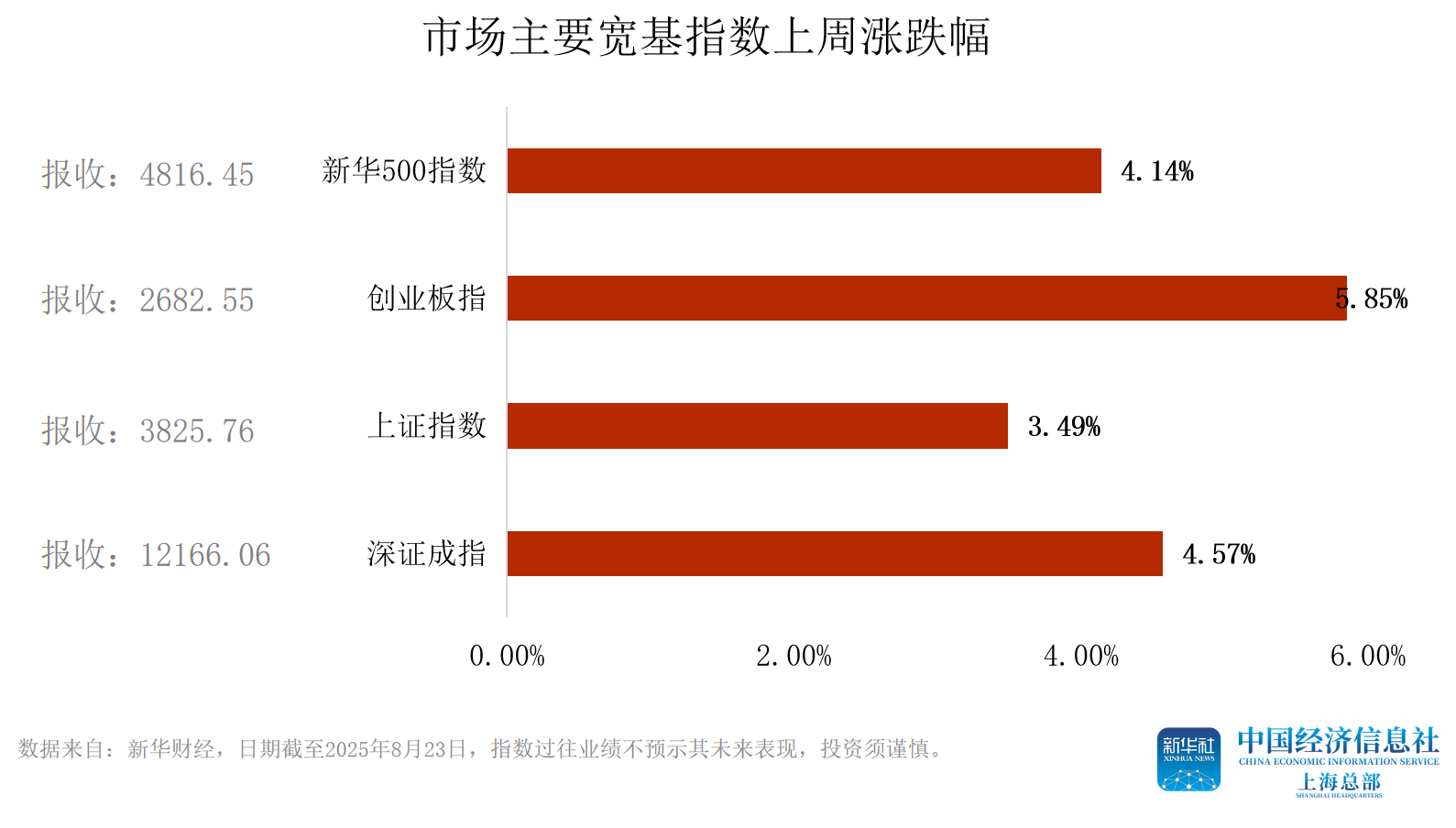
Market Overview - Major indices accelerated their rise last week, with the Shanghai Composite Index surpassing the 3800-point mark, increasing by 3.49% weekly. The Shenzhen Component Index rose by 4.57%, the ChiNext Index by 5.85%, and the Xinhua 500 Index by 4.14% [1] - The Xinhua 500 Index achieved its best weekly performance of the year, opening at 4644.1 points and closing at 4816.45 points, with a weekly fluctuation of 4.34% and a total trading volume of 4.1 trillion yuan, an increase of 1.03 trillion yuan week-on-week [1] Industry Performance - All industry indices under the Shenwan first-level industry classification rose last week, with the highest gains seen in the telecommunications, electronics, comprehensive, computer, and beauty care sectors. Conversely, the real estate, coal, pharmaceutical, banking, and non-ferrous metals sectors lagged behind [4] Government Policies and Regulations - The State Council issued guidelines to enhance financial support for government and social capital cooperation (PPP) projects, allowing local governments to utilize general and special bonds for construction costs of eligible ongoing projects [6] - The Ministry of Finance and the State Taxation Administration announced improvements to the VAT refund policy, providing full monthly refunds for certain industries, including manufacturing and environmental protection [7] - New regulations for rare earth mining and smelting were introduced, imposing penalties on companies that violate the rules [7] - A draft regulation on internet platform pricing behavior was released, focusing on guiding lawful pricing practices and establishing a collaborative governance mechanism [7] - The Financial Regulatory Bureau is seeking opinions on a draft for managing commercial bank merger loans, categorizing them into control-type and equity-type loans [8]


芯片制造,将被改写
半导体行业观察· 2025-08-25 01:46
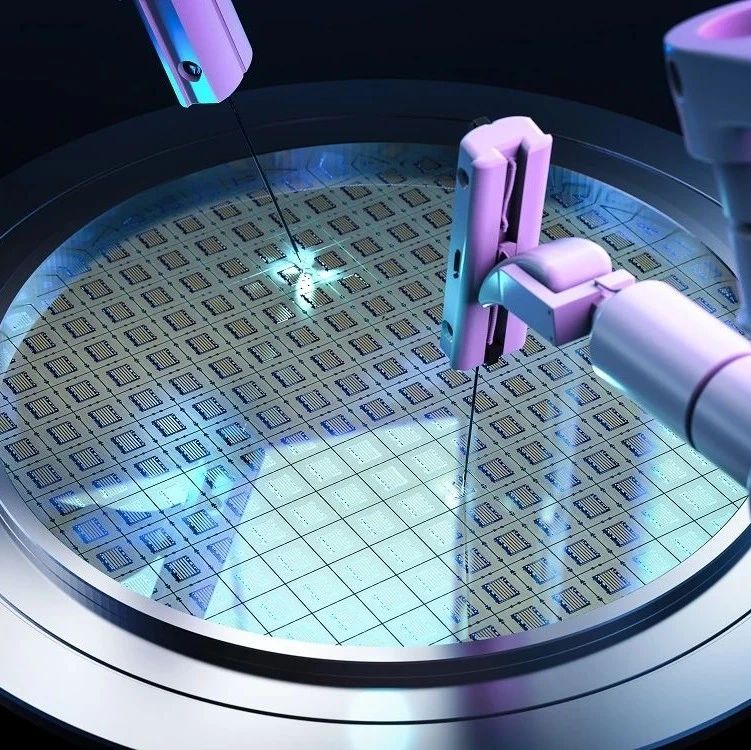
Core Viewpoint - The article emphasizes the critical role of hybrid bonding technology in advancing semiconductor manufacturing, particularly as it moves towards sub-micron dimensions, highlighting the challenges and necessary innovations in process control and design integration [2][3][26]. Group 1: Current State of Hybrid Bonding - Hybrid bonding has been in production for years, achieving stable yields with 10µm interconnects, but as the process scales down to 5µm, the tolerances become extremely tight, requiring precise control of surface morphology and alignment [2][3]. - Most manufacturers currently operate within the 8 to 6µm range, with new bonding and measurement equipment pushing defect rates closer to the sub-micron thresholds needed for next-generation applications [3][5]. Group 2: Challenges in Sub-Micron Bonding - As bonding distances shrink below 1µm, surface treatment and alignment become equally critical, with even minor defects potentially leading to significant yield loss [5][6]. - Defect control extends beyond microscopic features; macro defects like edge chipping and residue can critically impact yield, necessitating rigorous inspection of the entire wafer [6][7]. Group 3: Process Control and Measurement - The complexity of managing variables in sub-micron bonding requires a fundamental restructuring of design, measurement, and process control interactions [2][5]. - Real-time monitoring and feedback control systems are essential to maintain alignment and process parameters, as even slight deviations can lead to yield loss [15][16]. Group 4: Integration of Design and Manufacturing - The separation between design and manufacturing becomes a burden as hybrid bonding technology advances, necessitating early consideration of bonding process parameters in design [23][24]. - Assembly Design Kits (ADK) bridge the gap by translating manufacturing constraints into actionable design rules, ensuring that designs are manufacturable and yield-friendly [23][24]. Group 5: Future Directions and Economic Viability - The success of sub-micron hybrid bonding hinges on the integration of design, process, and supply chain ecosystems, with a focus on achieving predictable economic benefits [26][27]. - The industry must address interoperability issues among equipment from different suppliers and the challenges posed by heterogeneous stacking to realize the full potential of hybrid bonding technology [26][27].
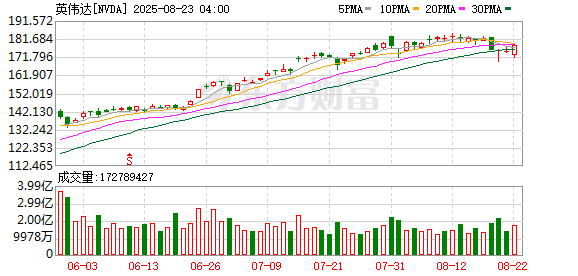
“AI信仰”迎大考!美股新高之路的“重磅关卡”:英伟达(NVDA.US)本周能否交出完美财报?
Zhi Tong Cai Jing· 2025-08-24 23:32
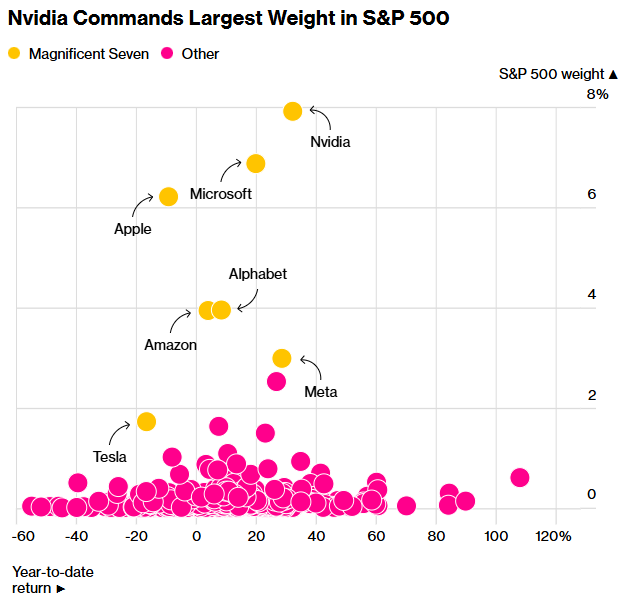
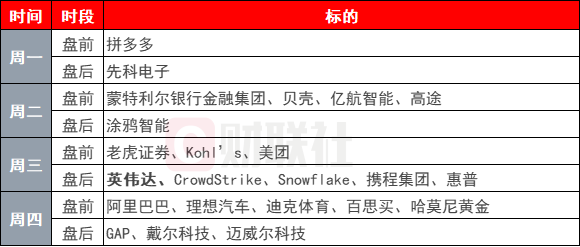
在美联储主席鲍威尔表示9月将要降息之后,市场情绪得以稍为放松;但接下来,美股将面临新的一项考 验。那就是:要评估过去几年推动上涨的主要因素是否还有动能,即对人工智能的狂热追捧。本周,美 股市场将迎来最重磅的财报——英伟达(NVDA.US),该公司将于周三盘后(周四晨间)公布最新季度业 绩。 上周五,开盘时市场情绪较为低迷,标普500指数原本势将连续五天下跌,或是自1月以来持续时间最长 的连跌态势。华尔街交易员此前一直减少押注美联储即将降息,但鲍威尔的言论消除了这些担忧,推动 标普500指数飙升至5月以来的最佳单日表现,距离历史最高点仅差不到两点。 对于AI热潮,交易员们希望英伟达能够缓解人们对AI领域投资的担忧,并切实证明股市近期的上涨并 非仅仅是技术股的泡沫现象。 据Steward Partners财富管理部门的执行董事Eric Beiley称:"英伟达对于股市至关重要,因为任何进一步 增强的势头都足以点燃这个市场,使其沸腾起来。。潜在的风险在于,如果这些AI投资未能取得成 效,且其前景较为谨慎,那么这可能会导致市场波动。"他持有该公司股票,但在其股价大幅上涨后, 他已开始增加对冲措施。 英伟达的占比规模在 ...

新华财经周报:8月18日至8月24日
Zhong Guo Jin Rong Xin Xi Wang· 2025-08-24 10:05
Key Points - The State Council is focusing on implementing large-scale equipment updates and a consumption upgrade policy to boost sports consumption potential and promote high-quality development in the sports industry [1] - The Ministry of Finance allows local governments to utilize general and special bonds for the construction costs of existing PPP projects, enhancing financial support for these initiatives [2] - The announcement regarding the personal pension system includes three new scenarios for pension withdrawals, effective from September 1, aimed at increasing accessibility [1] - The introduction of tax exemptions for childcare subsidies is set to take effect from January 1, 2025, promoting family support [3] - New regulations on rare earth mining and smelting have been issued to ensure compliance and proper management within the industry [4] - The average pig-to-grain price ratio has dropped below 6:1, prompting the National Development and Reform Commission to enter a warning zone and initiate measures to stabilize the pork market [5] - The financial regulatory authority is seeking opinions on a draft for managing commercial bank merger loans, categorizing them into control-type and equity-type loans [5] - The Hong Kong Stock Exchange is considering a 24-hour trading mechanism, following Nasdaq's plans, which will require system upgrades and regulatory adjustments [8] - The Shanghai Municipal Government is promoting the application of industrial robots in key sectors to enhance production efficiency and safety [9]
可口可乐考虑出售旗下英国咖啡连锁品牌Costa Coffee|首席资讯日报
首席商业评论· 2025-08-24 04:27
Group 1 - The article discusses the regulatory framework for internet platforms, emphasizing that the recent document is aimed at standardizing practices rather than halting competition or subsidies [1] - The document requires platforms to disclose rules for promotional activities and prohibits false advertising and exaggeration of subsidy amounts [1] Group 2 - Lucky Coffee, a brand under Mixue Group, opened its first overseas store in Malaysia, selling nearly 2000 cups on the opening day, marking the start of its global expansion [2] - As of July, Lucky Coffee has signed over 7000 stores in the domestic market and plans to refine its overseas store model while deepening its presence in Southeast Asia [2] Group 3 - Coca-Cola is considering selling its UK coffee chain Costa Coffee, which it acquired for $3.9 billion in 2019, and has hired Lazard to evaluate potential options [3] - Initial discussions have taken place with a few potential bidders, including private equity firms, but no deal is guaranteed at this stage [3] Group 4 - In the first seven months of the year, Shaanxi's automobile production reached 1.083 million units, a year-on-year increase of 22.1%, significantly outpacing the national growth rate of 11.6% [4] - The production of new energy vehicles in the province reached 743,000 units, accounting for 68.6% of total automobile production [4] Group 5 - Honglu Steel Structure has begun limited external sales of its self-developed welding industrial robots, which are primarily used internally at present [5] - The company has deployed nearly 2500 welding robots across its ten production bases [5] Group 6 - Oriental Selection reported a 32.7% year-on-year decline in net revenue for its continuing operations, dropping from 6.5 billion yuan to 4.4 billion yuan for the fiscal year ending May 31, 2025 [6] - The company achieved a net profit of 6.2 million yuan for the fiscal year, compared to a profit of 249.1 million yuan in the previous year, but would have seen a 30% increase in profit if the sale of a subsidiary had been excluded [6] Group 7 - The film "Final Destination: Bloodline Curse" has grossed over 30 million yuan in its first two days of release in mainland China [7] Group 8 - Huawei Cloud is undergoing organizational restructuring, focusing on AI and consolidating several departments to improve operational efficiency [8] - The restructuring aims to increase investment in strategic industries while reducing focus on non-strategic areas [8] Group 9 - The U.S. government has become Intel's largest shareholder by investing $8.9 billion for a 9.9% stake in the company, raising concerns about market intervention [9]


【环球财经】一周前瞻:英伟达财报揭晓,美联储青睐的通胀指标公布
Xin Hua Cai Jing· 2025-08-24 02:06
Market Overview - The US non-farm payroll data for May and June was significantly revised downwards, leading to a dovish shift from Fed Chair Powell at the Jackson Hole global central bank meeting, resulting in a decline in US Treasury yields and the dollar, while US stocks surged [2] - The S&P 500 index rose by 0.27% for the week, approaching its historical closing high set on August 14, while the Dow Jones Industrial Average increased by 1.53%, reaching a new all-time high [2][4] - European stocks also saw gains, with the STOXX 600 index up 1.40% for the week, while Asian markets were mixed, with Japan's Nikkei 225 down 1.72% and India's SENSEX 30 up 0.88% [2][4] Currency and Commodity Markets - The US dollar index initially rose but fell by 0.12% to close at 97.72 after Powell's comments on employment market risks [3] - Precious metals saw gains, with spot gold rising to $3,371.54 per ounce, up 1.07%, and COMEX silver futures increasing by 2.38% to $38.88 per ounce [3][4] - Crude oil prices also rose, with WTI crude up 2.89% to $63.77 per barrel and Brent crude up 2.17% to $67.28 per barrel [3][4] Nvidia Earnings Expectations - Nvidia is set to release its Q2 FY2026 earnings on August 27, with expected revenue of $45.8 billion, reflecting a year-over-year growth of 52.4% [5] - Analysts are particularly focused on the demand structure for AI chips, the ramp-up of Blackwell chip production, and the outlook for the Chinese market [5] - Nvidia's revenue is anticipated to be driven primarily by its data center business, which is expected to generate $42-43 billion, a 64% year-over-year increase [5] Alibaba and Pinduoduo Earnings Forecast - Alibaba is scheduled to announce its Q1 FY2026 results on August 29, with expected revenue of 249 billion yuan, a 2% year-over-year increase [7] - Analysts predict a decline in adjusted EBITA by 15% to 38.2 billion yuan due to increased investment in flash sales [7] - Pinduoduo is expected to report Q2 FY2025 earnings on August 25, with anticipated revenue of 103.2 billion yuan, a 6.32% year-over-year increase, but a significant drop in earnings per share [8]
高通芯片,越来越贵了
半导体行业观察· 2025-08-24 01:40
Core Viewpoint - Samsung Electronics is facing rising costs for mobile application processors (AP) due to reliance on high-priced external APs from Qualcomm, making the performance of its own Exynos processors increasingly critical for future smartphone models [2][3]. Group 1: Cost and Procurement - Samsung's mobile AP procurement costs increased by 29.2% in the first half of the year, reaching 7.7899 trillion KRW compared to 6.0275 trillion KRW in the same period last year [2]. - The proportion of mobile APs in the total raw material procurement of the Device Experience (DX) department rose from 17.1% to 19.9% [2]. - The high-end Galaxy S25 series and Galaxy Z Fold 7 smartphones are equipped with Qualcomm's Snapdragon processors, which are more expensive than Exynos [2]. Group 2: Future Developments - Samsung is developing the next-generation Exynos 2600 using advanced 2nm process technology, which is expected to improve performance and stability [3]. - The evaluation of Exynos 2600 is ongoing, with indications that it may be used in the upcoming Galaxy S26 series [3][4]. - Analysts suggest that the application of Exynos 2600 in flagship models could enhance profitability and competitiveness compared to the current year [4]. Group 3: Market Dynamics - Qualcomm's Snapdragon 8 Gen 4 is projected to be 25% to 30% more expensive than its predecessor, with prices expected to range from $190 to $200 [4]. - Qualcomm has requested a price increase of $15 per unit for its APs supplied to Samsung for the next year, raising the cost to approximately $210 per device for Samsung's Galaxy series [4]. - The majority of smartphone components, aside from APs and memory, have not seen significant specification changes in recent years, prompting manufacturers like Samsung and Xiaomi to invest more in self-developed chips [5].


环球下周看点:英伟达(DVNA.US)财报重磅登场 美联储最青睐通胀指标将出炉
智通财经网· 2025-08-24 01:23
Core Viewpoint - The Federal Reserve Chairman Jerome Powell's comments have opened the door for potential interest rate cuts, leading to a significant rebound in risk assets, with the Dow Jones Index hitting its first record close of the year and the S&P 500 ending a five-day decline [1] Group 1: Nvidia's Earnings Impact - Nvidia's upcoming earnings report is seen as a critical test for the entire AI trading logic, with expectations of $45.9 billion in revenue for Q2 and a 48% year-over-year increase in earnings per share [1] - Nvidia has become synonymous with the AI market, and its performance is expected to have a rapid ripple effect across the entire AI supply chain, which has been a major driver for the S&P 500's rise this year [2] - The stock's recent surge has not only supported the tech sector but has also buoyed the overall market, with Nvidia recently becoming the first company to surpass a $4 trillion market capitalization [1] Group 2: Market Sentiment and Tech Sector - Recent weakness in tech stocks is attributed to cautious sentiment regarding the AI industry's outlook, with warnings from industry leaders about potential overexcitement and market bubbles [2] - Major cloud companies like Google, Microsoft, and Amazon have raised their capital expenditure forecasts, which is favorable for Nvidia, as demand for AI chips is expanding beyond large-scale companies to a broader range of industry clients [2] Group 3: Upcoming Economic Indicators - Investors are anticipating key economic data next week, including the Personal Consumption Expenditures (PCE) price index, which is favored by the Federal Reserve [3] - Economists expect the core PCE index for July to remain unchanged at 0.3% month-over-month, with a slight year-over-year rebound to 2.9%, which may not disrupt the Fed's plans for a rate cut in September [3]
【环球财经】美国政府收购英特尔约10%股份 成为大股东
Zhong Guo Jin Rong Xin Xi Wang· 2025-08-23 04:12
Core Viewpoint - Intel has reached an agreement with the U.S. government for an investment of $8.9 billion, resulting in the government acquiring a 9.9% stake in the company, making it one of Intel's largest shareholders [1] Investment Details - The investment consists of $5.7 billion in subsidies from the CHIPS and Science Act and an additional $3.2 billion from a government-funded project [1] - The government will purchase 433.3 million shares at a price of $20.47 per share, totaling $8.9 billion [1] - Including previously received subsidies of $2.2 billion, the total investment from the U.S. government amounts to $11.1 billion [1] Shareholder Rights - The U.S. government will hold a passive stake and will not have board seats, governance rights, or information rights [1] - The government has agreed to align with the company's board on matters requiring shareholder approval, with few exceptions [1]

芯片巨头,壮士断臂
半导体行业观察· 2025-08-23 02:10
Core Viewpoint - The semiconductor industry is undergoing significant transformation driven by emerging technologies such as 5G, AI, and IoT, necessitating companies to strategically focus on high-potential technology sectors while also being willing to divest from less promising areas [2][3]. Group 1: Strategic Shifts in Semiconductor Companies - Major semiconductor companies are increasingly adopting a "cut and focus" strategy, which involves exiting less profitable segments to concentrate resources on high-value areas [4][5]. - Companies like AMD, Philips, Texas Instruments, Intel, and NVIDIA have successfully transformed by implementing similar strategic shifts, demonstrating the importance of market insight and timely decision-making [4][5]. Group 2: Recent Industry Developments - Samsung, SK Hynix, and Micron have announced plans to cease DDR4 production, redirecting resources towards higher-margin products like DDR5 and HBM due to declining profitability in the DDR4 market [7][8][9][10]. - Micron has also decided to halt mobile NAND development, focusing instead on SSD and automotive NAND markets, reflecting a strategic realignment towards more profitable segments [12][13]. - Samsung's exit from MLC NAND production is driven by its marginal contribution to revenue and the shift towards more advanced NAND technologies [15]. Group 3: Company-Specific Strategic Decisions - SK Hynix has closed its CIS department to focus on high-bandwidth memory (HBM) production, capitalizing on the growing demand in AI server markets [19][20]. - TSMC has announced its exit from GaN foundry services, citing low profitability and high competition, while also planning to phase out its 6-inch wafer production to concentrate on advanced processes [21][22][23]. - NXP is closing several 8-inch wafer fabs to invest in 12-inch manufacturing, aligning with the industry's shift towards larger wafers for better efficiency and cost-effectiveness [24][25][26]. Group 4: Broader Industry Trends - The semiconductor industry is witnessing a trend of companies divesting from low-margin businesses and reallocating resources to high-potential areas such as AI and advanced manufacturing processes [46][47]. - This trend reflects a broader industry movement towards optimizing business structures and enhancing competitiveness in a rapidly evolving market landscape [46][47].