运输设备

Search documents
美国制造业崩盘式萎缩,关税风暴下“避险之王”刷新历史高点
Sou Hu Cai Jing· 2025-09-03 03:40
Group 1: Gold Market Dynamics - Gold prices surged over 1% on September 2, reaching a historic high of $3539.88 per ounce, closing at $3533.40 per ounce, reflecting a 34.5% increase year-to-date, significantly outperforming other assets [1] - The rise in gold prices is attributed to the weak U.S. economy, trade policy uncertainties, and global geopolitical risks, with investors seeking safe-haven assets amid these challenges [1][4] - The demand for gold is further supported by central bank purchases and diversification away from the U.S. dollar, reinforcing its status as a reliable hedge against economic instability [6][10] Group 2: U.S. Manufacturing Sector - The U.S. manufacturing sector has been in decline for six consecutive months, with the August PMI slightly improving to 48.7 but still below the neutral level of 50, indicating ongoing contraction [3] - High tariff policies implemented by the Trump administration have led to increased costs for manufacturers, negatively impacting profit margins and employment in the sector [3][5] - Factory construction spending fell by 6.7% year-over-year in July, signaling a cooling investment sentiment within the manufacturing industry [3] Group 3: Economic Indicators and Market Reactions - The market anticipates a 90% probability of a 25 basis point rate cut by the Federal Reserve on September 17, with potential discussions for a 50 basis point cut if upcoming non-farm payroll data is weak [7][11] - The uncertainty surrounding tariffs has led to significant declines in stock markets, with the Dow Jones Industrial Average dropping 0.55% and the S&P 500 down 0.69% at the start of September [5] - Rising U.S. debt levels, now at $37.18 trillion, and concerns over fiscal deficits are contributing to increased yields in the bond market, further driving investors towards gold [5][6] Group 4: Global Economic Context - Global factors, including inflation concerns in the Eurozone and political instability in Japan and the UK, are contributing to a complex risk environment that supports gold's appeal as a safe-haven asset [10] - The interplay of stagnant economic growth and inflationary pressures, described as "stagflation," enhances gold's role as a hedge [10] - The upcoming release of U.S. economic data, including factory orders and job openings, will be critical in shaping market expectations and gold prices [11]


中国贸促会:全球经贸摩擦继续呈现缓和态势
Bei Ke Cai Jing· 2025-08-28 05:20
Group 1 - The global trade friction index for June is 92, indicating a moderate to high level of trade tensions, with a year-on-year decrease of 14.7% and a month-on-month decrease of 13.7% in the monetary value of trade friction measures [1] - Among 20 monitored countries, India, the United States, and Brazil have the highest trade friction indices, with the United States having the most significant monetary involvement for 12 consecutive months [2] - In 13 major industries monitored, trade friction is primarily concentrated in the electronics, transportation equipment, and machinery sectors, with the electronics sector having the highest trade friction index [3] Group 2 - A total of 23 import and export tariff measures were announced across the 20 monitored countries, along with 47 trade remedy investigations, 93 notifications to the WTO regarding technical barriers to trade (TBT) and sanitary and phytosanitary measures (SPS), 12 import and export restrictions, and 145 other restrictive measures, indicating that tariff measures are a common tool for protecting domestic industries [3] - The trade friction index concerning China is at a high level of 102 among 19 countries, with India having the highest index related to China, particularly in the electronics sector, including cameras, routers, and chips [3] - The monetary value of trade friction measures involving China has decreased by 16.3% year-on-year and 13.6% month-on-month among the 19 countries [3]
中国通号(688009):城轨复苏明显,海外收入继续高增
HTSC· 2025-08-28 05:00
Investment Rating - The report maintains a "Buy" rating for the company [7][5]. Core Views - The company reported a total revenue of 14.73 billion yuan for H1 2025, a year-on-year increase of 2.77%, with a net profit of 1.62 billion yuan, reflecting a year-on-year growth of 1.34% [1]. - The recovery in urban rail and significant growth in overseas revenue are expected to drive future performance, alongside the demand for upgrades and renovations in the rail transit sector [1][3]. - The company is positioned to benefit from the ongoing upgrades in high-speed rail communication systems and the opening of new growth avenues in overseas markets [5]. Summary by Sections Financial Performance - For H1 2025, the gross margin was 28.76%, a decrease of 0.6 percentage points year-on-year, while the net profit margin was 12.70%, down 0.35 percentage points year-on-year [2]. - In Q2 2025, the company achieved a gross margin of 30.06%, a year-on-year decrease of 0.93 percentage points but an increase of 2.83 percentage points quarter-on-quarter [2]. Business Segments - The company’s revenue from the urban rail sector reached 3.92 billion yuan in H1 2025, a year-on-year increase of 12.85%, while overseas revenue surged by 55.92% to 944 million yuan [3]. - The total new contracts signed in H1 2025 amounted to 17.57 billion yuan, a decrease of 16.44% year-on-year, primarily due to a strategic reduction in low-margin engineering contracts [3]. Market Position - The company continues to lead in the high-speed rail and urban rail signal system integration markets, with significant contracts awarded for key projects [4]. - The company secured contracts worth 1.48 billion yuan for high-speed rail renovation projects, marking a year-on-year increase of 74.86% [4]. Profit Forecast and Valuation - The forecast for net profit for 2025-2027 is adjusted to 3.70 billion, 3.93 billion, and 4.24 billion yuan respectively, with corresponding EPS estimates of 0.35, 0.37, and 0.40 yuan [5]. - The target price for the company's A/H shares is set at 7.00 yuan and 4.02 HKD, reflecting a valuation of 20x and 10.5x PE respectively for 2025 [5].

中国贸促会:6月全球经贸摩擦呈缓和态势
Zhong Guo Xin Wen Wang· 2025-08-27 06:37
Group 1 - The global trade friction index for June is reported at 92, indicating a moderate to high level of trade tensions, with a year-on-year decrease of 14.7% and a month-on-month decrease of 13.7% in the monetary value of trade friction measures [1] - The United States continues to lead in global trade friction measures, with the highest monetary involvement for 12 consecutive months, followed by India and Brazil [1] - The electronics, transportation equipment, and machinery sectors are the primary focus of trade friction, with the electronics sector having the highest trade friction index [1] Group 2 - The trade friction index concerning China from 19 countries is at 102, indicating a high level of trade tensions, with India having the highest index [2] - The monetary value of trade friction measures involving China has decreased by 16.3% year-on-year and 13.6% month-on-month [2] - The electronics sector, particularly in areas such as cameras, routers, and chips, shows a high level of trade friction in relation to China [2]
中国贸促会:受美国延长暂停征收对等关税期限等因素影响,全球经贸摩擦继续呈现缓和态势
Xin Hua Cai Jing· 2025-08-27 06:25
Core Insights - The global trade friction index for June is reported at 92, indicating a medium to high level of trade tensions [1] - Global trade friction measures have decreased, with the total amount involved dropping by 14.7% year-on-year and 13.7% month-on-month [1] Industry Analysis - Among 13 major industries monitored, trade friction measures are primarily concentrated in the electronics, transportation equipment, and machinery sectors, with the electronics industry having the highest trade friction index [1] - The index for import and export tariff measures is the highest among various sub-indices, reflecting the impact of U.S. tariff policies as a common method for economies to protect domestic industries [1] Trade Measures Overview - A total of 23 import and export tariff measures were reported across 20 countries/regions, alongside 47 trade remedy investigations initiated [1] - There were 93 notifications submitted to the WTO regarding technical barriers to trade (TBT) and sanitary and phytosanitary measures (SPS), as well as 12 import and export restrictions and 145 other restrictive measures [1]
中国贸促会:外企在华深耕意愿强烈 中国仍是全球外资前三大投资目的地之一
智通财经网· 2025-08-27 06:08
Group 1: Trade Promotion and Foreign Investment - In July 2025, the China Council for the Promotion of International Trade (CCPIT) issued a total of 741,700 certificates, marking a year-on-year increase of 10.82%, indicating a strong performance in foreign trade [7][11] - The non-preferential certificates amounted to $30.953 billion, with a volume of 398,100 certificates, reflecting a 5.13% increase year-on-year [7] - The preferential certificates reached $8.756 billion, with 276,300 certificates issued, showing a significant year-on-year growth of 39.66% in value and 49.42% in volume [7] Group 2: Global Trade Tensions - The global trade friction index for June 2025 was reported at 92, indicating a moderate level of trade tensions, with a year-on-year decrease of 14.7% in the monetary value of trade friction measures [4] - The United States continued to lead in trade friction measures, with the highest monetary impact, maintaining this position for 12 consecutive months [4] - The electronics sector was identified as the primary area of conflict in trade tensions, with significant measures reported [4] Group 3: International Cooperation and Events - The China-ASEAN Business and Investment Summit is set to take place, highlighting the ongoing collaboration between China and ASEAN countries, with a trade value of 4.29 trillion yuan, reflecting a 9.4% increase [20][21] - The upcoming Shanghai Cooperation Organization (SCO) summit will feature various economic activities aimed at enhancing cooperation among member states [17][18] - The Guangdong-Hong Kong-Macao Greater Bay Area Development Business Conference has attracted over 2,000 representatives from nearly 30 countries, showcasing its significance in regional economic collaboration [22][23] Group 4: Brand Promotion at International Events - The China Pavilion at the Osaka World Expo has attracted over 1.3 million visitors since its opening, showcasing numerous Chinese brands and innovations [9][8] - Notable exhibits include AI technologies and sustainable practices from leading Chinese companies, emphasizing the shift from "Made in China" to "Created in China" [8][9] - The pavilion serves as a platform for promoting Chinese culture and brands to a global audience, enhancing China's international image [9]
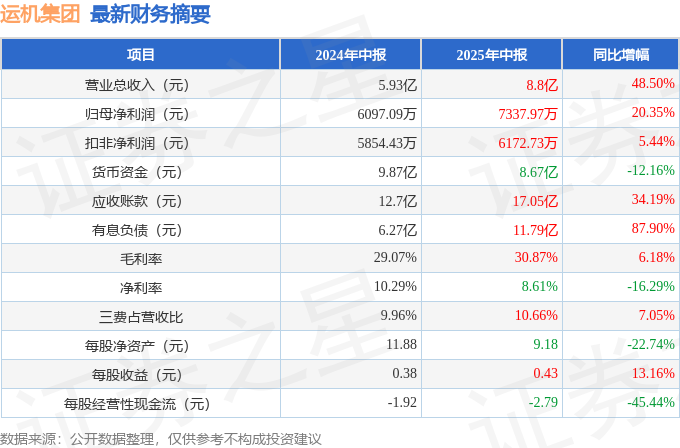
运机集团2025年中报简析:营收净利润同比双双增长,应收账款上升
Zheng Quan Zhi Xing· 2025-08-26 23:09
Core Viewpoint - The recent financial report of Yunjigroup (001288) shows significant growth in revenue and net profit, but also highlights concerns regarding rising accounts receivable and declining cash flow per share [1][3]. Financial Performance Summary - Total revenue for the first half of 2025 reached 880 million yuan, a year-on-year increase of 48.5% compared to 593 million yuan in 2024 [1]. - Net profit attributable to shareholders was 73.38 million yuan, up 20.35% from 60.97 million yuan in the previous year [1]. - The gross profit margin improved to 30.87%, an increase of 6.18% year-on-year, while the net profit margin decreased to 8.61%, down 16.29% [1]. - The total of selling, administrative, and financial expenses amounted to 93.82 million yuan, accounting for 10.66% of revenue, which is a 7.05% increase from the previous year [1]. - Earnings per share rose to 0.43 yuan, reflecting a 13.16% increase from 0.38 yuan [1]. Balance Sheet Highlights - Accounts receivable increased by 34.19% to 1.705 billion yuan, indicating a rise in credit sales [1][3]. - Cash and cash equivalents decreased by 12.16% to 867 million yuan due to increased expenditures on investment projects and inventory [3]. - Interest-bearing liabilities surged by 87.90% to 1.179 billion yuan, primarily due to increased bank borrowings [1][3]. Cash Flow Analysis - Operating cash flow per share was -2.79 yuan, a significant decline of 45.44% year-on-year, indicating cash flow challenges [1]. - The net cash flow from operating activities decreased by 113.57%, attributed to increased procurement payments [3]. Investment and Capital Expenditure - The company’s return on invested capital (ROIC) was reported at 6.26%, which is considered average [4]. - The company relies heavily on capital expenditures for growth, necessitating careful evaluation of the profitability of these investments [5]. Market Sentiment and Shareholder Actions - The controlling shareholder has indicated no plans for significant share reductions in the next 2-3 years, except for a small portion held by employees [6]. - The largest fund holding Yunjigroup shares is the Bosera Convertible Bond Enhanced Bond A, which has seen a 52.81% increase over the past year [5].
中金:破解出口好于市场预期的原因
中金点睛· 2025-08-25 23:26
Core Viewpoint - China's export growth from January to July 2025 significantly exceeded market expectations, driven by the acceleration of industrialization in emerging markets and developing countries, alongside China's competitive supply chain and increased export of intermediate goods [2][4]. Export Growth Analysis - In the first seven months of 2025, China's exports in dollar terms increased by 6.1% year-on-year, while the market anticipated only a 0.88% growth due to global tariff disruptions [2]. - The export growth was primarily supported by intermediate goods, which saw a year-on-year increase of 9.5%, outperforming capital goods at 6.8% and consumer goods at -1.6% [4]. Export Structure Changes - The share of intermediate goods in China's export structure rose from 45.4% in 2024 to 47.4% in 2025, while consumer goods decreased from 31.9% to 29.4%, and capital goods slightly declined from 20.0% to 19.9% [6]. - Since 2018, the share of intermediate goods in China's exports has been on an upward trend, increasing by 5.5 percentage points from 2017 to the first seven months of 2025 [6]. Regional Export Dynamics - The growth in intermediate goods exports was primarily directed towards emerging markets and developing countries, with significant increases in exports to Thailand (28%), Saudi Arabia (23%), and India (21%) [8][10]. - In contrast, exports of intermediate goods to developed countries like the United States, Netherlands, and Japan experienced negative growth [8]. Sector-Specific Export Performance - Key sectors showing high growth in intermediate goods exports included machinery and electronics (15%), non-ferrous metals (6%), transportation equipment (7%), and precision instruments (16%) [15]. - This performance reflects China's manufacturing scale advantages and enhanced technological innovation capabilities [15].

科创板收盘播报:科创50指数冲高回落涨3.20% 寒武纪成交额近250亿元
Xin Hua Cai Jing· 2025-08-25 07:44
Group 1 - The Sci-Tech Innovation 50 Index experienced a high and then a pullback on August 25, with an initial increase of nearly 6%, closing at 1287.73 points, reflecting a gain of 3.20% and a volatility of 5.44% [1] - A total of 364 stocks in the Sci-Tech Innovation Board rose, with both high-priced and low-priced stocks showing upward trends [1] - Key sectors such as aviation, healthcare, and transportation equipment saw active performance, while some semiconductor and biopharmaceutical stocks declined [1] Group 2 - On August 25, the average increase for 589 stocks on the Sci-Tech Innovation Board was 1.23%, with an average turnover rate of 5.19%, and a total trading volume of 347.3 billion yuan, averaging a volatility of 5.34% [1] - Among individual stocks, Angtian Hongtu and Kaipu Cloud led the gains with a 20% increase, while Haooubo experienced the largest decline at 9.01% [1] - In terms of trading volume, Cambrian Technology topped the list with 24.99 billion yuan, while ST Pava had the lowest at 1.299 million yuan [2]

安联贸易:2025全球应收账款与营运资金报告
Sou Hu Cai Jing· 2025-08-21 03:53
Core Insights - The report indicates that global working capital requirements (WCR) increased by 2 days to 78 days in 2024, marking the highest level since 2008, with no signs of relief at the beginning of 2025 [2][8][11] - Economic volatility, trade tensions, and tightening financial conditions are driving this increase, forcing companies to adapt to uncertainty and bear associated costs [2][8] - There are significant regional differences in working capital needs, with Western Europe experiencing a continuous increase of 4 days, while North America saw a decrease of 3 days [2][12] Regional Analysis - In Western Europe, companies face delayed receivables, with accounts receivable turnover days (DSO) increasing for the third consecutive year, leading to a reliance on trade credit, which is projected to reach approximately €11 billion [9][28] - North American companies have reduced their working capital needs by 3 days, primarily through inventory reduction and reallocating funds to shareholders, with stock buybacks expected to exceed $1 trillion in 2025 [2][8][29] - The Asia-Pacific region saw a slight increase of 2 days in working capital needs, with significant contributions from China and Singapore [27][12] Industry Trends - Almost all industries are experiencing an increase in DSO, particularly in transportation equipment (+11 days) and electronics (+4 days), leading to a general rebound in working capital needs [3][34] - Seven industries globally are witnessing increased working capital requirements across North America, Western Europe, and Asia-Pacific due to weak demand, while declines are more scattered [3][35] - The construction and commodities sectors are showing the most significant reversals in trends at the beginning of 2025 [3][34] Financial Dynamics - European companies are acting as "shadow banks," providing significant trade credit, which poses risks if economic growth slows or interest rates rise [9][28] - The report highlights that 35% of global companies have working capital needs exceeding 90 days, indicating a persistent challenge in cash flow management [11][18] - The report also notes that the average inventory turnover days (DIO) remain stable, with inventory still accounting for a significant portion of working capital needs [19][34]