
光模块

Search documents
新力量NewForce总第4899期
First Shanghai Securities· 2025-11-10 11:51
Group 1: Company Research - Hua Hong Semiconductor (1347, Buy): Revenue reached a historical high of $635 million in Q3 2025, up 20.7% YoY and 12.2% QoQ, with a gross margin of 13.5%[8] - Applied Optoelectronics (AAOI, Buy): Q3 revenue was $119 million, up 81.9% YoY, with a Non-GAAP gross margin of 31%[15] - PetroChina (857, Buy): Revenue for the first three quarters of 2025 was CNY 2.17 trillion, down 3.9% YoY, with a net profit of CNY 126.3 billion, down 4.9% YoY[21] - GF Securities (1776, Buy): Expected net profits for 2025-2027 are CNY 14.39 billion, CNY 16.82 billion, and CNY 19.40 billion respectively[37] Group 2: Industry Insights - The semiconductor industry is experiencing a sustained demand for computing power driven by AI applications, with expectations for domestic chip production to ramp up in 2026[48] - The global market for optical modules is projected to see significant growth, with 800G and 1.6T module shipments expected to exceed 45 million and 28 million units respectively by 2026[53] - Risks include potential underperformance in production expansion, demand fluctuations, and currency exchange rate changes[12]

创业板50指数上涨0.88%,光模块和电池板块表现强劲
Xin Lang Cai Jing· 2025-11-10 11:41
Market Overview - The A-share market showed an overall upward trend last week, with major indices recording positive growth. The CSI 300 index rose by 0.82%, while the CSI 500 index slightly decreased by 0.04%. The ChiNext 50 index performed particularly well, increasing by 0.88% [1] - The average daily trading volume in the A-share market remained around 2 trillion yuan, indicating an increase in market activity [1] Industry Highlights - Key sectors attracting market attention include photovoltaic, new energy, and cyclical industries such as coal, steel, and chemicals. Investors are advised to focus on new energy and photovoltaic sectors, utilizing ETF products like the ChiNext 50 ETF, which has 38% exposure to new energy [1] - The ChiNext 50 index reported a year-on-year growth rate of 49% in net profit attributable to shareholders for Q3 2025, alleviating valuation pressure and enhancing investment value [1] - The ChiNext serves as a direct financing platform for innovative enterprises, supporting the development of "three innovations" (innovation, creation, and creativity) and "four new" (new technologies, new industries, new business formats, and new models) [1] Sector Performance - In the optical module and battery sectors, the ChiNext 50 index outperformed the ChiNext index and other mainstream indices. Despite a capital outflow in the optical module sector last week, long-term demand remains strong, driven by the need for 800G/1.6T optical modules due to AI model training [2] - Major cloud providers in North America, including Microsoft, Google, Meta, and Amazon, increased their capital expenditures to a total of $96.4 billion in Q3 2023, a 68% increase year-on-year. The demand for 1.6T optical modules is expected to be revised up to 20 million units by 2026 [2] - The photovoltaic sector rebounded significantly last week, supported by policy guidance from the Ministry of Industry and Information Technology, which emphasized industry self-discipline to promote the coordinated development of photovoltaic and energy storage [2] - The global photovoltaic installation capacity is projected to exceed 500 GW by 2025, providing strong support for the industry's long-term development [2] Pharmaceutical Sector - The pharmaceutical and biotechnology sector experienced a decline last week and is currently undergoing a technical adjustment. The results of medical insurance negotiations indicate that 127 drugs outside the catalog will participate in negotiations, presenting opportunities for some innovative drugs [3] - The increase in flu cases in northern regions poses challenges for related companies. However, some CXO companies reported over 40% year-on-year revenue growth in Q3 2023, demonstrating strong market competitiveness [3] - Long-term innovation remains a key driver in the pharmaceutical industry, with accelerated global licensing of new therapies such as ADC and bispecific antibodies, and significant potential for domestic companies' internationalization [3] ChiNext 50 ETF - The ChiNext 50 ETF (code: 159949) tracks the ChiNext 50 index and adopts standards focused on the "three innovations" and "four new" criteria, primarily selecting leading companies in five major technology sectors: new energy vehicles, biomedicine, electronics, photovoltaics, and internet finance [3] - The index reflects the overall performance of 50 high liquidity and market capitalization companies on the ChiNext, showcasing high investment value. The ChiNext 50 ETF has a strong liquidity profile, with an average daily trading volume of 1.497 billion yuan over the past year, ranking among the top ETFs on the Shenzhen Stock Exchange [3] - The latest fund size of the ChiNext 50 ETF is 26.974 billion yuan, making it one of the larger funds related to the ChiNext market [3]

主力资金丨尾盘10股获资金爆买!
Zheng Quan Shi Bao Wang· 2025-11-10 11:06
Core Insights - The main point of the articles is the analysis of capital flow in various industries, highlighting the sectors that experienced significant inflows and outflows of funds on November 10, 2023. Group 1: Industry Performance - A total of 23 industries saw an increase, with the beauty care and food & beverage sectors leading with gains exceeding 3% [1] - Among the 8 declining industries, the power equipment sector had the largest drop at 1.09% [1] - The food & beverage and retail sectors received the highest net inflows, each exceeding 1.1 billion [1] Group 2: Capital Inflows - Ten industries experienced net inflows, with food & beverage and retail sectors leading with inflows over 1.1 billion each [1] - The real estate sector saw a net inflow of 700 million, while light industry manufacturing and pharmaceutical sectors each had inflows exceeding 400 million [1] Group 3: Capital Outflows - The power equipment sector had the highest net outflow, amounting to 6.88 billion [2] - Other sectors with significant outflows included electronics, mechanical equipment, automotive, and computer industries, each exceeding 2 billion [2] Group 4: Individual Stock Performance - Notable stocks with significant net inflows included Cambridge Technology with 758 million, marking the highest inflow since June 12, 2023 [4] - Wuliangye, a leading liquor company, saw a net inflow of 652 million, emphasizing its commitment to shareholder returns with a projected cash dividend rate of 70% for 2024 [4] - Other companies with notable inflows included BYD, Fushikong, and China Duty Free, among others [5] Group 5: End-of-Day Capital Flow - At the end of the trading day, there was a net inflow of 1.165 billion across the markets, with the ChiNext board contributing 928 million [10] - Individual stocks with significant end-of-day inflows included Tianfu Communication with 316 million [11]





每日投行/机构观点梳理(2025-11-10)
Jin Shi Shu Ju· 2025-11-10 10:46
Group 1: Market Reactions and Economic Indicators - Mitsubishi UFJ highlights that the end of the U.S. government shutdown is expected to reduce data uncertainty and boost investor sentiment, contributing to a recent rebound in U.S. stock markets driven by optimism about the shutdown's resolution [1] - Citigroup forecasts that the yield on Japan's 30-year government bonds will remain in the range of 3% to 3.2%, supported by a reduction in issuance scale, despite potential influences from U.S. market dynamics [1] - ANZ suggests that the impact of the U.S. government shutdown's end on the interest rate market may be limited, as initial market reactions were not particularly negative [1] Group 2: Investment Trends in Japan - Goldman Sachs reports a significant influx of U.S. capital into Japanese stocks, particularly those focused on technology and AI, with participation levels reaching the highest since 2022, driven by strong returns compared to U.S. equities [2] - The Nikkei 225 index has risen approximately 30% this year in U.S. dollar terms, outperforming the S&P 500's 14% increase, indicating a favorable investment climate in Japan [2] - Goldman Sachs believes there is still room for foreign capital inflow into Japan, as current net holdings by global investors are still below peak levels seen during the "Abenomics" era [2] Group 3: Commodity and Sector Insights - CICC anticipates that gold prices will continue to rise next year, supported by structural and cyclical opportunities, including increased gold reserves by emerging market central banks due to geopolitical tensions [3] - CITIC Securities identifies cyclical sectors such as non-ferrous metals, steel, and building materials as potential investment opportunities, driven by expectations of a strong economic cycle in 2026 [4] - Guotai Junan emphasizes the importance of focusing on low-valuation sectors with improving profitability, as the market shifts from a liquidity-driven to a fundamentals-driven phase [6] Group 4: Technological Advancements and Market Opportunities - Guojin Securities highlights the significant growth potential in the lithium battery industry, driven by breakthroughs in solid-state battery technology and surging demand in the global energy storage market [7] - Guosen Securities notes that the rise of silicon photonics technology is reshaping the optical module industry, shifting investment focus towards chip design and wafer manufacturing [8] - China Galaxy Securities suggests that amidst sector rotation, there are opportunities in dividend themes and emerging trends, with a focus on sectors like electric power equipment and lithium batteries [9]
全球股市狂欢能否跨年?游学重庆与付鹏、郁乐畅聊2026资产风向
华尔街见闻· 2025-11-10 10:24
Group 1 - The core concern in the market as 2025 ends is whether the "celebration" of global risk assets can continue into 2026 [1] - The Federal Reserve announced a 25 basis point rate cut and will end its "balance sheet reduction" process on December 1, which has contributed to the rise of the US stock market, reaching a historical high of 6920 points, up over 40% since April [1] - The A-share market also experienced a bull market in 2025, with the Shanghai Composite Index surpassing 4000 points, driven by strong performances in technology and innovative pharmaceutical sectors, with some tech stocks rising over 500% this year [3] Group 2 - Gold has seen rapid price increases, breaking through the $3000 and $4000 per ounce marks, but recently experienced a significant 10% pullback, raising questions about whether this is a temporary technical correction or a shift in its long-term bullish trend [3] - Japan's stock market has surged, with the Nikkei 225 index rising over 70% since April, influenced by political changes and monetary easing policies introduced by the new Prime Minister, who announced a 14 trillion yen stimulus plan [4][7] - The upcoming APEC summit in South Korea is expected to impact global economic and financial market trends, with significant events in the political and economic landscape anticipated in the next two months [8]

剑桥科技20251107
2025-11-10 03:34
Summary of Cambridge Technology Conference Call Company Overview - **Company**: Cambridge Technology - **Industry**: Optical Modules Key Points Financial Performance - Cambridge Technology's revenue for the first three quarters of 2025 reached 3.3 billion RMB, falling short of the 750 million Euro threshold set by the OECD's Pillar Two tax regime [2][4][5] - The company expects to maintain a positive outlook for Q4 2025 despite facing delivery pressures, driven by increased customer demand [2][3] Market Demand and Growth - The demand forecast for optical modules, particularly 800G, has been consistently revised upwards, with expectations that demand may exceed 100 million units by 2027 [2][6] - The company is closely collaborating with clients to ensure future delivery plans and material preparations, indicating a robust growth phase in the industry [2][6] Product Development and Technology - Silicon photonics technology is gaining high acceptance in the market, with most of Cambridge Technology's products above 800G utilizing this solution [2][7] - The company has signed supply agreements with five strategic partners to secure CW light source supplies and has addressed key material issues such as silicon photonic engines and DSPs [2][8] Production Capacity and Plans - Cambridge Technology aims to achieve a production capacity of 2.3 million units by the end of 2025, slightly exceeding expectations, and plans to reach 5 million units by the end of 2026, including both 800G and 1.6T production lines [4][15] - The 1.6T product is expected to account for 20% of total production capacity by the end of 2026 [29] Customer Base and Market Expansion - The company is expanding its business not only through existing customers but also by acquiring new clients, indicating a successful market share expansion for its high-speed optical modules [4][9] - Major clients are expected to drive the demand for 1.6T modules, with significant interest from large customers who require high bandwidth solutions [17] Pricing and Profitability - The current price range for 800G modules is approximately $350 to $400, while 1.6T modules are priced above $1,000, with expectations of price reductions in 2026 [19] - The gross margin for the first half of the year reached 32.4%, with projections to maintain above 40% in 2026 as production scales up [26][31] Supply Chain and Material Preparedness - The company has made sufficient preparations for key materials such as lasers and DSP chips, ensuring supply chain stability through annual agreements [25] - The assembly yield is reported to be above the industry average, contributing to the current gross margin levels [33] Strategic Partnerships and Future Outlook - Cambridge Technology is actively pursuing partnerships with new suppliers to meet diverse customer needs and ensure flexibility in responding to market demands [12][14] - The company is also exploring opportunities with major clients like Nokia, which may lead to increased demand for optical modules in 2026 [28] Challenges and Risks - The company acknowledges potential supply chain challenges, particularly concerning the availability of 800G capacity, which may be slightly below the target of 600,000 units for 2025 [21] - The impact of the OECD's Pillar Two tax regime is being monitored, although the company does not expect to be affected in the short term [4][5] Conclusion Cambridge Technology is positioned for growth in the optical module market, driven by increasing demand for high-speed solutions and strategic partnerships. The company is focused on expanding its production capacity and ensuring supply chain stability while navigating potential challenges in the evolving market landscape.
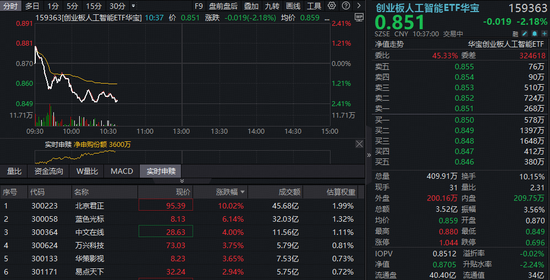
创业板人工智能ETF(159363)回踩20日线,布局窗口到了?AI驱动存储芯片涨价,北京君正逆市涨超10%
Xin Lang Ji Jin· 2025-11-10 02:53
Core Insights - The AI sector continues to experience a pullback, with the ChiNext AI index dropping over 2%, particularly affecting companies heavily invested in optical modules and computing hardware [1] - Despite the downturn, storage chip leader Beijing Junzheng saw a surge of over 10%, indicating a divergence in performance within the sector [1] - The first ChiNext AI ETF (159363) faced a decline of over 2%, with a trading volume exceeding 350 million CNY, reflecting ongoing market volatility [1] Market Performance - Major optical module companies like Xinyisheng and Zhongji Xuchuang experienced declines of over 5% and 4% respectively, while Tianfu Communication fell by over 2% [1] - In contrast, companies involved in AI applications, such as BlueFocus and Zhongwen Online, saw increases of over 4% [1] - The ChiNext AI ETF reported a net subscription of 34.6 million shares despite its price drop, indicating continued investor interest [1] Storage Chip Market - SanDisk, a leading flash memory company, announced a significant price increase of up to 50% for NAND flash contracts, driven by tight supply conditions due to surging demand from AI data centers and wafer supply constraints [2] - This marks SanDisk's third price hike in 2023, following earlier increases of 10% in April and September, which prompted other major players like Micron to follow suit [2] Future Outlook - Tianfeng Securities remains optimistic about the computing power industry, suggesting that 2025 could be a pivotal year for AI infrastructure and applications in China [3] - The firm encourages ongoing monitoring of AI industry dynamics and investment opportunities [3] - The first ChiNext AI ETF (159363) is highlighted as a key investment vehicle, with over 54% of its holdings in optical module leaders, and a significant portion allocated to AI applications [4] Investment Trends - The ChiNext AI ETF has a total scale exceeding 3.5 billion CNY, with an average daily trading volume of over 700 million CNY, positioning it as a leader among similar ETFs tracking the ChiNext AI index [4] - The ETF's strategy focuses on capturing AI thematic trends, with over 70% of its portfolio allocated to computing power and more than 20% to AI applications [4]

新易盛股价跌5.08%,达诚基金旗下1只基金重仓,持有6720股浮亏损失11.93万元
Xin Lang Cai Jing· 2025-11-10 02:23
Core Insights - New Yisheng experienced a decline of 5.08% on November 10, with a stock price of 332.03 CNY per share and a total market capitalization of 3300.29 billion CNY [1] Company Overview - Chengdu New Yisheng Communication Technology Co., Ltd. was established on April 15, 2008, and went public on March 3, 2016. The company specializes in the research, development, production, and sales of optical modules [1] - The revenue composition of the company's main business includes 98.86% from above 25G, 0.87% from below 25G, and 0.26% from other sources, with no revenue from PON [1] Fund Holdings - Dachen Fund has one fund heavily invested in New Yisheng, specifically the Dachen Value Pioneer Flexible Allocation A (011030), which reduced its holdings by 6,100 shares in the third quarter, now holding 6,720 shares, representing 7.23% of the fund's net value [2] - The fund has incurred an estimated floating loss of approximately 119,300 CNY today [2] Fund Performance - Dachen Value Pioneer Flexible Allocation A (011030) was established on May 19, 2021, with a current scale of 17.3476 million CNY. Year-to-date, it has achieved a return of 34.5%, ranking 2469 out of 8219 in its category, and a one-year return of 31.59%, ranking 2010 out of 8125 [2] - Since its inception, the fund has experienced a loss of 16.14% [2] Fund Management - The fund is managed by Wu Haoyang and Chen Ran. Wu has been in the position for 1 year and 61 days, with a total asset scale of 165 million CNY, achieving a best return of 43.06% and a worst return of 14.94% during his tenure [3] - Chen has been managing the fund for 323 days, with a total asset scale of 335 million CNY, achieving a best return of 41.61% and a worst return of 3.37% during his tenure [3]
当估值锚遭遇景气度:“老登小登”正面交锋
Zhong Guo Zheng Quan Bao· 2025-11-10 01:49
Core Viewpoint - The discussion of "Old Deng" and "Young Deng" has evolved into a new narrative in the investment community, reflecting a clash of investment styles and market cycles, with a focus on whether to adhere to value investing or embrace growth trends [1][3]. Group 1: Investment Styles - "Old Deng" refers to investors who prefer mature industry leaders and are less concerned with short-term fluctuations, while "Young Deng" investors chase emerging technologies and market trends [3]. - The performance gap between these investment styles has widened significantly in the current market environment, with "Young Deng" stocks like AI and semiconductor companies outperforming traditional sectors [3][4]. - Fund managers are increasingly recognizing the need to balance their investment strategies between maintaining a value-oriented approach and adapting to growth opportunities [4][10]. Group 2: Market Dynamics - The recent market has seen a stark divide, with some funds experiencing significant gains in technology sectors, while others focusing on traditional sectors face performance pressures [4][8]. - The ongoing debate highlights the importance of understanding market cycles and the potential for value recovery in traditional sectors like finance and real estate [8][9]. - Fund managers emphasize the need for a diversified investment approach, suggesting that maintaining a flexible strategy can help navigate market volatility [10][11]. Group 3: Future Outlook - There is a consensus among fund managers that the current technology cycle, particularly in AI and related fields, is expected to last for several years, presenting both opportunities and risks [6][8]. - The importance of a robust investment thesis based on verified profitability and growth potential is underscored, with caution advised against overly optimistic projections [6][7]. - The ability to adapt and expand one's investment capabilities is seen as crucial for long-term success in a rapidly changing market landscape [10][11].
早新闻|这个领域迎大利好
Zheng Quan Shi Bao· 2025-11-09 23:51
Macroeconomic Highlights - In October, the national consumer price index (CPI) increased by 0.2% year-on-year, with the core CPI (excluding food and energy) rising by 1.2%, marking the sixth consecutive month of growth [1] - The producer price index (PPI) for industrial producers fell by 2.1% year-on-year, but the decline narrowed by 0.2 percentage points from the previous month, with a month-on-month increase of 0.1%, marking the first positive change this year [1] Regulatory Updates - The China Securities Regulatory Commission (CSRC) and the Ministry of Finance jointly released the "Securities Settlement Risk Fund Management Measures," effective from December 8, 2025. The contribution ratio for equity products is adjusted from 0.0003 to 0.00009 of the transaction amount, and the proportion of the risk fund collected by securities registration and settlement institutions is revised from 20% to 9% of business income [1][2] Company News - Zhongji Xuchuang reported that its core processes for optical modules are produced using self-developed or customized automated equipment [8] - Taiji Co., Ltd. announced that its controlling shareholder and concerted parties plan to transfer 4.6423% of the company's shares to China Electronics Jin Investment [9] - Shen Sanda A's controlling shareholder's concerted party intends to transfer 3.01% of the company's shares [10] - Yuxin Technology noted a strong demand for system upgrades from traditional overseas financial institutions, with initial success in its overseas strategy this year [11] - Jian Ke Yuan's shareholders plan to reduce their holdings by no more than 1% of the company's shares [12] - Xin Lei Neng's shareholders plan to reduce their holdings by no more than 0.65% of the company's shares [13] - Silk Road Vision's director Wang Junping intends to reduce his holdings by no more than 0.056% of the company's shares [14] - Tianyi New Materials is facing a bankruptcy pre-restructuring application from creditors [15] - Hanyu Group's controlling shareholder plans to reduce its holdings by no more than 1.91% of the company's shares [16] - Huakun Zhenyu launched the HuaKun AT958 B3 server equipped with the latest Ascend 910C chip [17] - Sichuan Road and Bridge plans to acquire a bridge component asset group from Xin Zhu Shares for 628 million yuan [18] - Zhongying Technology's controlling shareholder and actual controller's concerted party intends to reduce its holdings by no more than 0.7713% of the company's shares [19] - Dameng Data plans to jointly establish an industrial fund to invest in projects related to the database industry chain [20]