
新能源汽车

Search documents
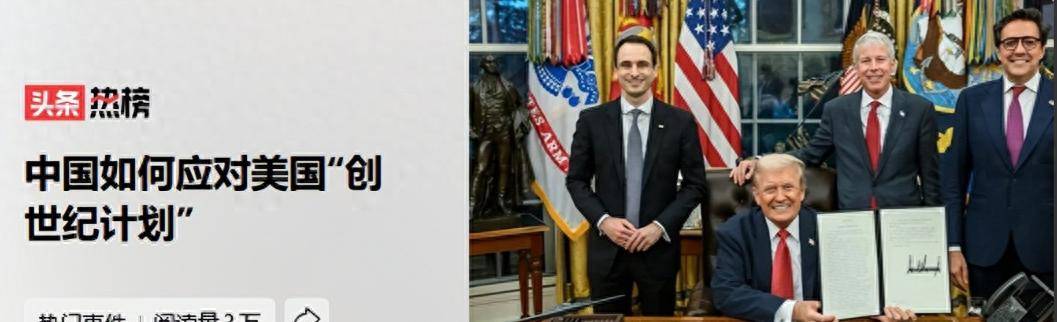
美国打响“创世纪计划”,24家科技巨头签署协议,可中国早已亮剑
Sou Hu Cai Jing· 2026-02-08 15:55
Group 1 - The "Genesis Plan" initiated by the Trump administration aims to consolidate the U.S. technological power, particularly in artificial intelligence, to maintain global leadership against China [3][5][29] - The plan involves collaboration with 24 major tech companies, including Nvidia, Intel, Microsoft, and Amazon, to leverage their resources and expertise in key areas like AI and cloud computing [9][11] - Amazon has committed to invest $50 billion in AI and supercomputing infrastructure to support government initiatives, marking its largest federal technology investment [11] Group 2 - The U.S. government faces challenges in funding and data integration, with proposed budget cuts and existing "data silos" complicating the implementation of the Genesis Plan [16][17] - China is proactively addressing technological competition by focusing on efficient technological paths, a complete industrial ecosystem, and precise countermeasures against U.S. restrictions [23][25][27] - The competition between the U.S. and China reflects fundamentally different approaches, with the U.S. seeking to maintain hegemony through closed alliances, while China emphasizes innovation and open collaboration [30][31]


持股过节——A股一周走势研判及事件提醒
Datayes· 2026-02-08 15:08
摘要 / 持股过节 今天没有段子,哈哈哈,但是马厂长又带来不少消息,且听我一一说来! 先说整体,下周A股应该稳了,至少不会再大跌了,首先海外反弹了,周五美股 强力上涨,标普500涨1.97%,纳斯达克涨2.18%;道指涨2.47%,直接突破5 万点关口!英伟达大涨7%,芯片股指飙升5.7%,中概股指数大涨3.71%。 从资金面来看,数据显示, 这周股票型ETF场内净申购金额本周447.08亿元, 结束此前连续3周的净赎回。 这说明GJD终于不砸了,甚至在周五权重ETF拉升 时出现了密集的放量。 再说历史规律,春节前后A股上涨概率均超七成,宽基指数上涨概率均较高。风 格来看,春节前后成长价值风格表现均衡,而大小盘风格则表现迥异,春节前大 盘风格上涨概率高于小盘风格,春节后则表现为小盘风格明显占优。 广发证券指出,牛市趋势中,每次万得全A指数跌破20均线后一周左右,往往是 加仓良机。 | 蛇次 | | | T+5胜率 T+5平均涨幅 T+20胜率 T+20平均涨幅 T+60胜率 | | | T+60平均涨 | | T+180胜率 T+180平均涨幅 | 破位后平均 破位 | | | --- | --- | --- ...


赛力斯拟剥离重要资产
Di Yi Cai Jing· 2026-02-08 15:03
2月8日晚间,赛力斯(601127.SH)发布《关于签署合作协议的公告》,公告称,赛力斯于2026年2月8 日与重庆市沙坪坝区人民政府签署《合作协议》。 蓝电汽车业务"出表"。 第一财经记者发现,赛力斯并未在财报中提及"蓝电"作为独立产品线或独立业务板块的详细经营数据, 也未单独披露其营业收入、净利润或销量等财务指标,仅作为赛力斯下属子公司列示于企业集团构成表 中。 分析人士指出,作为年销量在2万至3万辆区间的新创品牌,蓝电汽车的财务数据若能"出表"(即不再并 入赛力斯上市公司主体的合并报表),或有助于提升赛力斯上市公司报表的利润率水平和盈利表现。 赛力斯也在公告中称,本次合作剥离存量资产旨在优化公司资产结构。值得注意的是,这次合作仍存在 较大不确定性,包括投资人的最终出资金额、公司出资资产和估值、对赛力斯经营业绩的影响等。 事实上,赛力斯与沙坪坝区政府的深度合作也早有端倪。2025年9月,赛力斯和重庆市沙坪坝区国资委 已经合资注册成立了重庆蓝电汽车科技有限公司,赛力斯持股比例为35%,重庆市沙坪坝区国资委控股 的两家企业合计持股65%。 这家合资公司100%持股重庆凤凰技术有限公司,后者业务范围涵盖人工智能 ...

电力设备及新能源周报20260208:预计“十五五”全球光伏市场保持高增,首个重大电网项目获核准-20260208
Guolian Minsheng Securities· 2026-02-08 13:55
Investment Rating - The report maintains a "Recommended" rating for key companies in the electric power equipment and new energy sectors, including Ningde Times, Keda Li, and others [6][7]. Core Insights - The global photovoltaic market is expected to maintain high growth during the "14th Five-Year Plan" period, with annual new installations projected to reach 725-870 GW globally and 238-287 GW domestically [3][39]. - The electric power equipment sector is witnessing significant developments, including the approval of major grid projects and the awarding of contracts for high-voltage equipment [4][39]. - The new energy vehicle market continues to show strong momentum, with major manufacturers reporting significant year-on-year delivery increases [2][14]. Summary by Sections New Energy Vehicles - In January 2026, several new energy vehicle manufacturers reported substantial delivery growth, with NIO delivering 27,182 units (+96.1% YoY) and BYD maintaining a leading position with 210,051 units delivered [2][14][24]. - The third China All-Solid-State Battery Innovation Development Summit was held, focusing on key materials and technological advancements [2][27]. New Energy Generation - The photovoltaic industry is transitioning from scale expansion to high-quality development, with a focus on technological integration and new application scenarios [39][40]. - The cancellation of export tax rebates for photovoltaic products starting April 1, 2026, marks a shift to full market competition, pushing companies towards innovation and sustainable competitiveness [45][48]. Electric Power Equipment and Automation - The State Grid's recent tender for ultra-high voltage equipment involved 119 packages, with 115 awarded, indicating robust demand in the sector [4][39]. - The approval of the first major grid project by the National Development and Reform Commission signifies a positive outlook for infrastructure development in the electric power sector [4][39]. Commercial Aerospace - The domestic first "one rocket, 36 satellites" satellite launch technology facility has been accepted, indicating advancements in commercial aerospace capabilities [5]. Market Performance - The electric power equipment and new energy sector saw a weekly increase of 2.20%, outperforming the Shanghai Composite Index, with lithium battery and solar indices showing significant gains [1].



电力设备与新能源行业周观察:太空光伏催化持续,电力设备需求高景气延续
HUAXI Securities· 2026-02-08 13:44
证券研究报告|行业研究周报 [Table_Date] 2026 年 2 月 8 日 [Table_Title] 太空光伏催化持续,电力设备需求高景气延续 [Table_Title2] 电力设备与新能源行业周观察 [Table_Summary] 报告摘要 1. 新能源 SpaceX 收购 xAI,重视太空数据中心发展机遇 我们认为,随着可回收火箭发射成本持续下行,以及低轨卫星星 座建设日趋成熟,太空数据中心的建设与部署成本正进入持续优 化通道。2025 年光伏行业供给侧改善的预期已充分反映在当前股 价中,而卫星在轨运行对太阳能的刚性需求,以及太空数据中心 这一新兴场景的崛起,赋予光伏全新成长空间。 同时,北美光伏制造布局趋势显现,马斯克宣布特斯拉及 SpaceX 将分别扩充 100GW 光伏产能,为国内企业带来增量订单。国内光 伏设备、辅材及电池片企业有望凭借技术积累和成本优势,有望 持续斩获海外订单。短期来看,伴随海外头部企业密集到访、核 心订单加速兑现等催化事件落地,板块情绪有望持续,推动相关 标的实现估值与盈利双重共振。受益标的:双良节能、帝科股 份、奥特维、迈为股份、福斯特、连城数控、晶盛机电、拉普拉 ...
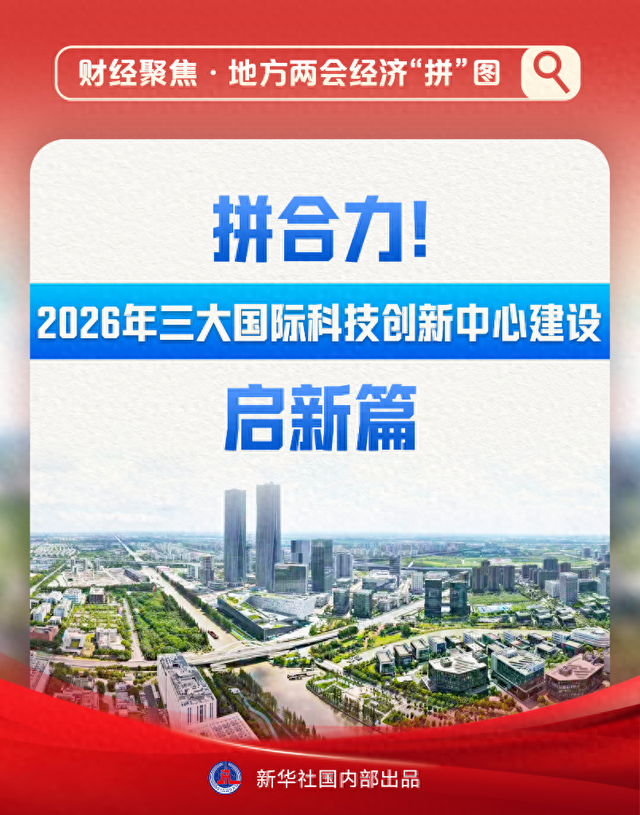
拼合力!2026年三大国际科技创新中心建设启新篇
Bei Jing Ri Bao Ke Hu Duan· 2026-02-08 12:06
北京提出,提升雄安新区中关村科技园发展能级,建设北京—雄安人才科创走廊。天津将做优科创服务 生态,大力发展研究开发、概念验证、知识产权、企业孵化等业态,建设20个校企联合实验室,加快重 点产业和领域中试平台建设。河北明确,建强用好燕赵系列实验室,聚焦重点产业突破一批关键核心技 术。 这是1月23 日拍摄的京津中关村科技城(无人机照片)。新华社记者 孙凡越 摄 2025年12月举行的中央经济工作会议提出,建设北京(京津冀)、上海(长三角)、粤港澳大湾区国际 科技创新中心。记者从近期召开的地方两会上获悉,三大国际科创中心立足自身禀赋,在合作上出招、 在协同上发力,努力形成政策制定、要素流动、产业联动等方面合力,进一步释放创新动能。 京津冀:释放协同创新效能与活力 翻看京津冀三地2026年政府工作报告,有一个共同的关键词:北京(京津冀)国际科技创新中心。 北京提出,强化产业圈联动发展,积极推动北京(京津冀)国际科技创新中心建设,持续提升科技成果 区域内转化效率和比重。天津明确,充分用好北京(京津冀)国际科技创新中心建设扩围机遇,全面加 强协同创新合作。河北也提出,积极参与北京(京津冀)国际科技创新中心建设,实施京津 ...
安踏进军美国市场;OpenAI首款AI硬件曝光丨Going Global
创业邦· 2026-02-08 11:49
Key Insights - Temu and SHEIN have suspended their cross-border operations in Turkey, shifting towards localized operations due to regulatory changes [5] - Hungarian Post has signed a memorandum of understanding with Temu to enhance cross-border logistics cooperation [6] - TSMC's 2nm production capacity has been fully booked by major tech companies, indicating strong demand for advanced semiconductor technology [7] - Hesai Technology has partnered with Grab to accelerate the deployment of LiDAR technology in Southeast Asia [8] - Anta is set to open its first store in the United States, marking a significant step in its global expansion strategy [10][13] - Baiotai has signed a licensing agreement for its BAT3306 injection in the Middle East and North Africa, with a potential transaction value of up to $7 million [15] - Alibaba Cloud has been recognized as the global leader in cloud service adoption for Chinese enterprises going abroad [16][18] - OpenAI's first AI headset, Dime, has been revealed, although its initial capabilities may be scaled back due to supply chain challenges [20][22] - Tesla plans to increase investments in AI hardware and energy sectors in China, with a projected capital expenditure exceeding $20 billion by 2026 [24]





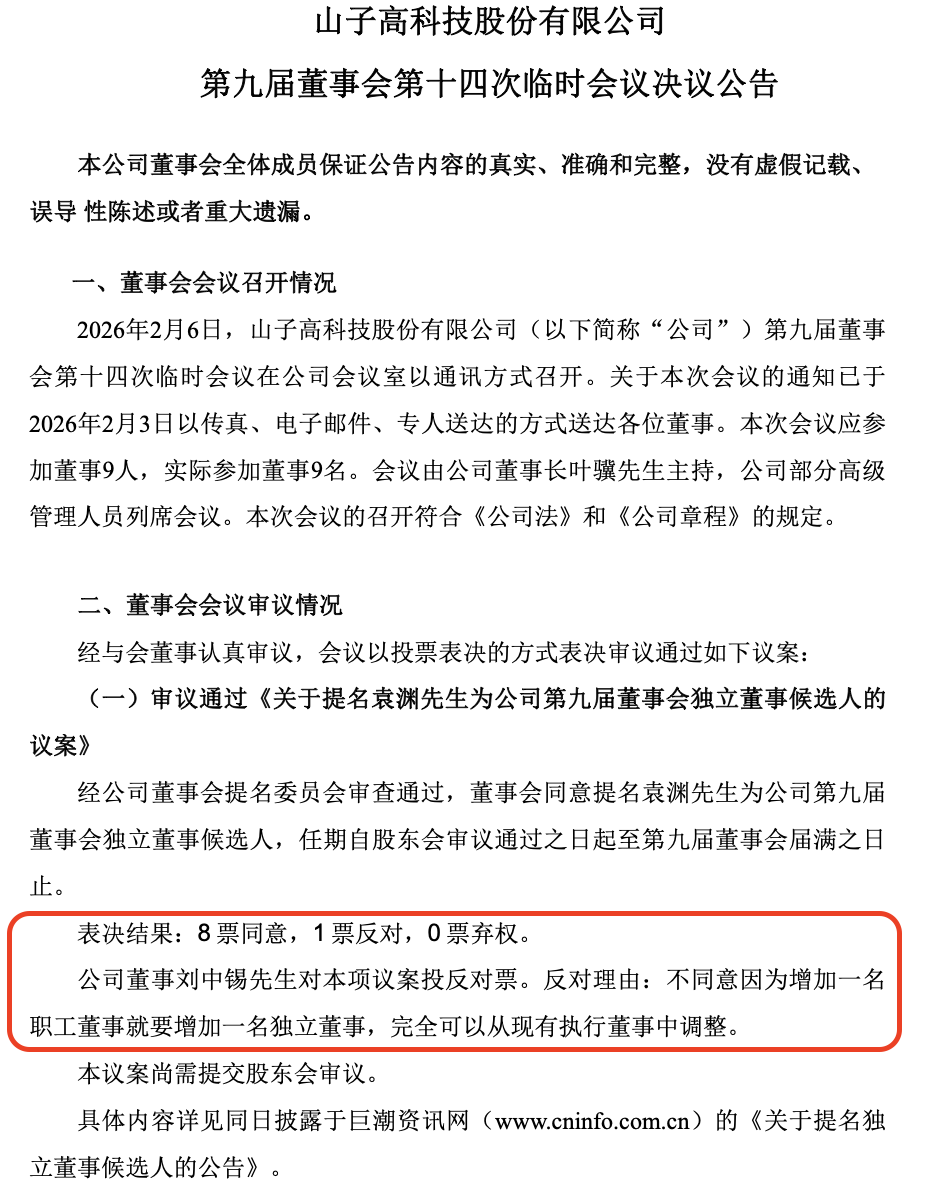
山子高科独董提名遭反对,“一增一补”引治理争议
Shen Zhen Shang Bao· 2026-02-08 11:31
2月8日,山子高科(000981)披露第九届董事会第十四次临时会议决议公告,在五项议案中,一项关于独立董事提名的决议出现了罕见的反对票,董事刘中 锡公开质疑公司"因增加职工董事而配套增加独立董事",为这场人事调整增添了戏剧性色彩。 现任中德证券有限责任公司投行董事总经理,上海德能投资筹备组负责人,兼任香港大公报专栏作者,新疆大全新能源股份有限公司独立董事及公司独立 董事。 山子高科董事刘中锡对该项议案投反对票。其反对理由为:不同意因为增加一名职工董事就要增加一名独立董事,完全可以从现有执行董事中调整。 据了解,刘中锡于1977年出生。浙江工商大学营销管理硕士,具备律师执业资格。历任中国民生银行苏州分行公司管理部副总和授信评审部副总(主持工 作),杭州银行绍兴分行行长及党委书记等。 2016年10月至2018年1月任海尔集团财务公司总经理,2018年1月至2022年任海尔金融保理(重庆)有限公司总经理。2017年12月至今任天津海立方舟投资 管理有限公司法人代表及总经理,2018年起担任上海海毅供应链管理有限公司法人和总经理,同时还兼任海尔集团(青岛)金盈控股有限公司董事、湖南 潭州教育网络科技有限公司董事和山 ...

蔚来死磕换电,到底脑子咋想的?
半佛仙人· 2026-02-08 09:50
Core Viewpoint - The article emphasizes the significance of NIO's battery swapping model, highlighting its efficiency, cost savings, and safety, which have led to over 100 million battery swaps, establishing it as a leader in the new energy vehicle sector [3][7][10]. Group 1: Battery Swapping Advantages - NIO's battery swapping stations have achieved a milestone of 100 million swaps, indicating a robust network that spans across various terrains in China [3][7]. - The cost savings from battery swapping exceed 26.3 billion, averaging 2,700 per vehicle owner, which is comparable to receiving additional food packages with the purchase of a NIO vehicle [3][7]. - The time saved from charging is approximately 8.5 million hours, showcasing the efficiency of the battery swapping process compared to traditional charging methods [3][7]. Group 2: Market Position and Strategy - NIO's approach to battery swapping is likened to the development of high-speed rail, where initial skepticism gives way to acceptance as the infrastructure becomes widespread [3][10]. - The company has transitioned from being merely a car manufacturer to an energy operator, with its battery swapping stations acting as distributed energy storage networks that can alleviate grid pressure [7][10]. - NIO's long-term strategy is underscored by its consistent investment in battery swapping infrastructure over the past decade, which is now paying off as the company anticipates profitability in Q4 [10][11]. Group 3: Safety and Reliability - The safety of the battery swapping process is reinforced by the absence of reported issues during the 100 million swaps, indicating a successful stress test of the system [7][10]. - The model addresses the common issues associated with electric vehicle charging, such as waiting times and battery degradation, providing a more reliable alternative for consumers [3][7]. Group 4: Future Outlook - NIO's battery swapping technology is positioned as a foundational element for the future of energy supply in the AI era, potentially becoming a key player in the energy market as electric power becomes increasingly valuable [7][10]. - The article suggests that as consumers become accustomed to the convenience of battery swapping, they are unlikely to revert to traditional charging methods, indicating a shift in consumer behavior [7][10].

电新行业周报:国家超算互联网核心节点上线,电力投资聚焦绿色转型-20260208
Western Securities· 2026-02-08 08:29
Investment Rating - The report does not explicitly state an investment rating for the industry Core Insights - The domestic first commercial SAR satellite closed-loop service system is taking shape as Tianyi Research Institute aims for an A-share IPO [1] - The national supercomputing internet core node has been launched, establishing a foundation for a trillion-parameter model computing capacity with a 30,000-card domestic cluster [1] - Tesla has achieved mass production of dry electrode technology, and Changan Automobile will be the first globally to equip sodium-ion batteries from CATL in its vehicles [2] - The State Grid has clarified that the "14th Five-Year Plan" investment will focus on green transformation and enhancing cross-regional transmission capacity [2] - The offshore wind power sector in China is progressing, with an expected addition of 6.12 GW of new grid-connected capacity by 2025 [2] Summary by Sections Section 1: Commercial Space and AI Computing - Tianyi Research Institute is preparing for an A-share IPO, establishing a commercial SAR satellite service system [1] - The national supercomputing internet core node will provide efficient computing services for large-scale AI applications [1] Section 2: Battery Technology and Electric Vehicles - Tesla's dry electrode technology is now in mass production, significantly reducing costs and energy consumption [2] - Changan Automobile's introduction of sodium-ion batteries marks a significant advancement in battery technology for electric vehicles [2] Section 3: Power Infrastructure and Renewable Energy - The State Grid's investment plan for the "14th Five-Year Plan" will reach 4 trillion yuan, focusing on green energy and quality improvement [2] - The offshore wind power sector is set to expand with significant new installations planned for 2025 [2]