建筑

Search documents
深圳源谱能源服务有限公司成立 注册资本10万人民币
Sou Hu Cai Jing· 2025-10-18 06:13
Core Insights - Shenzhen Yuanpu Energy Service Co., Ltd. has been established with a registered capital of 100,000 RMB and is represented by Hu Zhimo [1] Company Overview - The company engages in a wide range of services including labor services (excluding labor dispatch), human resources services (excluding vocational intermediary activities and labor dispatch services), loading and unloading, professional cleaning, disinfection services, and housekeeping services [1] - It also provides engineering management services, safety consulting, sales of construction decoration materials, information security equipment, furniture installation and maintenance, daily necessities sales, and various sales related to electrical and communication equipment [1] - The company is involved in new energy technology research and development, as well as sales of new energy power equipment [1]
伊朗走投无路
虎嗅APP· 2025-10-17 09:36
Core Viewpoint - The article discusses the severe economic crisis in Iran, highlighting the rapid devaluation of the Iranian rial and the government's inability to restore economic stability through superficial reforms [5][6][12]. Group 1: Currency Devaluation and Economic Impact - As of September 2025, the exchange rate of the US dollar to the Iranian rial reached 1:1,150,000, a significant increase from 800,000 rial per dollar at the beginning of the year and 10,000 rial per dollar in 2010 [6][7]. - The rapid devaluation has rendered the currency nearly worthless, leading to a drastic decline in economic efficiency and daily consumer difficulties [8][10]. - In response to hyperinflation, the Iranian parliament approved a comprehensive reform to remove four zeros from the rial's face value, which is seen as a technical fix rather than a solution to the underlying economic issues [11][12]. Group 2: Government Revenue and Economic Structure - Since 2022, Iranian government revenues have significantly decreased, with the economy entering a recession again after a brief growth in 2024 [21][22]. - The projected tax revenue for 2025 is approximately $12.8 billion, accounting for less than 2.5% of GDP, indicating a near collapse of the tax base [23][24]. - The article suggests that the Iranian government has lost its ability to regulate society due to financial constraints, exacerbated by external sanctions and internal mismanagement [27][28]. Group 3: Political and Economic System - Iran's political system is characterized by a theocratic structure where religious authority supersedes democratic governance, leading to inefficiencies and corruption [29][30]. - The Bonyad, a network of religious foundations, contributes about 20% of Iran's GDP but operates outside normal regulatory frameworks, enjoying tax exemptions and government subsidies [35][48]. - The Islamic Revolutionary Guard Corps (IRGC) has evolved into a military-industrial complex, controlling significant economic sectors and contributing over 30% of GDP, further entrenching the economic challenges faced by the government [78][79]. Group 4: Socioeconomic Disparities - The wealth distribution in Iran has become increasingly skewed, with a small elite, including high-ranking clerics, accumulating vast fortunes while the majority of the population struggles with low incomes [49][50]. - The article highlights the disparity between the high allowances of clerics and the low average income of citizens, illustrating the deepening economic divide [49][50]. - The current economic situation is viewed as a result of systemic issues within the governance structure, where wealth is concentrated among a few, leading to widespread discontent among the populace [104][106].


基建ETF(159619)盘中净流入2500万份,自主可控、内需基建或在中美博弈背景下占优
Mei Ri Jing Ji Xin Wen· 2025-10-17 08:33
Core Viewpoint - The infrastructure ETF (159619) has seen a significant inflow of 25 million units, indicating strong investor interest in infrastructure assets amid international uncertainties such as the US-China tariff disputes [1]. Group 1: Market Dynamics - The National Development and Reform Commission announced a new policy financial tool worth 500 billion yuan, aimed at injecting capital into projects and enhancing investment stability through a combination of capital support and bank loans [1]. - The focus on domestic demand and infrastructure, particularly in high-demand sectors like water conservancy, is expected to benefit from increased government support in response to external market volatility [1]. Group 2: ETF and Index Characteristics - The infrastructure ETF (159619) tracks the CSI Infrastructure Index (930608), which selects listed companies involved in the construction and machinery sectors to reflect the overall performance of China's infrastructure construction industry [1]. - The CSI Infrastructure Index has a high industry concentration, prominently featuring leading enterprises in the sector, characterized by a strong state-owned enterprise presence and relatively low valuation levels, along with good liquidity [1].
企业在落地中破解实践困局梨花声音研修院退费
Sou Hu Cai Jing· 2025-10-17 08:13
Core Insights - The implementation of goal management systems like KPI and OKR is essential for enhancing corporate efficiency, yet many companies struggle with execution, leading to a disconnect between ambitious goal-setting and practical outcomes [1][3] Group 1: Issues in Goal Management - Companies often face "misalignment" in goal-setting, where top management sets targets without considering frontline feedback, resulting in unrealistic expectations [3] - Over-centralization can lead to rigid targets that do not account for market realities, while excessive decentralization may cause divergent departmental goals, ultimately harming overall performance [4] - A lack of dynamic tracking mechanisms during execution can result in significant delays and failures, as companies may only assess progress at quarterly or annual intervals [4] Group 2: Solutions for Improvement - Establishing a "full-link closed-loop" practice system is crucial, which includes a three-tier consensus mechanism involving executives, middle management, and frontline employees to ensure goals are both strategic and feasible [5] - Implementing regular review processes, such as weekly retrospectives and monthly adjustments, can facilitate better tracking and cross-departmental collaboration [5] - Utilizing a dual-dimensional assessment approach that evaluates both results and processes can enhance the quality of goal execution, as demonstrated by successful practices at companies like Huawei and ByteDance [6]

事故隐患内部报告奖励机制成效显著
Zhong Guo Hua Gong Bao· 2025-10-17 04:42
Core Points - The Ministry of Emergency Management held a quarterly press conference, highlighting the progress made in implementing the internal reporting reward mechanism for accident hazards since the State Council's issuance of relevant opinions [1] - The mechanism's implementation has been integrated into the central safety production assessment and inspection, with significant promotional efforts at both national and provincial levels [1] - By the end of Q3 this year, 99.5% of production and operation units in 14 key industries had established the mechanism, with 100% in 28 provinces, and over 95% in other sectors [1] Group 1 - Comprehensive policy measures have been strengthened, with 39 national and over 1,200 provincial typical cases published to enhance demonstration and guidance [1] - The mechanism has led to a significant increase in the scientific and standardized management levels of enterprises [1] Group 2 - A total of approximately 8 million accident hazards have been identified and rectified across various production and operation units, with rewards amounting to about 590 million yuan [2] - Over two-thirds of the rewards were distributed in high-risk industries such as hazardous chemicals, mining, and construction, effectively motivating employees to eliminate hazards at an early stage [2] Group 3 - The establishment of this mechanism aims to encourage enterprises to actively fulfill their safety production responsibilities and engage employees in identifying and managing hazards [2] - The effectiveness of the mechanism is gradually becoming evident, with innovative practices in rewarding employees and recognizing their contributions [2]
答卷十四五·央企惠民生|从赋能到共生,央企解锁乡村振兴新密码
Zhong Guo Zheng Quan Bao· 2025-10-17 02:25
Core Insights - Central enterprises are actively participating in rural revitalization efforts across China, focusing on infrastructure, education, and agricultural development to enhance local economies and improve living standards [1][5][11] Group 1: Infrastructure and Energy Projects - The National Energy Group has implemented key projects in Qinghai, including photovoltaic power generation, education infrastructure, and industry revitalization, generating stable income for local communities [1] - The group has built 15 solar kindergartens in the region, contributing to the modernization of rural education [1] Group 2: Agricultural Development - The China Inspection and Certification Group has established a red date research institute in Xinjiang, enhancing the marketability of local red dates through traceability and quality assurance [2] - China National Chemical Corporation has invested 348 million yuan in modern agricultural initiatives across several provinces, resulting in an average annual increase in agricultural output of 8%-10% [3] Group 3: Employment and Economic Contributions - The China Communications Construction Group has created a village-level construction enterprise in Yunnan, generating contracts worth nearly 70 million yuan and providing employment for over 11,200 people [2] - China National Offshore Oil Corporation has developed an agricultural brand in Hainan, leading to a significant increase in local production and income [3] Group 4: Education Initiatives - China Coal has invested 14.5 million yuan in educational programs in Guizhou, achieving a 100% college admission rate for students in its specialized class [9][10] - The South Power Grid is establishing reading houses in rural areas, aiming to benefit approximately 510,000 students by 2025 [10] Group 5: Health and Well-being - The China National New Group has built a new medical facility in Hubei, significantly improving access to healthcare for local residents [8] - The facility has seen a total outpatient volume of 16,856 since its opening, reducing the financial burden of medical expenses for villagers [8]

从赋能到共生 央企解锁乡村振兴新密码
Zhong Guo Zheng Quan Bao· 2025-10-16 22:25
Core Viewpoint - Central enterprises in China are actively participating in rural revitalization efforts, leveraging their resources and expertise to improve local economies and infrastructure, thereby enhancing the quality of life for rural residents [1][2][3]. Group 1: Investment and Economic Development - The National Energy Group has implemented key projects in Qinghai, including photovoltaic power generation, education infrastructure, and industrial revitalization, generating stable income and improving local living standards [1]. - The China Inspection and Certification Group has established a red date research institute in Xinjiang, enhancing market recognition and traceability for local agricultural products, which significantly boosts local economies [2]. - Central enterprises have invested over 120 billion yuan in various assistance programs since the 14th Five-Year Plan, contributing to the economic development of 256 counties [3]. Group 2: Technological Innovation - Central enterprises are integrating advanced technologies into agricultural practices, such as AI and big data, to enhance production efficiency and product quality, leading to increased income for local farmers [4][5]. - The China Telecom-supported bio-fertilizer processing plant in Sichuan exemplifies the use of smart technology to optimize agricultural production, resulting in a threefold increase in product value [4]. Group 3: Education and Healthcare - The China Coal Group's "Rural Revitalization Class" in Guizhou has achieved a 100% college admission rate for its students, showcasing the impact of educational investment on local youth [7]. - The establishment of a new medical facility in Hubei by China Guoxin has significantly improved healthcare access for local residents, reducing their medical expenses [6]. Group 4: Community Engagement and Social Responsibility - Central enterprises are focusing on community engagement through various initiatives, such as building schools and healthcare facilities, which contribute to the overall development of rural areas [8][9]. - The South Power Grid's "Nanwang Zhixing Book House" initiative aims to enhance educational resources in rural areas, benefiting approximately 510,000 students by 2025 [8].
从赋能到共生央企解锁乡村振兴新密码
Zhong Guo Zheng Quan Bao· 2025-10-16 20:11
Core Insights - Central enterprises in China are actively participating in rural revitalization efforts, leveraging their resources and expertise to improve local economies and infrastructure [1][2][3][4][5][6][7] - Significant investments have been made by these enterprises, with over 120 billion yuan allocated for various support initiatives since the start of the 14th Five-Year Plan [3][6] - The focus is on creating sustainable development models that empower local communities, transitioning from mere financial aid to fostering self-sufficiency [3][4][5][6] Group 1: Investment and Economic Impact - The National Energy Group's solar project in Qinghai generates 360 million kWh annually, providing stable income for local herders [1] - In Inner Mongolia, China National Chemical has invested 348 million yuan since 2018, benefiting over 5,200 households and increasing agricultural yields by 8%-10% [2] - China Telecom's smart production initiatives in Sichuan have increased the value of local agricultural products by three times, benefiting over 600 impoverished households [4] Group 2: Technological Innovation - Central enterprises are integrating advanced technologies into agricultural practices, enhancing productivity and market access for local farmers [2][4][5] - The establishment of a red date research institute in Makeyti has improved market recognition for local products through traceability systems [2] - Digital transformation initiatives have led to significant improvements in production efficiency and product quality across various agricultural sectors [4] Group 3: Social Development and Education - The establishment of medical facilities, such as the Longle Hospital in Hubei, has improved healthcare access for local communities, with over 16,000 outpatient visits recorded [6] - Educational initiatives by China Coal have resulted in a 100% college admission rate for students in their rural programs, significantly enhancing local educational outcomes [6][7] - The "善建" colorful classroom project by China National Building Material Group has provided summer care and educational resources for nearly 4,000 left-behind children [7]
主动量化组合跟踪:近期量化指增策略的回调复盘与归因分析
SINOLINK SECURITIES· 2025-10-16 14:58
- The recent phenomenon of "strong index, weak quantitative Alpha" is attributed to style mismatches, with cumulative excess returns driven by small-cap and short-term momentum factors initially, and later by analyst consensus expectations and growth styles[2][3] - The Guozheng 2000 Index enhancement strategy involves factor testing and selection, including technical, reversal, and idiosyncratic volatility factors, which have shown excellent performance in the Guozheng 2000 Index constituents[4] - The machine learning index enhancement strategy based on multiple objectives and models uses GBDT and NN models, trained on different feature datasets and combined to construct a GBDT+NN stock selection factor, which has performed well across various broad-based indices in the A-share market[5] - The dividend style timing + dividend stock selection fixed income+ strategy uses 10 indicators related to economic growth and monetary liquidity to construct a dynamic event factor system for dividend index timing, showing significant stability improvement compared to the CSI Dividend Index total return[6] - The Guozheng 2000 Index enhancement factor's IC mean is 12.54%, with a T-statistic of 12.56, indicating good predictive performance[4] - The GBDT+NN machine learning stock selection factor in the CSI 300 constituents has an IC mean of 11.43% and an annualized excess return of 15.39%[43] - The GBDT+NN machine learning stock selection factor in the CSI 500 constituents has an IC mean of 9.77% and an annualized excess return of 29.48%[48] - The GBDT+NN machine learning stock selection factor in the CSI 1000 constituents has an IC mean of 13.49% and an annualized excess return of 16.10%[53] - The Guozheng 2000 Index enhancement strategy has an annualized excess return of 13.18% and an IR of 1.73[38] - The GBDT+NN CSI 300 Index enhancement strategy has an annualized excess return of 10.86% and an IR of 1.81[47] - The GBDT+NN CSI 500 Index enhancement strategy has an annualized excess return of 10.27% and an IR of 1.71[52] - The GBDT+NN CSI 1000 Index enhancement strategy has an annualized excess return of 15.83% and an IR of 2.34[57] - The dividend stock selection strategy has an annualized return of 18.83% and a Sharpe ratio of 0.89[58] - The dividend timing strategy has an annualized return of 13.58% and a Sharpe ratio of 0.88[58] - The fixed income+ strategy has an annualized return of 7.34% and a Sharpe ratio of 2.17[58]
A股9月回购月报:中国巨石股价高位官宣回购,美的、宁德时代单月豪掷均超20亿元!
Mei Ri Jing Ji Xin Wen· 2025-10-16 10:57
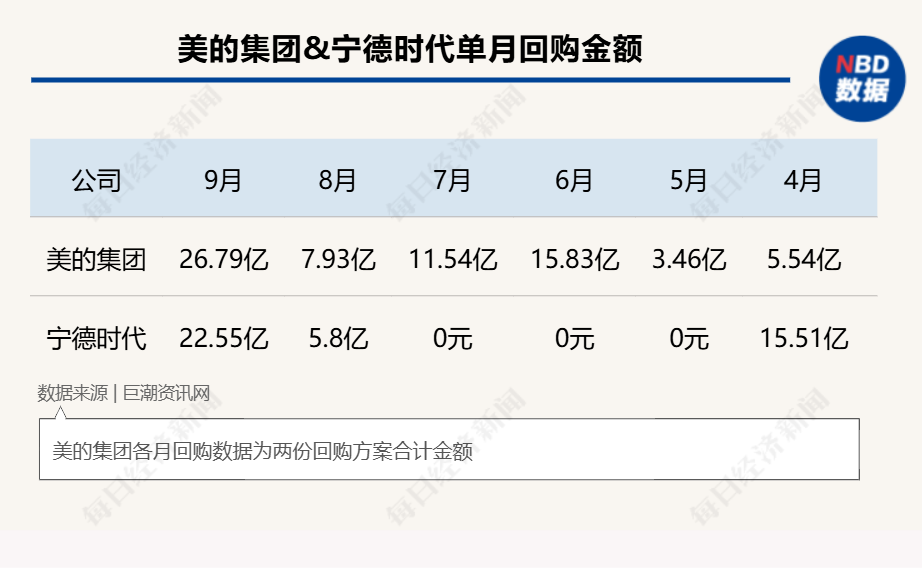
Core Viewpoint - In September, A-share listed companies continued to implement share buybacks, with 22 companies announcing buyback plans, reflecting their recognition of self-value and commitment to shareholder rights and market confidence [1][2]. Group 1: Buyback Plans and Amounts - A total of 22 companies announced new buyback plans in September, a decrease of 37.14% from 35 in August, with a proposed maximum buyback amount of approximately 3.969 billion yuan, down from 10.007 billion yuan in August [1][2]. - Among the companies, China Jushi announced the highest proposed buyback amount of 880 million yuan, followed by Shougang Co. at 520 million yuan and China International Marine Containers at 500 million yuan [2]. - The buyback amount for Midea Group and CATL exceeded 2 billion yuan each in September, leading the buyback efforts for the month [1][5]. Group 2: Company-Specific Insights - China Jushi's stock price has been on an upward trend since June, with a maximum increase of over 60%, raising questions about the timing of its buyback announcement [2]. - The company stated that the buyback is a response to confidence in future stock prices and a commitment to shareholder interests, with the buyback amount representing about 6% of its liquid funds [2]. - Jian Sheng Group, a leading player in the knitted sportswear industry, announced a second buyback plan for the year, aiming to use 150 million to 300 million yuan for share cancellation [3]. Group 3: Market Reactions and Future Plans - Newpoint Software announced a buyback plan of 30 million to 50 million yuan for employee stock ownership plans, while also changing the purpose of a previous buyback to share cancellation [4]. - Despite a decrease in the number of companies announcing buybacks, the commitment to returning value to investors is evident, with companies like Midea and CATL showing significant buyback amounts [1][5]. - As of the end of September, approximately 379 companies had announced buyback progress, with 137 companies having met or exceeded their minimum buyback amounts [5][11].