
有色金属

Search documents
观点与策略:国泰君安期货商品研究晨报-20260225
Guo Tai Jun An Qi Huo· 2026-02-25 01:33
Report Summary 1. Industry Investment Ratings The report does not provide an overall investment rating for the industry. Instead, it offers individual trend intensities for various commodities: - **Positive Trends**: Gold, silver, tin, aluminum, platinum, palladium, nickel, stainless steel, lithium carbonate, logs, p-xylene, PTA, MEG, rubber, short fibers, bottle chips, palm oil, soybean oil, cotton [2][18][26][30][36][60][63][71][143][156][173] - **Neutral Trends**: Copper, zinc, lead, alumina, synthetic rubber, LLDPE, PP, caustic soda, pulp, glass, methanol, urea, styrene, soda ash, LPG, PVC, fuel oil, low - sulfur fuel oil, container shipping index (European line), double - offset paper, pure benzene, soybean meal, soybeans, corn, sugar, peanuts [8][11][15][22][74][77][80][83][89][94][97][103][107][110][114][123][126][128][147][152][161][164][168][186] - **Negative Trends**: Iron ore, eggs, live pigs [43][178][181] 2. Core Views - **Commodity - Specific Views**: Each commodity's performance is influenced by its unique supply - demand dynamics, cost factors, and macro - economic and industry news. For example, gold and silver showed positive trends during the holiday period; iron ore faced poor demand expectations; and lithium carbonate had a tight supply - demand situation [2][43][36] - **Macro - economic Impact**: Global events such as Trump's tariff policies, geopolitical tensions in the Middle East, and AI - related economic impacts have affected market sentiment and commodity prices [7] 3. Summary by Commodity Precious Metals - **Gold**: Oscillated upward during the holiday. The price of domestic and international gold contracts decreased, and trading volume and positions changed. ETF holdings decreased slightly [2][5] - **Silver**: Attention should be paid to the post - holiday gap - up opening. The price of silver contracts decreased significantly, and trading volume and positions also changed [2][5] - **Platinum and Palladium**: Both showed a generally upward - trending pattern. The prices of platinum and palladium contracts rose, and trading volume and positions changed [26] Base Metals - **Copper**: The price rebounded as the US stock market rebounded. Supply - demand data showed changes in inventory and price differentials. Macro - economic and industry news included tariff policies and production data [8] - **Zinc**: Underwent wide - range adjustments. Price, trading volume, and inventory data showed certain fluctuations. News related to tariff policies also affected the market [11] - **Lead**: The increase in domestic inventory restricted price rebounds. Price, trading volume, and inventory data were presented, along with relevant news [15] - **Tin**: Showed a slightly upward - trending pattern. Price, trading volume, and inventory data changed, and there were some macro - economic and industry news [18][19] - **Aluminum**: Attention should be paid to the spring rally. Alumina had increased maintenance, and cast aluminum alloy followed the trend of electrolytic aluminum. A large amount of fundamental data was provided [22] Energy and Chemicals - **Crude Oil and Related Products**: Although not the main focus, some related information was mentioned. For example, the price of Brent crude oil futures increased, and it affected the cost of downstream products [64][66] - **P - xylene and PTA**: Had strong cost support, and the market was expected to rise after the holiday. Supply - demand and cost factors were analyzed [63][64][69] - **MEG**: Traded in a range, with a strategy of going long on PTA and short on MEG. Inventory and supply - demand information was provided [63][67][70] - **Rubber**: Showed a slightly upward - trending pattern. Price, trading volume, and inventory data were presented, and there was some industry news [71] - **Synthetic Rubber**: Was expected to trade in a short - term range. The price, trading volume, and some fundamental data were provided [74] - **LLDPE**: Had strong cost support due to geopolitical disturbances during the holiday. Supply - demand and market conditions were analyzed [77] - **PP**: The C3 raw material was strong, and PDH maintenance remained high. Price, trading volume, and supply - demand information were provided [80] - **Caustic Soda**: Was mainly trading in a range with cost support. Supply - demand and inventory information were presented [83] - **Pulp**: Showed a slightly upward - trending pattern. Price, trading volume, and inventory data were provided, along with industry news [89] - **Glass**: The price of the original sheet was stable. Price, trading volume, and supply - demand information were presented [94] - **Methanol**: Traded in a range. Price, trading volume, and inventory data were provided, and there was some market news [97] - **Urea**: The price center shifted upward. Price, trading volume, and supply - demand information were presented, and there was some industry news [103] - **Styrene**: Traded in a slightly upward - trending pattern. Price, trading volume, and inventory data were presented, and there was some market news [107] - **Soda Ash**: The spot market changed little. Price, trading volume, and supply - demand information were presented [110] - **LPG**: Had strong short - term geopolitical disturbances. Price, trading volume, and supply - demand information were presented [114] - **Propylene**: The fundamentals remained tight, and attention should be paid to post - holiday restocking dynamics. Price, trading volume, and supply - demand information were presented [114] - **PVC**: Traded in a range. Price, trading volume, and supply - demand information were presented [123] - **Fuel Oil and Low - Sulfur Fuel Oil**: Fuel oil decreased slightly at night, and low - sulfur fuel oil rebounded significantly. Price, trading volume, and supply - demand information were presented [126] Agricultural Products - **Palm Oil and Soybean Oil**: Palm oil was difficult to decline in the short term due to production cuts, and soybean oil had limited driving force from US soybeans and rebounded within a range. Price, trading volume, and supply - demand information were presented [156] - **Soybean Meal and Soybeans**: Soybean meal might rebound and oscillate, and soybeans' spot price increased to catch up, with the futures market oscillating. Price, trading volume, and supply - demand information were presented [161] - **Corn**: Showed a slightly upward - trending pattern. Price, trading volume, and supply - demand information were presented, and there was some market news [164] - **Sugar**: Traded in a narrow range. Price, trading volume, and supply - demand information were presented, and there was some industry news [168] - **Cotton**: Reached a new high for the year. Price, trading volume, and supply - demand information were presented, and there was some industry news [173] - **Eggs**: Traded in a weak - oscillating pattern. Price, trading volume, and supply - demand information were presented [178] - **Live Pigs**: The spot price was lower than expected, and it was difficult to reduce inventory during the off - season. Price, trading volume, and supply - demand information were presented [181] - **Peanuts**: Traded in an oscillating pattern. Price, trading volume, and supply - demand information were presented, and there was some market news [186] Shipping - **Container Shipping Index (European Line)**: Should be treated with an oscillating mindset. Price, trading volume, and supply - demand information were presented, and there was some market news [128] Fibers - **Short Fibers and Bottle Chips**: Had cost support and were expected to be strong in the short term. Price, trading volume, and supply - demand information were presented [143] Paper - **Offset Printing Paper**: Should be observed. Price, trading volume, and supply - demand information were presented, and there was some industry news [147]
A股马年开门红,逢低关注“科技+资源品”双主线
British Securities· 2026-02-25 01:27
Market Overview - The A-share market experienced a "red opening" on the first trading day of the Year of the Horse, with the Shanghai Composite Index surpassing the 4100-point mark and the Shenzhen Component Index rising over 1%, setting a positive tone for post-holiday market trends [2][9][10] - Despite the positive opening, there was a notable structural differentiation in market performance, with cyclical sectors like petrochemicals and non-ferrous metals leading gains, influenced by external factors such as the escalating US-Iran situation and internal price increase logic [2][10] Capital Flow and Market Sentiment - The return of capital post-holiday was in line with expectations, significantly boosting market liquidity, as evidenced by a notable increase in trading volume, with total turnover reaching 22,021 billion [6][10] - However, the weak performance of the Hong Kong market has somewhat dampened risk appetite in the A-share market, indicating a cautious overall market sentiment on the first trading day [10][11] Future Market Outlook - The upcoming important meetings are expected to clarify policy directions for the "14th Five-Year Plan," with anticipated policy benefits likely to gradually materialize, suggesting a probable continuation of a fluctuating upward trend in the market [3][9] - Key areas to monitor include the sustainability of price increase logic in cyclical sectors and signs of stabilization in the technology sector following recent corrections [3][9] Investment Strategy - Investors are advised to focus on the dual main lines of "technology + resource products," specifically targeting cyclical sectors benefiting from price increases and geopolitical catalysts, such as petrochemicals and non-ferrous metals [3][9] - Additionally, long-term trends in technology sectors, including AI computing power, semiconductors, and humanoid robots, should be considered for opportunistic investments during any temporary pullbacks [3][9]
贵金属早报-20260225
Yong An Qi Huo· 2026-02-25 00:57
Group 1: Price Performance - London Gold's latest price is 5191.40 with a change of 196.45 [1] - London Silver's latest price is 86.94 with a change of 9.59 [1] - London Palladium's latest price is 2058.00 with a change of -51.00 [1] - WTI Crude's latest price is 66.31 with a change of 3.42 [1] - LME Copper's latest price is 13061.50 with a change of 167.00 [1] - US Dollar Index's latest value is 97.74 with a change of 0.88 [1] - Euro to US Dollar's latest rate is 1.18 with a change of -0.01 [1] - British Pound to US Dollar's latest rate is 1.35 with a change of -0.02 [1] - US Dollar to Japanese Yen's latest rate is 154.67 with a change of 1.97 [1] - US 10 - year TIPS's latest value is 1.77 with a change of 0.00 [1] Group 2: Trading Data - COMEX Silver's value is 11321.76 with a change of -386.68 [1] - SHFE Silver's value is 349.88 with a change of -3.68 [1] - Gold ETF's value is 1086.47 with a change of 0.00 [1] - Silver ETF's value is 15830.38 with a change of 0.00 [1] - SGE Silver's value is 493.67 with a change of 9.44 [1] - SGE Gold's value is 1 with a change of 0.00 [1] - Another SGE Silver's value is 2 with a change not clearly presented [1]
金属、非金属与采矿行业周报:假期金属价格走强,看好节后配置机遇-20260225
Changjiang Securities· 2026-02-25 00:44
丨证券研究报告丨 行业研究丨行业周报丨金属、非金属与采矿 [Table_Title] 假期金属价格走强,看好节后配置机遇 报告要点 [Table_Summary] 铜铝节后易涨难跌,重视板块机会。商品端,铜铝节后易涨难跌,中长期经济底部与逆全球化 促进供需结构优化,弹性可期:1)短期,美国对降息及铜关税态度,依然是短期工业金属价格 走势的主导因素,在二者并未发生根本性转变之前,维持铜铝趋势看涨判断,节后国内金三银 四旺季、中美会谈、联储主席换届等均构成催化;2)中期,美联储降息引领全球趋势宽松促进 铜铝周期上行;3)长期,逆全球化加剧各国对资源争夺,铜铝中枢趋势上行。 分析师及联系人 [Table_Author] 王鹤涛 肖勇 叶如祯 王筱茜 肖百桓 SAC:S0490512070002 SAC:S0490516080003 SAC:S0490517070008 SAC:S0490519080004 SAC:S0490522080001 SFC:BQT626 SFC:BUT918 SFC:BWM115 请阅读最后评级说明和重要声明 %% %% %% %% research.95579.com 1 丨证券研究报 ...
波兰铜业集团1月铜产量6.05万吨 销量5.07万吨 白银销量10.85万吨
Wen Hua Cai Jing· 2026-02-25 00:39
Group 1 - KGHM reported a deliverable copper production of 60,500 tons for January 2026 [2] - The company's copper sales for the same period were 50,700 tons [2] - KGHM's silver sales in January reached 10,850 tons [2] Group 2 - China's copper industry faces three major challenges: increasing dependence on foreign resources, overcapacity in the midstream processing sector, and downstream demand being suppressed by high copper prices [2] - Shanghai Nonferrous Metals Network collaborated with copper industry enterprises to compile the "2026 China Copper Industry Chain Distribution Map" in both Chinese and English [2]

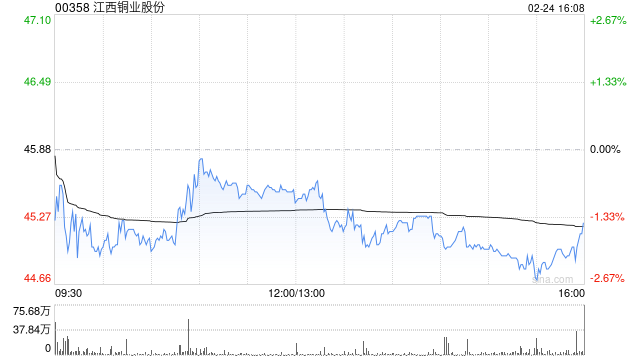
江西铜业股份获摩根大通增持约79.80万股 每股均价约44.49港元
Xin Lang Cai Jing· 2026-02-24 23:52
Group 1 - Morgan Stanley increased its stake in Jiangxi Copper Company (00358) by 798,043 shares at an average price of HKD 44.4931 per share, totaling approximately HKD 35.5074 million [1][3] - After the increase, the total number of shares held by Morgan Stanley is approximately 69,782,100, representing a holding percentage of 5.02% [1][3]

A股市场大势研判:A股马年开门红
Dongguan Securities· 2026-02-24 23:30
Market Performance - The A-share market opened positively in the Year of the Horse, with major indices showing significant gains, including the Shanghai Composite Index rising by 0.87% to close at 4117.41 points and the Shenzhen Component Index increasing by 1.36% to 14291.57 points [2][4] - The trading volume in the Shanghai and Shenzhen markets reached 2.2 trillion yuan, an increase of 219.4 billion yuan compared to the previous trading day, indicating a strong market sentiment [6] Sector Analysis - The top-performing sectors included Oil & Petrochemicals, which rose by 5.53%, and Building Materials, which increased by 3.71% [3] - Conversely, sectors such as Media and Computer experienced declines, with the Media sector dropping by 3.20% [3] - Notable concept stocks included Combustible Ice and Cultivated Diamonds, which saw significant gains, while MLOps and AI Corpus concepts faced declines [4][3] Future Outlook - The report indicates a positive outlook for the A-share market, supported by strong performance in oil and gas stocks, chemical sectors, and precious metals [4] - The market is expected to benefit from favorable macroeconomic policies and the upcoming Two Sessions, which historically lead to a high probability of index increases post-Spring Festival [6] - Analysts suggest focusing on sectors such as dividends, TMT (Technology, Media, and Telecommunications), and power equipment for potential investment opportunities [6]
油气ETF领涨 资金流向或迎反转
Zhong Guo Zheng Quan Bao· 2026-02-24 21:03
Group 1 - The A-share market showed strength on February 24, with resource-related ETFs leading the gains, particularly oil and gas ETFs which rose over 9% [2][3] - The overall market saw a net outflow of over 830 billion yuan in ETFs since the beginning of 2026, with a notable trend of funds flowing into bond ETFs and out of broad-based stock ETFs [1][5][6] - The outlook for the non-ferrous metals sector remains positive, driven by increased demand from new industries such as electric vehicles and renewable energy, alongside a tightening supply of quality mineral resources [3][4] Group 2 - Bond ETFs, particularly short-term bond ETFs, experienced high trading volumes, with the Hai Fu Tong short-term bond ETF exceeding 55 billion yuan in transaction value [4] - The China Securities A500 ETF saw significant trading activity, with multiple funds exceeding 5 billion yuan in transaction value, indicating strong investor interest [4] - Despite the overall net outflow in broad-based ETFs, specific industry ETFs such as chemicals and non-ferrous metals have attracted substantial inflows, each exceeding 10 billion yuan since the start of 2026 [5][6]
油气ETF领涨资金流向或迎反转
Zhong Guo Zheng Quan Bao· 2026-02-24 20:28
Group 1 - The A-share market showed strength on February 24, with resource-related ETFs leading the gains, particularly oil and gas ETFs which rose over 9% [1][2] - The overall market saw a net outflow of over 830 billion yuan in ETFs since the beginning of 2026, with a notable trend of funds flowing into bond ETFs prior to the Spring Festival [1][4] - The outlook for the non-ferrous metals sector remains positive, driven by increased demand from new industries such as electric vehicles and AI, alongside a tightening supply of quality mineral resources [2][4] Group 2 - The trading volume for the A500 ETFs was notably high, with several funds exceeding 50 billion yuan in transaction value on February 24, indicating strong investor interest [3] - Bond ETFs, particularly short-term bond ETFs, experienced significant inflows leading up to the Spring Festival, while broad-based ETFs continued to see net outflows [3][4] - Market analysts predict a continuation of a "volatile upward" trend, with a shift in investment logic from valuation recovery to profit-driven strategies, highlighting the attractiveness of A500 ETFs as a long-term investment option [3][4]
A股马年“开门红” 逾4000只个股飘红
Xin Lang Cai Jing· 2026-02-24 16:13
Group 1 - A-shares experienced a strong opening on the first trading day of the Year of the Horse, with the Shanghai Composite Index rising by 0.87% to close at 4117.41 points, the Shenzhen Component Index increasing by 1.36% to 14291.57 points, and the ChiNext Index up by 0.99% to 3308.26 points [1] - The trading volume in the Shanghai and Shenzhen markets reached 22.184 billion yuan, an increase of 2.193 billion yuan compared to the previous trading day, indicating a significant recovery in market activity [1] - Despite the positive opening, there was a notable structural divergence in the market, with expectations for strong performance in AI and robotics sectors not materializing, while cyclical sectors like petrochemicals and non-ferrous metals led the gains [1] Group 2 - The performance of capital flows aligned with post-holiday expectations, supporting the market's strong opening, as funds that had previously exited the market began to return [2] - However, the single-day increase in trading volume does not guarantee sustained capital inflows, and overall market sentiment remains cautious, influenced by the weak performance of Hong Kong stocks [2] - The market is entering an earnings verification period, with upcoming disclosures of 2025 annual reports and 2026 Q1 reports, making earnings performance a critical factor for stock movements [2] Group 3 - The technical outlook shows a clear recovery in short-term market sentiment, with over 4000 stocks closing higher and more than a hundred hitting the daily limit up, particularly in the oil and gas, and chemical sectors [3] - Despite the increase in trading volume, the overall market's willingness to chase higher prices remains limited, suggesting that a broad upward trend may be difficult to sustain [3] - Different types of investors are advised to adopt differentiated strategies, with short-term investors encouraged to take profits on high openings and wait for better buying opportunities, while swing traders should monitor the sustainability of price increases in cyclical sectors and signals of stabilization in technology stocks [3]