
债券

Search documents
日本拟增发2年期和5年期国债 为经济刺激计划筹措逾7万亿日元
Sou Hu Cai Jing· 2025-11-27 00:15
Core Points - The Japanese government plans to increase the issuance scale of 2-year and 5-year government bonds in the revised debt issuance plan for the fiscal year 2025 to fund economic stimulus measures [1] - The total planned government bond issuance for the current fiscal year, ending in March, will increase by approximately 7 trillion yen (about 44.7 billion USD) from the original 171.8 trillion yen [1] - The issuance amounts for 10-year, 20-year, 30-year, and 40-year government bonds will remain unchanged [1] - The government is expected to increase the issuance scale of discount treasury bills by about 6 trillion yen and may raise the monthly issuance of 2-year and 5-year bonds by 100 billion yen each starting in January [1] - The revised issuance plan will be submitted for discussion at the government bond market underwriting meeting and then presented for cabinet review [1]
资本市场多措并举赋能新质生产力发展
Zheng Quan Ri Bao· 2025-11-26 16:23
Core Insights - The approval of 16 technology-themed funds, including AI and chip ETFs, signals regulatory support for "hard technology" companies to access long-term capital [1][2] Group 1: Regulatory Support for Technology - Regulatory bodies are actively facilitating long-term capital support for "hard technology" enterprises, which is crucial for the development of new productive forces [2] - The capital market is enhancing its inclusivity and adaptability to provide a more flexible financing environment for enterprises related to new productive forces [3] - The economic value added from "three new" sectors (new industries, new business formats, new business models) is projected to reach 242.908 billion yuan in 2024, growing by 6.7% year-on-year, accounting for 18.01% of GDP [3] Group 2: Multi-Layered Market System - The multi-tiered market system effectively expands coverage for technology innovation, providing full-cycle capital support for different types of enterprises [4] - The Science and Technology Innovation Board focuses on "hard technology," while other boards serve various segments of innovative enterprises, ensuring comprehensive support for technology companies [4] Group 3: Financial Tools and Services - Innovative financial tools and services are being developed to offer diverse financing options, aiding enterprise growth [5] - The bond market is innovating to support strategic sectors, with the introduction of a "technology board" to guide funds towards early-stage, small, long-term investments in hard technology [5] - From May 7 to November 25, 2025, the technology innovation bond market issued 1,317 bonds, with a total issuance scale of 1.5 trillion yuan [5] Group 4: Patient Capital - The growth of patient capital is essential for providing stable funding sources for technology innovation [6] - Regulatory bodies are broadening channels for medium- and long-term capital to enter the market, creating an attractive environment for long-term investments [6] - Future efforts will focus on nurturing patient and long-term capital to support technological and industrial innovation [6]
中国主权债券何以全球“圈粉”
Zheng Quan Ri Bao· 2025-11-26 16:14
Core Viewpoint - The issuance of sovereign bonds by the Chinese government in Luxembourg and Hong Kong demonstrates strong international investor confidence in China's economic stability and the attractiveness of its sovereign debt in the global financial market [1][5]. Group 1: Economic Stability - China's economy is operating steadily, with a complete industrial system and accelerated transformation of new and old growth drivers, creating a high-certainty and high-growth investment environment for international capital [2]. - In the first three quarters of this year, China's GDP grew by 5.2% year-on-year, exceeding expectations and showcasing strong resilience in high-quality development [2]. - The complete industrial system enhances the economy's ability to withstand external shocks, providing fundamental support for the long-term stability of sovereign credit [2]. Group 2: Macro Policy - China maintains a "self-driven" macro policy stance with ample policy reserves, allowing for precise counter-cyclical adjustments amid global economic fluctuations [3]. - The continuous promotion of institutional openness and alignment with international standards enhances international capital's confidence in transaction convenience, compliance safety, and risk management [3]. - This combination of policy autonomy and institutional openness creates a rare certainty premium for sovereign assets, positioning Chinese sovereign bonds as a stabilizing force in global financial turbulence [3]. Group 3: Sovereign Bond Attributes - Chinese sovereign bonds possess three attributes: safe asset, yield asset, and hedging asset, effectively meeting the diverse needs of global investors [4]. - The safe asset attribute is supported by the country's sound fiscal policies and complete industrial system, providing sovereign credit assurance [4]. - The yield asset attribute reflects significantly higher yields compared to some developed economies, making it a scarce value target in a low-interest-rate environment [4]. - The hedging asset attribute allows for effective diversification of investment portfolio risks due to its misalignment with major mature market economic cycles [4].
报应来了!日元剧烈贬值,日方发出强烈警告,日本经济要完?
Sou Hu Cai Jing· 2025-11-26 15:11
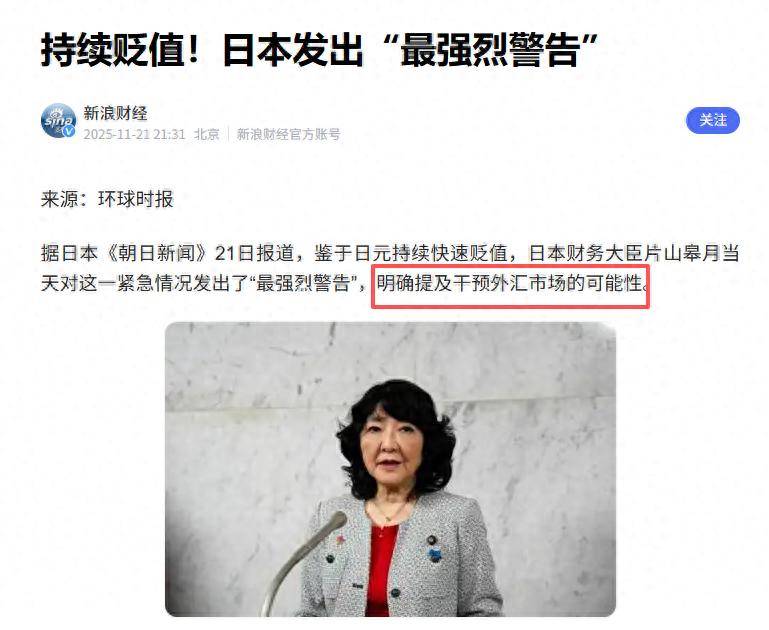
Group 1 - The recent depreciation of the Japanese yen is characterized as a sharp and dramatic decline rather than a gradual one, with the exchange rate nearing 157.3:1 against the US dollar, marking a single-day drop of 1.8% [1] - The Japanese government, particularly Finance Minister Katsuyuki Kitagawa, has issued strong warnings and appears ready to intervene in the market due to the alarming currency situation [1][3] - The yen's depreciation has not led to an increase in exports but has instead resulted in soaring import costs, pushing inflation to unprecedented levels, with core CPI rising 3.0% year-on-year as of October 2025 [5][12] Group 2 - The yen has depreciated over 50% since 2021, from 102 to over 157, leading to significant economic challenges, including rising costs of essential goods like rice and eggs [5][14] - The government’s economic stimulus package of 21.3 trillion yen (approximately 96.56 billion RMB) has exacerbated the situation, relying heavily on issuing more government debt, which has led to a sell-off of Japanese bonds [7][9] - Japan's national debt has reached twice its GDP, and the rising bond yields indicate a loss of market confidence, with 40-year bond yields hitting a historic high of 3.695% [7][9] Group 3 - The political landscape under Prime Minister Kishi has contributed to the crisis, with aggressive policies leading to a disconnect between political actions and economic realities, resulting in a self-inflicted economic downturn [3][10] - The tourism and retail sectors are suffering due to strained relations with China, which has halted imports of Japanese seafood and discouraged Chinese tourists, further impacting Japan's economy [10][12] - The ongoing capital flight from Japan, as investors lose faith in government policies, has led to a significant drop in the stock market, with a 2.4% decline observed recently [12][16] Group 4 - The current crisis reflects a broader failure of economic policy, where the yen's depreciation has not translated into competitive advantages but rather into increased living costs for citizens [12][18] - The situation poses a risk of escalating tensions with the US if Japan attempts to intervene in the currency market, potentially leading to further economic isolation [16][18] - The overall outlook for Japan's economy is grim, with the potential for a complete policy failure if current trends continue, leading to a significant political and economic crisis [18]

固收 信用:年末或有一定波动
2025-11-26 14:15
固收 信用:年末或有一定波动 20251125 摘要 摊余成本债基转向信用债投资,尤其集中在 3-5 年期普信债,推动信用 利差压缩至年内新低,但需考虑国开债切券的影响,实际利差空间已不 大。 摊余成本债基建仓仍在进行中,预计将持续支撑 3-5 年期信用债表现至 12 月底或明年 1 月,但二永债受流动性和定价逻辑影响,其比价未来大 概率回落。 12 月份市场波动性可能增加,历史数据显示四季度信用利差压降受政策 影响显著,今年年初至今利差已大幅压缩,需警惕流动性扰动。 当前信用债市场面临政策预期和资金面波动的不利因素,利差压降空间 有限,广普利率下行是关键,但年内整体利率下行难度较大。 短期信用债抗波动能力弱,性价比不高;中长期信用债虽有摊余成本债 基支撑,但需谨慎;超长期限信用债可考虑止盈,博弈未来货币政策宽 松。 若未来货币政策宽松,5 年以上中长期信用债或有反应,而 5 年以内中 短期信用债因已处低位,跟随速度可能较慢,压缩空间有限。 二永债比价优势明显,未来货币政策宽松或摊余成本建仓结束后,比价 回落可能带来收益,在票息和抗波动能力上优于 3-5 年普信债。 展望四季度末及 2026 年初,我们认为 ...
固收:利率债交易与信用债配置思路
2025-11-26 14:15
Summary of Key Points from Conference Call Records Industry Overview - The focus is on the fixed income market, particularly interest rate bonds and credit bond allocation strategies [1][2][3]. Core Insights and Arguments - **Interest Rate Bonds Market**: The current market shows limited downward potential for interest rates, leading to a decrease in investor willingness to take long positions. The market is reacting less to positive factors [1][2]. - **Investment Strategy**: - For absolute return portfolios, a low duration defensive strategy is recommended, waiting for interest rate adjustments before considering new opportunities [1][3]. - For relative return portfolios, attention should be paid to the compression of spreads between government bonds and policy bank bonds [1][3]. - **Recommended Bonds**: - Long-term: 10-year policy bank bond 215 and 30-year government bonds are highlighted for their liquidity and potential capital gains [1][7]. - Short-term: 5-year policy bank bonds 208 and 203 are recommended, while avoiding certain convex positions due to low cost-effectiveness [1][8]. - **Hedging Strategy**: Utilizing government bond futures for hedging operations is advised, specifically buying policy bank bonds and hedging with 5-year or 10-year government bond futures to enhance cost-effectiveness [1][9]. Important but Overlooked Content - **Credit Bonds**: - Emphasis on focusing on economically strong provinces and cities for long-term credit bonds, while regions with insufficient growth momentum should prioritize bonds with maturities of three years or less [1][10][11]. - Specific attention to key industrial chains in provinces like Shandong and Sichuan, which are investing in renewable energy sectors such as photovoltaics and hydrogen energy [1][12][14]. - **Local Government Support**: The role of local governments in attracting investment and providing policy support is crucial for the development of local enterprises and industries [1][15]. - **Future Investment Opportunities**: Identifying investment opportunities based on local industrial development plans, particularly in emerging sectors like new energy and intelligent manufacturing, is essential for long-term growth [1][16][20]. Conclusion - The fixed income market is currently characterized by cautious investor sentiment due to limited interest rate movement. Strategic allocation in both long-term and short-term bonds, along with a focus on economically robust regions and sectors, is recommended for potential investment success.
国泰海通|固收:防御优先:海外流动性趋紧或持续
国泰海通证券研究· 2025-11-26 13:12
Core Insights - The global bond market is experiencing a decline in yields due to policy uncertainty and tightening liquidity, indicating a phase of "high interest rates + liquidity repricing" [1] - The focus is on U.S. Federal Reserve policy signals, European fiscal risks, and sovereign debt issuance in Asia [1] - The report emphasizes a strategy centered on medium to long-term U.S. Treasuries, high-rated assets, and enhanced liquidity management to navigate policy shifts and avoid credit tail risks [1] Group 1: Global Bond Market Trends - Global major government bond yields have significantly decreased, with the U.S. 10-year yield dropping by 8.1 basis points, driven by rising risk aversion [1] - The UK 20-year yield surged by 30.03 basis points to 5.229%, reflecting heightened concerns over fiscal sustainability [1] - Japanese 10-year yield increased by 11.9 basis points to 1.824%, influenced by a stimulus plan that has led to a reassessment of inflation expectations [1] Group 2: Credit Market Developments - The issuance of Dim Sum bonds totaled 19 issues amounting to 138.03 billion yuan, with financial bonds making up 63.3% of this total [2] - The offshore-onshore yield spread has narrowed significantly to 8.95 basis points, a decrease of 34% [2] - Moody's upgraded Italy's sovereign rating to Baa2, while S&P upgraded Uzbekistan to BB and downgraded Bahrain to B [2] Group 3: Liquidity Conditions - The global monetary market is experiencing structural tightening, with the New York Fed reporting that reserves are no longer abundant [3] - The Hong Kong dollar HIBOR has significantly decreased, with the 1-month rate falling by 56.851 basis points to 1.93%, indicating improved liquidity [3] - The recommendation is to focus on medium-term holdings, select high-rated credits, and manage liquidity effectively, particularly favoring 5-7 year U.S. Treasuries [3]

走在债市曲线之前系列报告(十):债券指数体系与应用解析(下)
Changjiang Securities· 2025-11-26 11:19
1. Report Industry Investment Rating No relevant content provided. 2. Core Viewpoints of the Report The report focuses on the practical applications of bond indices in investment, systematically exploring their three core functions: serving as a tool for measuring asset performance, acting as a benchmark and tracking target for fund performance, and facilitating the construction of investment portfolios. It also introduces the Campisi and Brinson performance attribution models to analyze the logic of portfolio return decomposition and practical application steps [3]. 3. Summary by Related Catalogs Index Application: Analytical Tools in Investment Decision - Making Index Application One: Measuring Asset Performance - The interval price change of an index provides a reference for comparing the returns of different indices. By comparing the performance of wealth and net - price indices, bond returns can be split into coupon income and capital gains. Coupon income is relatively stable, with a slow downward trend in recent years, while capital gains are more volatile and significantly impact overall bond asset returns [17]. - Different - duration indices show distinct performance in various market conditions. Long - duration indices perform well in bull markets, and short - duration indices are more defensive in bear markets. Across different asset classes, there is a rotation relationship between bond indices and stocks, commodities, etc., which provides important references for asset allocation [7][24]. - Bond indices can be used as benchmarks for measuring the performance of fund portfolios. Different types of funds have different performance characteristics. Bond funds generally show better risk - dispersion and drawdown control capabilities compared to direct bond investments [27][34]. - Customized indices can be constructed to observe their risk and return performance [37]. Index Application Two: Performance Benchmark and Tracking Target - For actively managed funds, bond indices are performance benchmarks, and fund managers use strategies such as credit downgrading and duration management to outperform the benchmark. For passive index funds, bond indices are tracking targets, with requirements for daily average tracking deviation not exceeding 0.2% and annual tracking error not exceeding 2%. In practice, most index bond funds do not reach these upper limits [8][42]. - Fund performance comparison benchmarks can be divided into four types: index - based, interest - rate - based, numerical, and hybrid. The choice of performance benchmark affects the objective evaluation of fund managers' investment capabilities. Using wealth or total return indices as benchmarks can more comprehensively reflect the actual returns of investors [49][50]. - Index bond funds usually use full replication or sampling replication methods to construct portfolios. Sampling replication is more commonly used, and there are different specific methods. Tracking errors are mainly caused by subjective and objective factors [51][54]. - Index - enhanced bond funds are relatively scarce. They seek excess returns by adjusting the proportion of non - index component bonds and investing in other assets such as stocks [55]. Index Application Three: Flexible Construction of Investment Portfolios - Based on interest - rate forecasts, a duration - timing strategy can optimize portfolio performance. When yields are falling, the portfolio shifts to the ChinaBond 7 - 10 - year Treasury Bond Index to lengthen the duration; when yields are rising, it switches to the ChinaBond 1 - 3 - year Treasury Bond Index to shorten the duration [9]. - Incorporating bond indices into the stock - bond equilibrium framework can capture rebalancing signals through relative price changes between assets. A multi - asset timing strategy can continuously generate excess returns by switching between bond holdings and cash positions [9]. Performance Analysis Campisi Attribution Model - The Campisi model decomposes bond returns into holding income, price income, and bond residual income. Holding income includes coupon income and discount/premium convergence income; price income can be further split into Treasury curve riding income, Treasury curve movement income, and spread change income [70][71]. - Through the analysis of a simulated portfolio A, it is found that the portfolio failed to outperform the benchmark mainly due to insufficient exposure to interest - rate risks, resulting in lower price income [78][82]. Brinson Attribution Model - The Brinson model can be divided into the BHB model and the BF model, which differ in the calculation of industry allocation income. The model decomposes excess returns into industry allocation, individual security selection, and cross - income [83][84]. - Through the analysis of a simulated portfolio B, it is found that the total excess return of the portfolio in the second quarter of 2025 was 0.2995%. The main source was individual security selection income, followed by cross - income, which offset the small negative impact of industry allocation [90][93].
2026年信用债年度策略:信用利差扩大的观察之年
Soochow Securities· 2025-11-26 11:11
Group 1: Credit Bond Market Overview - The credit bond market is expected to maintain slight growth in scale, with a structure continuing from 2025, primarily focusing on industrial bonds supplemented by urban investment bonds [6][16] - The supply side is driven by the "14th Five-Year Plan" emphasizing "technological self-reliance," leading to an increased probability of expansion for technology innovation bonds [6][16] - The demand side is anticipated to remain stable overall, but structural changes may occur due to regulatory constraints affecting major buyers, potentially leading to weakened or more volatile demand [6][22] Group 2: Urban Investment Bonds Outlook - The urban investment bond sector is expected to continue facing a "zero tolerance" regulatory environment, maintaining a tight balance in financing, with a focus on debt resolution and market-oriented transformation [6][28] - The strategy for urban investment bonds suggests prioritizing regions with strong local financial resources and successful debt resolution progress, with a focus on extending durations for certain bonds [6][28] - The supply of urban investment bonds is projected to remain limited, with a significant reduction in issuance and net financing, reflecting ongoing regulatory pressures [6][28] Group 3: Industrial Bonds Outlook - The industrial bond sector is expected to maintain a stable issuance pace, with financing capabilities improving as the real economy gradually recovers [7][10] - Demand for industrial bonds is driven by new supply and spillover effects from other sectors, with certain industries like transportation and construction attracting institutional investors due to higher valuation ranges [7][10] Group 4: Perpetual Bonds Outlook - The perpetual bond market is likely to see a slight contraction in new issuance, as banks have less need to issue new perpetual bonds due to improved capital adequacy ratios [10][22] - Demand for perpetual bonds may weaken as institutional investors face challenges in adjusting their investment strategies amid regulatory changes [10][22] Group 5: Credit Expansion Signals and Fundamental Recovery - The overall credit expansion remains limited compared to pre-pandemic levels, with a structural rather than a broad recovery observed across different industries [10][22] - Industries such as electronics and public utilities show signs of credit expansion, while sectors like real estate and food and beverage are experiencing credit contraction [10][22]
产投债:地方政府破解产业基金缺钱困局的“破局之道”
Sou Hu Cai Jing· 2025-11-26 05:56
Core Viewpoint - The issuance of industrial investment bonds (产投债) is emerging as an innovative financing solution for local governments to overcome funding bottlenecks in the process of upgrading local industries and cultivating new productive forces [1] Group 1: Industrial Investment Bonds as a Financing Tool - Industrial investment bonds are specialized bonds issued by local governments or urban investment platforms to support industrial development, providing long-term, low-cost funding for industrial funds and major projects [1] - These bonds emphasize "industry orientation," directing funds towards areas such as technological innovation, green economy, and strategic emerging industries, aligning with local government goals for industrial ecosystem cultivation and economic transformation [1] Group 2: Six Core Advantages of Industrial Investment Bonds - **Flexible Scale**: The issuance scale ranges from 500 million to 1 billion yuan, with a total scale controlled at 30%-40% of local fixed asset scale, meeting the needs for large fundraising while avoiding excessive debt risk [2] - **Elastic Term**: The bonds feature a "3+2+2" flexible term structure, with a maximum duration of 7 years, alleviating short-term repayment pressure and aligning with the long investment return cycle [3] - **Low Cost**: The interest rate ranges from 2.5% to 3.5%, with a comprehensive fee not exceeding 5%, significantly lower than non-standard channels like trusts and financing leases, saving local governments millions to tens of millions in financing costs annually [4] - **Pure Credit Financing**: These bonds are backed by local government or urban investment credit without requiring fixed asset collateral, suitable for light asset and high-growth industries [5] - **Wide Usage**: Funds can be used for establishing industrial funds, investing in strategic projects, and supplementing corporate capital, covering the entire chain from R&D to industrialization [6] - **Flexible Repayment**: Policies allow for the issuance of new bonds to repay old ones before maturity, mitigating liquidity risks and enabling a virtuous cycle of financing, investment, and returns [7] Group 3: Future of Industrial Investment Bonds - Industrial investment bonds serve not only as a financing tool but also as a catalyst for the "capitalization transformation" of local economies, enabling local governments to achieve three breakthroughs: transforming resources into capital, converting short-term debt into long-term investments, and aligning with national policy directions [8] - Regions like Jiangsu, Zhejiang, and Guangdong have successfully incubated multiple hundred-billion yuan industrial funds through industrial investment bonds, attracting over 100 billion yuan in social capital across sectors like new energy, biomedicine, and intelligent manufacturing [9] Conclusion - For local governments, the challenge of funding industrial funds is not insurmountable; the key lies in selecting the right tools and effectively utilizing policies. Industrial investment bonds provide a tailored financing solution with advantages of low cost, long duration, high flexibility, and wide applicability, enabling local governments to connect capital with industrial and innovation chains, thereby seizing opportunities for high-quality development [10]