
啤酒

Search documents
重庆啤酒总裁李志刚:把握消费场景需求 谋划业绩增长新篇
Zhong Guo Zheng Quan Bao· 2025-11-30 22:27
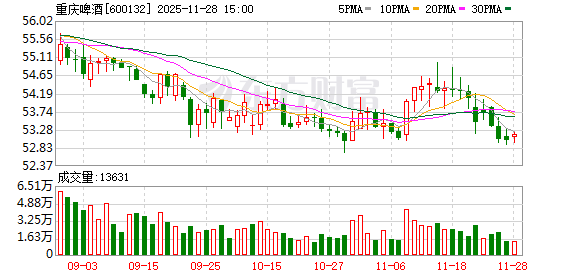
Core Viewpoint - The Chinese beer industry is undergoing structural adjustments and a transformation in consumer logic, with Chongqing Beer exploring a path that balances local culture and global vision through a dual strategy of local and international brands [2][4]. Product and Channel Transformation - Chongqing Beer has focused on continuous upgrades in product structure and strategic reshaping of channel resources, responding to the slowing growth of the beer industry by innovating in product offerings and channel strategies [2][3]. - The company has launched approximately 30 new products this year, including craft beers, tea beers, and low-alcohol options, while also expanding into non-beer categories like fruit drinks and energy drinks [3]. - The shift towards non-on-premise channels has seen over half of the company's sales coming from these channels, with partnerships established with platforms like Meituan and JD Daojia to enhance distribution [3]. Local and International Brand Synergy - The combination of local and international brands is a key competitive advantage for Chongqing Beer, with local brands accounting for over 70% of total sales, particularly in base markets like Chongqing [4][5]. - Local brands are deeply connected to regional culture, while international brands bring a sense of fashion and vitality, allowing for complementary growth and channel synergy [5][6]. Geographic Expansion and Category Diversification - Chongqing Beer plans to continue its "big city strategy" to enhance its presence in high-potential markets, particularly in South China, where local production has been established to reduce logistics costs [6][7]. - The company aims to upgrade its product structure and accelerate its expansion into non-beer categories, focusing on deeper consumer engagement and continuous iteration of new products [7]. Digitalization and Operational Efficiency - The company emphasizes the role of digital tools in enhancing channel efficiency, aiming for better inventory management and market insights through data optimization [7]. - Continuous iteration is highlighted as a crucial strategy for responding to competition from new beverage brands and the entry of liquor companies into the beer market, with a focus on rich product offerings and efficient channels [7].


把握消费场景需求 谋划业绩增长新篇
Zhong Guo Zheng Quan Bao· 2025-11-30 22:22
Core Insights - The Chinese beer industry is undergoing structural adjustments and a transformation in consumer logic, with companies like Chongqing Beer exploring a dual strategy of local and international brand integration to adapt to these changes [1][4] Group 1: Company Performance - Chongqing Beer reported a sales volume of 2.6681 million kiloliters and revenue of 13.059 billion yuan in the first three quarters of 2025, with an operating profit of 3.233 billion yuan [1] - The company's president emphasized that the stable performance is attributed to continuous optimization in product structure, channel focus, and brand combination [1] Group 2: Product and Channel Innovation - The company is focusing on two main areas for innovation: continuous upgrading of product structure and strategic reshaping of channel resources [2] - Chongqing Beer has launched approximately 30 new products this year, including craft beers, tea beers, and low-alcohol beers, while also expanding into non-beer categories like fruit drinks and energy drinks [2][5] - The company is shifting resources towards non-on-premise channels, with over half of its sales now coming from these channels, and has partnered with various instant retail platforms [2] Group 3: Brand Strategy - Chongqing Beer's competitive advantage lies in its combination of local and international brands, with local brands accounting for over 70% of total sales [3] - The local brand "Wusu Beer" has become a representative national brand, while "Chongqing Beer" has established a strong presence in regional markets [3] Group 4: Future Outlook - The company anticipates that the Chinese beer market will continue to grow, shifting from quantity-driven growth to quality-driven growth [4] - Chongqing Beer plans to enhance its geographical presence, upgrade its brands, and optimize its channels to achieve sustainable and quality growth [4][5] - The company is also focusing on digitalization to improve channel efficiency and market responsiveness [5]
少了杨瀚森 依旧有信心
Qi Lu Wan Bao· 2025-11-30 22:08
Group 1 - The Qingdao Laoshang Beer Men's Basketball Team officially embarks on the CBA new season with a new sponsorship deal from Laoshang Beer, symbolizing the integration of sports and culture in the city [1][2] - Last season, the team achieved a remarkable 7th place in the league, securing a playoff spot 11 rounds early, with notable players like Yang Hansheng being drafted in the NBA [1] - The team has made strategic roster adjustments, including the signing of new players and retaining key foreign players to enhance tactical diversity for the upcoming season [1] Group 2 - The partnership between Laoshang Beer and the Qingdao Men's Basketball Team represents a cultural resonance between the "City of Basketball" and the "Beer Capital," with Laoshang Beer having a brand value of 77.635 billion yuan [2] - Laoshang Beer has been actively involved in basketball marketing since 2014, promoting the brand through various community events and initiatives aimed at popularizing basketball [2] - The team will host its first home game of the new season on December 15, with affordable ticket prices available through various platforms, reflecting the team's commitment to community engagement [2]

重庆啤酒总裁李志刚: 把握消费场景需求 谋划业绩增长新篇
Zhong Guo Zheng Quan Bao· 2025-11-30 20:27
Core Insights - The Chinese beer industry is undergoing structural adjustments and a transformation in consumer logic, with companies like Chongqing Beer exploring a dual strategy of local and international branding to adapt to these changes [1][3] Product and Channel Transformation - Chongqing Beer is focusing on product structure upgrades and strategic channel resource reallocation to address the slowing growth in the beer industry [2] - The company has launched approximately 30 new products this year, including craft beers and non-beer beverages, to capture evolving consumer preferences [2] - Non-on-premise channel sales now account for over half of the company's total sales, with partnerships established with major instant retail platforms [2] Local and International Brand Synergy - The combination of local and international brands is a key competitive advantage for Chongqing Beer, with local brands accounting for over 70% of total sales [3] - The company’s local brands, such as "Wusu Beer" and "Chongqing Beer," dominate the market share in their respective regions, enhancing brand recognition and consumer loyalty [3] Geographic Expansion and Efficiency Improvement - Chongqing Beer plans to continue its "big city strategy" to deepen its market presence in high-potential areas, particularly in South China [4] - The establishment of the Foshan brewery has improved supply chain efficiency and reduced logistics costs, supporting the company's growth in the Greater Bay Area [4] Brand and Category Development - The company aims to upgrade its product structure and expand into non-beer categories to meet diverse consumer demands [5] - Emphasis is placed on continuous iteration and gradual market penetration rather than seeking immediate blockbuster products [5] Digitalization and Operational Efficiency - The company is leveraging digital tools to enhance channel efficiency, optimize inventory management, and improve market responsiveness [5] - Continuous iteration is highlighted as a crucial strategy to navigate competition from new beverage brands and adapt to changing consumer preferences [5]
林芝逾80种特色产品亮相广州引关注
Nan Fang Du Shi Bao· 2025-11-30 10:21
Group 1 - The event "Yuelin Tongxin · Shanhai Gongxing" 2025 Linzhi Economic Development Zone Investment Promotion Conference was held in Guangzhou, Guangdong Province [1] - Four representatives from investment enterprises in Linzhi shared their entrepreneurial stories, highlighting unique products such as "Linzhi Beer" and "Motu Tea" [3] - The event featured a dual venue format with an outdoor section that attracted many citizens, showcasing over 80 specialty products from more than 10 enterprises in Linzhi [3] Group 2 - The event was co-hosted by the People's Government of Linzhi City, Tibet Autonomous Region, and the 11th batch of Guangdong aid team to Tibet, with the Linzhi Economic Development Zone Management Committee as the organizer [5] - Four investment projects were signed during the event, with a total signing amount of 605 million yuan, covering clean energy, green industry, and highland specialty agriculture and animal husbandry [5]

周观点:茅台定调审时度势,原奶周期拐点可期-20251130
GOLDEN SUN SECURITIES· 2025-11-30 06:27
证券研究报告 | 行业周报 gszqdatemark 2025 11 30 年 月 日 食品饮料 周观点:茅台定调审时度势,原奶周期拐点可期 投资建议:1、白酒:茅台定调理性、科学应对周期波动,供给改善信号进一步明 确,白酒板块动销磨底、报表出清、预期低位下把握底部机遇,建议配置:1)短 期边际变化弹性标的:泸州老窖、港股珍酒李渡、舍得酒业、酒鬼酒、水井坊; 2)筹码结构优化:迎驾贡酒、洋河股份、老白干酒等;3)中长期经营质量龙头 标的:贵州茅台、五粮液、山西汾酒、古井贡酒、今世缘等。2、大众品:中国旺 旺收入同比微增,原奶周期拐点可期,优先关注成长股、后续切换复苏:1)高景 气或高成长逻辑:东鹏饮料、燕京啤酒、珠江啤酒、万辰集团、盐津铺子、有友食 品、新乳业、百龙创园等,港股卫龙美味等。2)政策受益或复苏改善:百润股份、 青岛啤酒、海天味业、伊利股份、重庆啤酒、安琪酵母、洽洽食品、仙乐健康、安 井食品、立高食品、好想你等,港股农夫山泉、华润饮料、H&H 国际控股等。 白酒:茅台定调理性,彰显龙头底色。本周贵州茅台召开 2025 年第一次临时股东 大会,新董事长陈华总携高管团队出席坦诚回应行业发展与茅台未来, ...

需求增长105%,年轻人爱上这种酒,发烧友年销近亿
Sou Hu Cai Jing· 2025-11-30 05:00
Core Insights - The craft beer industry in China is transitioning from niche to mainstream, with increasing competition both online and offline [1][2] - "Dajiu Brewing," founded by Li Yuxing, has achieved significant sales, nearing 100 million yuan annually, and ranks among the top ten in Tmall's beer category [1] - The brand's fruit-flavored craft beers have seen a 105% increase in GMV during the recent Double 11 shopping festival, with female consumers now making up over 50% of the customer base [1][12] Industry Overview - In 2017, the craft beer market was dominated by major brands like Snow Beer and Tsingtao, with a consumer base primarily consisting of expatriates and young urbanites [3][5] - The rise of craft beer has been accelerated by capital influx and market education, leading to a rapid expansion of the industry [5][7] Company Strategy - "Dajiu Brewing" focuses on maintaining control over its supply chain and core technology, which has been crucial for quality assurance and cost management [13][19] - The company emphasizes a hybrid sales strategy, prioritizing offline channels while leveraging online platforms for brand awareness [14][16] Product Development - The brand has shifted its product focus from traditional strong flavors to more approachable fruit-flavored beers, aligning with consumer preferences for lighter, refreshing options [9][11] - New product launches are based on consumer feedback from small-scale tests, ensuring high repurchase rates and market fit [11] Market Trends - The demographic of craft beer consumers is evolving, with a notable increase in female consumers, particularly urban professionals aged 20-30 [16] - The craft beer market is expected to become saturated by 2025, with increased competition from both new entrants and established brands [18][19]

非白酒板块11月28日跌0.01%,青岛啤酒领跌,主力资金净流出1.21亿元
Zheng Xing Xing Ye Ri Bao· 2025-11-28 09:08
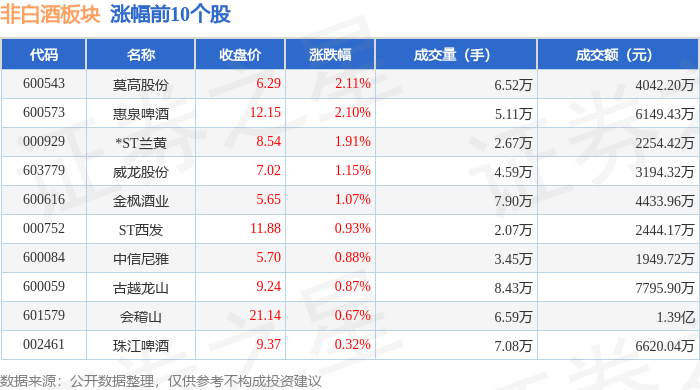
Core Viewpoint - The non-baijiu sector experienced a slight decline of 0.01% on November 28, with Qingdao Beer leading the drop, while the overall market indices showed positive movements [1] Market Performance - The Shanghai Composite Index closed at 3888.6, up 0.34% - The Shenzhen Component Index closed at 12984.08, up 0.85% [1] Non-Baijiu Sector Stock Performance - Notable gainers in the non-baijiu sector included: - Mogao Co., Ltd. (600543) with a closing price of 6.29, up 2.11% - Huichuan Beer (600573) at 12.15, up 2.10% - ST Lanhua (000929) at 8.54, up 1.91% - Weilang Co., Ltd. (603779) at 7.02, up 1.15% - Jinfeng Wine Industry (600616) at 5.65, up 1.07% [1] Capital Flow Analysis - The non-baijiu sector saw a net outflow of 121 million yuan from institutional investors - Retail investors contributed a net inflow of 78.65 million yuan, while speculative funds saw a net inflow of 42.59 million yuan [1]


食品饮料行业双周报(2025、11、14-2025、11、27):白酒筑底,关注结构性机会-20251128
Dongguan Securities· 2025-11-28 08:14
Investment Rating - The report maintains an "Overweight" rating for the food and beverage industry, indicating an expectation that the industry index will outperform the market index by more than 10% over the next six months [2][47]. Core Viewpoints - The white liquor sector is bottoming out, with a focus on structural opportunities. The report anticipates continued pressure on sales in the white liquor market through Q4 of this year and Q1 of next year, with a potential recovery in Q2 of next year due to a low base effect. The report suggests monitoring high-end liquor brands like Kweichow Moutai and other regional brands for investment opportunities [2][44]. - The report highlights a mixed performance across various segments within the food and beverage industry, with certain sectors like snacks and soft drinks showing potential growth driven by key products and channel contributions [2][44]. Summary by Sections 1. Market Review - The SW food and beverage industry index decreased by 2.97% from November 14 to November 27, 2025, outperforming the CSI 300 index by approximately 1.00 percentage points [9][11]. - Most sub-sectors underperformed the CSI 300 index during the same period, with the dairy sector showing the smallest decline of 0.11% [11][12]. - Approximately 6% of stocks in the industry recorded positive returns, with notable gainers including Hai Xin Food (+11.34%) and Nan Qiao Food (+7.86%) [13][14]. - The industry valuation is currently below the five-year average, with a PE ratio of approximately 21.3 times, compared to the historical average of 32 times [15]. 2. Key Industry Data Tracking 2.1 White Liquor Sector - The report notes a decline in the prices of premium liquor brands, with the price of Feitian Moutai at 1590 RMB per bottle, down 50 RMB from the previous period [17]. 2.2 Seasoning Sector - Prices for soybean meal increased, while white sugar and glass prices decreased. The price of white sugar fell to 5470 RMB per ton, a decrease of 290 RMB [22]. 2.3 Beer Sector - The average price of barley decreased to 2195 RMB per ton, while the price of aluminum ingots increased slightly [27]. 2.4 Dairy Sector - The average price of fresh milk remained stable at 3.03 RMB per kilogram [34]. 2.5 Meat Products Sector - The average wholesale price of pork decreased to 18.07 RMB per kilogram, reflecting a year-on-year decline of 22.88% [36]. 3. Industry News - The report mentions a 4.1% year-on-year growth in retail sales of tobacco and alcohol for October 2025, indicating a positive trend in consumer spending [39]. - The report also highlights a 16.1% increase in beer exports for the first ten months of 2025, suggesting a growing international demand [40]. 4. Company Announcements - Yili Group announced a shareholder return plan for 2025-2027, committing to a cash dividend of no less than 75% of the net profit attributable to shareholders [43]. 5. Weekly Industry Perspective - The report emphasizes the importance of monitoring economic recovery and distributor confidence in the white liquor sector, while also suggesting investment in high-quality brands and sectors benefiting from policy support [44][45].



遭网络攻击致客户信息泄露 日本朝日集团道歉
Yang Shi Xin Wen Ke Hu Duan· 2025-11-28 00:08
Core Points - Asahi Group announced on the 27th that a cyber attack led to a system failure, potentially compromising 1.914 million personal information records of customers and employees [1] - The company's president, Atsushi Katsuki, publicly apologized during a press conference in Tokyo, acknowledging the distress caused to customers and related parties [1] - This is the first public statement from the management since the system failure occurred on September 29 [1] Personal Information Details - Among the potentially leaked information, 1.525 million records are related to customers, including names, addresses, and phone numbers [1] - The hacker group claiming responsibility, known as "Qilin," has released internal documents and images of employee personal information online, stating that approximately 9,300 files were stolen [1]