
零售业

Search documents
有喜有忧!东莞镇街2025上半年经济“成绩单”陆续公布
Nan Fang Du Shi Bao· 2025-08-21 10:21
Core Insights - Dongguan's economy shows a mixed performance in the first half of 2025, with strong consumer markets and active foreign trade, but a slowdown in fixed asset investment [2][3][21] Economic Performance - Dongguan's GDP reached 606.78 billion yuan, growing by 4.8% year-on-year, which is 0.6 percentage points higher than the provincial average [3] - Among the 20 towns that reported, Dongkeng, Xiegang, and Gaobu had the highest GDP growth rates of 24.2%, 18.1%, and 8.1% respectively [3][4][6] Consumer Market - The total retail sales of social consumer goods in Dongguan amounted to 2,195.55 billion yuan, with a year-on-year increase of 3.4% [10] - Notably, the retail sales in Liubu and Dongcheng grew by 10.9% and 15.9% respectively, outperforming the city average [10][13] Foreign Trade - Dongguan's total import and export value reached 7,492.8 billion yuan, marking a year-on-year increase of 16.5%, ranking second in the province [17][19] - Noteworthy growth in foreign trade was observed in Tangxia and Xiegang, with increases of 184% and 2.8% respectively [19][20] Fixed Asset Investment - Fixed asset investment in Dongguan decreased by 10.9% year-on-year, although the decline was less severe than in the first quarter [21] - Some towns like Huangjiang and Tangxia experienced declines in fixed asset investment, while others like Dongcheng and Xiegang saw increases of 20.8% and 3.9% respectively [21][22][24]


大商股份: 大商股份有限公司2025年第二次临时股东大会决议公告
Zheng Quan Zhi Xing· 2025-08-21 05:40
董事的议案》 事的议案》 | 证券简称:大商股份 公告编号:2025-036 | 证券代码:600694 | | | | | | --- | --- | --- | --- | --- | --- | | 大商股份有限公司 | | | | | | | 本公司董事会及全体董事保证本公告内容不存在任何虚假记载、误导性陈述 | | | | | | | 或者重大遗漏,并对其内容的真实性、准确性和完整性承担法律责任。 | | | | | | | | 重要内容提示: | | | | | | 本次会议是否有否决议案:无 | ? | | | | | | 会议召开和出席情况 | 一、 | | | | | | 年 | (一)股东大会召开的时间:2025 | 8 月 20 日 | | | | | (二)股东大会召开的地点:大连市中山区青三街 1 号公司总部 19 楼会议室 | | | | | | | (三)出席会议的普通股股东和恢复表决权的优先股股东及其持有股份情况: | | | | | | | | 数的比例(%) | | | | | | (四)表决方式是否符合《公司法》及《公司章程》的规定,大会主持情况等。 | | | | | ...

永辉超市上半年营收299亿净亏2.41亿,二季度关店186家
Bei Ke Cai Jing· 2025-08-21 01:53
Group 1 - The core point of the article highlights that Yonghui Supermarket reported a net loss of 241 million yuan in the first half of 2025, compared to a net profit of 275 million yuan in the same period last year [1] - The company's operating revenue for the second quarter was 29.948 billion yuan, reflecting a year-on-year decline of 20.73% [1] - In a significant operational move, Yonghui Supermarket closed 186 stores in the second quarter [1]

002056 拟每10股派现3.8元
Zhong Guo Zheng Quan Bao· 2025-08-20 23:20
Company News - Hengdian East Magnetic achieved a net profit of 1.02 billion yuan in the first half of the year, a year-on-year increase of 58.94%, and plans to distribute a cash dividend of 3.8 yuan per 10 shares (tax included) [10] - Muyuan Foods reported a revenue of 76.463 billion yuan, a year-on-year increase of 34.46%, and a net profit of 10.53 billion yuan, a year-on-year increase of 1169.77%. The company plans to distribute a cash dividend of 9.32 yuan per 10 shares (tax included), totaling 5 billion yuan [10] - *ST Yazhen announced that its stock will resume trading on August 21 after completing a trading suspension review. The company expects a net profit of -39.5 million to -33 million yuan for the first half of 2025 [10][12] - Heng Rui Medicine achieved a revenue of 15.761 billion yuan, a year-on-year increase of 15.88%, and a net profit of 4.45 billion yuan, a year-on-year increase of 29.67%. The company plans to repurchase shares worth 1 to 2 billion yuan [10] - Yonghui Supermarket reported a revenue of 29.948 billion yuan, a year-on-year decrease of 20.73%, and a net loss of 241 million yuan [11] Industry News - The People's Bank of China announced that the loan market quotation rate (LPR) for one year is 3.0% and for five years or more is 3.5%, unchanged from the previous period [6] - The National Financial Supervision Administration is revising the "Commercial Bank M&A Loan Risk Management Guidelines" to broaden the scope of M&A loans and optimize loan conditions [6] - The Ministry of Finance announced that starting January 1, 2025, childcare subsidies will be exempt from personal income tax [7] - The China Securities Regulatory Commission plans to enhance product supply in the futures market, focusing on important energy varieties like liquefied natural gas [8]



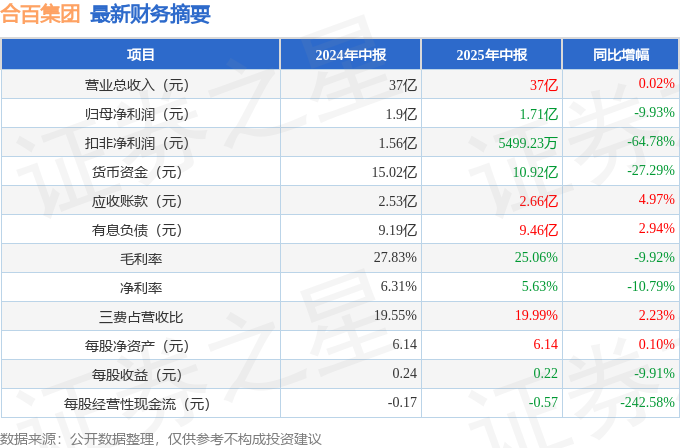
合百集团2025年中报简析:增收不增利,公司应收账款体量较大
Zheng Quan Zhi Xing· 2025-08-20 23:08
财务报表中对有大幅变动的财务项目的原因说明如下: 财务费用变动幅度为51.84%,原因:本报告期存款利率下行,利息收入减少。 经营活动产生的现金流量净额变动幅度为-242.58%,原因:本报告期收到销售商品款项减少。 据证券之星公开数据整理,近期合百集团(000417)发布2025年中报。截至本报告期末,公司营业总收 入37.0亿元,同比上升0.02%,归母净利润1.71亿元,同比下降9.93%。按单季度数据看,第二季度营业 总收入15.68亿元,同比下降7.69%,第二季度归母净利润9560.28万元,同比上升13.14%。本报告期合 百集团公司应收账款体量较大,当期应收账款占最新年报归母净利润比达139.47%。 本次财报公布的各项数据指标表现一般。其中,毛利率25.06%,同比减9.92%,净利率5.63%,同比减 10.79%,销售费用、管理费用、财务费用总计7.4亿元,三费占营收比19.99%,同比增2.23%,每股净资 产6.14元,同比增0.1%,每股经营性现金流-0.57元,同比减242.58%,每股收益0.22元,同比减9.91% | 项目 | 2024年中报 | 2025年中报 | 同比增 ...

新疆友好(集团)股份有限公司2025年半年度报告摘要
Shang Hai Zheng Quan Bao· 2025-08-20 19:42
Group 1 - The company reported a net profit of 12.14 million yuan for the first half of 2025, representing a year-on-year increase of 52.93% [8] - The net profit attributable to shareholders after deducting non-recurring gains and losses was 3.54 million yuan, showing a year-on-year growth of 11.65% [8] - The company closed one supermarket during the reporting period and signed a contract for one new standard supermarket, with several other projects under negotiation [6] Group 2 - The main business revenue in the northern region decreased year-on-year due to the closure of loss-making stores [8] - The main business revenue in the southern region also saw a decline due to the termination of operations in certain areas of a shopping center [8] - The company is expanding the area for dining and entertainment in its stores to adapt to changing consumer demands, which has positively impacted overall profit despite affecting main business revenue and gross margin [8]

一般零售板块8月20日涨0.74%,汇嘉时代领涨,主力资金净流入1.2亿元
Zheng Xing Xing Ye Ri Bao· 2025-08-20 08:41
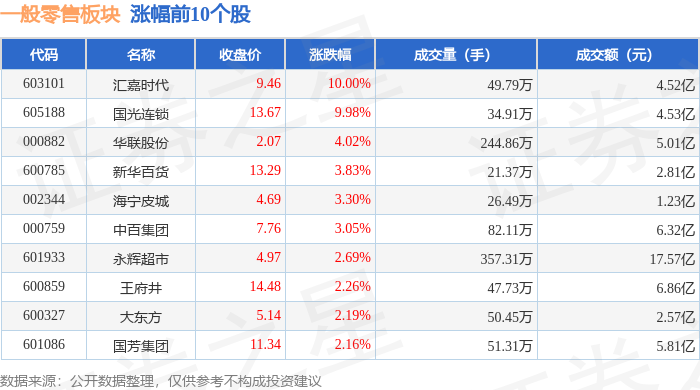
Market Overview - On August 20, the general retail sector rose by 0.73% compared to the previous trading day, with Huijia Times leading the gains [1] - The Shanghai Composite Index closed at 3766.21, up 1.04%, while the Shenzhen Component Index closed at 11926.74, up 0.89% [1] Top Gainers in General Retail Sector - Huijia Times (603101) closed at 9.46, up 10.00% with a trading volume of 497,900 shares and a turnover of 452 million [1] - Guoguang Chain (605188) closed at 13.67, up 9.98% with a trading volume of 349,100 shares and a turnover of 453 million [1] - Tianlian Stock (000882) closed at 2.07, up 4.02% with a trading volume of 2,448,600 shares and a turnover of 501 million [1] - Other notable gainers include Xinhua Department Store (600785) and Haining Leather City (002344) with increases of 3.83% and 3.30% respectively [1] Top Losers in General Retail Sector - Wushang Group (000501) closed at 12.01, down 4.38% with a trading volume of 654,100 shares and a turnover of 789 million [2] - Dalian Friendship (000679) closed at 9.82, down 3.16% with a trading volume of 137,000 shares and a turnover of 13.5 million [2] - Other notable losers include Xiaoshangpin City (600415) and Hui Tong Energy (600605) with declines of 1.48% and 1.41% respectively [2] Capital Flow Analysis - The general retail sector saw a net inflow of 120 million from institutional investors, while retail investors contributed a net inflow of 217 million [2][3] - However, there was a net outflow of 338 million from speculative funds [2][3] Individual Stock Capital Flow - Yonghui Supermarket (601933) had a net inflow of 12.8 million from institutional investors, but a net outflow of 12 million from speculative funds [3] - Wangfujing (600859) experienced a net inflow of 66.5 million from institutional investors, with a net outflow of 24.9 million from speculative funds [3] - Guohua Chain (605188) had a net inflow of 60.3 million from institutional investors, but also saw a net outflow of 15.6 million from speculative funds [3]


王府井(600859)8月20日主力资金净流入6652.44万元
Sou Hu Cai Jing· 2025-08-20 08:09
Core Insights - Wangfujing Group Co., Ltd. reported a total revenue of 2.985 billion yuan for Q1 2025, a year-on-year decrease of 9.76% [1] - The net profit attributable to shareholders was 55.6412 million yuan, down 72.43% year-on-year [1] - The company has a current ratio of 1.619 and a quick ratio of 1.385, indicating liquidity [1] Financial Performance - The stock price closed at 14.48 yuan, with an increase of 2.26% [1] - The trading volume was 477,300 hands, with a transaction amount of 686 million yuan [1] - Main capital inflow was 66.5244 million yuan, accounting for 9.7% of the transaction amount [1] Investment and Business Activities - Wangfujing Group has invested in 109 companies and participated in 698 bidding projects [2] - The company holds 649 trademark registrations and 19 patents [2] - It has 28 administrative licenses [2]
懂王继续重锤,关税阴云犹在,“全球央妈年会”即将召开!
Sou Hu Cai Jing· 2025-08-20 05:55
Group 1: Trade Policy Changes - The Trump administration has expanded the coverage of steel and aluminum tariffs by 50%, adding over 400 product categories including firefighting equipment, machinery, construction materials, and specialty chemicals made from steel and aluminum [2][3] - The expansion of tariffs aims to close loopholes and support the ongoing revitalization of the U.S. steel and aluminum industries, according to Jeffrey Kessler, Deputy Assistant Secretary for Industrial and Security [3] Group 2: Economic Impact - The new tariffs are estimated to affect at least $320 billion worth of imported goods, potentially increasing cost-push inflation pressures as domestic producers raise prices [3] - Several U.S. companies, including Procter & Gamble, Walmart, and Home Depot, have issued price increase warnings, indicating that the tariffs will lead to higher product prices [3] - A recent survey revealed that nearly one-third of U.S. businesses plan to raise prices within six months, reflecting a trend of passing higher input and import costs onto consumers [3] Group 3: Federal Reserve and Interest Rates - The tariffs have reignited discussions about inflation and interest rates, with President Trump urging the Federal Reserve to lower rates [4] - Treasury Secretary Mnuchin suggested that the Fed's benchmark rate should be reduced by 150-175 basis points, although this view has faced criticism [4] - Market expectations indicate a nearly certain 25 basis point rate cut by the Fed next month, with at least one more cut anticipated by the end of the year [4][5] Group 4: Federal Reserve's Policy Framework - The upcoming Jackson Hole conference is expected to see Fed Chair Powell address the monetary policy framework, with speculation that the Fed may shift away from the "flexible average inflation targeting" introduced during the COVID-19 pandemic [6] - Powell's actions and statements are closely watched as they could significantly influence global financial markets amid the intertwined issues of tariffs, inflation, and monetary policy [6]

美银:稳定币颠覆性应用在跨境P2P支付,年化或催生高达750亿美债需求
智通财经网· 2025-08-20 03:53
Group 1 - The core viewpoint of the report emphasizes the transformative potential of stablecoins in the financial system, particularly in cross-border transactions and retail settlements, despite regulatory controversies [1][2] - Cross-border peer-to-peer (P2P) payments are identified as the most disruptive application of stablecoins, offering significant advantages in settlement efficiency and cost compared to traditional banking systems, potentially becoming a vital channel for capital flow in emerging markets [1] - The report highlights that the demand for stablecoins in the U.S. Treasury market could reach between $25 billion to $75 billion over the next 12 months, although this is insufficient to alter the current supply-demand dynamics in the Treasury market [1] Group 2 - There is a noticeable divergence in attitudes between the banking and retail sectors towards stablecoins, with traditional financial institutions expressing caution due to customer readiness issues, while retail giants like Amazon and Walmart are actively promoting stablecoin adoption through incentives [2] - The GENIUS Act's loopholes have become a focal point in the industry, as it prohibits direct interest payments by stablecoin issuers but allows for reward mechanisms through partnerships with exchanges, raising concerns about potential shifts of bank deposits to on-chain systems [2] - The long-term vision proposed by the report includes the trading of on-chain financial assets, which could significantly reduce the need for fiat currency exchanges, although this transformation will require years and substantial infrastructure investment [2][3]