造船

Search documents
波兰升级海军以应对波罗的海的“俄罗斯威胁”
Xin Lang Cai Jing· 2026-01-22 05:49
Core Viewpoint - Poland is undertaking its largest naval reform since the Cold War to rebuild its long-neglected naval capabilities in response to increasing Russian strength in the Baltic Sea region [1] Group 1: Naval Developments - Poland is constructing three frigates at the Baltic coast city of Gdynia [1] - In November of the previous year, Poland agreed to purchase three submarines from Sweden [1] - The country has launched a new mine countermeasure vessel and started building a rescue ship to support submarine operations [1] Group 2: Historical Context - The Polish Navy currently operates one submarine, which is a Soviet-made vessel transferred to Poland in 1986 [1] - Additionally, the navy has two frigates built in the 1970s in the United States [1] - These developments aim to address decades of underinvestment in Poland's naval forces [1]
回眸二〇二五:解码中国制造的升级脉动
Jing Ji Ri Bao· 2026-01-22 00:02
Core Viewpoint - China's manufacturing sector is poised for high-quality development, focusing on high-end, intelligent, green, and integrated approaches to overcome challenges and enhance its global competitiveness [1][2][3][6][12]. High-End Development - High-end manufacturing is crucial for China's economic quality, addressing issues like reliance on foreign technology and enhancing the resilience of the supply chain [2][3]. - The transition to high-end manufacturing is necessary to optimize industrial structure and meet the growing demand for high-quality products [3]. - By 2025, China's automotive production and sales are expected to exceed 34 million units, maintaining its position as the world's largest market for 17 consecutive years [3]. Intelligent Development - The integration of artificial intelligence in manufacturing is transforming the sector, enhancing efficiency and driving innovation [6][7]. - By 2025, over 1 million industrial devices are expected to be connected through industrial internet platforms, significantly improving production efficiency and reducing costs [7][8]. - The digital transformation is not limited to large enterprises; small and medium-sized enterprises are also rapidly adopting digital technologies [8]. Green Development - The shift towards green manufacturing is essential for sustainability and economic growth, with a focus on reducing carbon emissions and enhancing resource efficiency [9][10]. - By 2025, nearly 60% of new energy vehicles are expected to be part of vehicle replacement programs, reflecting a strong consumer preference for green products [10][11]. - Innovative green technologies are being adopted across industries, contributing to significant reductions in carbon emissions [10]. Integrated Development - The integration of manufacturing with services and digital technologies is reshaping the industry, creating new growth opportunities and enhancing competitiveness [12][13]. - Policies are being implemented to promote service-oriented manufacturing, encouraging companies to shift from product sales to service-oriented business models [13][14]. - The collaboration between large and small enterprises is fostering a more integrated and efficient industrial ecosystem [14][15].
韩国经济处于结构转型关键阶段(经济透视)
Ren Min Wang· 2026-01-21 22:38
Core Viewpoint - The International Monetary Fund and the Organisation for Economic Co-operation and Development predict that South Korea's economy is expected to achieve moderate recovery by 2026, driven by a rebound in semiconductor and high-end manufacturing exports, with a focus on emerging sectors like artificial intelligence, advanced semiconductors, and green technology [1] Group 1: Economic Transition - South Korea is undergoing a structural transformation, moving beyond traditional industries such as automotive, telecommunications, and shipbuilding, which are now in a mature phase, to high-value sectors like AI, advanced semiconductors, biomedicine, and future mobility [1] - The government is implementing a combination of policies, including tax incentives, regulatory easing, and enhanced R&D support, to systematically promote the development of emerging industries [1] Group 2: Digital and Green Transformation - Digitalization and green transformation are identified as two core pillars of South Korea's economic strategy, with a focus on addressing global climate challenges and enhancing technological competitiveness [2] - The government is collaborating with enterprises to build large AI data centers and promote the integration of AI technology into manufacturing and services, aiming for revolutionary improvements in productivity and cost structures [2] - In the digital transformation aspect, South Korea is leveraging its advanced ICT infrastructure and a mature public-private collaboration mechanism, exemplified by the "K-Cloud" project, which aims to promote domestic cloud platforms [3] - For green transformation, South Korea is constructing a "hydrogen economy ecosystem," focusing on hydrogen production, storage, transportation, and applications, including the promotion of hydrogen fuel cell vehicles and the development of low-cost clean hydrogen production technologies [3] Group 3: Regional Cooperation - Strengthening regional cooperation is crucial, as China and South Korea are significant trade partners with deeply integrated supply chains, with China being South Korea's largest trading partner for 21 consecutive years [4] - The future of South Korea-China economic relations is expected to focus on "manufacturing innovation" and "service collaboration," promoting policy communication and industrial alignment for mutual benefits [4]
2025造船年度总结:二手船价领先新船企稳,下半年订单回升
Shenwan Hongyuan Securities· 2026-01-21 06:33
Investment Rating - The report indicates a positive outlook for the shipbuilding industry, with a focus on the recovery of new orders in the second half of 2025, driven by the stabilization of second-hand ship prices ahead of new ship prices [2][3]. Core Insights - The second-hand ship prices have stabilized before new ship prices, with a notable increase in new orders in the latter half of 2025 [2]. - As of the end of 2025, the newbuilding price index stands at 184.65 points, reflecting a year-on-year decline of 2.4%, while the second-hand price index is at 191.07 points, showing an increase of 8.6% year-on-year [2][53]. - The global shipbuilding orderbook has reached 395 million DWT, marking a 37% year-on-year increase, with significant contributions from various ship types [2][60]. - The report highlights that the demand side is gradually strengthening, indicating a long-term upward trend in the shipbuilding cycle [50]. Summary by Sections Ship Price Trends - The new ship price index decreased by 2.4% year-on-year, while the second-hand ship price index increased by 8.6% year-on-year [53][57]. - Specific new ship price indices for container ships, oil tankers, bulk carriers, and LNG ships have shown declines ranging from 3% to 5% [57]. Order Backlog - The global shipbuilding orderbook has increased to 395 million DWT, with container ships, LNG ships, bulk carriers, oil tankers, and other vessels contributing to this growth [60]. - The orderbook's capacity ratio remains low, with only 17.1% of the total capacity accounted for by the orderbook, indicating potential for future growth [60]. New Orders Analysis - In 2025, the total new orders amounted to 56.43 million CGT, a decrease of 27% year-on-year, with container ships making up the largest share at 41% [61]. - The total value of new orders was $18.13 billion, reflecting a 21% year-on-year decline, with container ships again leading in terms of order value [64]. Country-Specific Insights - China remains the dominant player in new orders, accounting for 69% of the total deadweight tonnage and 50% of the total order value in 2025 [68]. - South Korea has seen an increase in its share of new orders, indicating a shift in competitive dynamics within the industry [68]. Market Dynamics - The report notes that the recovery in new orders is expected to accelerate due to rising charter rates and increased optimism among shipowners regarding future market conditions [22][24]. - The container shipping segment is projected to continue its growth trajectory, with sustained demand for new vessels [25][28].


从“四艘船”感悟中国企业的历史、当下与未来(有感而发)
Ren Min Ri Bao· 2026-01-20 22:09
Core Viewpoint - The article highlights the historical evolution and current achievements of Chinese enterprises, emphasizing their contributions to the nation's industrial foundation and economic growth, as well as their promising future prospects. Group 1: Historical Context - The development of Chinese shipping began with the "Yidun" ship, followed by significant vessels like the "Hailiao" and "Minghua," culminating in the modern "Xinyi Dun," reflecting the struggles and milestones of a century-old enterprise [1] - After the Opium War, numerous individuals established various industrial enterprises, laying the groundwork for modern Chinese industry [2] - Post-1949, amidst poverty, enterprises emerged to build a complete industrial system through self-reliance and hard work [2] Group 2: Current Achievements - In 2025, BYD achieved a remarkable sales figure of 2.2567 million units, becoming the global leader in pure electric vehicle sales, showcasing the advantages of China's economy [2] - The China State Shipbuilding Corporation has made significant strides in the shipbuilding industry, while CRRC's CR450 train sets a new benchmark for global high-speed rail equipment [3] - The number of billion-dollar enterprises in China has increased to 267, with 15 companies surpassing 100 billion yuan in revenue, indicating a continuous rise in the entry threshold for the "China Top 500 Enterprises" list [3] Group 3: Future Outlook - The "14th Five-Year Plan" suggests enhancing the modern enterprise system with Chinese characteristics and fostering a spirit of entrepreneurship to build more world-class enterprises [4] - Various policy measures are being implemented to create a better ecosystem for enterprise development, including promoting technological innovation and supporting the growth of the private economy [4] Group 4: Conclusion - Chinese enterprises are poised to navigate the waters of high-quality development with confidence and determination, seizing opportunities for growth [5]


Palantir与HD现代签署多年数亿美元协议
Xin Lang Cai Jing· 2026-01-20 20:57
这项新协议建立在始于2021年的合作基础之上。 通过利用Palantir的软件,HD现代已报告其造船业务的 制造速度提高了约 30%,合作已取得显著成果。 责任编辑:张俊 SF065 Palantir与韩国造船巨头 HD 现代达成了一项重要的新软件协议。该协议在达沃斯世界经济论坛上宣 布,据报道价值数亿美元,为期数年,标志着双方合作的重大扩展。 Palantir与韩国造船巨头 HD 现代达成了一项重要的新软件协议。该协议在达沃斯世界经济论坛上宣 布,据报道价值数亿美元,为期数年,标志着双方合作的重大扩展。 这项新协议建立在始于2021年的合作基础之上。 通过利用Palantir的软件,HD现代已报告其造船业务的 制造速度提高了约 30%,合作已取得显著成果。 责任编辑:张俊 SF065 ...

全球调查结果:普遍希望看到中国反超美国,除了乌克兰和韩国
Sou Hu Cai Jing· 2026-01-20 10:08
Group 1 - The global perception is shifting, with a survey indicating that nearly all countries believe the U.S. hegemony is declining and that China will dominate the world in the next decade [1][3] - In South Africa, 83% of respondents expect China's influence to grow, while Brazil and Turkey report 72% and 63% respectively, indicating a widespread acknowledgment of China's rising power even among U.S. citizens, where 54% agree [3] - The survey reveals a significant shift in trust towards China among global South countries, reflecting disappointment in the U.S.-led order and a belief in the inevitability of the East's rise [3] Group 2 - China is recognized for its core hard power, with many EU citizens expecting it to lead in electric vehicles and renewable energy, thus gaining a voice in global industry standards [5] - The West's previous belief in technological superiority as a protective barrier has been challenged, as China now offers a comprehensive suite of low-cost, efficient modern solutions, contrasting with the U.S.'s limited competitive offerings in civilian industries [5] Group 3 - Ukraine and South Korea are notable exceptions in viewing China negatively, driven more by geopolitical tragedies than rational strategic assessments [7] - Ukraine's despair from ongoing conflict has led to a projection of blame onto China for not intervening against Russian aggression, while South Korea's hostility stems from a complex relationship with the U.S. and fears of losing industrial advantages to China [7] - The anxiety in South Korea regarding the loss of key industries to China has manifested as illogical anger towards China, which does not alter the reality of the shifting global landscape [7]


韩国交易所CEO看高Kospi指数至6000点,誓言清退“僵尸企业”
Zhi Tong Cai Jing· 2026-01-20 01:43
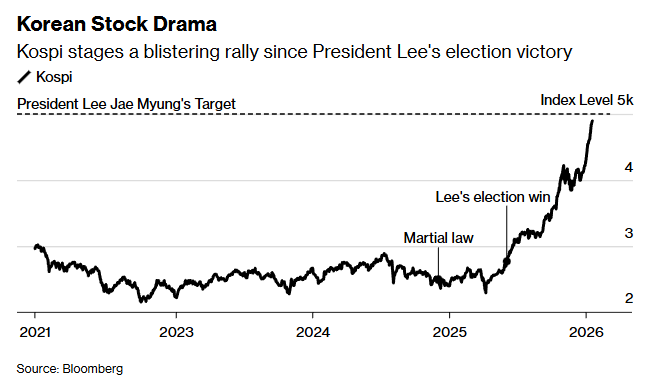
在过去12个月大涨逾94%之后,韩国基准股指Kospi指数距离曾被视为遥不可及的5000点关口仅差约 2%。这一目标已被写入韩国总统李在明的竞选承诺之中。郑恩博的乐观表态正是在这一背景下作出 的。 韩国股市的上涨很大程度上得益于与人工智能和国防相关股票的持续走强——这两个领域目前是全球最 热门的板块。同时,韩国立法机构在提升公司治理标准方面的关键改革也为市场上涨提供了支撑。 郑恩博上周五在接受采访谈及Kospi指数时表示:"Kospi指数正接近5000点,但我认为在此之上,甚至 6000点也是可能的。"尽管他并未给出达到6000点的具体时间表,但他补充称:"韩国的半导体、国防和 造船等核心产业竞争力不断提升,这似乎正在引领股市新一轮的价值提升。" Kospi指数升至6000点意味着还需再上涨约22%。尽管该指数在新的一年延续了惊人的涨势——周一连 续第12个交易日上涨并再创历史新高——但汇丰控股等机构的部分市场观察人士仍建议保持谨慎,市场 宽度不足、本币大幅贬值以及人工智能泡沫担忧都是潜在风险。 自去年上任以来,李在明承诺在4月前将Kospi指数推向5000点,韩国这个3万亿美元规模的股市投资者 对这类里程碑 ...
韩国交易所理事长:韩国KOSPI指数上看6000点
Ge Long Hui· 2026-01-20 00:51
美股频道更多独家策划、专家专栏,免费查阅>> 责任编辑:栎树 1月20日,韩国交易所理事长郑恩甫表示,随着韩国积极推进改善股东回报和吸引全球资本的措施,本 轮韩股涨势有望延续。韩国首尔综指KOSPI指数在过去12个月飙升逾94%,目前距曾经遥不可及的5000 点大关仅差约2%。这个关键目标也是韩国总统李在明竞选承诺的一部分。此轮市场上涨很大程度上得 益于人工智能和国防等全球热门板块相关股票的持续上涨,与此同时,韩国立法者在提升企业治理标准 方面做出了关键改革。 郑恩甫说:"该股指正在逼近5000点,但我认为除此之外,甚至6000点也是可能的。"但他并未给出具体 时间框架。"韩国半导体、国防和造船等主要产业的竞争力已经增强,这似乎正引领股市实现新的价值 提升,"他表示。若达到6000点,意味着韩国KOSPI指数将再涨22%。 ...
韩国交易所CEO看高Kospi指数至6000点 誓言清退“僵尸企业”
Zhi Tong Cai Jing· 2026-01-20 00:37
韩国交易所首席执行官郑恩博(Eun-Bo Jeong)表示,随着韩国持续推进提升股东回报并吸引全球资本的 改革举措,韩国股市这轮领跑全球的涨势有望延续。 在过去12个月大涨逾94%之后,韩国基准股指Kospi指数距离曾被视为遥不可及的5000点关口仅差约 2%。这一目标已被写入韩国总统李在明的竞选承诺之中。郑恩博的乐观表态正是在这一背景下作出 的。 韩国股市的上涨很大程度上得益于与人工智能和国防相关股票的持续走强——这两个领域目前是全球最 热门的板块。同时,韩国立法机构在提升公司治理标准方面的关键改革也为市场上涨提供了支撑。 郑恩博上周五在接受采访谈及Kospi指数时表示:"Kospi指数正接近5000点,但我认为在此之上,甚至 6000点也是可能的。"尽管他并未给出达到6000点的具体时间表,但他补充称:"韩国的半导体、国防和 造船等核心产业竞争力不断提升,这似乎正在引领股市新一轮的价值提升。" 郑恩博还将政府持续推进公司改革作为其乐观判断的依据。他表示,Kospi权重股三星电子预计将在7月 前公布提升股东回报的具体措施。他还提到韩国争取升级为发达市场的努力。虽然MSCI的重新分类"可 能需要几年时间",但 ...