
半导体

Search documents
半导体行业月报:海外模拟厂商陆续发布涨价函,国内存储模组厂商26Q1业绩超预期-20260313
Zhongyuan Securities· 2026-03-13 09:34
Investment Rating - The report maintains an "Outperform" rating for the semiconductor industry [1]. Core Insights - The semiconductor industry is experiencing a recovery driven by the demand for AI systems, with significant price increases announced by overseas analog chip manufacturers [3]. - Domestic storage module manufacturers reported better-than-expected performance in Q1 2026, with revenue forecasts indicating substantial growth [5]. - The global semiconductor sales continue to grow, with January 2026 sales up 46.1% year-over-year, marking 27 consecutive months of growth [26][27]. Summary by Sections 1. Market Performance - In February 2026, the domestic semiconductor industry underperformed, declining by 1.30%, while the Shanghai Composite Index rose by 0.09% [5][11]. - The semiconductor sector has seen a year-to-date increase of 17.09% as of February 2026 [11]. 2. Global Semiconductor Sales - Global semiconductor sales reached approximately $82.5 billion in January 2026, with a year-over-year increase of 46.1% and a month-over-month increase of 3.7% [26]. - The Asia-Pacific region saw a remarkable year-over-year growth of 82.4% in semiconductor sales [26]. 3. Price Trends - The prices of DRAM and NAND Flash continued to rise, with DRAM prices expected to increase by 90-95% in Q1 2026 and NAND Flash prices by 55-60% [5][33]. - The report highlights that the demand for storage solutions driven by AI applications is expected to sustain the upward price trend in the semiconductor market [5]. 4. Investment Opportunities - The report suggests focusing on domestic semiconductor manufacturers, particularly in the storage module and chip sectors, as they are likely to benefit from the ongoing industry trends [5][6].
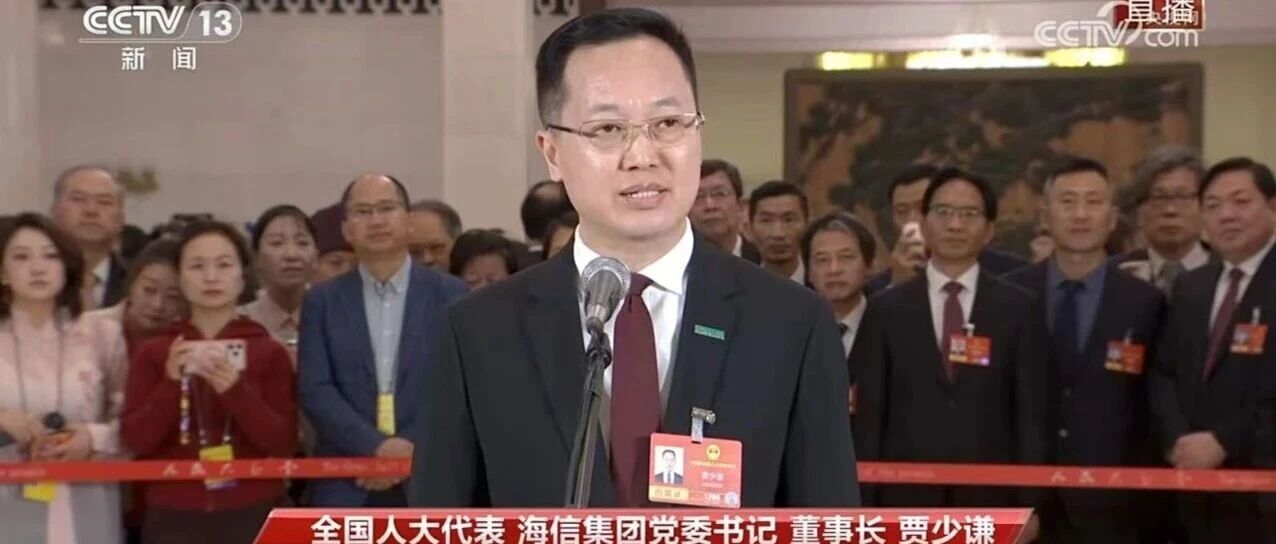
从第一颗中国芯到“代表通道”,为什么是海信?
经济观察报· 2026-03-13 09:29
Core Viewpoint - The article highlights Hisense's journey in innovation and manufacturing, showcasing its advancements in display technology and its significant growth in international markets, marking a shift from being a follower to a leader in certain sectors of the manufacturing industry [6][9]. Group 1: Innovation in Display Technology - Hisense launched RGB three-dimensional color control technology at CES 2025, which attracted significant attention from international experts [2][4]. - The company has developed two groundbreaking chips that address long-standing industry challenges, achieving a one-year lead in mass production over foreign competitors [16][18]. - Hisense's RGB-Mini LED televisions captured 48.7% of the high-end market during the 2025 Double Eleven shopping festival, with the company holding over 95% of the sales share in this segment [19][20]. Group 2: Manufacturing Advancements - Hisense has established "lighthouse factories" that utilize AI to enhance production efficiency, achieving a 49% increase in production efficiency and a 35% reduction in production costs [24][22]. - The company has implemented AI-driven quality control systems that significantly reduce inspection times and improve defect detection rates [25]. - Hisense's commitment to R&D is evident, with 5% of its revenue allocated to research, resulting in over 70,000 patent applications and participation in 78 international standards [12][9]. Group 3: International Expansion - Hisense's international revenue reached 1,107 billion yuan in 2025, accounting for 49.3% of its total revenue, with a significant increase in overseas brand recognition [34][33]. - The company has successfully acquired and revitalized several international brands, such as Sharp and Toshiba, leading to profitability within months of acquisition [34][36]. - Hisense has established a global presence with 36 industrial parks and production bases, and 64 overseas companies and offices [37]. Group 4: Future Outlook and Strategic Vision - The company emphasizes the importance of integrating traditional manufacturing with emerging technologies, aiming for sustainable growth and innovation in both established and new industries [40]. - Hisense's leadership believes in the necessity of preparing for future market dynamics while maintaining competitiveness in traditional sectors [40].


债券“科技板”他山之石:海外科技巨头债券融资路径演变对我国非国有科技企业有何启示?(AI、半导体、新能源)
Soochow Securities· 2026-03-13 09:07
1. Report's Industry Investment Rating There is no information about the industry investment rating in the provided content. 2. Report's Core Viewpoint The report emphasizes that China's AI, semiconductor, and new energy industries are in a critical development period but face core technology gaps compared to overseas counterparts. By analyzing the bond - financing experiences of overseas technology giants, it concludes that the core logic of "synergizing bond issuance with strategy and matching financing with development" can be applied. Promoting the construction of the bond market's "technology board", enriching bond product systems, and improving credit enhancement mechanisms will help non - state - owned technology companies in these three industries expand capital channels, optimize capital structures, and achieve leap - forward development [15]. 3. Summary According to Relevant Catalogs 3.1 China's AI, Semiconductor, and New Energy Industry Non - State - owned Enterprises Development Overview - **AI Industry**: Non - state - owned enterprises are the market's main force, focusing on application and algorithm layers. However, they lag behind overseas in basic capabilities, capital operation, and cash - flow stability [18][19]. - **Semiconductor Industry**: Non - state - owned enterprises focus on niche segments but are weak in high - end chips and advanced manufacturing. They face challenges in technology, capital, and strategic synergy compared to overseas giants [21][22]. - **New Energy Industry**: Non - state - owned enterprises have a scale advantage but are less competitive in high - end segments. They have an imbalanced financing structure and insufficient ESG and credit management capabilities [23][24]. 3.2 Analysis of Non - State - owned Bond - issuing Entities of Outstanding Sci - tech Bonds in Each Industry - A total of 20 non - state - owned bond - issuing entities with outstanding sci - tech bonds in the three industries were selected. The total scale of outstanding sci - tech bonds is about 44.942 billion yuan, indicating low participation of private technology companies in the sci - tech bond segment and significant room for bond - market financing [25]. - **AI Industry**: 8 non - state - owned bond - issuing entities were identified, with a balance of outstanding sci - tech bonds of 19.83 billion yuan. The credit rating of these entities is mainly high - grade, but institutions' recognition is divided. Most bonds have a short - term maturity, and the industry uses sci - tech bonds for liquidity management [28][29]. - **Semiconductor Industry**: 6 non - state - owned bond - issuing entities were found, with a balance of outstanding sci - tech bonds of about 6.012 billion yuan. The credit rating is high - grade, but institutional recognition and financing scale are low. The industry shows a high enthusiasm for issuing sci - tech bonds, and there is some differentiation in bond maturity [33][35]. - **New Energy Industry**: 6 non - state - owned bond - issuing entities were selected, with a balance of outstanding sci - tech bonds of 19.1 billion yuan. The credit quality is good, and institutions have relatively higher recognition. The coupon rate is relatively high, and the bond maturity is mainly in the 2 - 5 - year range [36][38]. 3.3 Enlightenment from Overseas Technology Giants' Bond - financing Experiences to China's Non - State - owned Enterprises in the Same Industries 3.3.1 General Enlightenment - **Deep Synergy between Bond - financing and Corporate Development Strategy**: Overseas technology giants use bond - financing to support strategic implementation. Chinese non - state - owned technology companies should abandon the traditional view and plan bond - issuance based on strategic goals, and establish a closed - loop thinking to improve credit and reduce financing costs [41][42]. - **Precise Matching of Financing Strategies with Corporate Development Stages**: Overseas technology giants adjust their bond - financing strategies according to different development stages. Chinese private technology companies can issue different types of bonds at different stages to meet development needs [43][44]. - **Strengthening Credit Foundation and Cash - flow Management**: Overseas technology giants have high - quality credit and stable cash - flows. Chinese private technology companies should strengthen cash - flow management, standardize corporate governance and information disclosure, and enhance credit through various means [46]. 3.3.2 Differentiated Enlightenment by Industry - **AI Industry**: Focus on core R & D and computing power construction, use long - term bonds and convertible bonds, seize market windows, and strengthen cooperation with industry giants [50][51]. - **Semiconductor Industry**: Rely on technology breakthroughs, use bond - financing for mergers and acquisitions, enhance credit through credit enhancement, and optimize bond maturity structure [52][55]. - **New Energy Industry**: Leverage the green attribute to issue green bonds, use asset securitization to optimize cash - flow, match bond maturity with project return periods, and optimize financing regions and currency structures [56][57].
港股半导体、芯片股,集体下跌
第一财经· 2026-03-13 08:37
Market Overview - The Hang Seng Index closed down by 0.98% at 25,465.60, with a trading volume of 246.5 billion [2] - The Hang Seng Technology Index fell by 0.99% to 4,978.08, with a trading volume of 44 billion [2] - The semiconductor and chip stocks experienced significant declines, with notable drops in companies such as Tensu Zhixin and Huahong Semiconductor, both down over 7% [2][3] Sector Performance - Semiconductor and chip stocks collectively dropped, with Tensu Zhixin down 7.49% to 291.40, and Huahong Semiconductor down 7.37% to 88.00 [3] - Gold stocks also saw declines, with Zijin Mining International falling over 7% to 188.10, and other companies like Zhu Feng Gold and Chow Tai Fook also experiencing losses [4] Technology Sector - Major tech stocks showed mixed performance, with Baidu, Alibaba, NetEase, and Tencent seeing gains, while Kuaishou, Bilibili, Trip.com, and Meituan faced declines [5] - Kuaishou dropped by 1.74% to 59.15, while Meituan fell by 0.98% to 75.95 [6]

尾盘突发!多只科创板股竞价异动
证券时报· 2026-03-13 08:24
Market Overview - The Shanghai Composite Index experienced a decline, closing at 4095.45 points, down 0.81%, while the Shenzhen Component Index fell by 0.65% and the ChiNext Index decreased by 0.22% [2] - The total trading volume in the Shanghai and Shenzhen markets was approximately 2.42 trillion yuan, a decrease of about 43 billion yuan compared to the previous day [2] - Over 3800 stocks in the A-share market closed lower, with sectors such as electricity, non-ferrous metals, chemical fiber, and semiconductors showing declines [2] Sector Performance - The computing power concept stocks collectively retreated, with companies like Yuke Technology and Hand Information dropping over 10% [2] - The chemical sector continued its strong performance, with Jinniu Chemical hitting the daily limit and achieving six limit-ups in the last ten trading days, with a total increase of over 80% [13] - The fertilizer concept also performed well, with Lu Hua Technology achieving consecutive limit-ups and Chuan Jin Nuo rising nearly 15% [2] Brain-Computer Interface Concept - The brain-computer interface concept saw a significant rise in the afternoon, with Yingkang Life increasing by over 12% and Beiyikang rising by over 7% [10] - The National Medical Products Administration approved the registration application for an innovative brain-computer interface product, marking the global first for an invasive brain-computer interface medical device [12] - Citic Securities noted that the commercialization of brain-computer interfaces in China is accelerating, driven by policies, capital, and technology, with three main investment lines identified: leading companies in invasive technology breakthroughs, diversified applications in non-invasive fields, and companies with strong CDMO/CRO capabilities [12] Stock Movements - Multiple stocks on the Sci-Tech Innovation Board experienced significant price movements, with stocks like Baichu Electronics and Stone Technology rising, while others like Cambrian and Zhongke Xingtu saw rapid declines [4][8] - Huagong Technology experienced a pullback, with a trading volume of 19.45 billion yuan, making it the highest in A-share trading [2]


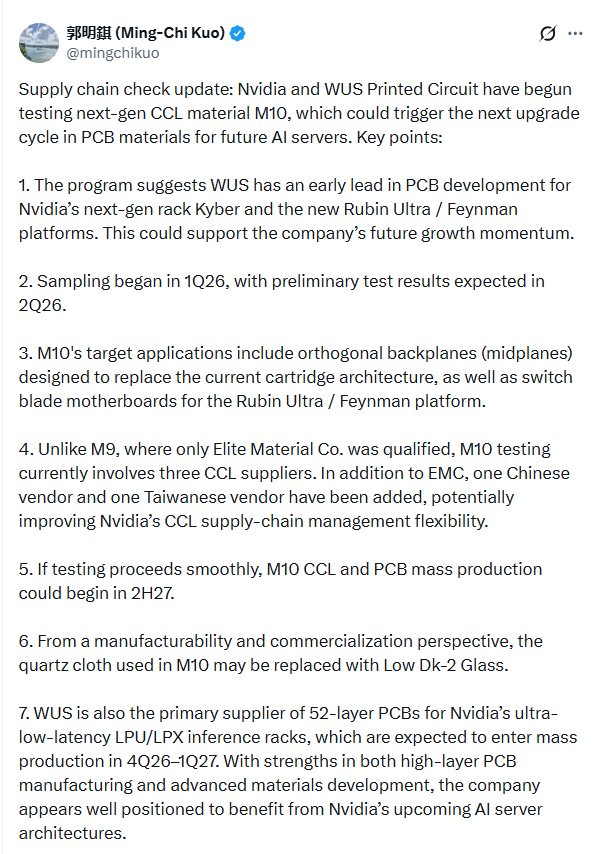
天风郭明錤:英伟达下一代Rubin平台启动新材测试,PCB升级周期将至
Hua Er Jie Jian Wen· 2026-03-13 07:28
英伟达新一代AI服务器平台的供应链布局正在加速推进,新一轮PCB材料升级周期的轮廓逐渐清晰。 据天风国际证券分析师郭明錤最新供应链调查,英伟达已与PCB厂商就下一代覆铜板(CCL)材料 M10启动测试,目标应用涵盖Rubin Ultra及Feynman平台的正交背板与交换刀片主板。 根据郭明錤的供应链调查,英伟达与沪电股份已正式开启M10 CCL材料的测试工作。采样工作于2026 年第一季度启动,初步测试结果预计于2026年第二季度出炉。 M10的目标应用场景主要包括两类:一是专为取代现有插槽式架构而设计的正交背板(中平面),二是 面向Rubin Ultra及Feynman平台的交换刀片主板。 这两类应用均处于英伟达下一代AI服务器架构的核心位置,对PCB材料的性能要求较现有方案大幅提 升。 郭明錤认为,上述测试进展表明沪电股份在Kyber机架及Rubin Ultra、Feynman平台的PCB开发中已取得 领先地位,有助于支撑公司未来的成长动能。 供应商格局生变 此次M10测试在供应商结构上出现显著变化。上一代M9材料测试中,仅有台光电一家CCL供应商通过 资格认证。 而M10阶段,英伟达已将测试范围扩展至 ...

黄仁勋罕见长文
投资界· 2026-03-13 07:09
Core Viewpoint - AI is not merely a software tool or chatbot; it represents a fundamental infrastructure akin to electricity and the internet, driving one of the largest infrastructure developments in human history [1][21]. Group 1: AI as Infrastructure - AI operates on real hardware, energy, and economic systems, transforming raw materials into scalable intelligence [2]. - The AI technology stack consists of five layers: Energy, Chips, Infrastructure, Models, and Applications, each layer supporting the next [4][6]. - The first layer, Energy, is crucial as real-time intelligence generation requires real-time power supply [4]. - The second layer, Chips, involves processors designed for high efficiency in converting energy into computational power [4]. - The third layer, Infrastructure, includes massive parallel computing capabilities and high-bandwidth memory [4]. - The fourth layer, Models, encompasses AI models that can understand various types of information, driving transformative advancements across multiple fields [5]. - The fifth layer, Applications, is where economic value is generated, with AI factories designed to produce intelligence rather than merely store information [5][6]. Group 2: Infrastructure Development - The current infrastructure development for AI is just beginning, with thousands of billions already invested and trillions more needed [7]. - This construction is unprecedented in scale and may become the largest infrastructure project in human history [7]. Group 3: Labor Demand in AI Era - The labor force required for AI infrastructure is substantial, necessitating high-skill, high-income jobs that are currently in short supply [8]. - AI is enhancing productivity in knowledge economies, allowing professionals to focus on more complex tasks as AI takes over repetitive work [9][11]. Group 4: Economic Value and Open Source Models - In the past year, AI applications have begun to demonstrate real economic value, indicating a significant shift in market dynamics [12][13]. - Open-source models play a critical role in advancing AI, enabling researchers and companies to leverage cutting-edge technology without prohibitive costs [14]. Group 5: Future Implications - AI factories are being constructed to meet the demand for real-time intelligence generation, with chips being redesigned for efficiency [19]. - The ongoing development of AI infrastructure will impact various industries and economies globally, marking a significant industrial transformation [23][24].

基于实战检验的A股“抓主线”投资方法论:永立潮头,东方不败
Guotou Securities· 2026-03-13 05:48
Group 1 - The core investment methodology in A-shares focuses on identifying the main line, which is not about capturing everything but rather understanding that a clear main line exists only about 60% of the time, while 40% lacks clarity [1][10] - The current approach to grasping the main line involves two major strategies: macro strategy pricing and industry track pricing [1][10] - In the macro strategy pricing perspective, it is crucial to identify whether the political cycle or economic cycle is dominant, with tools such as information advantage and macro narrative being essential [1][10] Group 2 - Industry track pricing is divided into short-term industry rotation and medium-term industry trends, where the practical application of "high cut low" style switching is more effective than comprehensive scoring of 30 industries [2][11] - The medium-term industry trend focuses on the relationship between emerging tracks and traditional industries, utilizing a four-stage investment framework based on new and old momentum conversion [2][11] - The three-rate system, which includes penetration rate, substitution rate, and market share, is central to evaluating industry tracks [2][11][44] Group 3 - The four main tools for grasping the main line in A-shares are macro narrative, industry trends, incremental funds, and style switching, with a clear understanding of effective tools being essential [2][14] - The effectiveness of these tools in pricing is ranked as macro narrative > industry trends > incremental funds > style switching, while the difficulty of practical identification is ranked as incremental funds > macro narrative > style switching > industry trends [2][14] - The relationships and causal connections between these tools are evolving, particularly with the rise of AI, which has led to a resonance between macro narratives and industry trends [3][14] Group 4 - The macro narrative in A-shares is currently focused on the transition from old to new momentum, with the main lines shifting based on economic recovery characteristics [18][30] - The narrative emphasizes consumer upgrades, self-sufficiency, domestic substitution, and cyclical trends during strong economic recovery, while focusing on technology stocks, rational consumption, high dividends, and export opportunities during weak recovery [18][30] - The current economic environment indicates a stabilization of the real estate sector and a shift towards manufacturing and technology, which supports the new momentum narrative [30][31] Group 5 - The industry trend tool emphasizes understanding growth as a fundamental principle, with a focus on the lifecycle of industries and their global competitiveness [43][44] - The lifecycle approach identifies key factors such as economies of scale, replicable business models, and product compatibility as essential for industry success [43][44] - The global competitiveness of industries is crucial for determining the main line, with successful export strategies leading to increased return on equity and valuation benchmarks [43][44]
中国 AI GPU-缩小与美国的差距
2026-03-13 04:46
Summary of the Conference Call on China's AI GPU Industry Industry Overview - The report focuses on the **Chinese AI GPU industry**, highlighting its development and the competitive landscape in comparison to the US market [2][3][4]. Key Insights 1. **Significant Progress in Domestic AI GPU Supply**: - China's AI GPU development has advanced significantly despite restrictions on acquiring advanced AI chips from the US due to export controls. The domestic industry has made substantial progress in alleviating equipment and foundry bottlenecks over the past 12 months [4][5]. - By around 2028, domestic foundry capacity and chip supply are expected to meet core "sovereign demand" [4]. 2. **Policy Support and Economic Viability**: - Continuous policy support has accelerated early development, but long-term value will depend on the commercial competitiveness of Chinese AI GPU manufacturers. They must demonstrate attractive economics to achieve sustainable growth post-2028 [4][5]. - The total cost of ownership (TCO) for Chinese AI data centers is competitive due to lower chip prices and electricity costs, enhancing the attractiveness of domestic solutions [4]. 3. **Market Dynamics and Investment Outlook**: - The localization strategy in China is progressing, with efforts to expand chip, foundry, and equipment scales to compensate for process disadvantages. The optimistic scenario suggests that domestic GPUs could expand into training workloads and potentially achieve overseas applications [5]. - While no direct investment ratings for AI GPU stocks were provided, a positive outlook on the Chinese semiconductor supply chain was expressed, including companies like SMIC (foundry), NAURA (equipment), and ASM Pacific Technology (advanced packaging) [5]. Market Projections - The total addressable market (TAM) for Chinese AI chips is projected to grow to **$67 billion by 2030**, primarily driven by sovereign sectors and state-owned enterprises, with commercialization becoming key for long-term growth [11][12]. - The self-sufficiency ratio for AI chips in China is expected to rise to **76% by 2030**, although there may be a trend towards homogenization in the industry [20]. Competitive Landscape - The performance and cost comparison between Chinese AI GPUs and Nvidia's mainstream chips shows that the gap is narrowing, particularly with the upcoming H200 chip [15][31]. - The report emphasizes the importance of system-level performance and cost efficiency, suggesting that while there is still a performance gap at the chip level, Chinese solutions are becoming increasingly competitive in terms of overall system economics [31]. Risks and Challenges - The industry faces risks of homogenization as large clients may prefer to support sovereign GPU manufacturers, which could limit market access for independent third-party vendors [36]. - The potential for declining profit margins in the medium to long term due to increased competition and consolidation in the industry was noted [36]. Conclusion - The Chinese AI GPU industry is rapidly evolving, with significant advancements in domestic supply capabilities and a strong policy backing. However, the long-term success will hinge on the ability of local manufacturers to maintain competitive advantages in performance and cost while navigating the risks of market homogenization and potential profit margin pressures [24][37].


AI内容供需旺盛,英伟达发力本地AI创作
2 1 Shi Ji Jing Ji Bao Dao· 2026-03-13 04:32
Core Insights - NVIDIA is focusing on promoting AI content creation tools at GDC, aiming to lower development barriers for users [1] - The company introduced simplified features for its AI drawing tool ComfyUI and enhanced local AI video generation processes [1][2] - NVIDIA's RTX Video Super Resolution technology significantly improves the efficiency of 4K video production, making it 30 times faster than other mainstream tools [2] Group 1: AI Content Creation Tools - NVIDIA launched a new "application view" for ComfyUI, targeting designers unfamiliar with node workflows, allowing them to generate AI content easily by inputting prompts and adjusting parameters [1] - Since September 2022, performance on RTX GPUs for ComfyUI has improved by 40%, with the GeForce RTX 50 series offering up to 2.5 times performance improvement using NVFP4 format and 1.7 times using FP8 format, while also reducing memory usage by 60% and 40% respectively [1] Group 2: Market Trends and Growth - The demand for AI-generated content is surging, with AI-generated videos gaining acceptance in the market, driven by OpenAI's Sora and subsequent offerings from ByteDance and Kuaishou [2] - The AI comic drama market in China is projected to exceed 24 billion yuan by 2026, with user numbers surpassing 300 million, as traditional production cycles are reduced from months to weeks, cutting costs by over 60% [3] - NVIDIA is aligning its software, models, and toolchains to lower the barriers for local AI creation tools, integrating its GPUs with AI production processes to capitalize on the growing AI content production trend [3]