
智能汽车

Search documents
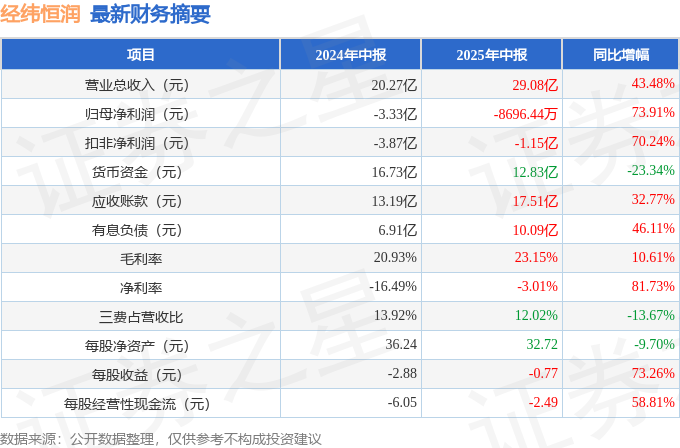
经纬恒润2025年中报简析:营收上升亏损收窄,盈利能力上升
Zheng Quan Zhi Xing· 2025-08-27 22:56
| 项目 | 2024年中报 | 2025年中报 | 同比增幅 | | --- | --- | --- | --- | | 营业总收入(元) | 20.27 乙 | 29.08亿 | 43.48% | | 归母浄利润(元) | -3.33 Z | -8696.44万 | 73.91% | | 扣非净利润(元) | -3.87 亿 | -1.15 Z | 70.24% | | 货币资金(元) | 16.73亿 | ﻛ 12.83亿 | -23.34% | | 应收账款(元) | 13.19亿 | 17.51亿 | 32.77% | | 有息负债(元) | 6.91亿 | 10.09亿 | 46.11% | | 毛利率 | 20.93% | 23.15% | 10.61% | | 净利率 | -16.49% | -3.01% | 81.73% | | 三费占营收比 | 13.92% | 12.02% | -13.67% | | 每股净资产 (元) | 36.24 | 32.72 | -9.70% | | 每股收益(元) | -2.88 | -0.77 | 73.26% | | 每股经营性现金流(元) | -6.0 ...


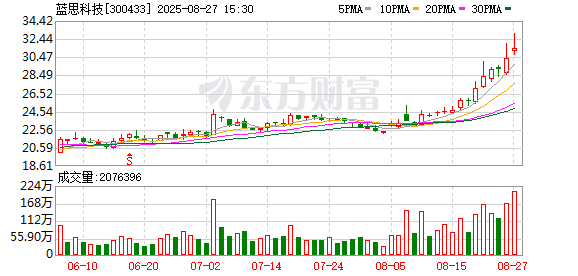
蓝思科技20250827
2025-08-27 15:19
Summary of the Conference Call for Lens Technology (蓝思科技) Company Overview - Lens Technology is a leading player in the consumer electronics and automotive sectors, focusing on glass and metal structural components for various applications, including smartphones, computers, and smart vehicles. Key Financial Highlights - Revenue growth from 37 billion in 2020 to nearly 70 billion in 2024, with a compound annual growth rate (CAGR) of 17.3% driven by the recovery of the consumer electronics market and supply chain integration [2][8] - Net profit for 2024 is projected to reach 3.6 billion, a year-on-year increase of nearly 20% [2] - In 2024, smartphone and computer-related business revenue is expected to be 57.8 billion, accounting for 83% of total revenue, with a gross margin of approximately 15% [2][10] Business Segments Consumer Electronics - Main products include glass covers and metal frames, with a strong partnership with Apple since 2006, establishing a significant competitive advantage [3] - The glass cover business remains stable, while the smart wearable segment is experiencing rapid growth [8] Automotive and Smart Cockpit - The smart automotive and cockpit business has become the second growth curve for the company, contributing 8.5% to total revenue in 2024 [4][17] - The Chinese smart cockpit market is expected to grow from 74 billion in 2022 to over 100 billion by 2025, with increasing penetration rates [4][14] - The company is actively involved in the development of ultra-thin laminated glass and has partnered with Samsung for foldable screen technology [4][12] Emerging Technologies - Lens Technology is expanding into smart wearables and robotics, forming strategic partnerships to enhance its capabilities in these areas [6][19] - The company has successfully entered the humanoid robot sector and is collaborating with Linban Technology to produce AI glasses [19] Market Trends and Future Outlook - The company anticipates significant innovation and growth in the glass sector, particularly with the upcoming release of Apple's foldable screen product in 2026 [12] - Revenue projections for 2025-2027 are 92.1 billion, 115.5 billion, and 137.7 billion respectively, with net profits of 5.3 billion, 6.5 billion, and 7.8 billion [4][20] - The smart cockpit market is expected to see increased demand due to consumer preferences for intelligent automotive experiences, with penetration rates in lower-priced vehicles expected to rise [15][14] Additional Insights - The company has a global production footprint with nine R&D and manufacturing bases, ensuring capacity to meet international demand [9] - The metal structural components business, bolstered by the acquisition of Kesheng Keli, is projected to benefit from the growing AI hardware market [13] - The company is well-positioned to capitalize on the increasing demand for smart automotive components, having established partnerships with over 30 major automotive manufacturers [17] This comprehensive overview highlights Lens Technology's robust growth trajectory, strategic positioning in emerging markets, and optimistic future outlook across its diverse business segments.

华为高管:世界上根本没有免费的东西
半导体芯闻· 2025-08-27 10:40
Core Viewpoint - Huawei's automotive business is rapidly expanding, particularly in the field of assisted driving, with various collaboration models with car manufacturers being explored [2][3]. Group 1: Collaboration Models - Huawei's automotive business unit (BU) collaborates with car manufacturers through multiple models, including component supply, single intelligence (either smart cockpit or assisted driving), dual intelligence (both smart cockpit and assisted driving), and full-stack solutions [2]. - The collaboration process involves Huawei supporting car manufacturers throughout the entire lifecycle, from product definition and design to manufacturing and marketing [2][7]. Group 2: Technology Approach - Huawei's approach to assisted driving does not align with the Vision-Language-Action (VLA) model favored by some car manufacturers; instead, it emphasizes the World and Action (WA) model, which directly controls the vehicle through sensory inputs [3][9]. - The WA model is considered by Huawei to be the ultimate solution for achieving true autonomous driving, bypassing the language processing step [9]. Group 3: Commercialization and Market Strategy - Huawei does not have a specific short-term commercialization goal for its assisted driving technology, focusing instead on long-term user-centered strategies and sustainable investment [7]. - The company believes that the market for assisted driving features will evolve, and that pricing strategies should reflect the ongoing development and maintenance costs associated with these technologies [12]. Group 4: Industry Trends and Future Outlook - The number of players in the autonomous driving space is expected to decrease as the industry consolidates, with future success relying heavily on data-driven approaches [10]. - The differentiation in assisted driving technology is minimal, as the primary goal remains zero accidents and fatalities, with pricing determined by perceived value to consumers [11].
多元布局释放增长新动能,蓝思科技上半年交出亮眼答卷
Hua Xia Shi Bao· 2025-08-27 08:42
Core Viewpoint - Lens Technology has reported strong financial results for the first half of 2025, with revenue reaching 32.96 billion yuan, a year-on-year increase of 14.18%, and a net profit of 1.194 billion yuan, up 35.53% year-on-year. The company is transitioning into a global AI hardware innovation platform, capitalizing on the growth in consumer electronics and emerging sectors like smart automotive and wearable devices [2][3]. Financial Performance - The company's revenue from smartphones and computers, which is the core of its income, reached 27.185 billion yuan, growing 13.19% year-on-year, showcasing strong market competitiveness [3]. - The company plans to distribute a cash dividend of 1 yuan per 10 shares, totaling approximately 526 million yuan, as a way to reward shareholders [2]. Business Segments - The smart automotive and cockpit business generated revenue of 3.165 billion yuan, up 16.45% year-on-year, while the smart glasses and wearable devices segment saw revenue of 1.647 billion yuan, increasing 14.74% year-on-year. Other smart terminal businesses experienced significant growth, with revenue reaching 364 million yuan, a remarkable increase of 128.2% [5][6]. - The company has established partnerships with over 30 well-known automotive brands, expanding its business boundaries in the smart cockpit sector [6]. Technological Advancements - Lens Technology is a leading supplier of ultra-thin flexible glass (UTG) and has made significant progress in developing multi-layer folding structure designs to enhance screen quality for foldable devices [4]. - The company has achieved breakthroughs in the production of AR glasses, optimizing yield rates and automating assembly processes, which positions it favorably in the AR glasses manufacturing sector [7]. Market Trends - The global market for foldable smartphones is expected to grow, with shipments projected to reach 19.83 million units by 2025, reflecting a year-on-year increase of 6% [4]. - The AI glasses market in China is anticipated to see a dramatic increase, with shipments expected to exceed 2.75 million units in 2025, marking a year-on-year surge of 107% [7]. Strategic Outlook - The company’s diversification strategy is reducing reliance on single consumer electronics and specific clients, positioning it well in future industry sectors such as smart automotive, AR glasses, and embodied intelligence [8]. - With the upcoming launch of new Apple products, which are crucial for Lens Technology's revenue, the company is expected to benefit from increased demand and orders [5].
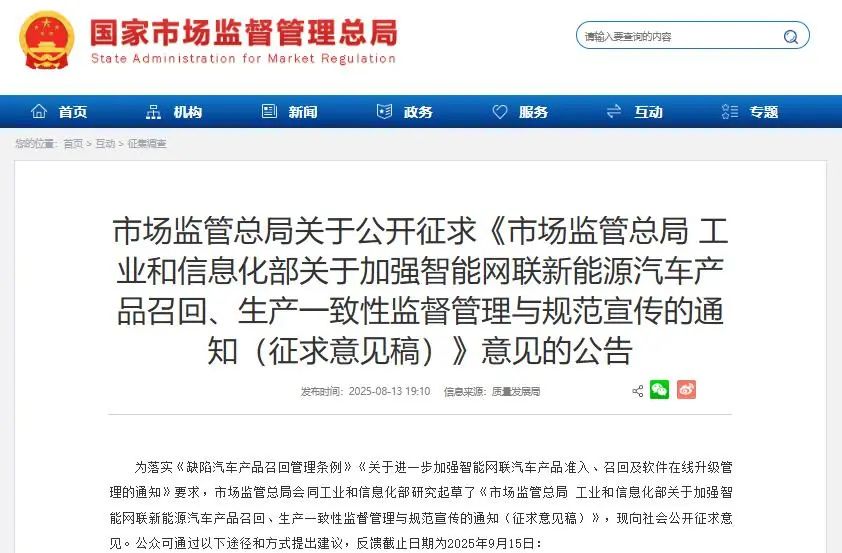
OTA暂停?智能汽车强监管时代来了
3 6 Ke· 2025-08-27 07:11
Core Insights - The article discusses the increasing regulation of Over-The-Air (OTA) updates in the smart electric vehicle industry, highlighting the shift from a "free trial" approach to mandatory compliance and oversight [1][2][3] - The new regulatory framework aims to ensure that all OTA updates are properly tested and approved before being pushed to consumers, marking a significant change in how automotive companies can operate [2][3][11] Regulatory Changes - The recent notification from the Market Regulation Administration and the Ministry of Industry and Information Technology emphasizes that all OTA upgrades must be filed for approval, especially those related to core functions like autonomous driving [2][3] - This regulatory shift has led to a slowdown in OTA updates across the industry, affecting companies like Tesla, XPeng, and Aito, which have faced delays in their planned updates due to compliance issues [2][3] User Experience and Expectations - The decline in OTA update frequency has resulted in user dissatisfaction, with many consumers expressing frustration over the lack of new features and updates, leading to concerns about the reliability of their vehicles [4][6] - Legal experts warn that failure to deliver on promises of "lifetime OTA" updates could lead to consumer rights violations and potential lawsuits, impacting brand reputation [6][11] Future of OTA and Revenue Models - OTA is evolving from a free service to a potential revenue stream, with companies like Tesla already generating significant income from paid software upgrades [8][10] - The automotive software market is projected to grow substantially, with estimates suggesting a tripling in size from €76 billion to €252 billion between 2020 and 2030, indicating a shift in focus towards enhancing functionality and value rather than just update frequency [10] Conclusion - The current pause in OTA updates presents both challenges and opportunities for the industry, as companies must adapt to stricter regulations while also improving the safety and reliability of their software [11] - The regulatory changes signify a transition in China's smart automotive sector from encouraging innovation to prioritizing safety and compliance, which may ultimately strengthen consumer trust in the long run [11]

泉果基金调研虹软科技,在PSAI市场战略上坚持“应用+服务”双轮驱动
Xin Lang Cai Jing· 2025-08-27 05:18
Core Viewpoint - The company has shown significant growth in revenue and net profit for the first half of 2025, alongside strategic advancements in its core business areas, particularly in smartphone technology and AI applications. Financial Performance - For the first half of 2025, the company reported a revenue of 410 million yuan, representing a year-on-year increase of 7.73% [2] - The net profit attributable to shareholders was 88.54 million yuan, up 44.06% year-on-year [2] - The net profit after deducting non-recurring gains and losses was 72.01 million yuan, reflecting a year-on-year increase of 33.86% [2] Dividend Distribution - The company plans to distribute a cash dividend of 2.20 yuan per 10 shares, totaling approximately 88.16 million yuan, which accounts for 99.58% of the net profit attributable to shareholders for the first half of 2025 [3][4] R&D Investment - As of June 30, 2025, the company employed 596 R&D personnel, making up 62.15% of its total workforce [5] - R&D expenses for the first half of 2025 amounted to 199 million yuan, representing 48.39% of revenue, with a year-on-year growth of 2.36% [5] Business Development Smartphone Business - The company has made continuous improvements in its smart ultra-domain integration technology, enhancing product penetration across various smartphone models [6] - Significant optimizations have been achieved in video solutions, particularly in extreme lighting conditions and long-duration recording scenarios [6] - The company has focused on high-magnification zoom scenarios, utilizing generative super-resolution technology to enhance image clarity and processing efficiency [6] Automotive Business - The company has made strides in driver and passenger safety assistance technologies, achieving multiple rounds of technical iterations and performance enhancements [7] - The DMS product has passed EU ADDW certification, meeting mass production conditions for the European market [7] - The company is advancing its "out-of-cabin" business, focusing on intelligent parking assistance and intelligent driving systems, with successful POC technology validations [8] AI Glasses - The company is pursuing a dual strategy of "technology deepening + ecosystem co-construction" in the AI glasses sector, focusing on product capability enhancement and ecosystem resource expansion [10] - Collaborations with leading chip manufacturers like Qualcomm are underway to optimize algorithms and performance for AI glasses [10] - The company has signed contracts with 5-6 AI glasses brands, with expectations for significant future growth in this area [17] Market Strategy - The company is enhancing its adaptability to overseas markets by aligning its products with European regulatory standards and expanding its technical capabilities [9] - The focus is on deepening partnerships and localizing operations to broaden market penetration [9] Future Outlook - The company anticipates continued growth in its smartphone business, driven by upgrades in smart chips and hardware, as well as expanding market penetration across various smartphone segments [24] - The strategy includes developing killer applications related to imaging and vision, leveraging AI to reduce hardware costs and enhance value for customers [25][26]

华为靳玉志:车企像参天大树,我们是下面的黑土地
Zhong Guo Qi Che Bao Wang· 2025-08-27 02:30
Core Insights - Huawei's autonomous driving solution, QianKun Intelligent Driving (ADS), has achieved significant milestones, including 1 million units of delivery and 40 billion kilometers of assisted driving mileage [1][5][9] Group 1: ADS Development and Features - The ADS has undergone three commercial iterations, with ADS 1 launched in 2022 for urban NCA, ADS 2 in 2023 enabling nationwide driving without high-precision maps, and ADS 3 offering end-to-end and parking functionalities [3][5] - The recently released ADS 4 has upgraded its technical architecture and user experience, providing comprehensive support for various driving scenarios, including parking and emergency braking [5][6] - As of July 2023, Huawei's ADS system has over 700,000 active users, with an average assisted driving mileage of nearly 700 kilometers per user in July alone [5][6] Group 2: Future Plans and Market Position - Huawei aims to accelerate the development of L3 and L4 autonomous driving technologies, targeting L3 commercial deployment on highways by 2026 and L4 pilot projects in urban areas by the same year [6] - The company has invested over 10 years in the automotive sector, with R&D expenditures exceeding 10 billion yuan in 2024 and a workforce of 8,000 dedicated to smart vehicle solutions [9] - Huawei's collaboration with automotive manufacturers focuses on empowering state-owned enterprises, enhancing their capabilities in electric and intelligent vehicle transitions [9]

均胜电子与阿里云达成AI全面合作 助力打造机器人智能体
Zheng Quan Shi Bao· 2025-08-27 02:16
Group 1 - Junsun Electronics' subsidiary, Ningbo Junsun Embodied Intelligent Robot Co., has entered into a comprehensive AI cooperation with Alibaba Cloud to develop advanced cognitive, decision-making, and interaction capabilities for robots [1][2] - The partnership aims to create solutions for various sectors including industrial manufacturing, healthcare, and special operations, while also targeting overseas markets for embodied intelligent robots [1][2] - Junsun Electronics is positioning itself as a leading provider of smart automotive technology solutions, having fully entered the humanoid robot field this year and focusing on key components such as controllers and energy management modules [1][2] Group 2 - Since the beginning of the year, Junsun Electronics has expanded its R&D and manufacturing capabilities from the automotive sector to the embodied intelligent robot field, achieving breakthroughs in key components [2] - The establishment of Junsun Embodied Intelligence in April 2025 has brought together experts from renowned universities to provide various intelligent system solutions for robots [2] - The collaboration with Alibaba Cloud will leverage its global cloud infrastructure and advanced AI capabilities to support Junsun's robot development, ensuring compliance and cultural adaptability for international markets [2]

蓝思科技(300433):公司点评:业绩稳健增长,AI驱动引领成长
SINOLINK SECURITIES· 2025-08-27 01:49
Investment Rating - The report maintains a "Buy" rating for the company, with a projected price-to-earnings (PE) ratio of 31/25/20x for the years 2025-2027 [4]. Core Insights - The company achieved a revenue of 32.96 billion yuan in the first half of 2025, representing a year-on-year growth of 14.2%, and a net profit attributable to shareholders of 1.14 billion yuan, up 32.7% year-on-year [2]. - The consumer electronics segment generated revenue of 27.185 billion yuan in the first half of 2025, with a gross margin of 13.2%, slightly down by 0.56 percentage points year-on-year [3]. - The smart automotive and cockpit segment reported revenue of 3.165 billion yuan, a year-on-year increase of 16.45%, with a gross margin of 9.84% [3]. - The smart headsets and wearables segment achieved revenue of 1.647 billion yuan, growing 14.74% year-on-year, with a gross margin of 23.3%, an increase of 9.7 percentage points [4]. Summary by Relevant Sections Performance Review - In Q2 2025, the company recorded revenue of 15.9 billion yuan, a year-on-year increase of 18.9%, but a quarter-on-quarter decrease of 6.8%. The net profit for Q2 was 710 million yuan, up 29.3% year-on-year and 66.4% quarter-on-quarter [2]. Business Analysis - The consumer electronics business continues to solidify its market position, with significant growth in high-end mobile phone components and a recovery in personal computer sales [3]. - The smart automotive sector is expanding with successful product launches and collaborations with leading automotive brands, indicating a strong growth trajectory [3]. Profit Forecast and Valuation - The forecast for net profit attributable to shareholders is 5.175 billion yuan for 2025, with expected growth rates of 42.81% in 2025, 24.17% in 2026, and 25.35% in 2027 [4][8].
蓝思科技上半年净利增长超3成:全面拥抱AI,新智能终端多点开花
2 1 Shi Ji Jing Ji Bao Dao· 2025-08-26 11:58
Core Viewpoint - The company, Lens Technology, has achieved steady growth in its performance in the first half of the year, driven by its multi-business layout and strategic focus on AI-driven hardware innovation [1] Financial Performance - The company reported a revenue of 32.96 billion yuan, representing a year-on-year increase of 14.18% - Net profit reached 1.194 billion yuan, up 35.53% year-on-year - Basic earnings per share were 0.23 yuan, reflecting a growth of 35.29% year-on-year - A cash dividend of 1 yuan per 10 shares is proposed, totaling approximately 526 million yuan [1] Business Segments Consumer Electronics - The consumer electronics segment, particularly smartphones and computers, generated revenue of 27.185 billion yuan, a year-on-year increase of 13.19% - The company has maintained its leading position in the market for glass, ceramics, sapphire, and metal components, successfully preparing for the production of several flagship smartphones [2] Automotive Business - The automotive segment achieved revenue of 3.165 billion yuan, growing by 16.45% year-on-year - Key products such as central control modules and smart charging piles have seen significant volume growth, with plans for capacity expansion based on customer demand [4] New Smart Devices - The company is actively expanding into new smart device sectors, including AR glasses and smartwatches, with revenue of 1.647 billion yuan, up 14.74% year-on-year - The company has made breakthroughs in core processes such as optical waveguide lens yield optimization and high-precision automated assembly [5][6] Emerging Intelligent Devices - Revenue from emerging intelligent devices reached 364 million yuan, a remarkable increase of 128.20% year-on-year - The company has made substantial progress in partnerships with leading companies in the field of embodied intelligence, focusing on high-end smart manufacturing solutions [7] Future Outlook - The company plans to deepen its vertical integration capabilities across materials, modules, and complete machines, aiming to capture opportunities in the AI-driven smart terminal industry upgrade [8]