
服务业

Search documents
非制造业延续扩张态势:暑期消费强劲,服务业景气度维持高位
Yang Shi Wang· 2025-07-31 09:03
Group 1 - The non-manufacturing sector is experiencing a slowdown in growth but remains in the expansion zone [1][7] - The non-manufacturing business activity index for July is at 50.1%, a decrease of 0.4 percentage points from the previous month [3] - The construction industry is facing a slowdown, with the business activity index at 50.6%, down 2.2 percentage points from last month [5] Group 2 - The service industry business activity index remains stable, with sectors related to travel and consumption showing strong performance, with indices above 60% [3][5] - The business activity expectation index for the service industry is above 55%, indicating optimism among most service enterprises regarding market prospects [5] - The overall expectation for non-manufacturing remains stable, with a business activity expectation index of 55.8%, an increase of 0.2 percentage points from the previous month [7]

宏观数据观察:东海观察7月PMI数据低于预期,经济景气有所下降
Dong Hai Qi Huo· 2025-07-31 08:46
Group 1: Report Industry Investment Rating - No relevant content provided Group 2: Report's Core View - In July, due to entering the traditional production off - season and factors like high - temperature, rainstorm and flood disasters in some areas, the business activities of enterprises slowed down. The three major PMIs declined but remained above the critical point, and the overall economic output in China continued to expand. However, demand was weak in the short - term, and production and price trends were complex. The export's role in driving the economy was expected to weaken in the second half of the year [2]. Group 3: Summary by Related Catalogs 3.1 Overall Economic Situation - China's official manufacturing PMI in July was 49.3% (expected 49.7%, previous value 49.7%); non - manufacturing PMI was 50.1% (expected 50.2%, previous value 50.5%); comprehensive PMI was 50.2% (previous value 50.7%). The three major indexes all declined, indicating a slowdown in economic prosperity, but the overall economic output remained in the expansion range [1]. 3.2 Investment - Real estate investment remained weak. Although sales and capital sources improved, investment - side policies were restricted. Infrastructure investment slowed down due to factors like high - temperature and flood disasters affecting construction progress, despite accelerated special bond issuance. Manufacturing investment slowed down but continued to grow at a high speed, and short - term restocking motivation of manufacturing enterprises declined [2]. 3.3 Consumption - The growth rate of consumption slowed down, but its driving effect on the economy remained strong [2]. 3.4 Export - Exports maintained resilience due to the mitigation of external shocks, but as the US restocking demand weakened in the future, export growth might slow down, and its driving effect on the economy was expected to weaken in the second half of the year [2]. 3.5 Manufacturing - The manufacturing PMI in July was 49.3%, lower than expected and the previous value. New order index and production index both declined, indicating a slowdown in market demand and a continued but decelerated expansion in production. New export order index declined, showing a slowdown in external demand, while import demand rebounded. Price indexes rebounded, and both finished - product and raw - material inventory indexes declined [3][4]. 3.6 Non - manufacturing - The non - manufacturing business activity index in July was 50.1%, still above the critical point. The service industry business activity index was 50.0%, slightly down. Some service - related industries were in a high - level prosperity range, while real estate and other industries had weak prosperity. The construction industry business activity index was 50.6%, down 2.2 percentage points. Most service enterprises were optimistic about the market, while the construction industry's market expectation declined [5]. 3.7 Comprehensive - The comprehensive PMI output index in July was 50.2%, down 0.5 percentage points from the previous month, indicating that overall business activities of enterprises in China continued to expand but at a slower pace [6].
国家统计局公布:49.3%
Jin Rong Shi Bao· 2025-07-31 07:31
Core Insights - The July Purchasing Managers' Index (PMI) data indicates a slight decline in China's manufacturing and non-manufacturing sectors, reflecting economic pressures [1][3][4] Manufacturing Sector - The manufacturing PMI for July is reported at 49.3%, a decrease of 0.4 percentage points from the previous month, indicating contraction [1][3] - The production index and new orders index are at 50.5% and 49.4%, respectively, showing a decline of 0.5 and 0.8 percentage points, suggesting a slowdown in market demand [5] - Despite the decline, the manufacturing sector shows resilience with high-tech and equipment manufacturing PMIs remaining above the critical point [5] Non-Manufacturing Sector - The non-manufacturing business activity index stands at 50.1%, down 0.4 percentage points from June, but still above the critical threshold [1][6] - The service sector remains stable, with a business activity index of 50.0%, slightly down by 0.1 percentage points [6] - The summer holiday effect positively influences service-related sectors such as transportation and entertainment, with indices exceeding 60.0% [6] Economic Outlook - Experts suggest that the fluctuations in the manufacturing PMI are primarily due to short-term factors, and the foundation for economic recovery remains solid [4] - The construction sector is experiencing a slowdown due to adverse weather conditions, but is expected to rebound as the rainy season ends [6][7]
最新PMI数据发布
天天基金网· 2025-07-31 05:33
Core Viewpoint - The manufacturing PMI decreased to 49.3% in July, indicating a slight contraction in the manufacturing sector, while the non-manufacturing business activity index remained above the critical point, suggesting overall economic expansion [1][3][6]. Manufacturing Sector - The manufacturing PMI fell by 0.4 percentage points from the previous month, attributed to seasonal production slowdowns and adverse weather conditions [3][4]. - The production index and new orders index were at 50.5% and 49.4%, respectively, indicating continued expansion in manufacturing activities but a slowdown in market demand [4]. - The manufacturing business activity expectation index rose to 52.6%, reflecting increased confidence among manufacturers regarding market developments [4]. - Key industries such as equipment manufacturing and high-tech manufacturing maintained PMIs above the critical point at 50.3% and 50.6%, respectively, while the consumer goods sector saw a decline to 49.5% [4]. Non-Manufacturing Sector - The non-manufacturing business activity index was reported at 50.1%, down 0.4 percentage points from the previous month, but still above the critical threshold [6]. - The service sector's business activity index remained stable at 50%, with significant growth in transportation and entertainment sectors due to summer holiday effects [7]. - The construction sector's business activity index decreased to 50.6%, influenced by adverse weather conditions, with a corresponding drop in the business activity expectation index to 51.6% [8]. Market Outlook - The overall market expectations in the service sector improved, with a business activity expectation index of 56.6%, indicating optimism among service providers [7]. - Experts suggest that increased government investment in public goods and infrastructure could help boost order volumes and stabilize economic growth in the latter half of the year [4][8].

【金融街发布】国家统计局:7月份制造业采购经理指数(PMI)为49.3%
Xin Hua Cai Jing· 2025-07-31 05:32
Group 1: Manufacturing PMI Overview - In July, the Manufacturing Purchasing Managers' Index (PMI) was 49.3%, a decrease of 0.4 percentage points from the previous month, indicating a decline in manufacturing activity [2][4] - The production index was 50.5%, down 0.5 percentage points, still indicating expansion in manufacturing production [4][5] - The new orders index fell to 49.4%, a decrease of 0.8 percentage points, suggesting a slowdown in market demand [4][5] Group 2: Enterprise Size Analysis - Large enterprises had a PMI of 50.3%, down 0.9 percentage points, remaining above the critical point [4] - Medium-sized enterprises reported a PMI of 49.5%, an increase of 0.9 percentage points, but still below the critical point [4] - Small enterprises had a PMI of 46.4%, a decrease of 0.9 percentage points, indicating continued contraction [4] Group 3: Non-Manufacturing PMI Overview - The Non-Manufacturing Business Activity Index was 50.1%, down 0.4 percentage points, but still above the critical point [8] - The construction industry index was 50.6%, down 2.2 percentage points, while the service industry index was 50.0%, down 0.1 percentage points [11] - The new orders index for non-manufacturing fell to 45.7%, a decrease of 0.9 percentage points, indicating a decline in market demand [13] Group 4: Price and Employment Indices - The input price index for non-manufacturing was 50.3%, up 0.4 percentage points, indicating a rise in input costs [13] - The sales price index was 47.9%, down 0.9 percentage points, suggesting a decrease in sales prices [13] - The employment index for non-manufacturing was 45.6%, up 0.1 percentage points, indicating a slight improvement in employment conditions [13] Group 5: Composite PMI Overview - The Composite PMI Output Index was 50.2%, a decrease of 0.5 percentage points, but still above the critical point, indicating overall expansion in production activities [17]

杨德龙:中央政治局会议部署下半年经济工作 巩固拓展经济回升向好势头
Xin Lang Ji Jin· 2025-07-31 03:46
Group 1: Manufacturing Sector - The manufacturing PMI for July is 49.3%, a decrease of 0.4 percentage points from the previous month, indicating a decline in manufacturing activity [1] - Large enterprises have a PMI of 50.3%, slightly down but still above the critical point; medium enterprises have a PMI of 49.5%, up by 0.9 percentage points but below the critical point; small enterprises have a PMI of 46.4%, down by 0.9 percentage points and below the critical point [1] - The production index is at 50.5%, down by 0.5 percentage points but still indicates expansion; the new orders index is at 40.4%, down by 0.8 percentage points, showing a slowdown in market demand [1] Group 2: Non-Manufacturing Sector - The non-manufacturing PMI for July is 50.1%, a decrease of 0.4 percentage points but still above the critical point; the construction index is at 50.6%, down by 2.2 percentage points, while the service index is at 50.0%, down by 0.1 percentage points [2] - The CD index is at 45.7%, down by 0.9 percentage points, indicating a decline in non-manufacturing market demand [2] - The comprehensive PMI output is at 50.2%, down by 0.5 percentage points but still indicates overall expansion in business activities [2] Group 3: Economic Policy and Outlook - The Central Political Bureau meeting emphasized maintaining policy continuity and stability while enhancing flexibility and foresight to address internal and external shocks [3][4] - The meeting highlighted the need for proactive measures to stimulate domestic demand, with final consumption contributing 52% to GDP growth in the first half of the year [4] - The meeting also pointed out the importance of deepening reforms and fostering technological innovation to develop new competitive industries [5] Group 4: Capital Market - The meeting stressed enhancing the attractiveness and inclusivity of the domestic capital market, with a focus on improving the quality of listed companies to attract investments [6] - The Shanghai Composite Index has shown positive momentum, surpassing key levels of 3500 and 3600 points since April [6] - There is an expectation for a long-term bullish trend in the capital market, driven by increased investment from institutional investors and the inclusion of innovative companies in the market [6]
刚刚发布:49.3%
Zhong Guo Ji Jin Bao· 2025-07-31 03:28
Group 1: Manufacturing PMI Overview - In July, the Manufacturing Purchasing Managers' Index (PMI) was 49.3%, a decrease of 0.4 percentage points from the previous month, indicating a decline in manufacturing activity [2][12][14] - Large enterprises had a PMI of 50.3%, down 0.9 percentage points, while medium-sized enterprises saw an increase to 49.5%, up 0.9 percentage points, and small enterprises dropped to 46.4%, down 0.9 percentage points [2][15] - The production index was 50.5%, down 0.5 percentage points, indicating continued expansion in manufacturing production [3][14] Group 2: Non-Manufacturing PMI Overview - The Non-Manufacturing Business Activity Index was 50.1%, a decrease of 0.4 percentage points, but still above the critical point [8][12][17] - The service sector's business activity index was stable at 50.0%, while the construction sector's index fell to 50.6%, down 2.2 percentage points [8][17] - The new orders index for non-manufacturing was 45.7%, down 0.9 percentage points, indicating a decline in market demand [8][12] Group 3: Price and Employment Indices - The input price index for non-manufacturing rose to 50.3%, up 0.4 percentage points, indicating an increase in overall input prices [8] - The sales price index for non-manufacturing was 47.9%, down 0.9 percentage points, suggesting a decrease in overall sales prices [9] - The employment index for non-manufacturing was 45.6%, slightly up by 0.1 percentage points, indicating a slight improvement in employment conditions [10] Group 4: Comprehensive PMI Insights - The Comprehensive PMI Output Index was 50.2%, down 0.5 percentage points, indicating overall expansion in production and business activities [11][18] - The manufacturing production index and non-manufacturing business activity index were 50.5% and 50.1%, respectively, contributing to the overall PMI output index [18]

国家统计局发布重磅数据!
Zheng Quan Ri Bao Wang· 2025-07-31 03:27
Group 1: Manufacturing Sector - The manufacturing Purchasing Managers' Index (PMI) decreased to 49.3% in July, down 0.4 percentage points from the previous month, indicating a decline in manufacturing activity [1][2] - The production index remained in expansion at 50.5%, while the new orders index fell to 49.4%, reflecting a slowdown in market demand [2] - Large enterprises maintained expansion with a PMI of 50.3%, while medium-sized enterprises improved to 49.5%, and small enterprises decreased to 46.4% [3] Group 2: Non-Manufacturing Sector - The non-manufacturing business activity index was 50.1%, down 0.4 percentage points from last month, but still above the critical point [4] - The service sector's business activity index was stable at 50.0%, with strong performance in transportation and tourism-related industries [4] - The construction sector's business activity index fell to 50.6%, influenced by adverse weather conditions [4] Group 3: Price Indices - The price indices for major raw materials increased, with the purchasing price index at 51.5% and the factory price index at 48.3%, indicating an overall improvement in market prices [2] Group 4: Market Expectations - The production and business activity expectations index rose to 52.6%, showing increased confidence among manufacturing enterprises regarding market development [3] - The business activity expectations index for the service sector increased to 56.6%, indicating optimism among service industry enterprises [4]
2025年7月中国制造业采购经理指数(PMI)为49.3%
Guo Jia Tong Ji Ju· 2025-07-31 03:12
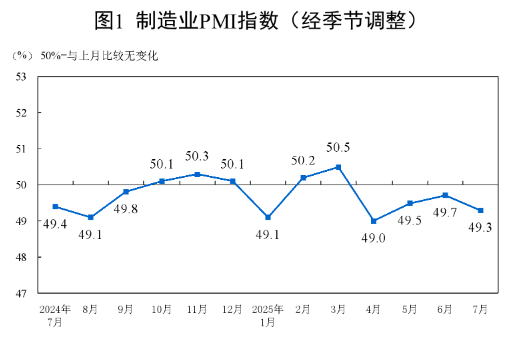
一、中国制造业采购经理指数运行情况 7月份,制造业采购经理指数(PMI)为49.3%,比上月下降0.4个百分点,制造业景气水平有所回落。 从企业规模看,大型企业PMI为50.3%,比上月下降0.9个百分点,高于临界点;中型企业PMI为49.5%,比上月上升0.9个百分点,低于临界点;小型企业 PMI为46.4%,比上月下降0.9个百分点,低于临界点。 从分类指数看,在构成制造业PMI的5个分类指数中,生产指数和供应商配送时间指数均高于临界点,新订单指数、原材料库存指数和从业人员指数低于临 界点。 生产指数为50.5%,比上月下降0.5个百分点,仍高于临界点,表明制造业生产延续扩张。 新订单指数为49.4%,比上月下降0.8个百分点,表明制造业市场需求有所放缓。 投入品价格指数为50.3%,比上月上升0.4个百分点,表明非制造业企业用于经营活动的投入品价格总体水平有所上涨。分行业看,建筑业投入品价格指数 为54.5%,比上月上升6.2个百分点;服务业投入品价格指数为49.6%,比上月下降0.6个百分点。 销售价格指数为47.9%,比上月下降0.9个百分点,表明非制造业销售价格总体水平较上月下降。分行业看,建筑业 ...
国家统计局发布重磅数据
Zheng Quan Ri Bao Wang· 2025-07-31 03:03
Group 1: Manufacturing Sector - The manufacturing Purchasing Managers' Index (PMI) decreased to 49.3% in July, down 0.4 percentage points from the previous month, indicating a decline in manufacturing activity [1][2] - The production index remained in expansion at 50.5%, while the new orders index fell to 49.4%, reflecting a slowdown in market demand [2] - Large enterprises maintained expansion with a PMI of 50.3%, while medium-sized enterprises improved to 49.5%, and small enterprises decreased to 46.4% [3] Group 2: Price Indices - The price index for major raw materials increased, with the purchasing price index at 51.5% and the factory price index at 48.3%, indicating an overall improvement in manufacturing market prices [2] - The purchasing price index for major raw materials rose above the critical point for the first time since March, suggesting a recovery in market conditions [2] Group 3: Non-Manufacturing Sector - The non-manufacturing business activity index was 50.1%, down 0.4 percentage points from the previous month, but still above the critical point, indicating continued expansion [1][4] - The service sector's business activity index remained stable at 50.0%, with certain industries like transportation and entertainment showing strong growth due to seasonal effects [4] - The construction sector's business activity index fell to 50.6%, influenced by adverse weather conditions, while the business activity expectation index for the service sector rose to 56.6%, indicating optimism among service enterprises [4] Group 4: Composite PMI - The composite PMI output index was 50.2%, down 0.5 percentage points from the previous month, but still indicating overall expansion in production and business activities [5][6] - The manufacturing production index and non-manufacturing business activity index contributed to the composite PMI, standing at 50.5% and 50.1% respectively [6]