饮料

Search documents
巴菲特“谢幕信”:善意无需成本,却无价︱重阳荐文
重阳投资· 2025-11-11 07:32
Group 1 - Warren Buffett's Thanksgiving letter this year is particularly anticipated as he hands over the reins of Berkshire Hathaway to Greg Abel, indicating a significant transition in leadership [5][18] - Buffett converted 1,800 Class A shares into 2.7 million Class B shares, donating them to four family foundations, highlighting his philanthropic efforts [5][6] - The letter emphasizes the personal connection and reflections of Buffett, contrasting with the more business-focused annual shareholder letters [8][20] Group 2 - Buffett expresses confidence in Greg Abel's ability to manage Berkshire's funds, stating he cannot think of anyone more suitable for the role [8][58] - The letter reflects on the importance of trust in leadership transitions, with Buffett's children fully supporting Abel [52][58] - Buffett discusses the need for vigilance regarding potential risks associated with CEO transitions, emphasizing the importance of board awareness [59][60] Group 3 - The letter includes personal anecdotes from Buffett's life, illustrating the impact of luck and the importance of relationships formed in Omaha [21][42] - Buffett acknowledges the challenges of aging and the need for careful planning regarding his estate and philanthropic goals [48][50] - The letter concludes with reflections on personal growth and the importance of choosing good role models, encouraging continuous improvement [67][71]


饮料市场 销售下滑丨消费参考
2 1 Shi Ji Jing Ji Bao Dao· 2025-11-11 05:07
Group 1: Beverage Market Overview - The beverage market has entered a contraction phase, with overall sales down 9% year-on-year in September, and offline sales down 10.4% [1] - Uni-President China reported that its beverage business saw a low single-digit decline in revenue for Q3, while food business revenue grew in the mid to low single digits [1] - The decline in beverage revenue is attributed to price wars on delivery platforms and industry competition, with specific categories like juice facing significant pressure [1] Group 2: Dairy Industry Impact - The dairy market is also facing challenges, with Yili noting that ready-to-drink tea is substituting liquid milk products, particularly impacting packaged liquid milk sales [2] Group 3: Production Trends - National Bureau of Statistics data indicates a weakening trend in beverage production in Q3 compared to the first half of the year, with soft drink production declining by 0.17%, 6.79%, and 10.12% year-on-year in July, August, and September respectively [3] Group 4: External Factors - Adverse weather conditions, including typhoons and heavy rain, may have also impacted beverage sales during Q3 [4] Group 5: Market Recovery Signals - There are signs that the delivery platform price wars are becoming more manageable, which could be a positive development for the beverage market [5][6][7]
饮料市场,销售下滑
2 1 Shi Ji Jing Ji Bao Dao· 2025-11-11 04:47
Core Insights - The beverage market is entering a contraction phase, with overall sales down 9% year-on-year in September, and offline sales down 10.4% [1] Company Performance - Uni-President China reported that its overall revenue remained flat year-on-year in Q3, with beverage revenue declining in the low single digits. The food segment saw mid-to-low single-digit growth, driven by strong performance from products like "Qie Huang" and "Lao Tan Sauerkraut" [2] - Yili mentioned that ready-to-drink tea is substituting liquid milk products, particularly impacting packaged liquid milk sales, which are facing pressure from alternatives that are not fully captured in statistics [2] Industry Trends - Beverage production in China showed a significant weakening trend in Q3 compared to the first half of the year, with soft drink production declining by 0.17%, 6.79%, and 10.12% year-on-year in July, August, and September respectively, indicating a growing downward trend [3] - Adverse weather conditions, including typhoons and heavy rain, may have also impacted beverage sales during Q3 [4] Market Dynamics - The competition in the food delivery sector is becoming more manageable, as many executives noted that delivery subsidies have peaked [5][6] - This stabilization in the delivery market could potentially benefit the beverage sector [7] Market Performance Overview - The beverage category experienced a 9% decline in overall channel growth and a 10.4% decline in offline channel growth in September [12][13]
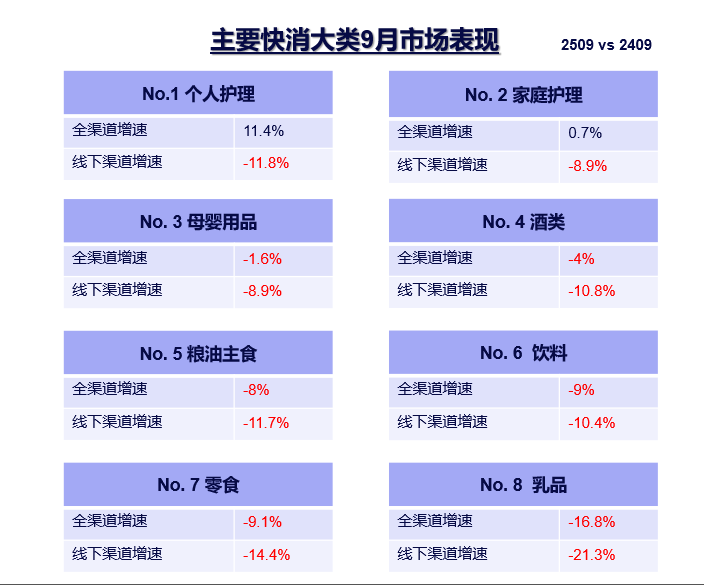
饮料市场,销售下滑丨消费参考
2 1 Shi Ji Jing Ji Bao Dao· 2025-11-11 04:45
Group 1: Beverage Market Overview - The beverage market is entering a contraction phase, with overall sales down 9% year-on-year in September, and offline sales down 10.4% [1] - Unification Enterprise's beverage business saw a low single-digit decline in revenue for Q3, attributed to price wars on delivery platforms and industry competition [2] - The dairy market is also facing challenges, with ready-to-drink tea beverages replacing liquid milk products, particularly impacting packaged liquid milk sales [2] Group 2: Production and Weather Impact - Beverage production in China showed a significant weakening trend in Q3 compared to the first half of the year, with monthly production declines of 0.17%, 6.79%, and 10.12% respectively [3] - Adverse weather conditions, including typhoons and heavy rain, may have also affected beverage sales during Q3 [4] Group 3: Market Recovery Signals - The competitive landscape of delivery services is becoming more manageable, with several market executives indicating that delivery subsidies have peaked [5][6] - This stabilization in the delivery market could potentially benefit the beverage sector [7]

我要“安静下来”了:巴菲特最后一封致股东信(全文)
Jin Shi Shu Ju· 2025-11-11 02:43
Group 1 - The company will have a new CEO, Greg Abel, by the end of the year, who is described as an excellent manager and communicator [2] - The company has a unique group of individual shareholders who generously share their wealth with less fortunate groups [2] - The company has a strong focus on maintaining trust and confidence among shareholders, especially during the transition to new leadership [17] Group 2 - The company has a history of successful investments, such as the acquisition of the Omaha Sun newspaper, which later achieved over 100% annual pre-tax returns [6] - The company emphasizes the importance of strong management and the need for vigilance regarding potential health issues among CEOs [19] - The company is committed to operating in a manner that prioritizes shareholder interests and avoids behaviors that could undermine its status as a valuable asset [21]
巴菲特“最后一封信”全文:我“纯属运气好”,但“时间老人”追上来了,我将“保持安静”
Hua Er Jie Jian Wen· 2025-11-11 00:47
Core Points - Warren Buffett announces his retirement as CEO of Berkshire Hathaway, marking the end of a 60-year career and a significant transition for the company [1][5] - Buffett emphasizes the importance of long-term value investing and criticizes the greed prevalent in corporate America, particularly regarding executive compensation [2][3] - Buffett has made substantial charitable donations, including a recent gift of 2.7 million shares of Berkshire B stock valued at approximately $1.3 billion [3][4] Group 1: Transition of Leadership - Buffett will step down as CEO by the end of the year, with Greg Abel set to take over [1][6] - The announcement has impacted market sentiment, with Berkshire's A shares dropping about 8% since the initial retirement announcement in May [1] - Buffett will continue to hold a significant portion of Berkshire A shares to ensure a smooth transition for his successor [1] Group 2: Corporate Philosophy - Buffett warns against the competitive nature of executive compensation, stating that it leads to jealousy and greed among CEOs [2][25] - He advocates for a management style that prioritizes long-term value over short-term gains, contrasting with the rise of speculative assets like cryptocurrencies [3][26] - Buffett's approach has transformed Berkshire from a struggling textile company into a diversified conglomerate with interests in various sectors [3][26] Group 3: Charitable Contributions - Buffett has committed to donating all his Berkshire stock to charity, continuing his philanthropic efforts through family foundations [4][24] - His recent donation of 2.7 million shares aligns with his long-standing commitment to charitable giving [3][4] - Buffett's charitable philosophy emphasizes the importance of responsible wealth distribution and the need for future generations to continue these efforts [24][23]

巴菲特发布谢幕信
财联社· 2025-11-11 00:25
Core Viewpoint - Warren Buffett has made significant charitable donations by converting 1,800 shares of Class A stock into 2.7 million shares of Class B stock, valued at over $1.3 billion, to be distributed among four family foundations [1]. Group 1: Charitable Donations - The donations include 1.5 million shares to the Susan Thompson Buffett Foundation and 400,000 shares each to the Sherwood Foundation, Howard G. Buffett Foundation, and NoVo Foundation [1]. Group 2: Leadership Transition - Greg Abel will take over as CEO at the end of the year, and Buffett expresses confidence in his capabilities as a manager and communicator [2][3][21]. Group 3: Personal Reflections - Buffett reflects on his life, expressing gratitude for his longevity and the influence of his hometown, Omaha, on his life and career [4][14][18]. Group 4: Future Outlook - The company is expected to grow larger and more robust under Abel's leadership, although stock prices may experience significant fluctuations [23].
巴菲特“交棒”股东信:将“归于平静”,重申美国梦,力挺阿贝尔
Di Yi Cai Jing· 2025-11-10 23:29
Core Viewpoint - Warren Buffett, CEO of Berkshire Hathaway, announced plans to reduce public activities after stepping down at the end of the year, although he will remain in the public eye through annual Thanksgiving messages and increased charitable contributions [1][4]. Group 1: Leadership Transition - Greg Abel, currently Vice Chairman of non-insurance operations, will succeed Buffett as CEO, having been designated as his successor since 2021 [4][6]. - Buffett expressed high expectations for Abel, stating that his performance has exceeded those expectations [4][15]. Group 2: Charitable Contributions - Buffett plans to accelerate donations to family-run foundations, converting 1,800 shares of Berkshire stock valued at $1.35 billion into Class B shares for this purpose [4][14]. - The total value of Berkshire stock held for donation is approximately $149 billion [4]. Group 3: Company Performance - Berkshire Hathaway's stock price has risen over 10% this year, with a market capitalization exceeding $1 trillion [4][6]. - The company has achieved an annualized return of nearly 20% over the past 60 years, significantly outperforming the S&P 500's 10% return during the same period [6]. Group 4: Investment Strategy - Buffett remains a value investor, focusing on undervalued stocks and those with reasonable pricing that he believes will be recognized by the market in the future [6]. - Berkshire Hathaway has been a net seller of stocks for 12 consecutive quarters, with cash reserves reaching a record $381 billion, surpassing the value of its stock portfolio [6][7]. Group 5: Market Outlook - Buffett warned that many companies will likely outperform Berkshire in the next 10 to 20 years due to the pressures of its large size [5][15]. - Despite the current market conditions, Buffett emphasized the importance of careful evaluation of company valuations and long-term prospects before investing [7]. Group 6: International Investments - Berkshire Hathaway is increasing its investments in Japan, preparing for a new round of yen bond issuance and continuing to buy shares in Japanese trading companies [8][7]. - The total value of Berkshire's holdings in Japanese trading companies has increased to approximately $33 billion, up from $31 billion a month prior [8].
东鹏饮料(605499):第二曲线高增,持续迈向平台型公司
Haitong Securities International· 2025-11-10 15:15
Investment Rating - The report maintains an "Outperform" rating for Eastroc Beverage with a target price of Rmb 333.00, indicating an expected upside from the current price of Rmb 276.89 [2][6]. Core Insights - Eastroc Beverage is experiencing rapid growth in its second curve, continuously progressing towards becoming a platform-based company. The company achieved a revenue of Rmb 16.844 billion in the first three quarters of 2025, representing a year-on-year increase of 34.1%, with a net profit of Rmb 3.761 billion, up 38.9% year-on-year [3][11]. - The core category of energy drinks is facing pressure, with revenue growth slowing to 15.1% year-on-year in Q3 2025. However, new product categories such as electrolyte drinks and low-sugar tea are driving significant growth, contributing to a more balanced revenue structure [4][12]. - The company has successfully expanded its product matrix, reducing reliance on a single core product. New products accounted for 16.9% of total revenue in Q1-Q3 2025, indicating a shift towards a more diversified portfolio [4][12]. Financial Performance - The company's gross profit margin was 45.2% in Q3 2025, a slight decrease of 0.6 percentage points year-on-year. However, effective expense control and improved operational leverage have led to a net profit margin increase to 22.7%, up 1.8 percentage points year-on-year [5][13]. - Revenue projections for 2025 to 2027 are Rmb 20.88 billion, Rmb 25.39 billion, and Rmb 30.03 billion, respectively, with net profit forecasts of Rmb 4.57 billion, Rmb 5.77 billion, and Rmb 6.89 billion, reflecting strong growth rates [6][15]. Market Strategy - Eastroc Beverage is focused on multi-category, national, and global strategies, with emerging markets such as North China, East China, and Southwest China showing over 30% year-on-year revenue growth. The company aims to consolidate its leading position in the beverage market and move towards becoming a comprehensive beverage group [5][14].

国泰海通 · 晨报1111|食品饮料、石化、海运、汽车、建筑
国泰海通证券研究· 2025-11-10 15:07
Group 1: Core Views - The article emphasizes that the food and beverage industry is approaching a turning point with supply and demand clearing, particularly in the liquor sector where inventory is being rapidly reduced and demand is being stimulated by falling prices [3][4]. - It suggests a focus on growth opportunities in various segments, including liquor, beverages, snacks, and food raw materials, while highlighting the resilience of mass-market products [3][5]. Group 2: Liquor Market Insights - The liquor market is experiencing accelerated clearing, with a notable decline in inventory and sales, indicating that the market has reached its bottom [4]. - The current adjustment cycle is characterized as U-shaped, with a significant quarterly decline that surpasses previous lows, suggesting a potential for recovery as the market stabilizes [4]. Group 3: Beer and Beverage Sector - The beer market is stable, with consistent pricing and sales, while the beverage sector shows strong structural growth driven by leading brands [5]. - The article recommends focusing on regional beer leaders with competitive advantages and emphasizes the long-term value potential of traditional beverage companies [5]. Group 4: Mass-Market Products - The mass-market segment is stabilizing, with certain industries like food raw materials and health products still in a growth phase [6]. - There is a notable divergence within the sector, with strong performance in condiments and dairy products, while the snack segment is experiencing a slight decline [6]. Group 5: Investment Recommendations - The article advises increasing holdings in liquor stocks that are showing growth and clearing trends, while also considering undervalued beverage stocks with high dividends [3][5]. - It highlights the importance of innovation and channel expansion for companies in the snack sector to maintain competitiveness [6].