
煤炭

Search documents
2月27日A股市场点评:资源股保持强势
Zhongshan Securities· 2026-03-02 12:08
Market Performance - The Shanghai Composite Index increased by 0.39%, while the Shenzhen Component Index decreased by 0.06%[3] - The CSI 300 Index fell by 0.34%, and the ChiNext Index rose by 0.15%[3] - The top-performing sectors included steel (+3.37%), coal (+3.20%), and non-ferrous metals (+3.10%) while construction materials (-1.45%) and telecommunications (-1.38%) lagged behind[3] Key Events - The Central Political Bureau discussed the 14th Five-Year Plan, emphasizing high-quality development and economic stability[5] - The People's Bank of China announced a reduction in the foreign exchange risk reserve ratio from 20% to 0% starting March 2, 2026, signaling a focus on stabilizing the RMB exchange rate[6] Market Outlook - The A-share market is expected to continue its mixed performance, with resource stocks and AI applications as key highlights[7] - Rare metals and coal sectors are anticipated to benefit from rising prices, while hardware sectors may face adjustments due to external factors[8] - Investors are advised to focus on sectors with strong performance certainty and to be cautious of increased volatility in sector rotations[8] Risk Factors - Potential risks include weaker-than-expected overseas demand, intensified geopolitical tensions, and volatility in commodity prices[9]
黑色产业链日报-20260302
Dong Ya Qi Huo· 2026-03-02 11:14
1. Report Industry Investment Rating - No relevant information provided 2. Core Viewpoints - For steel products, short - term policy expectations support the market, but weak fundamentals limit the upside. Wait for policy implementation after the Two Sessions and inventory depletion speed [3] - For iron ore, in March, during the Two Sessions and macro - fluctuation window period, market expectation volatility is expected to increase. Current economic stimulus expectations are low, and demand is pessimistic. Pay attention to the possibility of expectation differences. Valuation is low, and beware of capital re - allocation [21] - For coal and coke, from March to April, it's the terminal demand verification period. Considering the late Spring Festival this year, the post - holiday resumption of work may be slow. If there is a combination of "exceeding - expected resumption of domestic mines" and "weakening macro - sentiment", coal and coke prices may face significant downward pressure [32] - For ferroalloys, in the short term, silicon - manganese prices are supported by manganese ore news, but later, due to sentiment release and high - inventory suppression, there is a drive for hedging in the industrial end. Silicon - iron has good fundamentals and cost support, but limited upside due to weak black downstream fundamentals [47] - For soda ash, the current rigid demand is stable. There are ignition expectations in the float glass end and new ignition production lines in photovoltaic glass. Some manufacturers are expected to have maintenance, which will affect production. The Spring Festival inventory accumulation is slightly lower than expected. The upside and downside price spaces are limited, waiting for further accumulation of industrial contradictions [64] - For glass, the actual demand has not returned, and the production and sales are temporarily weak. The market is in the initial recovery stage. High mid - stream inventory and supply return expectations limit the upside, and demand needs to be verified [88] 3. Summary by Directory Steel - **Prices**: On March 2, 2026, the closing prices of rebar 01, 05, and 10 contracts were 3131, 3067, and 3105 yuan/ton respectively; the closing prices of hot - rolled coil 01, 05, and 10 contracts were 3259, 3219, and 3238 yuan/ton respectively [4] - **Spreads**: Rebar 01 - 05, 05 - 10, 10 - 01 month - spreads were 64, - 38, - 26 yuan/ton; hot - rolled coil 01 - 05, 05 - 10, 10 - 01 month - spreads were 40, - 19, - 21 yuan/ton [4] - **Spot and Basis**: Rebar and hot - rolled coil spot prices and basis in different regions changed slightly from February 28 to March 2, 2026 [9][11] - **Ratios**: 01, 05, 10 rebar/iron ore ratios were 4; 01, 05, 10 rebar/coke ratios were 2 [18] Iron Ore - **Prices**: On March 2, 2026, the closing prices of 01, 05, 09 iron ore contracts were 721.5, 754.5, 733.5 yuan/ton respectively. The basis of 01, 05, 09 contracts were 34, 2.5, 22 yuan/ton respectively [22] - **Fundamentals**: As of February 27, 2026, the daily average pig iron output was 233.28 tons, 45 - port throughput was 298.48 tons, and 45 - port inventory was 17091.96 tons [26] Coal and Coke - **Prices**: On March 2, 2026, the 09 - 01, 05 - 09, 01 - 05 month - spreads of coking coal were - 193, - 95.5, 288.5 yuan/ton; the 09 - 01, 05 - 09, 01 - 05 month - spreads of coke were - 91.5, - 79, 170.5 yuan/ton [33][35] - **Spot and Profits**: Spot prices of various types of coking coal and coke were stable on March 2, 2026. The immediate coking profit was - 3 yuan/ton [36] Ferroalloys - **Silicon - iron**: On March 2, 2026, the silicon - iron basis in Ningxia was - 176 yuan/ton, and the silicon - iron spot prices in different regions increased to varying degrees [48] - **Silicon - manganese**: On March 2, 2026, the silicon - manganese basis in Inner Mongolia was 18 yuan/ton, and the silicon - manganese spot prices in different regions also increased [49] Soda Ash - **Prices**: On March 2, 2026, the closing prices of 05, 09, 01 soda ash contracts were 1188, 1252, 1299 yuan/ton respectively. The 5 - 9, 9 - 1, 1 - 5 month - spreads were - 64, - 47, 111 yuan/ton respectively [65] - **Spot**: The spot prices of heavy and light soda ash in different regions were stable on March 2, 2026 [65] Glass - **Prices**: On March 2, 2026, the closing prices of 05, 09, 01 glass contracts were 1043, 1154, 1216 yuan/ton respectively. The 5 - 9, 9 - 1, 1 - 5 month - spreads were - 111, - 62, 173 yuan/ton respectively [89] - **Production and Sales**: The production and sales of glass in different regions were weak in late February 2026 [90]
双焦周报:宏观消息扰动,期价震荡偏多-20260302
Ning Zheng Qi Huo· 2026-03-02 10:27
Report Summary 1. Industry Investment Rating - Not provided in the report 2. Core Viewpoints - This week, the coal and coke market showed a pattern of weak supply and demand, with prices oscillating weakly. On the supply side, state - owned mines resumed production quickly after the Spring Festival, while private mines and coal washing plants were not fully operational, and the Mongolian coal port resumed customs clearance on the 23rd with a steadily increasing clearance volume, putting downward pressure on coal prices. On the demand side, coke was stable, steel mill demand recovered slowly, there were strong expectations of environmental protection control before major meetings, the start - up of coke and steel enterprises increased limitedly, and the recovery strength of the real estate and infrastructure sectors was unclear, so the release of steel demand was uncertain, which restricted the demand for coking coal. In the future, the resumption of production in coal mines will accelerate after the Spring Festival, but the supply level is still restricted by policies. Downstream enterprises are mainly digesting inventory. Although the coking coal fundamentals are under pressure, the overall contradiction is not prominent. Spot prices are expected to be weakly stable, and the futures market is expected to fluctuate widely due to capital sentiment [2] 3. Summary by Relevant Catalogs Market Review and Outlook - This week, the coal - coke market had weak supply and demand and prices oscillated weakly. After the Spring Festival, state - owned mines resumed production faster, but private mines and coal - washing plants were not fully back in operation. Mongolian coal ports resumed customs - clearance on the 23rd, with a steadily increasing clearance volume, which put pressure on coal prices. Coke demand from steel mills recovered slowly, and environmental protection control was expected to be strict before major meetings. The real - estate and infrastructure recovery was uncertain, restricting coking - coal demand. In the future, coal - mine production resumption will speed up, but supply is policy - restricted. Downstream is mainly digesting inventory. Coking - coal fundamentals are under pressure but the overall contradiction is not significant. Spot is expected to be weakly stable, and the futures market will fluctuate widely due to capital sentiment [2] Weekly Changes in Fundamental Data - The total coking - coal inventory was 2063.29 tons this week, a decrease of 363.36 tons from last week, a week - on - week change rate of - 14.97%. The total coke inventory was 980.03 tons this week, a decrease of 7.92 tons from last week, a week - on - week change rate of - 0.80%. The daily average pig - iron output of steel mills was 233.28 tons this week, an increase of 2.79 tons from last week, a week - on - week change rate of 1.21%. The profit per ton of coke for independent coke enterprises was - 7 yuan/ton this week, an increase of 1 yuan/ton from last week, a week - on - week change rate of - 12.5% [4] 1. Futures Market Review - The report provides a 5 - day intraday chart of the main contracts of coking coal and coke, but no specific data analysis is given. The data source is the Steel Union Terminal and Ningzheng Futures [6][7] 2. Spot Market Review - The report presents charts of the average price of various coking - coal types, the self - pick - up price of Mongolian main coking coal, and the arrival price of first - grade and quasi - first - grade metallurgical coke. The data sources are the Steel Union Terminal and Ningzheng Futures [8][11] 3. Fundamental Data - The report includes charts of the daily output of clean coal from mines and coal - washing plants, the customs - clearance volume of Mongolian coal at the Ganqimaodu Port, the coking - coal inventory of steel mills, independent coke enterprises and ports, the available days of coking - coal inventory for steel mills and independent coke enterprises, the daily output of coke from steel mills and independent coke enterprises, the daily average pig - iron output of 247 steel mills, the coke inventory of steel mills, independent coke enterprises and ports, the available days of coke inventory for steel mills, the profit per ton of coke for independent coke enterprises, and the profit - making rate of 247 steel mills. The data sources are the Steel Union Terminal and Ningzheng Futures [15][18][22]
地缘冲突有望继续推升煤炭价格
Shanxi Securities· 2026-03-02 10:21
Investment Rating - The report maintains an "A" rating for the coal industry, indicating an expected performance that leads the market [1]. Core Insights - The report highlights that overseas coal prices are rising due to supply constraints from Indonesia, which is expected to impact domestic coal prices positively [2][4]. - Domestic coal supply is gradually recovering post-holiday, but environmental regulations may tighten in some regions ahead of the March meetings, necessitating close monitoring of market supply conditions [4]. - The demand for Australian coal has increased due to supply issues, pushing prices higher [4]. Summary by Sections 1. Dynamic Data Tracking - Thermal coal production is gradually increasing, leading to tighter market supply. As of February 27, the spot price for thermal coal in the Bohai Rim was 742 RMB/ton, with a weekly change of +2.49%. The Qinhuangdao port price was 751 RMB/ton, with a weekly change of +4.02% [3]. - Metallurgical coal production has not fully recovered, with downstream purchases primarily driven by immediate needs. As of February 27, the price for main coking coal at Jingtang port was 1660 RMB/ton, remaining stable [3]. 2. Investment Recommendations - The report suggests that current conditions favor companies with overseas production capabilities, particularly Yancoal Energy. Other companies expected to benefit include Jincheng Anthracite Mining, Huayang Co., Shanxi Coal International, and others [5]. 3. Market Performance - The coal sector has shown a significant increase, with the coal index rising by 15.93% year-to-date, outperforming major indices [63].



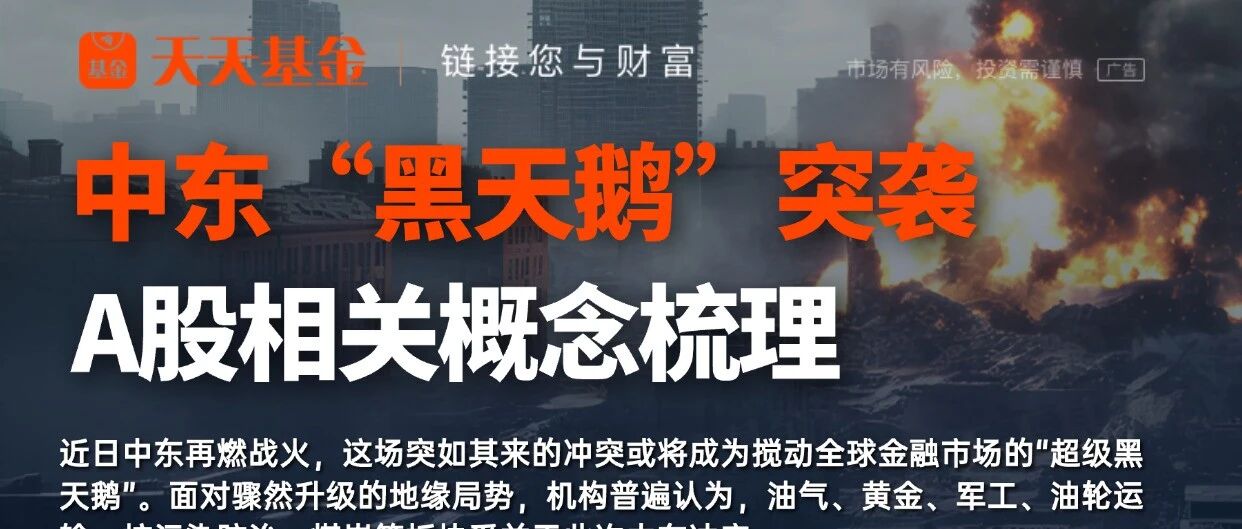
中东“黑天鹅”突袭!对A股哪些板块有影响?投资者如何应对?
天天基金网· 2026-03-02 10:07
Core Viewpoint - The recent escalation of conflict in the Middle East is seen as a potential "super black swan" event that could disrupt global financial markets, with sectors such as oil and gas, gold, military, shipping, nuclear pollution prevention, and coal expected to benefit from the situation [1][6]. Beneficial Sectors - Oil and Gas Exploration: The conflict has directly driven up oil prices, enhancing profits for upstream companies. High oil prices are expected to stimulate increased capital expenditure in oil and gas firms, benefiting oil service equipment [2][6]. - Gold: The military conflict is likely to heighten market risk aversion, which in turn is expected to push up gold prices [2][7]. - Defense and Military: The escalation of geopolitical tensions is anticipated to increase demand for military supplies, including missiles, drones, and air defense systems [2][8]. - Shipping: The conflict may impact oil transportation routes, such as the Strait of Hormuz, leading to increased shipping rates [2][9]. - Nuclear Pollution Prevention: The conflict's focus on nuclear issues is expected to drive demand for nuclear pollution monitoring and protective equipment [3][9]. - Coal: In the context of rising international oil prices and supply constraints, coal's value as an energy substitute is expected to increase significantly [3][10]. Institutional Insights - The impact of the Middle East conflict on equity assets is primarily seen in terms of risk preference and structural changes, with limited substantive effects on the fundamentals of the A-share market. As geopolitical shocks subside and domestic policy discussions intensify, risk preferences are expected to recover [4][11]. - In a scenario of a quick resolution, risk preferences may initially decline but then recover, with assets like gold, shipping, and military experiencing volatility. Conversely, if the conflict drags on, risk preferences may remain low, leading to sustained volatility in these assets [4][11]. - The military actions taken by the U.S. and Israel against Iran will significantly influence global markets and asset prices, depending on the objectives and duration of these actions [4][11]. Investor Recommendations - Investors are advised to maintain a rational approach and focus on structural opportunities, prioritizing sectors that directly benefit from the conflict, such as oil and gas, gold, and military [12]. - It is recommended to avoid sectors under pressure, such as aviation and oil refining, which may suffer from reduced profit margins due to rising oil prices [12]. - Long-term strategies should focus on domestic economic recovery and industry upgrades, using short-term volatility to invest in high-certainty core assets while balancing risk and return [12].




太意外 | 谈股论金
水皮More· 2026-03-02 09:49
Market Overview - A-shares showed mixed performance today, with the Shanghai Composite Index rising by 0.47% to close at 4182.59 points, while the Shenzhen Component Index fell by 0.20% to 14465.79 points, and the ChiNext Index decreased by 0.49% to 3294.16 points [3][4] - The total trading volume in the Shanghai, Shenzhen, and Beijing markets reached 3.04 trillion yuan, a significant increase of 539.8 billion yuan compared to the previous trading day [3][4] Sector Performance - The oil and coal sectors were expected to rise significantly, and they did, with the "three major oil companies" collectively hitting the daily limit [4] - The market's upward trend was supported by banks and operators, contributing to the Shanghai Composite Index's unexpected performance [4] Individual Stock Movements - Approximately 1,000 stocks rose today, while around 4,000 stocks declined, indicating a reversal in market style and a potential shift from a previous broad-based rally [5] - Notable individual stock movements included BYD, which surged by 8% due to an upcoming press conference announcing breakthrough technology [6] External Factors - The recent U.S. attack on Iran was characterized as a "gray rhino" event, indicating it was anticipated rather than unexpected, contributing to market uncertainty [6] - The fluctuations in oil and precious metal futures prices reflected the complexity of the situation, with initial declines followed by recoveries [6] Capital Flows - There was a significant net inflow of 16.2 billion yuan from mainland investors into the Hong Kong market, indicating a clear trend of mainland capital seeking opportunities in Hong Kong stocks [8] - The performance of the Hang Seng Index and the Hang Seng Tech Index is expected to depend heavily on future capital movements [8]

霍尔木兹变局可能助推能源转型加速
HTSC· 2026-03-02 09:41
Investment Rating - The report maintains a "Buy" rating for several companies including Tianqi Lithium, CATL, Aiko, Sungrow, and China Shenhua, with target prices set for each [7][34]. Core Insights - The geopolitical tensions, particularly the military actions in the Strait of Hormuz, are expected to disrupt energy supply and elevate prices, leading to increased urgency for energy security and a shift towards renewable energy sources [1][2]. - The report anticipates a significant increase in energy storage demand, with global installations projected to reach 1500 GWh by 2030, driven by supply disruptions and rising energy prices [2]. - The electrification of commercial vehicles in China is expected to accelerate, with a potential shift from LNG to electric vehicles due to geopolitical uncertainties affecting LNG supply [3]. - Asian LNG import regions may need to substitute approximately 33 million tons of standard coal for power generation if Middle Eastern LNG supplies are restricted, which could drive up global coal prices [4]. - The short-term disruption in methanol transport is likely to boost coal chemical demand, while the long-term trend is expected to favor the transition to green hydrogen for methanol production [5]. Summary by Sections Energy Supply and Pricing - The military actions in the Strait of Hormuz pose a risk of supply interruptions for oil and gas, which could lead to increased transportation costs and price volatility in energy markets [1]. - Countries heavily reliant on LNG imports are likely to increase coal procurement in the short term and rapidly deploy solar storage systems [1][2]. Energy Storage Demand - The report cites a significant increase in energy storage installations in Europe following the Russia-Ukraine conflict, with a year-on-year growth rate of 147.6% in 2022 [2]. - Global energy storage capacity is expected to grow by 43% in 2025, reaching 104 GW, with the Middle East contributing 3% of this growth [2]. Commercial Vehicle Electrification - The report predicts that the electrification of heavy-duty trucks in China will accelerate, with potential demand for electric trucks reaching up to 300,000 units by 2025 due to uncertainties in LNG supply [3]. Coal Demand and Pricing - If Middle Eastern LNG supplies are disrupted, Asian regions may require an additional 33 million tons of coal for power generation, which represents about 3% of global coal trade [4]. - The report suggests that this scenario could lead to an increase in global coal prices [4]. Methanol and Chemical Demand - The disruption in methanol transport is expected to increase coal chemical production in the short term, while the long-term focus will shift towards green hydrogen for methanol production [5].






煤炭行业ESG白皮书
荣续智库· 2026-03-02 09:25
Investment Rating - The report does not explicitly provide an investment rating for the coal industry. Core Insights - The coal industry is at a critical juncture for transformation under the "dual carbon" goals, necessitating a shift towards clean, efficient, and low-carbon utilization to ensure survival and sustainable development [3][5]. - The report emphasizes the importance of ESG (Environmental, Social, and Governance) frameworks in addressing the industry's challenges and transformation practices, providing a comprehensive reference for policymakers, industry practitioners, investors, and researchers [5]. Summary by Sections Chapter 1: Overview of the Coal Industry - Coal is classified into three main types: lignite, bituminous coal, and anthracite, each with distinct properties and uses, impacting energy efficiency and environmental effects [11][14]. - The global coal market is characterized by concentrated resources and production, with significant disparities in demand across different coal types and regions, influenced by energy transition and climate policies [24][25]. - China is the largest coal producer and consumer, with a production of approximately 4.71 billion tons in 2023, primarily of bituminous coal, which supports the electricity and steel industries [25]. Chapter 2: ESG Performance and Transformation Practices in the Coal Industry - The coal industry is undergoing a systematic transformation driven by the dual carbon goals and global energy restructuring, focusing on clean, efficient utilization and green low-carbon transition [72]. - Key development trends include the integration of clean high-efficiency utilization and green low-carbon transformation, with a focus on lifecycle carbon management and the adoption of green mining technologies [73]. - The report identifies four substantive ESG issues for the coal industry: occupational health and safety, greenhouse gas emissions and clean utilization, community relations and ecological restoration, and governance structure and business ethics [58]. Chapter 3: ESG Practices in the Coal Industry - The report highlights the importance of safety and health in the coal industry, with significant advancements in intelligent mining technologies leading to improved safety performance [59]. - The management of greenhouse gas emissions is critical, with companies focusing on carbon reduction pathways and clean utilization capabilities, aligning with national dual carbon goals [65]. - Community relations and ecological restoration are emphasized, with coal companies transitioning from simple compensation to shared development and ecological management [68]. Chapter 4: Excellent ESG Cases of Coal Enterprises - The report showcases exemplary cases from companies like China Shenhua and Coking Energy, illustrating successful ESG practices and innovations in the coal sector [58].

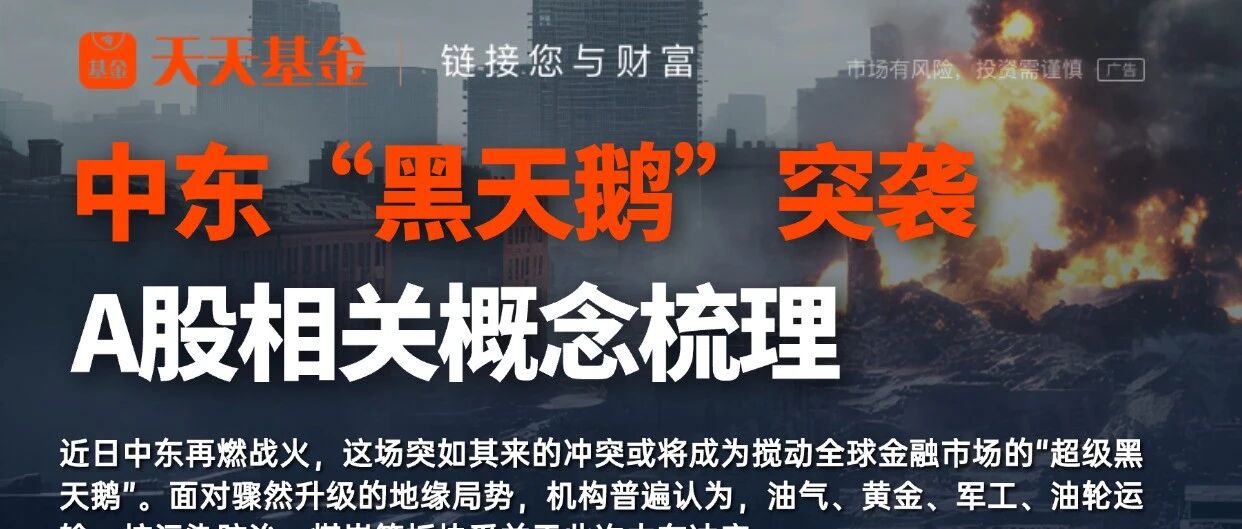
中东“黑天鹅”突袭!对A股哪些板块有影响?投资者如何应对?
天天基金网· 2026-03-02 08:31
Core Viewpoint - The recent escalation of conflict in the Middle East is seen as a potential "super black swan" event that could disrupt global financial markets, with sectors such as oil and gas, gold, military, shipping, nuclear pollution prevention, and coal expected to benefit from the situation [1][6]. Beneficial Sectors - **Oil and Gas Exploration**: The conflict has directly driven up oil prices, enhancing profits for upstream companies. High oil prices are expected to stimulate increased capital expenditure in oil and gas enterprises, benefiting oil service equipment [2][6]. - **Gold**: The military conflict is likely to heighten market risk aversion, which in turn is expected to push up gold prices [2][7]. - **Military and Defense**: The escalation of geopolitical tensions is anticipated to increase demand for military supplies, including missiles, drones, and air defense systems [2][8]. - **Shipping**: The conflict may impact oil transportation routes, such as the Strait of Hormuz, leading to increased shipping rates [2][9]. - **Nuclear Pollution Prevention**: The conflict's focus on nuclear issues is expected to drive demand for nuclear pollution monitoring and protective equipment [3][9]. - **Coal**: In the context of rising international oil prices and supply constraints, coal's value as an energy alternative is expected to increase significantly [3][10]. Institutional Interpretations - The impact of the Middle East conflict on equity assets is primarily seen in terms of risk preference and structural changes, with limited substantive effects on the fundamentals of the A-share market. As geopolitical shocks subside and domestic policy discussions intensify, risk preferences are expected to recover [4][11]. - In the event of a swift resolution to the conflict, risk preferences may initially decline but are likely to recover, with assets like gold, shipping, and military experiencing volatility. Conversely, if the conflict drags on, risk preferences may remain low, leading to sustained volatility in these assets [4][11]. - The military actions taken by the U.S. and Israel against Iran will significantly influence global markets and asset prices, with the A-share market's response largely dependent on risk preferences rather than fundamental changes [4][11]. Investor Guidance - Investors are advised to maintain a rational approach and focus on structural opportunities, prioritizing sectors that directly benefit from the conflict, such as oil and gas, gold, and military. It is recommended to avoid sectors under pressure, like aviation and oil refining, due to the impact of rising oil prices on profit margins [12].
粤开市场日报-20260302
Yuekai Securities· 2026-03-02 07:53
Market Overview - The A-share market saw mixed performance today, with the Shanghai Composite Index rising by 0.47% to close at 4182.59 points, while the Shenzhen Component Index fell by 0.20% to 14465.79 points. The ChiNext Index decreased by 0.49% to 3294.16 points, and the STAR Market 50 Index dropped by 1.56% to 1464.77 points. Overall, 1141 stocks rose while 4276 stocks declined, with a total trading volume of 30207 billion yuan, an increase of 5327 billion yuan compared to the previous trading day [1][10]. Industry Performance - Among the Shenwan first-level industries, the leading sectors included Oil & Petrochemicals, Coal, Non-ferrous Metals, National Defense & Military Industry, and Communications, with respective gains of 7.95%, 3.77%, 3.17%, 2.47%, and 1.88%. Conversely, the sectors that experienced declines included Media, Computers, Social Services, Beauty & Personal Care, and Retail, with losses of 3.98%, 2.88%, 2.68%, 2.44%, and 2.41% [1][11]. Sector Highlights - The top-performing concept sectors today were Oil & Gas Extraction, High Send-off, Natural Gas, Central State-owned Coal, Gold & Jewelry, Selected Chemical Raw Materials, Optical Modules (CPO), Shipping Selection, Industrial Metals Selection, Military Information Technology, Selected Coal Mining, Deep Sea Technology, Satellite Internet, Germanium, Gallium, Antimony Ink, and Optical Communication [2].