
银行业

Search documents
【一条有🧧的早报】央行今日出手!万亿逆回购来了;美股、黄金、白银、原油集体大跌
财联社· 2026-02-12 23:10
Macro News - The Chinese Ministry of Foreign Affairs confirmed that during a recent call between the leaders of China and the U.S., President Trump expressed his desire to visit China in April, while President Xi reiterated the invitation [1][4]. - The U.S. Treasury Secretary mentioned that his team met with Chinese officials in Beijing last week to prepare for upcoming high-level talks, indicating ongoing communication between the economic teams of both countries [4]. - The People's Bank of China announced a 1 trillion yuan reverse repurchase operation to maintain liquidity in the banking system, with a term of 6 months starting from February 13, 2026 [2][4]. - The Chinese Ministry of Commerce announced that starting February 13, 2026, anti-subsidy duties will be imposed on certain dairy products imported from the EU [4]. Industry News - The National Development and Reform Commission, along with other regulatory bodies, released implementation opinions aimed at promoting high-quality development of low-altitude insurance, with a mandatory insurance system for unmanned aerial vehicles expected to be established by 2027 [8]. - The Shanghai Stock Exchange announced a list of initiatives for 2026, including a series of fee reduction measures, which are expected to benefit the market by approximately 1.113 billion yuan [7]. Company News - Xianglu Tungsten Industry warned that significant economic fluctuations in the countries of its major clients could impact market demand for tungsten products and the recovery of accounts receivable [11]. - Jia Mei Packaging announced that its capital operation plan will be completely independent of the listed company, and it may apply for a trading suspension if stock prices rise abnormally [11]. - Tai Ling Microelectronics reported that its third-largest shareholder, the National Big Fund, reduced its holdings by 4.6513 million shares, bringing its stake below 5% [11]. - United Optoelectronics signed a business cooperation framework contract with Lingzhi Cloud Creation to provide assembly and processing services for robotic products [12].


美元资产持续“祛魅”,科技发展提振亚洲,亚洲股市开年跑赢欧美
Huan Qiu Shi Bao· 2026-02-12 22:56
Core Viewpoint - Asian stock markets are attracting global investors as they outperform US and European markets, driven by themes such as artificial intelligence, corporate reforms, and improving economic fundamentals [1][2][3]. Group 1: Asian Market Performance - Asian market indices continued their strong performance from 2025, with a 7.5% increase in January 2026, marking the largest monthly gain since 2023 [2]. - Major Asian stock indices have surpassed the S&P 500 and the European Stoxx 600, indicating a shift in investor confidence away from US assets [2][4]. - The resilience of Asian economies and the rapid development in the technology sector are drawing significant attention from investors [3]. Group 2: Investment Themes - Three key investment themes are driving the Asian market: artificial intelligence, corporate reforms across multiple Asian countries, and continuous improvement in economic fundamentals [2]. - Asia is becoming a focal point for global investors as it holds critical segments of the AI supply chain and provides substantial hardware support for AI infrastructure [2][6]. Group 3: Global Investment Trends - There is a noticeable trend of capital flowing out of the US and into international markets, with investors increasingly favoring Asian and emerging markets due to more attractive valuations and profit prospects [3][4]. - In January, investors allocated a net $51.6 billion to international equity ETFs, reflecting a significant shift in investment strategy [4]. Group 4: China's Market Outlook - Chinese stock indices have outperformed the S&P 500 and Nasdaq, with the Shanghai Composite Index rising 18% in 2025, marking its best performance in six years [6]. - The recent inclusion of 37 Chinese companies into the MSCI global standard index is expected to enhance the attractiveness of the Chinese market and prompt global funds to reassess their allocations [6][7]. - Increased weight in global indices may signal a growth trend for Chinese markets, attracting more buying interest from global investors [7].
去风险情绪骤升 流动性挤压下贵金属遭“踩踏式”抛售
智通财经网· 2026-02-12 22:37
Core Viewpoint - The global financial market is experiencing a "de-risking" sentiment, leading to a sell-off in precious metals, particularly gold and silver, due to a significant drop in U.S. tech stocks and increased liquidity demands [1][2]. Group 1: Market Dynamics - Gold prices saw a maximum intraday drop of 4.1%, while silver plummeted by 11%, and copper prices fell by 2.9%, before slightly rebounding from their lows [1]. - The sell-off in precious metals is attributed to traders liquidating metal assets to cover losses in stock positions, alongside a shift in funds towards U.S. Treasury bonds for safety [1][2]. - The recent volatility in gold and silver prices is heavily influenced by market sentiment and momentum, with short-term funds rapidly exiting during risk sentiment reversals [1][2]. Group 2: Technical Analysis and Future Outlook - The strong upward momentum in precious metals observed since the beginning of 2024 came to a halt on January 29, when gold recorded its largest single-day drop in over a decade, and silver experienced its largest historical decline [2]. - Analysts suggest that the recent sharp decline does not necessarily indicate a sustained downward trend for gold, but it does increase the likelihood of high volatility in the short term [2]. - Institutional perspectives remain bullish on gold in the medium to long term, citing unchanged supporting factors such as geopolitical tensions and concerns over the independence of the Federal Reserve [2]. Group 3: Silver Market Insights - The dynamics in the options market for silver have amplified volatility, with active trading in call options for the iShares Silver Trust (SLV.US) potentially exacerbating selling pressure [3]. - Traders are closely monitoring upcoming U.S. economic data, particularly core inflation indicators, to assess the Federal Reserve's interest rate trajectory, as lower borrowing costs typically benefit non-yielding precious metals [3]. - As of market close, spot gold fell by 3.15% to $4922.3 per ounce, while silver dropped over 10% to $75.31 per ounce, alongside declines in platinum and palladium prices [3].
CPI前夜惊魂!AI恐慌拖累金属,黄金、白银盘中闪崩
Jin Shi Shu Ju· 2026-02-12 22:31
Core Viewpoint - The financial markets experienced a significant sell-off, leading to a sharp decline in gold and silver prices as investors liquidated positions to cover losses in the stock market [1][2]. Group 1: Market Reactions - Gold prices plummeted nearly $200 within 30 minutes, closing down over 3% at $4878.37 per ounce, while silver fell nearly $9, closing at $75.26 per ounce, a drop of 10.64% [1]. - The sell-off in precious metals was partly driven by profit-taking after a recent surge in prices, which had been fueled by speculative buying [3][4]. - The sudden drop in metal prices was characterized as a "risk-off" market sentiment, where even safe-haven assets like gold were sold off by investors in need of liquidity [2][4]. Group 2: Technical Analysis and Market Sentiment - The recent volatility in gold and silver prices was attributed to a lack of new catalysts, leading to sharp fluctuations within a narrow range [4]. - Analysts noted that stop-loss orders triggered below $5000 contributed to the rapid decline in prices, indicating a chain reaction in the market [4]. - The overall sell-off appeared to be driven by algorithmic trading and systematic strategies, particularly from Commodity Trading Advisors (CTAs) reacting to key price levels being breached [4]. Group 3: Future Outlook - Despite the recent downturn, several banks maintain a bullish outlook on gold, citing ongoing factors such as geopolitical tensions and a shift in global capital from traditional assets [5]. - Major financial institutions like JPMorgan and Deutsche Bank project gold prices to reach between $6000 and $6300 per ounce by year-end [5]. - Market participants are closely monitoring upcoming economic data, such as the U.S. core CPI, which is expected to influence Federal Reserve interest rate expectations and potentially support gold prices [5].
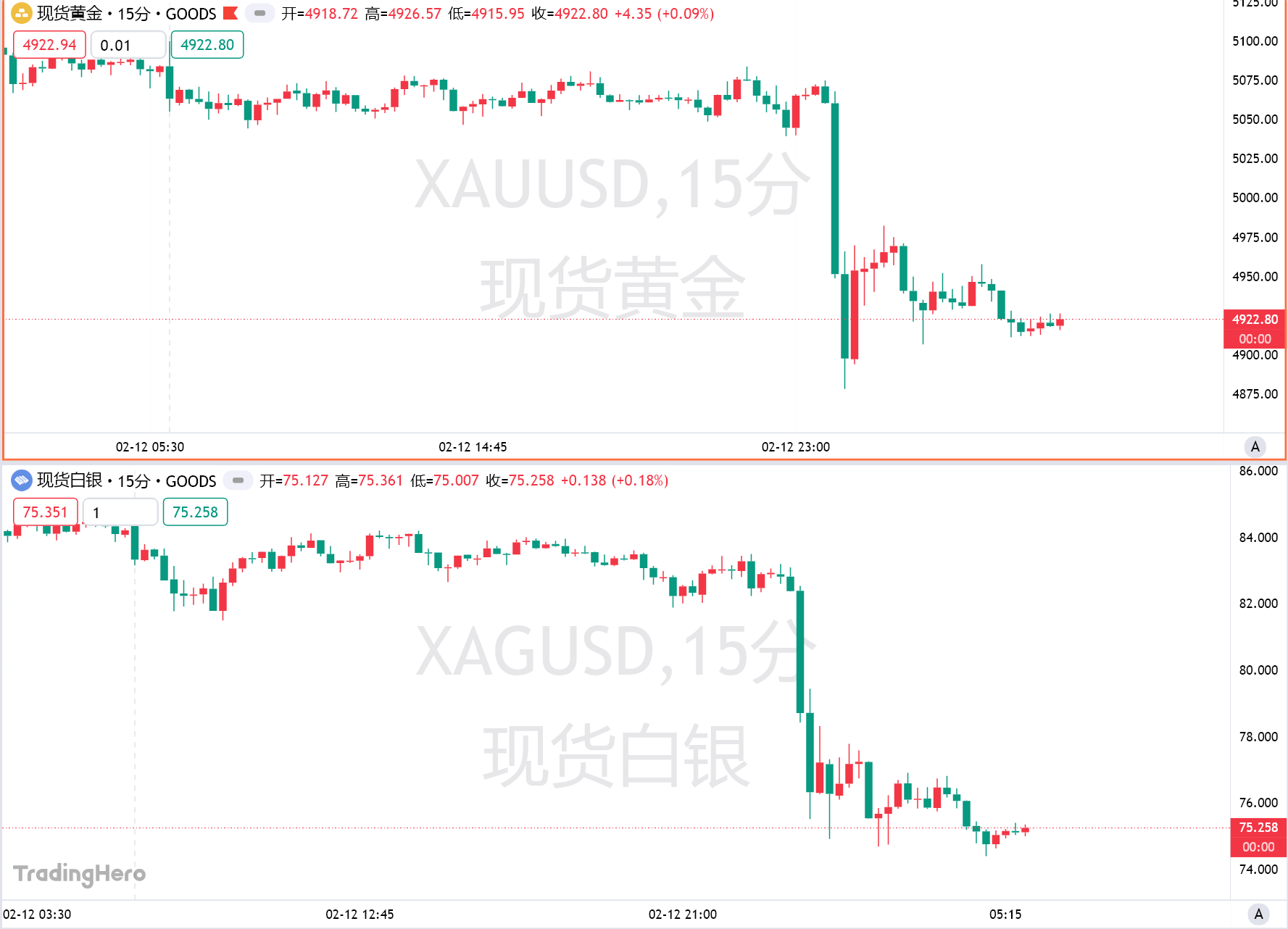
黄金一度跌超4%、白银暴跌11%,美股大跌引爆算法交易贵金属卖盘?
Sou Hu Cai Jing· 2026-02-12 22:09
Core Viewpoint - The U.S. stock market experienced a significant decline, with the Nasdaq dropping over 2%, leading to a sell-off in precious metals as traders sought liquidity to cover stock market losses [1] Group 1: Market Reactions - Precious metals such as gold, silver, and copper saw substantial declines, with gold dropping 4.1% at one point and silver plummeting 11% [1] - The COMEX gold futures fell by 3.06%, settling at $4,942.50 per ounce, while spot gold closed down 3.26% at $4,918.36 per ounce [1] - The dollar index saw a slight increase amid the market turmoil [1] Group 2: Analyst Insights - Analysts noted that the rapid sell-off in gold and silver was indicative of a "risk-off" sentiment, where even safe-haven assets were liquidated for cash [2] - The recent surge in gold and silver prices was largely driven by speculative buying, and the sell-off was partly due to profit-taking [2] - Despite the recent downturn, many analysts expect gold to regain an upward trend, citing ongoing geopolitical tensions and a shift from traditional assets to alternatives [3] Group 3: Future Outlook - JPMorgan Private Bank forecasts gold prices could reach between $6,000 and $6,300 per ounce by year-end, maintaining a bullish outlook alongside Deutsche Bank and Goldman Sachs [3] - The market is currently focused on upcoming U.S. economic data, particularly the CPI report, which could provide insights into the Federal Reserve's interest rate path [3]
【共和党要员Tillis反对参院接手鲍威尔调查,沃什提名确认路径依然受阻】美国共和党参议员Thom Tillis拒绝了由参议院银行委员会自行对美联储主席杰罗姆·鲍威尔展开调查的提议。该提议旨在取代司法部的调查,并为委员会批准美国总统唐纳德·特朗普提名的下一任美联储主席扫清障碍。
Sou Hu Cai Jing· 2026-02-12 20:23
【共和党要员Tillis反对参院接手鲍威尔调查,沃什提名确认路径依然受阻】美国共和党参议员Thom Tillis拒绝了由参议院银行委员会自行对美联储主席杰罗姆·鲍威尔展开调查的提议。该提议旨在取代司 法部的调查,并为委员会批准美国总统唐纳德·特朗普提名的下一任美联储主席扫清障碍。 ...
离岸汇率冲破6.90!外资疯狂涌入,人民币要开启“狂飙”模式?
Sou Hu Cai Jing· 2026-02-12 18:53
Core Viewpoint - The recent strengthening of the Renminbi (RMB) is influenced by both internal and external factors, with significant movements in the offshore market and a notable increase in foreign capital inflow [2][4][6]. Group 1: Currency Movements - The offshore RMB against the USD broke the 6.90 mark, reaching a high of 6.9060, while the onshore rate peaked at 6.9112, marking the first time in three years that the offshore rate surpassed 6.92 [2] - The CFETS RMB exchange rate index rose by 1.35, while the BIS currency basket index increased by 1.38, indicating a general strengthening of the RMB [8] Group 2: Foreign Capital Inflow - There has been a continuous net inflow of foreign capital through the northbound trading channel, with significant purchases of RMB-denominated bonds, indicating a growing international confidence in the RMB [6][12] - In January, China's foreign exchange reserves reached $3.3991 trillion, an increase of $41.2 billion, marking the highest level since December 2015 [4][17] Group 3: Economic Fundamentals - China's trade surplus remains robust, with the country maintaining the largest volume of goods trade globally, which supports the stability of the RMB [4][12] - The expectation of a decline in the Federal Reserve's interest rates and the narrowing of the interest rate differential between China and the US are attracting capital inflows into RMB assets [12] Group 4: Market Sentiment and Predictions - Market sentiment has shifted towards a view of "range fluctuations" for the RMB, with predictions suggesting a trading range of 6.90 to 7.00 in 2026, contingent on breaking the critical point of 6.90 [19] - Analysts caution that while the current conditions are favorable, the strength of the RMB may wane after seasonal factors dissipate, and future movements will depend on external variables [8][12]
“十四五”分红近9900亿元
Shen Zhen Shang Bao· 2026-02-12 18:33
Core Insights - The Shenzhen listed companies have contributed over 2 trillion yuan in taxes in the past five years and more than 3.5 trillion yuan in the last decade, supporting regional employment with over 4 million jobs [1][2] - During the 14th Five-Year Plan period, Shenzhen listed companies distributed nearly 990 billion yuan in dividends, significantly exceeding the equity financing scale, ranking second among major cities in China [1] - In 2025, the cash dividends are expected to exceed 180 billion yuan, with leading companies like China Ping An and China Merchants Bank maintaining over 10 years of continuous dividends [1] Financial Performance - In the first three quarters of 2025, 52 listed companies in Shenzhen paid out 50.201 billion yuan in cash dividends, setting a new record with a payout ratio exceeding 30% [1] - The stock prices of major companies have shown strong performance, with China Ping An's stock price increasing by 35.87%, China Merchants Bank's A-shares rising by 11.76%, and Industrial Fulian's stock price surging by 194.26% [1] Economic Impact - In the first three quarters of 2025, Shenzhen listed companies paid nearly 285 billion yuan in various taxes and provided over 4 million jobs, with total employee compensation exceeding 620 billion yuan and an average annual salary of over 200,000 yuan [2] - Leading enterprises are showing strong investment intentions, significantly increasing their investments in fixed assets and other long-term assets, which injects sustainable momentum into economic development [2] - Innovative companies like UBTECH and Huichuan Technology are not only creating numerous high-end job opportunities but also driving the development of thousands of small and medium-sized enterprises in the supply chain, fostering a robust ecosystem [2]



欧盟通过900亿欧元援乌贷款,俄罗斯上调增值税
Xin Lang Cai Jing· 2026-02-12 18:31
Group 1 - The European Parliament has approved a total of €90 billion in aid loans for Ukraine, with €30 billion allocated for macro-financial assistance and €60 billion for strengthening defense capabilities. The EU Council has reached an agreement on the loan framework, aiming to disburse the first tranche by early Q2 2026 [1] - Russia will increase its basic VAT rate from 20% to 22% starting in 2026, which economists predict may exacerbate inflation risks. The country's investment growth has stagnated, facing challenges from declining liquidity and geopolitical uncertainties [1] - European stock funds have seen strong inflows, attracting approximately $14 billion in net investments as of the week ending February 9, 2026, marking a new high in several months. This shift is partly due to investors reducing reliance on U.S. tech stocks and diversifying into markets including Eastern Europe [1] Group 2 - Alpha Bank's chief economist, Natalia Orlova, analyzes that the resource allocation in Russia remains imbalanced between military and civilian sectors, with reduced investment and economic slowdown being a natural phenomenon [2] - The Kiel Institute report indicates that as the U.S. withdraws funding, military aid to Ukraine will drop to its lowest level in 2025, with Europe bearing most of the related costs. Future tensions in U.S.-European relations may accelerate European defense expansion plans [2] - If the European Central Bank does not restart bond purchases, upward pressure on long-term interest rates may affect the valuations of military and security-related industries [2]
央行今日将开展1万亿元买断式逆回购操作
Xin Lang Cai Jing· 2026-02-12 18:30
Group 1 - The People's Bank of China (PBOC) announced a 1 trillion yuan reverse repo operation with a fixed amount and interest rate, set to take place on February 13, with a term of 6 months (182 days) [1] - In February, the PBOC has conducted a total of 1.8 trillion yuan in reverse repo operations, with a net injection of 600 billion yuan after accounting for 1.2 trillion yuan in maturing operations [1] - The increase in net reverse repo operations in February is aimed at countering potential liquidity tightening, especially with the upcoming Spring Festival and government bond issuances [1] Group 2 - Citic Securities noted that the demand for cash during the Spring Festival is a major factor affecting liquidity in February, with expectations of a phase of tightening at the end of the month [2] - The PBOC is expected to use various tools, including medium-term lending facilities (MLF) and structural tools, to inject medium-term liquidity into the market [2] - Analysts predict that the PBOC will continue to utilize reverse repos and MLF to maintain liquidity and support financial institutions amid pressure on net interest margins [2]
