有色金属

Search documents
高毅资产2025年末美股持仓出炉,持股近47亿元!近一个月调研26家A股公司!
Xin Lang Cai Jing· 2026-02-14 03:38
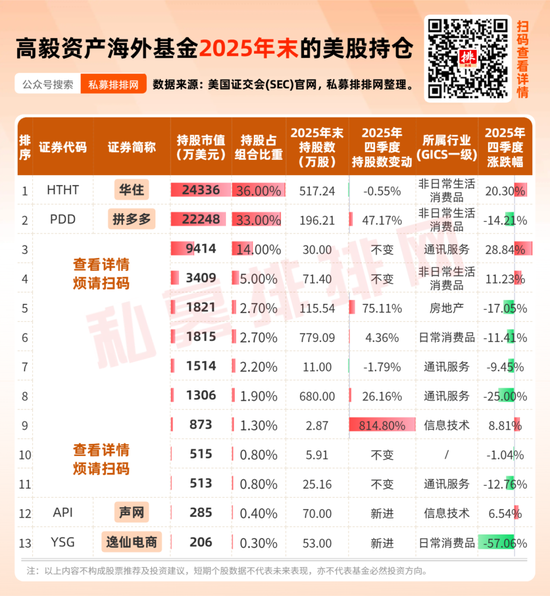
Group 1 - The core viewpoint of the article is that Gao Yi Asset, a prominent private equity firm, has disclosed its holdings in U.S. stocks as of the end of Q4 2025, with a total market value of approximately $683 million, including several Chinese concept stocks [1][9] - Gao Yi Asset's largest U.S. stock holding is Huazhu, valued at approximately $243.36 million, accounting for about 36% of its total U.S. stock portfolio, with a quarterly increase of over 20% [1][9] - The second-largest holding is Pinduoduo, valued at approximately $222.48 million, representing about 33% of the total U.S. stock portfolio, with a quarterly increase of 47.17% [1][9] Group 2 - As of the end of Q3 2025, Gao Yi Asset's A-share holdings totaled approximately 23.57 billion yuan, with significant positions in 18 A-share companies [4][12] - The firm has been active in adjusting its A-share portfolio, with new investments in 3 companies, increasing positions in 3, reducing in 10, and maintaining 2 unchanged [4][12] - The investment focus of Gao Yi Asset includes sectors such as non-ferrous metals and electronics, with notable managers like Feng Liu and Deng Xiaofeng leading these investments [4][12] Group 3 - Gao Yi Asset has been actively conducting research on A-share companies, having surveyed 26 companies in the past month, with a notable increase in the stock price of Wangsu Science and Technology by over 85% [7][15] - The firm has a strong research team of over 60 members, with senior fund managers averaging over 20 years of experience in the securities industry [10][12] - Gao Yi Asset has received multiple industry awards, including 31 Golden Bull Awards throughout its operational history [10][12]

解决航天核心资源瓶颈的钥匙,“铼”自资源卡位与提取技术突破
Soochow Securities· 2026-02-14 02:20
Investment Rating - The report maintains an "Accumulate" rating for the environmental protection industry [1]. Core Insights - The report highlights the critical role of rhenium as a strategic metal in aerospace, emphasizing its increasing demand driven by advancements in aircraft and commercial space engines, while also noting the supply constraints due to its scarcity [8][9]. - By 2030, global rhenium demand is projected to rise from 75 tons in 2019 to 191 tons, with China's demand increasing from 8 tons to 56 tons, primarily fueled by the aerospace sector [17][18]. - The report underscores the high dependency of both the US and China on imported rhenium, with the US relying on imports for 82% of its consumption [9][10]. Summary by Sections 1. Rhenium: A Strategic Metal for Aerospace - Rhenium is essential in high-temperature alloys used in aircraft engines and rocket engines, with its unique properties allowing for higher performance under extreme conditions [8]. - The global rhenium consumption in 2019 was approximately 75 tons, with the US being the largest consumer [9][10]. - The report forecasts that by 2030, rhenium demand in the aerospace sector will significantly increase due to advancements in engine technology and the growth of commercial space ventures [17][18]. 2. Supply Constraints - Global rhenium supply is limited, with only about 2,600 tons of proven reserves, primarily concentrated in Chile, the US, and Russia [34][35]. - Rhenium is mainly recovered as a byproduct of copper and molybdenum refining, which adds to the supply rigidity [35][36]. - The report notes that China's rhenium production is heavily reliant on imports, with a significant portion of its supply coming from copper and molybdenum smelting processes [34][36]. 3. Demand and Price Dynamics - If domestic rhenium supply does not improve, China could face a supply gap of 51 tons by the long term, indicating a potential price increase for rhenium [17][18]. - The report reviews historical price trends, indicating that rhenium is currently in a new price increase cycle, with ammonium perrhenate prices rising significantly [17][18]. - Profitability analysis shows that if rhenium prices rise to 120 million yuan per ton, net profits could reach 45 million yuan per ton [17][18]. 4. Company Insights: Sains - Sains is positioned as a key player in rhenium extraction, with strategic partnerships and technological advantages in rhenium recovery [17][18]. - The company has initiated a production line for ammonium perrhenate and is expected to expand its rhenium production capacity through partnerships with major mining companies [17][18].


2026年2月上旬流通领域重要生产资料市场价格变动情况
Guo Jia Tong Ji Ju· 2026-02-14 01:33
Core Viewpoint - The monitoring of market prices for 50 important production materials in China shows a mixed trend, with 28 products experiencing price increases, 20 seeing declines, and 2 remaining stable in early February 2026 compared to late January 2026 [2]. Group 1: Price Changes in Major Categories - In the black metal category, prices for rebar, wire rod, and ordinary medium plates decreased by 0.3%, 0.4%, and 0.2% respectively, while seamless steel pipes remained unchanged [4]. - In the non-ferrous metal category, electrolytic copper saw a price increase of 0.3%, while aluminum ingots and lead ingots decreased by 2.8% and 2.4% respectively [4]. - Chemical products like sulfuric acid and ethanol experienced price increases of 3.3% and 2.7%, while caustic soda and acetic acid saw declines of 2.4% and 4.4% respectively [4]. Group 2: Energy and Coal Prices - In the petroleum and natural gas sector, liquefied natural gas prices fell by 0.8%, while liquefied petroleum gas and gasoline prices increased by 0.3% and 0.9% respectively [4]. - Coal prices showed mixed results, with anthracite coal increasing by 0.7% and coking coal decreasing by 1.0% [4]. Group 3: Agricultural Products and Fertilizers - Among agricultural products, prices for rice and wheat increased by 0.1% and 0.3%, while cotton prices decreased by 0.6% [5]. - Fertilizer prices also varied, with urea increasing by 1.2% and potassium fertilizer rising by 0.5% [5]. Group 4: Monitoring Methodology - The price monitoring includes a comprehensive range of 50 products across 9 categories, covering over 300 markets and nearly 2000 businesses nationwide [7][8]. - The methodology involves various data collection techniques, including on-site price collection and electronic inquiries [8].
金属普跌 期铝自一周低位回升关税下调前景加剧定价不确定性【2月13日LME收盘】
Wen Hua Cai Jing· 2026-02-14 00:20
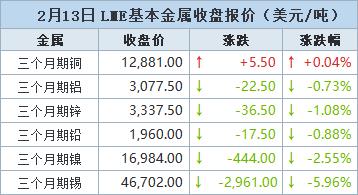
Core Viewpoint - Aluminum prices on the London Metal Exchange (LME) fell to a one-week low but recovered some losses, with tariff reduction prospects increasing pricing uncertainty [1][3]. Group 1: Aluminum Market - On February 13, LME three-month aluminum dropped by $22.5, or 0.73%, closing at $3,077.5 per ton, reaching its lowest level since February 6 [1][2]. - The prospect of the U.S. reducing aluminum tariffs has added uncertainty to trade flows and pricing, with U.S. buyers' prices dropping 6.8% to 93 cents per pound [3]. - Analysts indicate that the main market impact comes from primary aluminum tariffs, and any tariff reductions on derivative products will not affect LME aluminum prices unless they extend to primary metals [3]. Group 2: Other Base Metals - Other industrial metals experienced declines due to profit-taking and risk aversion, with LME three-month copper rising slightly by $5.5, or 0.04%, to $12,881.0 per ton, moving away from its record high of $14,527.50 set on January 29 [4]. - LME three-month zinc fell by $36.5, or 1.08%, closing at $3,337.5 per ton [5]. - LME three-month lead decreased by $17.5, or 0.88%, to $1,960.0 per ton, while nickel dropped by $444, or 2.55%, to $16,984.0 per ton [6]. - LME three-month tin saw a significant drop of $2,961, or 5.96%, closing at $46,702.0 per ton [7]. Group 3: Supply and Export Regulations - Indonesia is considering a plan to ban the export of various raw materials, including tin, in the coming years [8]. - The country has already banned the export of several raw ores, including nickel ore, bauxite, and copper concentrate, to attract domestic processing industry investment and promote high-value product exports [9].
收复失地!黄金白银深夜反弹 黄金突破5040美元
2 1 Shi Ji Jing Ji Bao Dao· 2026-02-14 00:13
Core Viewpoint - The current upward trend in gold prices is not yet over, driven primarily by liquidity expectations and geopolitical tensions providing a safe-haven appeal for gold [1][1][1] Group 1: Market Performance - On February 13, gold and silver prices rebounded, with spot gold rising by 2.4% to surpass $5040 per ounce, and spot silver increasing by 2.8% to $77.3 per ounce [1][1][1] Group 2: Analyst Insights - A chief analyst from CITIC Securities highlighted that liquidity expectations are the core driving force behind the current gold price movements [1][1][1] - Ongoing geopolitical conflicts are contributing to a phase of safe-haven demand for gold [1][1][1]

ETF收评 | A股全线下跌 ,航空航天板块走强 ,航空航天ETF涨2%
Ge Long Hui· 2026-02-13 16:09
Market Overview - The A-share market experienced a decline across all major indices, with the Shanghai Composite Index falling by 1.26%, the Shenzhen Component Index down by 1.28%, and the ChiNext Index decreasing by 1.57% [1] Sector Performance - The shipbuilding, aerospace, and comprehensive industries showed the highest gains, while the photovoltaic equipment, minor metals, and glass fiber sectors collectively retreated [1] - The aerospace sector saw a counter-trend increase, with the Huatai-PB Aerospace ETF and the Huaxia Aerospace ETF rising by 2.3% and 1.58%, respectively [1] - The semiconductor sector also performed well, with the Huatai-PB Korea Semiconductor ETF and the Semiconductor Equipment ETF increasing by 1.8% and 1.25%, respectively [1] - In contrast, the oil and gas sector faced declines, with the Bosera Oil and Gas ETF and the Oil ETF dropping by 4.21% and 3.99% [1] - The non-ferrous metals sector experienced a broad downturn, with the Fuguo Non-ferrous ETF and the Huatai Oil and Gas ETF falling by 3.73% and 3.72%, respectively [1] International Market - Japanese stocks continued to rise, with the Huaxia Nikkei ETF increasing by 1.39% [1]
港股收盘 | 恒指收跌1.72% 有色股全线回落 海致科技首挂大升263.64%
Zhi Tong Cai Jing· 2026-02-13 13:47
Market Overview - The Hong Kong stock market experienced a decline on the last trading day of the Year of the Snake, with the Hang Seng Index falling by 1.72% or 465.42 points, closing at 26,567.12 points, and a total trading volume of 257.58 billion HKD [1] - The decline is attributed to weak fundamentals, concerns over tightening liquidity, and a decrease in the attractiveness of Hong Kong's unique market structure [1] Blue-Chip Performance - Zijin Mining (601899) led the blue-chip decline, dropping 7.64% to 41.58 HKD, contributing a loss of 33.26 points to the Hang Seng Index [2] - Other notable movements included Haidilao (06862) rising 3.13% to 17.15 HKD, and Sinopec (00386) falling 5.12% to 5.37 HKD, contributing a loss of 10.66 points to the index [2] Sector Performance - Large technology stocks continued to decline, with Alibaba-W dropping over 2% and Tencent Holdings nearly 1% [3] - Conversely, domestic large model stocks saw gains, with Zhiyuan (02513) increasing by 20.65% to 485 HKD and MiniMax-WP (00100) rising 15.65% to 680 HKD [3] Commodity Sector - The non-ferrous metals sector saw a significant drop, with China Nonferrous Mining (01258) down 5.27% to 14.91 HKD and Zijin Mining (02899) down 4.98% to 42.78 HKD [5] - The market reacted to unexpectedly strong U.S. employment data, which dampened expectations for an early interest rate cut by the Federal Reserve [5] AI and Technology Developments - The recent release of domestic AI models has led to a surge in related stocks, with significant advancements in AI capabilities being reported [4] - ByteDance's Seedance 2.0 model has gained popularity overseas, expected to lower the barriers for high-quality video content creation [4] Company Highlights - Haizhi Technology (02706) saw a remarkable debut, with shares rising 242.2% to 92.6 HKD, following a successful IPO that was oversubscribed by 5065.06 times [8] - Health Road (02587) reported expected revenue of no less than 1.5 billion RMB for 2025, marking a growth of at least 25% compared to the previous year [9] - MicroPort Robotics-B (02252) reported strong performance with over 200 global commercial orders for its core product, indicating a positive market reception [10]
铜日报:铜价高位波动,春节期间关注美元可能的走强风险-20260213
Tong Hui Qi Huo· 2026-02-13 13:37
1. Report Industry Investment Rating No information provided. 2. Core Viewpoints - The copper price is expected to remain in a low - level fluctuation range of 100,000 - 103,000 yuan/ton in the next one to two weeks. The supply is relatively stable or slightly increasing, the demand is significantly weakened due to the Spring Festival holiday, and the inventory is continuously accumulating [3][51][53]. 3. Summary by Relevant Catalogs Copper Futures Market Data Change Analysis - **Main Contract and Basis**: On February 12, 2026, the SHFE main contract price rose slightly to 102,770 yuan/ton, a 0.75% increase from the previous day. The basis weakened overall, with the premium copper's discount deepening to - 45 yuan/ton, the flat - water copper maintaining a - 70 yuan/ton discount, and the wet - process copper's discount slightly narrowing to - 120 yuan/ton. The LME(0 - 3) discount remained at - 76.01 US dollars/ton [1][36]. - **Position and Trading Volume**: The position volume slightly increased, with the LME copper position increasing by 893 lots to 326,184 lots on February 11, 2026. The trading volume significantly shrank as the Spring Festival holiday approached, and the market participation decreased [1]. Industry Chain Supply - Demand and Inventory Change Analysis - **Supply Side**: The supply is relatively stable but has potential disturbances. South America may become a new center for the critical mineral supply chain, and CopperTech Metal Company is applying new technologies to improve the exploration efficiency of the Konkola mine. However, the termination of the merger between Rio Tinto and Glencore may affect global copper resource competition. The domestic anode copper operating rate dropped by 27.90 percentage points to 38.98% due to the Spring Festival holiday, and smelting activities slowed down [2]. - **Demand Side**: The demand significantly weakened, mainly affected by the Spring Festival holiday. New orders in the downstream power, construction, and automotive fields cooled down, the brass rod operating rate decreased by 6.09 percentage points to 40.31%, and the enameled wire operating rate dropped by 10.27 percentage points to 73.53%. The markets in Shandong and North China entered the holiday state, logistics was suspended, and the procurement demand was weak, with the recycled copper rod quotation discount widening to 1,000 yuan/ton [2]. - **Inventory Side**: The inventory continued to accumulate, reflecting a loose supply - demand situation. The LME inventory increased to 187,179 tons, and the SHFE inventory increased to 196,650 tons. There was a significant increase in inventory in Shanghai due to the arrival of goods during the opening of the import window and the weakening demand [2]. Price Trend Judgment - The copper price is expected to remain in a low - level fluctuation in the next one to two weeks. The supply - side changes show that short - term smelting activities slow down due to the Spring Festival, but inventory accumulation and new technology applications may relieve the tightness. The demand - side changes indicate that the downstream demand remains weak during the holiday, and it will take time for post - holiday resumption of work, resulting in a lag in demand recovery. From the perspective of macro sentiment, supply - chain adjustments provide medium - to - long - term support, but the market sentiment is cautious during the holiday [3].
缩量调整,蛇年收官
Tebon Securities· 2026-02-13 12:41
Market Analysis - The A-share market experienced a volume contraction and adjustment on the last trading day before the Spring Festival, with the Shanghai Composite Index falling by 1.26% to 4082.07 points, below the 4100-point mark [4] - The Shenzhen Component Index decreased by 1.28% to 14100.19 points, while the ChiNext Index dropped by 1.57% to 3275.96 points, indicating a broad market decline with 3824 stocks falling and only 1537 rising [4] - For the entire year, the Shanghai Composite Index rose by 25.28%, the Shenzhen Component Index by 38.84%, and the ChiNext Index by 58.73% [4] Sector Performance - The defense and military sector was the only one to gain, up 0.46%, driven by advancements in commercial aerospace technology and geopolitical tensions [6] - Semiconductor equipment index rose by 1.65%, benefiting from increased demand for storage chips and AI computing power [6] - The non-ferrous metals sector saw a significant decline of 3.31%, influenced by fluctuations in international precious metal prices [6] Bond Market - The bond futures market showed mixed performance, with the 30-year main contract rising by 0.04% to 112.84 yuan, while the 10-year contract fell by 0.10% to 108.505 yuan [8] - The central bank conducted a net injection of 613.5 billion yuan, leading to a significant decline in short-term interest rates [8] - The market is expected to remain confident in the central bank's moderately loose monetary policy, which may support bond market recovery [8] Commodity Market - The commodity index fell by 1.69%, with industrial products leading the decline, particularly in precious metals and energy [8] - The main crude oil contract dropped by 4.22% to 456.3 yuan per barrel, amid concerns over supply surplus [8] - Soybean prices surged to a one-year high, driven by supply-demand factors and weather conditions in Brazil [8] Investment Opportunities - The report suggests a balanced allocation in technology and consumer sectors, with a focus on sectors like photovoltaic technology, commercial aerospace, and non-ferrous metals for future growth [8][12] - The report highlights several hot investment themes, including AI applications, commercial aerospace, nuclear fusion, quantum technology, brain-machine interfaces, and robotics, indicating strong future potential [10][12]
【13日资金路线图】两市主力资金净流出超340亿元,国防军工等行业实现净流入
证券时报· 2026-02-13 12:39
盘后数据出炉。 2月13日,A股蛇年收官日,上证指数收跌1.26%,深证成指跌1.28%,创业板指跌1.57%。A股全天成交2万亿元,上日成交2.16万亿元。市场逾3800股下 跌。 1.两市主力资金净流出超340亿元 今日沪深两市主力资金开盘净流出120.50亿元,尾盘净流出63.01亿元,两市全天主力资金净流出344.04亿元。 | | | 沪深两市最近五个交易日主力资金流向情况 (亿元) | | | | --- | --- | --- | --- | --- | | 日期 | 净流入金额 | 开盘净流入 | 尾盘净流入 | 超大单净买入 | | 2026-2-13 | -344.04 | -120.50 | -63.01 | -140.55 | | 2026-2-12 | -11.81 | -31.42 | -8.00 | 101.00 | | 2026-2-11 | -433.50 | -121.12 | -59.95 | -221.13 | | 2026-2-10 | -322.04 | -144.75 | -44.52 | -115.38 | | 2026-2-9 | 116.42 | 55.21 ...