交通工具租赁服务

Search documents
数据点评 | 为何2月通胀“再超预期”?(申万宏观·赵伟团队)
申万宏源宏观· 2026-03-09 15:13
Core Viewpoints - February inflation "exceeded expectations" due to input factors and improvement in service consumption [2][67] - February PPI year-on-year "exceeded expectations" driven by rising international prices of non-ferrous metals and crude oil, with a month-on-month increase of 0.4% [2][67] - The increase in copper smelting prices is attributed to strong demand from AI-related industries, contributing significantly to PPI growth [2][67] PPI Analysis - February PPI year-on-year was -0.9%, an increase of 0.5 percentage points from the previous month [39] - The rise in PPI is primarily driven by non-ferrous metal prices, with copper smelting prices increasing by 3.7% month-on-month [67] - International oil prices also contributed to PPI growth, with a month-on-month increase of 0.2% [67] CPI Analysis - February CPI showed a significant rebound, rising 1.1 percentage points month-on-month to 1.3%, influenced by the timing of the Spring Festival [3][68] - Service CPI increased by 1.1% month-on-month, outperforming previous years during the Spring Festival [3][68] - Core service CPI saw substantial increases in prices for air tickets, transportation rentals, travel agency fees, and accommodation [3][68] Food and Core Goods CPI - Food CPI increased by 2.4 percentage points year-on-year to 1.7%, but the month-on-month increase of 1.9% was below the previous year's performance [25][68] - Core goods CPI remained flat at -1.7% year-on-year, with a month-on-month increase of 0.1% primarily influenced by gold prices [25][68] Future Outlook - The company has revised the PPI and CPI year-on-year central forecast upwards due to input factors and changes in service consumption [4][69] - If international oil prices remain above $100 per barrel, PPI may return to around 0% in March and turn positive in April, with an annual PPI forecast of 0.2% [4][69] - The annual CPI central forecast has been adjusted to approximately 0.8% due to oil price transmission and improvements in service consumption [4][69] Regular Tracking - February CPI and PPI both showed a year-on-year increase [70] - Significant price increases were noted in food items, particularly eggs, which rose by 6.3 percentage points [70] - Non-food CPI categories such as transportation and communication tools also saw marginal increases [70]


今年1月北京CPI环比上涨 同比涨幅回落
Zhong Guo Xin Wen Wang· 2026-02-12 05:53
Group 1 - In January, Beijing's Consumer Price Index (CPI) increased by 0.3% month-on-month, while the year-on-year growth rate decreased [1] - Food prices saw a rise in fresh fruit by 2.6%, eggs by 2.4%, and seafood by 2.2%, while fresh vegetable prices shifted from a 4.7% increase to a 4.3% decrease, and pork prices fell by 0.3% [1] - Non-food industrial consumer goods prices rose by 0.6%, with gold jewelry prices increasing by 8.2% and gasoline prices decreasing by 1.3% [1] Group 2 - Year-on-year, Beijing's CPI rose by 0.1%, with a decrease in the growth rate by 0.9 percentage points [2] - In the food category, fresh vegetables and fruits increased by 10.4% and 1.2% respectively, while pork and eggs saw declines of 15.2% and 10.9% [2] - The industrial producer price index decreased by 1.9% year-on-year, while it increased by 0.1% month-on-month [2]
重要数据发布!核心CPI持续回升
Sou Hu Cai Jing· 2025-09-10 06:30
Group 1: Consumer Price Index (CPI) Insights - In August, the national Consumer Price Index (CPI) remained flat month-on-month and decreased by 0.4% year-on-year, with the core CPI (excluding food and energy) rising by 0.9%, marking the fourth consecutive month of growth in this metric [1][2] - The year-on-year decline in CPI was attributed to a high comparison base from the previous year and lower-than-seasonal food price increases, with the tail effect from last year's price changes contributing approximately -0.9 percentage points to the CPI [2] - The prices of industrial consumer goods, excluding energy, increased by 1.5% year-on-year, with significant contributions from gold and platinum jewelry prices rising by 36.7% and 29.8%, respectively [2] Group 2: Producer Price Index (PPI) Insights - The Producer Price Index (PPI) decreased by 2.9% year-on-year in August, but the decline was narrower by 0.7 percentage points compared to the previous month, marking the first contraction in the decline since March [4] - The month-on-month PPI change shifted from a decline of 0.2% to flat, influenced by improved supply-demand dynamics in certain energy and raw material sectors, with coal processing prices rising by 9.7% [4] - The narrowing of the PPI decline was also supported by the ongoing optimization of domestic market competition, with significant reductions in price declines for coal processing and black metal smelting industries [5] Group 3: Service Price Trends - Service prices have shown a gradual increase since March, with an August rise of 0.6%, contributing approximately 0.23 percentage points to the CPI, driven by stable price increases in domestic services such as housekeeping and hairdressing [3] - Medical and educational service prices also saw year-on-year increases of 1.6% and 1.2%, respectively, indicating a broader trend of rising service costs [3] Group 4: Emerging Industry Trends - New growth drivers in emerging industries are contributing to price increases in specific sectors, with integrated circuit packaging and testing prices rising by 1.1%, and shipbuilding prices increasing by 0.9% [5][6] - The demand for upgraded consumer goods is also driving price increases in various manufacturing sectors, such as a 13.0% rise in the prices of arts and crafts products [6]
四川7月CPI环比上涨0.4%
Sou Hu Cai Jing· 2025-08-11 23:16
Group 1: Consumer Price Index (CPI) Analysis - In July, Sichuan's Consumer Price Index (CPI) experienced a month-on-month increase of 0.4%, reversing from a previous month of stability [1] - Year-on-year, the CPI decreased by 0.4%, with the decline rate widening by 0.1 percentage points compared to the previous month [1] - The rise in CPI was driven by increased prices in tourism, transportation, accommodation, and refined oil [1] - Specific price changes included a 3.9% decrease in fresh vegetable prices, a 1.7% decrease in fresh fruit prices, and a 0.5% increase in pork prices [1] - The slight increase in pork prices is attributed to industry measures aimed at reducing production capacity and improving supply-demand balance [1] - During the peak travel season, air ticket prices rose by 20.1%, travel agency fees increased by 13.9%, hotel accommodation prices went up by 5.0%, and transportation rental fees rose by 4.8% [1] Group 2: Producer Price Index (PPI) Analysis - In July, the Producer Price Index (PPI) continued its downward trend, with a year-on-year decrease of 3.5%, and the decline rate expanded by 0.2 percentage points from the previous month [2] - Month-on-month, the PPI fell by 1.2%, with the decline rate narrowing by 0.1 percentage points compared to the previous month [2] - Contributing factors to the PPI decline included seasonal decreases in water and electricity prices, as well as an increase in the scale of market-oriented electricity transactions [2] - The prices in the black metal smelting and rolling processing industry continued to decline, along with ongoing decreases in the non-metallic mineral products industry [2]
7月物价运行边际改善
Cai Jing Wang· 2025-08-11 03:13
Group 1: CPI and Core CPI Analysis - In July, CPI turned from a decrease of 0.1% to an increase of 0.4% month-on-month, better than the historical average of 0.3%, driven by rising prices in services and industrial consumer goods [2] - Core CPI increased by 0.4% month-on-month and 0.8% year-on-year, marking the highest level since March of the previous year, reflecting improved market supply-demand dynamics due to ongoing consumption promotion policies [3] - Service prices rose by 0.6% month-on-month, contributing significantly to the CPI increase, with notable price hikes in travel and entertainment services during the summer [3] Group 2: PPI and Production Material Prices - In July, PPI decreased by 0.2% month-on-month, but the decline was the smallest since March, indicating signs of stabilization in some industrial product prices [4] - Production material prices saw a month-on-month decline of 0.2%, with the decrease narrowing compared to previous months, suggesting a potential bottoming out in certain sectors [4] - Prices in coal, steel, photovoltaic, cement, and lithium battery industries showed reduced declines, indicating improved market competition and pricing stability [5] Group 3: Policy and Market Outlook - The "anti-involution" policy is expected to be a key focus in the second half of the year, aiming to regulate low-price competition and enhance product quality across various industries [7][8] - Financial measures are being implemented to guide industries away from excessive competition, with the central bank adjusting credit management to raise financing costs for overcapacity sectors [8] - The effectiveness of the "anti-involution" measures in sustaining price recovery remains uncertain, as it involves both traditional and emerging industries, and the impact on upstream demand could suppress prices [9]
扩内需政策效应持续显现 中国核心CPI涨幅连续三个月扩大
Chang Jiang Shang Bao· 2025-08-11 00:06
Group 1 - The Consumer Price Index (CPI) in July 2025 increased by 0.4% month-on-month, reversing a 0.1% decline in June, indicating a positive trend in consumer prices driven by service and industrial goods [2][3] - Core CPI, excluding food and energy, rose by 0.8% year-on-year, marking the third consecutive month of growth, reflecting the ongoing effects of domestic demand expansion policies [2][3] - Service prices increased by 0.6% month-on-month, contributing approximately 0.26 percentage points to the overall CPI increase, with significant price hikes in travel-related services due to the summer vacation season [2][3] Group 2 - The Producer Price Index (PPI) decreased by 0.2% month-on-month in July 2025, but the decline was less than in previous months, indicating a narrowing of the downward trend for the first time since March [4][5] - Year-on-year, the PPI fell by 3.6%, with the average PPI for January to July 2025 down by 2.9% compared to the same period last year, marking 33 consecutive months of negative growth [4][5] - The improvement in PPI is attributed to seasonal factors and enhanced market competition in various industries, including coal, steel, and photovoltaic sectors, which have seen reduced price declines [4][5]
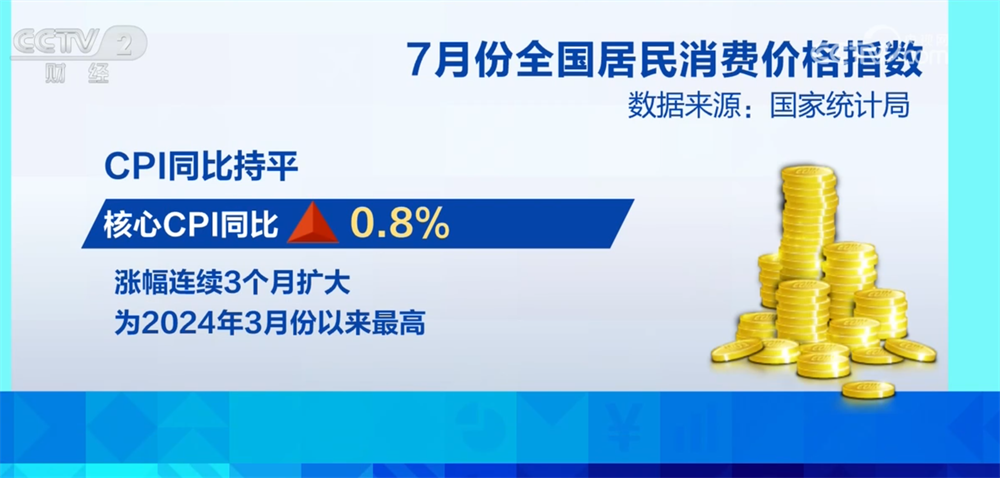
7月核心CPI同比上涨0.8% 涨幅连续3个月扩大
Zhong Guo Zheng Quan Bao· 2025-08-10 21:14
Core Insights - The expansion of domestic demand policies is showing positive effects, with the Consumer Price Index (CPI) rising by 0.4% month-on-month in July, reversing a 0.1% decline in June [1][2] - The Producer Price Index (PPI) decreased by 0.2% month-on-month in July, but the decline is narrowing compared to June, marking the first month of reduced decline since March [1][4] CPI Analysis - The month-on-month increase in CPI was primarily driven by rising prices in services and industrial consumer goods, with service prices up 0.6% and industrial consumer goods prices up 0.5% [2][3] - Key contributors to the service price increase included airfare (up 17.9%), tourism (up 9.1%), hotel accommodation (up 6.9%), and vehicle rental (up 4.4%) [2] - The core CPI, excluding food and energy, rose by 0.8% year-on-year, the highest since March 2024, indicating a continuous upward trend [2][5] PPI Analysis - The narrowing of the PPI decline is attributed to seasonal factors and uncertainties in the international trade environment, affecting prices in certain industries [4][6] - The construction sector faced demand slowdowns due to seasonal weather conditions, while the electricity sector saw reduced demand for coal due to increased hydropower generation [4] - The competitive market environment is improving, with significant reductions in price declines for coal, steel, photovoltaic, cement, and lithium battery industries [4][6] Industry Trends - The transformation and upgrading of traditional industries, along with the rapid growth of emerging industries, are contributing to a year-on-year price recovery in related sectors [5][6] - The implementation of consumption-boosting initiatives is driving healthy development in the consumer market, leading to price increases in sectors such as arts and crafts, sports equipment, and nutritional foods [6][7]
核心CPI温和回升 7月物价运行边际改善
Shang Hai Zheng Quan Bao· 2025-08-10 17:36
Group 1: CPI Analysis - In July, the CPI remained flat year-on-year, with a month-on-month increase of 0.4%, driven by rising service and industrial consumer goods prices [2][3] - The core CPI, excluding food and energy, rose by 0.8% year-on-year, marking the highest increase since March 2024, reflecting effective demand expansion and improved market supply-demand dynamics [3][6] - Food prices saw a year-on-year decline of 1.6%, primarily due to a high base from the previous year, with fresh vegetable prices dropping by 7.6% [2][3] Group 2: PPI Analysis - The PPI decreased by 3.6% year-on-year in July, with the decline remaining consistent with June, although some industries showed signs of price recovery [4][5] - The month-on-month PPI fell by 0.2%, but this marked the first narrowing of the decline since March, indicating improved market competition and price stabilization in certain sectors [5][6] - Industries such as coal mining, black metal smelting, and photovoltaic manufacturing experienced reduced price declines compared to June, contributing to a less negative PPI [5] Group 3: Future Outlook - Experts anticipate that proactive macroeconomic policies will continue to support demand recovery, leading to a stabilization of domestic prices [6] - New policies aimed at boosting consumption, such as support for childbirth and early education, are expected to further stimulate domestic demand and contribute to a gradual recovery in CPI [6] - The ongoing "anti-involution" measures are projected to elevate industrial product prices in August compared to July, with a significant reduction in year-on-year price bases expected to aid in this recovery [6]
从7月份CPI和PPI看全国消费市场亮点 扩内需政策效应持续显现
Yang Shi Wang· 2025-08-09 06:33
Group 1: Consumer Price Index (CPI) Insights - In July, the Consumer Price Index (CPI) increased by 0.4% month-on-month, reversing a previous decline, while year-on-year it remained flat [2][6] - The core CPI, excluding food and energy prices, rose by 0.8% year-on-year, marking the highest increase since March 2024 and continuing a trend of expansion for three consecutive months [2][6] - The rise in CPI was primarily driven by increases in service and industrial consumer goods prices, with notable price hikes in airfares, tourism, hotel accommodations, and vehicle rentals [2][4] Group 2: Producer Price Index (PPI) Insights - The Producer Price Index (PPI) decreased by 0.2% month-on-month, with the decline narrowing by 0.2 percentage points compared to the previous month, while year-on-year it fell by 3.6% [6][8] - The construction of a unified national market is improving market competition in industries such as coal, steel, photovoltaic, cement, and lithium batteries, leading to positive price changes in these sectors [6][8] Group 3: Agricultural Products Price Trends - In July, the wholesale price of pork increased by 1.3% month-on-month, influenced by tight supply due to low market release from farmers, although prices later stabilized as supply improved [8][10] - The average wholesale price of pork in Beijing was reported at 18.16 yuan per kilogram, reflecting a month-on-month increase of 4.37% but a year-on-year decrease of 20.18% [12] - The wholesale price of eggs decreased by 1.8% month-on-month and 25% year-on-year, attributed to increased supply and weak demand, although prices are expected to rise due to seasonal demand factors [15][17]
积极变化!重要数据,最新公布
券商中国· 2025-08-09 04:53
Core Viewpoint - The article discusses the recent trends in China's Consumer Price Index (CPI) and Producer Price Index (PPI), highlighting a shift in consumer prices and the implications for economic policy and market conditions [1][2][7]. CPI Analysis - In July, the CPI increased by 0.4% month-on-month, reversing a previous decline of 0.1%, and remained flat year-on-year. The core CPI, excluding food and energy, rose by 0.8%, marking the highest increase since March 2024 [1][6]. - The rise in CPI was primarily driven by increases in service prices (up 0.6%) and industrial consumer goods prices (up 0.5%). Seasonal factors and the impact of summer travel contributed to higher prices for air tickets, tourism, and accommodation [4][6]. - Food prices decreased by 1.6% year-on-year, influenced by a high base from the previous year, with fresh vegetables and fruits being significant contributors to this decline [6]. PPI Analysis - The PPI fell by 0.2% month-on-month, but this decline was the smallest since March, indicating a potential stabilization in industrial prices. Year-on-year, the PPI decreased by 3.6%, consistent with the previous month [2][8]. - The decline in PPI is attributed to seasonal factors, market order optimization, and uncertainties in international trade. Specific industries such as non-metallic mineral products and coal mining experienced price drops due to reduced demand [9][10]. - Despite the overall decline, the competitive market environment has led to a narrowing of price decreases in several sectors, including coal and steel, suggesting a potential for price stabilization in the future [10]. Economic Policy Implications - The article emphasizes the importance of coordinated monetary and fiscal policies to support economic stability and reasonable price levels. The People's Bank of China has indicated a need for moderately loose monetary policy to address domestic demand issues and low price levels [7].