
前海开源金银珠宝A

Search documents
创新药对外授权交易超600亿美元,如何布局?
Datong Securities· 2026-03-30 23:47
Market Overview - The equity market saw most major indices decline, with only the Wind Micro Index rising by 1.54% during the week. The North Securities 50 index fell by 3.40%, while the ChiNext Index and the Shanghai Composite Index decreased by 1.68% and 1.09%, respectively [4][5] - In the bond market, both short and long-term interest rates declined, with the 10-year government bond yield falling by 1.27 basis points to 1.817%. The credit spreads for both short and long-term bonds also narrowed [7][8] Equity Product Allocation Strategy - Event-driven strategy highlights include: - China's innovative drug licensing transactions exceeding $60 billion, with recommended funds such as Harvest Mutual Selection A (006603), ICBC Health A (006002), and Penghua Medical Technology A (001230) [12][13] - Attacks on two major aluminum plants in the Middle East, suggesting a focus on funds like Harvest Resource Selection A (005660) and Huaxia Prosperity Driven A (017598) [13] - The official naming of "Token" as "词元," indicating potential investment opportunities in computing power and chip sectors, with recommended funds including Nord New Life A (006887) and Harvest Frontier Innovation (009993) [14] - Asset allocation strategy recommends a balanced core with a barbell strategy, focusing on dividend and technology/high-end manufacturing sectors. Suggested funds include Anxin Dividend Selection A (018381) and Harvest Military Industry Theme A (004698) [16][17] Stable Product Allocation Strategy - Market analysis indicates a net injection of 281.9 billion yuan by the central bank, maintaining a balanced and loose funding environment. The 2025 China International Balance of Payments Report shows a current account surplus of $735 billion, representing 3.7% of GDP [20][22] - Industrial profits for large-scale enterprises grew by 15.2% in the first two months of 2026, indicating a positive economic outlook [22] - Recommended products include short-term bond funds like Nord Short Bond A (005350) and Guotai Lian A (016947), with a focus on maintaining liquidity while managing risk [23][24]
年内狂涨54%!这几只基金重仓资源股,却根本不是资源主题基金
Hua Xia Shi Bao· 2026-02-26 15:21
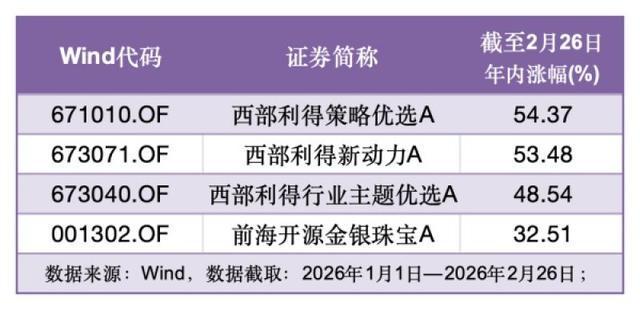
Core Viewpoint - The resource sector has shown strong performance in early 2026, with several funds heavily invested in this area achieving significant returns, despite not being classified strictly as resource-themed funds [1][2]. Fund Performance - As of February 26, 2026, the top-performing funds include: - Western Leading Strategy Preferred A with a return of 54.37% - Western Leading New Power A at 53.48% - Western Leading Industry Theme Preferred A at 48.54% - Qianhai Kaiyuan Gold and Silver Jewelry A at 32.51% [1]. Fund Structure and Strategy - The funds mentioned are classified as mixed funds with broad investment mandates, allowing for flexibility in stock selection and sector allocation [2][3]. - Western Leading Strategy Preferred A aims to identify companies with sustainable growth potential, with stock investments ranging from 60% to 95% of fund assets [3]. - Western Leading New Power A targets companies in consumer services and technological innovation, with stock assets also ranging from 0% to 95% [3]. Portfolio Composition - The top holdings of the Western Leading funds show significant overlap, with key stocks including Zijin Mining, Chifeng Jilong Gold, and Muyuan Foods, indicating a concentrated investment in both resource and domestic demand sectors [4]. - A notable shift in portfolio composition occurred in Q4 2025, where the funds increased their allocation to resource stocks, moving away from previous investments in aviation and brokerage sectors [5]. Fund Management Insights - The flexibility of all-market selection funds allows managers to adjust their portfolios based on market conditions, which has proven beneficial in the current resource stock rally [6]. - The distinction between all-market selection funds and thematic funds is emphasized, with the former relying on manager judgment and timing rather than strict thematic exposure [6]. Investor Considerations - Investors are advised to differentiate between a fund's temporary holdings and its long-term investment strategy, as short-term performance may not reflect the fund's intended focus [8]. - The potential for "style drift" exists if investors purchase funds based on short-term gains without understanding their contractual investment mandates [8].

近半主动权益基金净值新高 200多只“毛基”上岸 谁带来了开年“钱途”?
Di Yi Cai Jing· 2026-02-25 12:17
Core Viewpoint - The A-share market has experienced a significant surge, with public equity funds seeing a strong start to the year, as nearly half of these products have reached historical net asset value highs, and over 90% have achieved positive returns [1][2]. Group 1: Market Performance - The A-share market has shown a strong upward trend, with over 3,700 stocks rising and more than 100 hitting the daily limit in the last two days [6]. - The trading volume has increased significantly, surpassing 2 trillion yuan, reaching 2.48 trillion yuan [6]. - The performance of the non-ferrous metal sector has been particularly strong, with a year-to-date increase of 21.94%, and 18 constituent stocks within this sector have seen gains exceeding 50% [3]. Group 2: Fund Performance - Among 4,780 comparable active equity funds, 2,347 have achieved historical net asset value highs this year, representing 49.1% of the total [2]. - Over 90% of active equity funds have recorded positive returns since the beginning of the year, with 149 funds showing gains of over 20% [2]. - The top-performing funds, managed by the same fund manager, have achieved returns of 52.64%, 51.95%, and 46.61% respectively [2]. Group 3: Investment Strategies - Investment strategies are shifting from liquidity-driven to profit-driven, with a recommendation for investors to maintain a contrarian mindset as market leadership may rotate quickly [1]. - The focus on resource-related sectors has provided significant advantages in the current market environment, with many top-performing funds heavily invested in non-ferrous metals and technology stocks [3][4]. - Analysts suggest that the market may stabilize and recover post-Spring Festival, with emerging technologies and value stocks expected to perform well [7].





周期风格占比提升,权益基金跑赢ETF——权益基金月度观察(2026/01)-20260213
Huafu Securities· 2026-02-13 10:32
- The report introduces a quantitative model for evaluating equity funds, using 22 benchmark indices as independent variables and fund returns as dependent variables. The model applies a rolling window regression with a 6-month window to calculate the R² matrix for each fund. The benchmark index with the highest average R² over the last six periods is selected as the reference index for fund performance evaluation[18][19][24] - The construction process of the model involves linear regression for each benchmark index and fund return, followed by rolling window regression to derive the R² matrix. The formula used is $ R² = 1 - \frac{\sum_{i=1}^{n}(y_i - \hat{y}_i)^2}{\sum_{i=1}^{n}(y_i - \bar{y})^2} $, where $ y_i $ represents fund returns, $ \hat{y}_i $ represents predicted returns, and $ \bar{y} $ represents the mean of fund returns[18][19][24] - The model is evaluated as effective in identifying the most relevant benchmark index for fund performance, providing a robust framework for fund classification and strategy analysis[18][24] - The backtesting results of the model show that the average R² value for equity funds decreased slightly from 0.7478 in December to 0.7336 in January, indicating a slight reduction in the fit of funds to single benchmark indices[34] - The report categorizes equity funds into five styles: large-cap, mid-small-cap, value, growth, and thematic sectors. The classification is based on the benchmark index with the highest R² value derived from the model[24][27][33] - The performance of mid-small-cap funds was the highest in January, with a median return of 8.18%, followed by growth funds at 7.08%, large-cap funds at 4.13%, value funds at 3.88%, and thematic sector funds at 3.37%[24][25][27] - The thematic sector funds are further divided into categories such as healthcare, cyclical, infrastructure, consumption, technology, finance, and advanced manufacturing. Among these, cyclical funds performed the best, with an average return of 21.6% for active funds and 18.2% for passive funds[27][30][32] - The report highlights high-rated funds, defined as AAA and AA+ funds, which demonstrate strong alpha sustainability and upward alpha trends. AAA funds are stable alpha-type funds suitable for long-term holdings, while AA+ funds exhibit steadily increasing alpha values, indicating strong potential for excess returns[47][48][49] - The report identifies new emerging funds, defined as funds receiving their first rating this month and managed by fund managers with less than three years of experience. These funds predominantly track indices such as CSI Dividend and CSI 300[63][64] - The report also highlights funds with significant rating upgrades, defined as funds whose ratings improved substantially compared to the previous month. These funds are primarily aligned with indices such as CSI Cyclical, CSI Dividend, and TMT (CITIC)[65][66]
基金市场跟踪与 ETF 策略配置月报-20260201
Xiangcai Securities· 2026-02-01 15:38
1. Report Industry Investment Rating No relevant information provided. 2. Core Viewpoints of the Report - As of January 31, 2026, the total number of funds in the market increased by 104 to 13,722, while the total net asset value decreased by 452.4 billion yuan to 37.22 trillion yuan. Growth - type funds outperformed value - type funds in January 2026 [3][7]. - As of January 31, 2026, there were 1,430 ETFs in the Shanghai and Shenzhen stock markets, an increase of 28 from the previous period. The total asset management scale decreased by 555.748 billion yuan to 5.46 trillion yuan, and the total share decreased by 92.652 billion shares to 3.28 trillion shares. Commodity - type ETFs had a higher overall return in January, while bond - type ETFs had the worst performance [4][18]. - The industry ETF rotation strategy based on main funds and the PB - ROE framework both achieved positive excess returns compared to the CSI 300 Index in January 2026 and since 2023 [5][40][50]. 3. Summary According to Relevant Catalogs 3.1 Fund Market Tracking 3.1.1 Market Overview - As of January 31, 2026, the number of funds increased by 104, and the total net asset value decreased by 452.4 billion yuan. Hybrid, bond, and stock - type funds had the highest proportion in terms of quantity, while money - market, bond, and stock - type funds had the highest proportion in terms of scale [7]. - In January 2026, the number of stock - type funds increased by 49, and the scale of stock - type and bond - type funds decreased by 552.001 billion yuan and 88.818 billion yuan respectively [11]. 3.1.2 Fund Performance - From January 1 to 31, 2026, the returns of value, balanced, and growth fund indexes were 3.92%, 6.10%, and 7.02% respectively, all outperforming the CSI 300 Index. Growth - type funds outperformed value - type funds [13]. - The differences among large - cap, mid - cap, and small - cap fund indexes were small in January 2026, with mid - cap funds slightly outperforming large - cap and small - cap funds, and all outperforming the CSI 300 Index [13]. - The median return of all funds in January 2026 was 2.53%, and 94.84% of funds achieved positive returns. The top - performing fund was SDIC UBS Silver Futures A, with a gain of 61.60% in both January and year - to - date [16]. 3.2 ETF Market Tracking 3.2.1 ETF New Products - In January 2026, 33 ETFs were newly listed, including 3 science - and - technology innovation board chip ETFs and 30 other stock - type ETFs. 27 ETFs were newly established, with a total issuance scale of 16.57 billion yuan [20]. 3.2.2 ETF Product Classification Performance - Commodity - type ETFs had a median return of 18.61% in January, bond - type ETFs had the lowest median return of 0.25%, and stock - type ETFs had a median return of 4.74%, outperforming cross - border ETFs. Stock - type ETFs had the highest internal deviation in January [4][24]. - Among stock - type ETFs in January, gold - related and mining ETFs performed well, while bank - related ETFs performed poorly. The average share change of stock - type ETFs was a decrease of 108.9666 million shares, with chemical and software ETFs having significant share increases and CSI 300 and SSE 50 ETFs having significant share decreases [25]. - Among bond - type ETFs in January, the convertible bond ETF had the highest increase of 5.90%, and the science - innovation bond ETF had a decrease of 0.01%. As of January 31, 2026, the Haifutong CSI Short - Term Financing ETF had the largest scale of 70.223 billion yuan [29]. - Among cross - border ETFs in January, the China - South Korea Semiconductor ETF had the highest increase of 45.09%, and the Hong Kong Stock Connect Medical ETF had the highest decrease of 4.20%. The year - to - date performance was similar [31]. - Among commodity - type ETFs in January, the gold ETF had an increase of 19.11%, and the soybean meal ETF had the smallest increase of 1.69%. As of January 31, 2026, the Huaan Gold ETF had the largest scale of 93.985 billion yuan [35]. 3.3 ETF Strategy Tracking 3.3.1 Industry ETF Rotation Based on Main Funds - The strategy focused on non - ferrous metals, non - banking finance, and steel in January 2026. The cumulative return in January 2026 was 9.01%, with an excess return of 7.36% compared to the CSI 300 Index. Since 2023, the cumulative return was 61.84%, with an excess return of 40.28% compared to the CSI 300 Index [5][40][42]. 3.3.2 Industry ETF Rotation under the PB - ROE Framework - The strategy focused on communication, agriculture, forestry, animal husbandry, and fishery, and transportation in January 2026. The cumulative return in January 2026 was 2.83%, with an excess return of 1.18% compared to the CSI 300 Index. Since 2023, the cumulative return was 29.03%, with an excess return of 7.47% compared to the CSI 300 Index [5][50][51]. 3.4 Investment Recommendations - For the industry preference of main funds in February 2026, the steel, coal, and non - ferrous metal industries are favored, and the corresponding ETFs are their industry ETFs. - Based on the industry PB - ROE situation and supplementary indicators, the ETF rotation strategy under the PB - ROE framework recommends paying attention to the non - ferrous metal, transportation, and public utilities industries in February, and the corresponding ETFs are their industry ETFs [6][57].
三年跑输基准超10%将降薪,哪些产品和基金经理“亮红灯”
Sou Hu Cai Jing· 2025-05-26 09:52
Group 1 - The core viewpoint of the news is the introduction of a new policy by the China Securities Regulatory Commission (CSRC) aimed at enhancing the long-term performance of public fund managers by linking their compensation to the performance of their funds relative to benchmarks [2][3] - The policy targets fund managers whose products have underperformed their benchmarks by more than 10 percentage points over three years, leading to a significant reduction in their performance-based compensation [2][3] - The initiative is expected to align the interests of fund managers with those of investors, encouraging a shift away from short-term speculation towards a focus on long-term investment capabilities [2][3] Group 2 - As of May 21, 2023, there are 5,898 public funds managed by fund managers with over three years of experience, with 1,341 funds underperforming their benchmarks by over 10 percentage points [3][4] - Among these, 31 funds have underperformed their benchmarks by more than 50 percentage points, including notable funds managed by well-known managers such as Zheng Chengran from GF Fund and Yao Zhipeng from Harvest Fund [3][4][5] - The worst-performing fund, Morgan Small Cap A, managed by Guo Chen, has a cumulative return of -23.03% over three years, underperforming its benchmark by 127.69 percentage points [4][5] Group 3 - Conversely, there are 543 funds that have outperformed their benchmarks by over 10 percentage points, with 33 funds exceeding their benchmarks by more than 50 percentage points [7][9] - The top-performing fund, Huaxia North Exchange Innovation Small and Medium Enterprises Selected Fund, managed by Gu Xin Feng, achieved a cumulative return of 194.13%, surpassing its benchmark by 175.89 percentage points [9][10] - The North Exchange theme funds have emerged as a significant area for excess returns, with several funds exceeding their benchmarks by over 60 percentage points [10] Group 4 - In response to the new policy, many fund companies are adjusting their performance benchmarks to better reflect the risk-return characteristics of their funds [11][12] - Recent adjustments include changes to benchmarks for various funds, such as the adjustment of the performance benchmark for the浦银安盛稳健增利债券 from "CSI All Bond Index" to a more complex composite benchmark [11][12] - The trend of benchmark adjustments is expected to continue as fund companies seek to align their performance metrics with regulatory expectations and improve their competitive positioning [13][14]

大类资产与基金周报:黄金下跌,商品基金跌幅录得-3.58%-20250518
Tai Ping Yang Zheng Quan· 2025-05-18 14:12
- The report provides an overview of the major asset markets, including equities, bonds, commodities, and foreign exchange markets[4][9][10][26][27][32][33][39] - The report highlights the performance of various indices in the A-share market, such as the Shanghai Composite Index, Shenzhen Component Index, and others, with their respective percentage changes[9][11][12][13][15] - The report also covers the performance of the Hong Kong stock market, including the Hang Seng Index and the Hang Seng China Enterprises Index, along with their percentage changes[10][18][19][22] - The report includes the performance of the US stock market, with indices like the Dow Jones Industrial Average, Nasdaq Index, and S&P 500, along with their percentage changes[10][24][25] - The bond market section discusses the yield changes of various government and corporate bonds, including the yield spread between different maturities[26][27][28][29][30][31] - The commodities market section provides the weekly percentage changes of various commodities such as crude oil, gold, copper, aluminum, and others[32][33][34][35][36][37][38] - The foreign exchange market section details the exchange rate changes of major currencies against the Chinese Yuan[39][41][42][43] - The report summarizes the newly established funds for the week, including their types, sizes, and fund managers[44][46] - The report provides an overview of the total number and scale of open-end public funds in China, categorized by different types of funds[47][48][49][50] - The performance of different types of funds over the past week, month, year, and year-to-date is compared, highlighting the best and worst performers[51][52][54][55][56][57][59]