
医疗ETF

Search documents
金工ETF点评:行业主题ETF周净流出262.29亿元,钢铁、基础化工拥挤变幅较大
Tai Ping Yang Zheng Quan· 2026-03-27 13:25
Investment Rating - The report indicates a net outflow of 26.229 billion yuan from industry-themed ETFs this week, with significant fluctuations observed in the steel and basic chemical sectors [2][31][36]. Core Insights - As of March 20, 2026, there are a total of 1,456 listed ETFs in mainland China, with a total scale of 5.10 trillion yuan. Among these, stock ETFs account for the largest share, both in number (1,140) and scale (2.95 trillion yuan) [7][8]. - The A-share market saw a decline this week, with the Shanghai Composite Index closing at 3,957.05, reflecting a drop of 3.38%. Notably, the communication and banking sectors experienced gains of 2.10% and 0.36%, respectively, while the non-ferrous and basic chemical sectors faced declines of 11.82% and 10.53% [13][14][21]. - In terms of fund flows, broad-based ETFs saw a net inflow of 9.078 billion yuan, with the top three inflows coming from the CSI 500 ETF Southern (+4.450 billion yuan), the CSI 300 ETF Huatai-PB (+4.333 billion yuan), and the SSE 50 ETF (+3.056 billion yuan). Conversely, industry-themed ETFs experienced a net outflow of 26.229 billion yuan, with the top outflows from the chemical ETF (-4.373 billion yuan) and the non-ferrous metal ETFs [31][32][36]. Summary by Sections ETF Market Overview - As of March 20, 2026, the total number of ETFs is 1,456, with stock ETFs being the most prevalent, comprising 78.30% of the total number and 57.76% of the total scale [7][8][10]. Domestic and International Equity Market Index Performance - The A-share market indices showed a downward trend, with the Shanghai Composite Index down 3.38%. The communication and banking sectors were the only ones to show positive performance this week [13][14][21]. Stock ETF Fund Flows - Broad-based ETFs had a net inflow of 9.078 billion yuan, while industry-themed ETFs saw a significant net outflow of 26.229 billion yuan, indicating a shift in investor sentiment [31][32][36]. Industry Congestion Monitoring - The report highlights that the utility and communication sectors are currently experiencing higher congestion levels, while the automotive and textile sectors are less congested, suggesting potential investment opportunities [34][36].
ETF跟踪研究:ETF市场周度更新-20260323
Yin He Zheng Quan· 2026-03-23 04:44
ETF Market Overview - As of March 23, 2026, the total number of ETFs in the market reached 2,310, with a total scale of 1,234.5 billion yuan and a weekly trading volume of 123.4 billion yuan. The number of newly added funds this week was 13 [1][3]. - Equity funds dominate the market, with thematic equity funds accounting for 30.6% of the total number, and their scale reaching 1,234.5 billion yuan, representing 60.1% of the total scale. Bond ETFs had the highest weekly trading volume, accounting for 25.3% [1][4]. Fund Inflow and Outflow - The inflow of funds last week was primarily concentrated in broad-based indices and bond ETFs, with the top inflow being the Short-term Bond ETF from Hai Fu Tong, which saw an inflow of 1.2 billion yuan. The latest scale of this fund is 12.3 billion yuan [5][6]. - In contrast, resource and chemical ETFs experienced significant outflows, with the chemical ETF seeing an outflow of 1.2 billion yuan, and the non-ferrous metal ETF experiencing an outflow of 1.1 billion yuan [7][8]. Industry Sector Fund Flow - Only the financial real estate and pharmaceutical sectors saw a slight net inflow of funds, with the financial real estate sector receiving 1.2 billion yuan and the pharmaceutical sector 0.3 billion yuan. Other sectors, including consumption and technology, experienced net outflows [13][14]. New ETF Listings - Last week, a total of 13 new ETFs were listed, all of which were equity funds covering various sectors, themes, and cross-border categories. The largest new listing was the Agricultural and Fishery ETF from Invesco, with a scale of 1.2 billion yuan [16][17]. Core Broad-based Index and ETF Performance - The performance of core broad-based indices showed significant divergence, with the ChiNext index rising against the trend, achieving a weekly return of 3.5%. In contrast, the CSI 300 index saw the largest weekly decline of 2.3% [18][19].
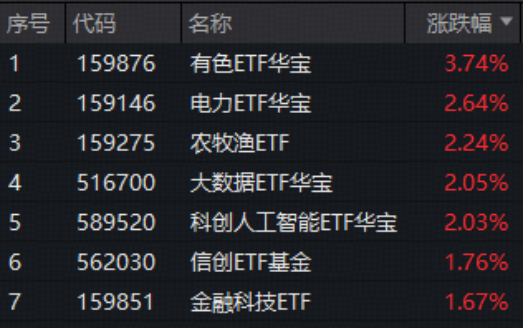
“HALO交易”火爆出圈!电力ETF(159146)再涨2.64%连创上市新高!涨价题材大放异彩!有色ETF最高上探3.82%
Xin Lang Cai Jing· 2026-02-27 11:45
Market Overview - A-shares concluded February with the Shanghai Composite Index achieving three consecutive monthly gains, and daily trading volumes exceeding 1 trillion yuan have become the norm [1][20] - On February 27, the three major indices showed mixed results, with over 3,200 stocks rising and a total trading volume of 2.51 trillion yuan, slightly down by 504 billion yuan from the previous day [1][20] Sector Performance - The small metals sector surged, with rare earth prices continuing to rise, leading to a wave of limit-up stocks including Hunan Gold [21][23] - The chemical sector also performed well, with the chemical ETF achieving four consecutive daily gains, reaching its highest point since January 2022 [21][23] AI and Technology Impact - China's AI token usage surpassed that of the US for the first time, indicating a potential benefit for domestic computing power [21][29] - The cloud computing sector is entering a price increase cycle, with the big data ETF seeing a significant price increase [21][29] Electricity Sector - The electricity sector experienced a strong rally, with the electricity ETF rising by 2.64%, reaching a new high since its listing [2][26] - The demand for electricity is expected to increase due to the growth of AI, making it a defensive investment in the current market environment [2][29] Medical Sector - The largest medical ETF in the market saw a price increase of 1.14%, recovering its annual line, with significant net subscriptions in the previous days [2][29] - The medical sector is expected to benefit from the growth of the CXO model, with strong performance from companies like WuXi AppTec [12][29] Investment Recommendations - Focus on cyclical commodities such as chemicals, non-ferrous metals, and agricultural products, as well as sectors related to technology and national strength, such as military and new energy [22] - The medical sector is recommended for investment, particularly in areas like AI healthcare and medical devices, which are expected to see significant growth [15][16]


ETF 及指数产品网格策略周报(2026/1/27)
华宝财富魔方· 2026-01-27 09:36
Core Viewpoint - The article emphasizes the importance of financial technology and healthcare sectors, highlighting the potential for investment opportunities through ETFs that focus on these areas, particularly in the context of China's economic policies and global health trends [3][4][6][7]. Financial Technology ETF (159851.SZ) - The "14th Five-Year Plan" reiterates the goal of accelerating the construction of a financial powerhouse, focusing on the development of "fintech" and "digital finance" [3]. - Advanced technologies such as generative AI and blockchain are rapidly being adopted, transforming the financial industry from an optional to a mandatory digitalization process [3]. - Leading financial institutions and IT companies are integrating AI into various applications, which is expected to drive cost reduction and innovation in the financial sector [4]. - The ETF tracks the CSI Financial Technology Theme Index, covering key areas like financial IT and internet finance, providing investors with an efficient tool to access the innovative benefits of the "finance + technology" intersection [4]. Healthcare ETF (512170.SH) - The emergence of the Nipah virus in India, with a mortality rate between 40% and 75%, is expected to catalyze short-term interest in the healthcare sector [6][7]. - In the medium to long term, the acceleration of innovative drugs entering international markets is seen as a core driver for the commercialization of the healthcare industry [6]. - China currently holds about 30% of the global pipeline for new drugs, ranking second worldwide, with 76 innovative drugs approved for market entry in 2025 [7]. - The total value of authorized transactions for innovative drugs from China is projected to exceed $130 billion, with over 150 transactions expected, marking a significant increase in China's global pharmaceutical capabilities [7].

ETF及指数产品网格策略周报-20260127
HWABAO SECURITIES· 2026-01-27 09:06
Group 1 - The report outlines the grid trading strategy as a method of profiting from price fluctuations without predicting market trends, making it suitable for volatile markets [4][12] - Characteristics of suitable grid trading targets include being exchange-traded, having stable long-term trends, low transaction costs, good liquidity, and high volatility, with equity ETFs being identified as appropriate candidates [4][12] - The report highlights two key ETFs for grid trading: the Financial Technology ETF (159851.SZ) and the Medical ETF (512170.SH), emphasizing their potential benefits from market trends and innovations [4][13][16] Group 2 - The Financial Technology ETF is positioned to benefit from capital market reforms and the digital transformation of finance, with advancements in AI and blockchain driving efficiency and innovation in the sector [4][13] - The Medical ETF is catalyzed by the recent Nipah virus outbreak in India, which serves as a short-term driver, while the long-term growth is supported by the acceleration of innovative drug exports from China, showcasing the country's significant presence in the global pharmaceutical market [5][16] - The report suggests that investors can enhance returns by diversifying their grid trading strategies across different ETFs, combining various types and investment scopes to optimize risk management and capital utilization [16][19]
医保新政出台,手术机器人龙头暴涨17%!港股通医疗ETF华宝(159137)摸高1.78%终结四连跌
Xin Lang Ji Jin· 2026-01-21 11:25
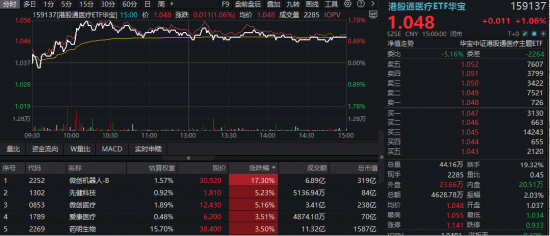
Core Viewpoint - The new policy from the National Healthcare Security Administration (NHSA) is expected to significantly boost the medical device industry, particularly benefiting high-end surgical assistance technologies, robotic surgeries, and telemedicine [1][3]. Group 1: Market Reaction - A-share medical ETFs, particularly the largest medical ETF (512170), saw a rise of 1.36% during intraday trading, indicating strong buying interest with over 270 million yuan invested the previous day [1]. - The Hong Kong medical ETF (159137) also experienced a rebound, reaching a peak increase of 1.78% before closing up 1.06%, ending a four-day decline [1]. - Notable stock performances included a 17.3% surge in the leading domestic surgical robot company, MicroPort Scientific Corporation-B, and over 5% increases in MicroPort Medical and Xianjian Technology [1]. Group 2: Policy Impact - The NHSA's new guideline establishes a market mechanism for high-end surgical assistance technologies, which is expected to enhance innovation and profitability in the industry [3]. - The unified pricing framework is anticipated to highlight the cost-performance advantages of domestic surgical robots and related consumables, accelerating the trend of domestic substitution [3]. - The NHSA's commitment to expanding the guideline in the future will create more opportunities for innovative medical device products, benefiting the overall innovation ecosystem in the industry [3]. Group 3: Investment Opportunities - The medical device sector is poised for significant investment opportunities due to the new NHSA policy, with a focus on high-end medical equipment, robotic surgeries, and compliant consumables [3]. - The CXO industry is experiencing improved conditions due to recovering overseas orders and domestic capacity clearance, contributing to sustained growth [3]. - The largest medical ETF (512170) and its associated funds focus on medical devices and services, with over 36% of its index weight in AI medical and brain-computer interface concept stocks [4].


脑机接口、AI医疗接力助攻,港股通医疗ETF华宝(159137)上市首周跑赢大市!机构:2026年看好医疗硬科技
Xin Lang Cai Jing· 2026-01-16 11:17
Core Viewpoint - The Hong Kong stock market continues to adjust, with the pharmaceutical sector declining alongside the market, particularly affected by a short-term cooling of AI medical concepts [1][12]. Group 1: Market Performance - The Hong Kong Medical ETF Huabao (159137) fell by 0.93%, marking two consecutive days of decline, while the Hong Kong Innovation Drug ETF (520880) dropped by 1.08% [1][12]. - The medical sector saw 13 stocks rise and 37 fall, with Ark Health, a hot stock in AI medical concepts, leading the decline at 6.98%, and Alibaba Health also falling by 5.16% [2][13]. - The Hong Kong Medical Theme Index achieved a record nine consecutive days of gains before experiencing a pullback, with the Medical ETF Huabao having a cumulative increase of 6.9% in its first week, outperforming the Hang Seng Index [3][14]. Group 2: Sector Analysis - The Hong Kong Medical ETF Huabao covers 50 leading stocks across various medical fields, including CXO, AI medical, medical devices, and innovative drugs, indicating a comprehensive approach to capturing market trends [5][16]. - The medical sector has shown significant recovery since 2026, driven by hot themes like brain-computer interfaces and AI medical, with increasing investment value [6][17]. - The CXO sector is expected to see a "Davis Double Play" with both profit and valuation improvements, as demand gradually recovers and supply has been cleared over the past three years [18]. Group 3: Future Outlook - Analysts predict that by 2026, key areas of growth will include innovative overseas expansion and hard technology sectors such as AI medical and brain-computer interfaces, with a focus on monitoring the expansion of medical insurance and essential drug directories [18]. - The Medical ETF Huabao is positioned as a high-elasticity tool for capturing new opportunities in the medical field, particularly in AI medical, brain-computer interfaces, and innovative drug supply chains [18]. - The total scale of the medical ETF fund reached 27 billion yuan, making it the largest in the market for medical-related ETFs [19].

AI医疗倒车接人?阿里健康挫近8%!港股通医疗ETF华宝(159137)跌2.79%频现溢价,标的指数止步9连阳
Xin Lang Cai Jing· 2026-01-15 11:31
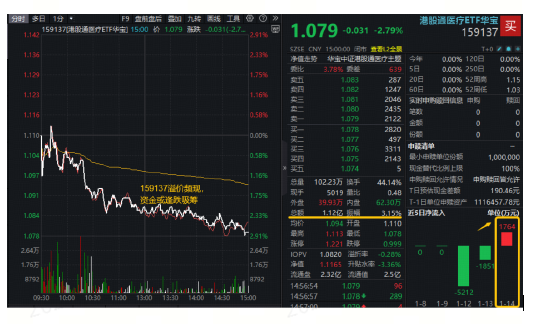
Core Viewpoint - The Hong Kong AI healthcare sector experienced a significant adjustment, halting a nine-day winning streak, marking its first decline since 2026. Despite this, the long-term investment logic in AI healthcare remains intact, with opportunities emerging in the oversold bottom range [1][3][11]. Group 1: Market Performance - The Hong Kong AI healthcare index saw a decline, with the Hong Kong Medical ETF (159137) dropping by 2.79% and trading volume significantly reduced to 112 million CNY [1][8]. - Major stocks in the AI healthcare sector faced substantial losses, including Crystal Tech Holdings (2228) down 10.74%, Alibaba Health (0241) down 7.84%, and Ping An Good Doctor (1833) down 4.88% [2][4][10]. Group 2: Market Analysis - Analysts attribute the decline to a phase of valuation correction in the AI healthcare industry, following a period of significant gains and profit-taking behavior in the market [2][10]. - The AI healthcare industry is entering a critical phase of commercialization, driven by a confluence of national strategy and market demand, with current conditions seen as a prime opportunity for new AI healthcare applications [3][11]. Group 3: Future Projections - The global AI healthcare market is projected to reach approximately 26.65 billion USD in 2024, with an expected rapid growth to about 505.59 billion USD by 2033, reflecting a compound annual growth rate of 38.8% [3][11]. - In China, the AI healthcare market is estimated to reach 159.8 billion CNY by 2028, up from 97.3 billion CNY in 2023 [3][11]. Group 4: Investment Recommendations - Citic Securities suggests focusing on five main areas for investment in AI healthcare: AI drug development, grassroots AI healthcare applications, medical data circulation, AI pathology diagnosis, and AI healthcare models [12]. - The Hong Kong Medical ETF (159137) is highlighted as a flexible investment tool, covering key sectors in AI healthcare and related innovations [12].
【早盘三分钟】1月14日ETF早知道
Xin Lang Cai Jing· 2026-01-14 01:31
Market Overview - The market temperature gauge indicates a 75% confidence level in the current investment climate, with the Shanghai Composite Index, Shenzhen Component Index, and ChiNext Index showing historical P/E ratios at 100%, 94.07%, and 51.87% respectively [1][15]. Sector Performance - The top-performing sectors on January 13, 2026, included: - Non-ferrous metals: +1.62% - Oil and petrochemicals: +1.21% - Pharmaceutical and biotechnology: +0.91% [2][15]. - The sectors with the largest declines were: - Telecommunications: -5.50% - Defense and military industry: -3.30% - Banking: -2.88% [2][15]. Fund Flows - The sectors with the highest net inflows were: - Pharmaceutical and biotechnology: 3.991 billion - Beauty and personal care: 0.115 billion - Oil and petrochemicals: 0.082 billion [2][15]. - The sectors with the largest net outflows included: - Computer: -22.321 billion - Electronics: -22.272 billion - Defense and military industry: -19.168 billion [2][15]. ETF Highlights - The medical ETF (512170) saw a significant increase, reaching a peak of 3.67% on January 13, 2026, driven by advancements in AI healthcare technologies [20]. - The general aviation ETF (159231) experienced a sharp decline of 7.27% amid volatility in the commercial aerospace sector, despite recent net inflows of 92.17 million over the past five trading days [20]. Investment Opportunities - The AI healthcare sector is gaining traction, with notable developments such as the DrugCLIP platform from Tsinghua University and increased user engagement in AI healthcare applications [20]. - The commercial aerospace sector is highlighted for its potential, with recommendations to focus on the rocket industry chain and satellite networks as key investment areas [20].

医疗ETF(159828)涨超2.5%,政策与新兴技术驱动行业前景
Mei Ri Jing Ji Xin Wen· 2026-01-13 06:12
Core Insights - The medical device sector is expected to gradually recover in profitability, influenced by medical anti-corruption measures, high-value consumable procurement, and the implementation of equipment replacement policies [1] - The industry faced overall profit pressure in the first three quarters of 2025, but the gradual implementation of procurement reforms is anticipated to correct market distortions, leading to valuation recovery [1] - Emerging fields such as brain-computer interfaces, AI in healthcare, and surgical robots are gaining increased attention, which may catalyze growth in related sectors [1] Industry Trends - The surgical robot industry is entering a phase of commercialization and policy acceleration, with orthopedic surgical robot sales expected to grow by 17.81% year-on-year and sales revenue by 21.62% from January to November 2025, indicating a simultaneous increase in volume and price [1] - The National Healthcare Security Administration has established a pricing management framework for robotic surgeries, which is expected to enhance clinical penetration and drive the industry's development from quantitative to qualitative changes [1] - The laparoscopic robot sector is entering a phase of intensive approvals, with projections indicating that the installation volume in tertiary hospitals could exceed 4,000 units by 2030 [1] Investment Opportunities - The Medical ETF (159828) tracks the CSI Medical Index (399989), which selects listed companies in the medical device, medical services, and medical information sectors from the A-share market to reflect the overall performance of Chinese medical-themed listed companies [1] - The CSI Medical Index comprises approximately 50 constituent stocks, concentrated in the pharmaceutical and healthcare sectors, characterized by high growth potential and volatility [1]