发电设备

Search documents
潍柴动力:年报点评:业绩短期承压,AIDC发电业务开启价值重估-20260330
Zhongyuan Securities· 2026-03-30 10:24
Investment Rating - The report assigns a "Buy" investment rating for the company, indicating an expected increase of over 15% relative to the CSI 300 index within the next six months [14][28]. Core Views - The company achieved a revenue of 231.81 billion yuan in 2025, a year-on-year increase of 7.5%, while the net profit attributable to shareholders was 10.93 billion yuan, a decrease of 4.2% year-on-year [6][7]. - The company is transitioning from a cyclical heavy truck leader to a global high-end equipment group, with strong growth in its AIDC (Artificial Intelligence Data Center) and power generation businesses [14]. - The company’s traditional business is recovering steadily, with significant growth in the heavy truck sector and a notable increase in sales of new energy vehicles [11][12]. Financial Performance - In Q4 2025, the company reported a revenue of 61.24 billion yuan, a quarter-on-quarter increase of 6.7% and a year-on-year increase of 14.0% [6][7]. - The gross profit margin for 2025 was 21.48%, a decrease of 0.95 percentage points year-on-year, while the net profit margin was 5.90%, down 0.72 percentage points year-on-year [9]. - The company plans to distribute a cash dividend of 3.74 yuan per 10 shares (including tax) [6]. Business Segments - The company’s engine sales reached 743,000 units, a year-on-year increase of 1.3%, while the sales of heavy-duty trucks grew by 29.41% to 153,000 units [7][11]. - The AIDC business showed strong demand, with backup power sales increasing by 259% in 2025, and the company launched a 5 MW high-speed diesel generator product [12][13]. - The company’s partnership with BYD in the power battery sector is expected to mitigate the impact of electrification on traditional engine business [11]. Future Projections - The company is projected to achieve net profits of 14.06 billion yuan, 15.31 billion yuan, and 16.22 billion yuan for the years 2026, 2027, and 2028, respectively [14][16]. - The expected earnings per share (EPS) for 2026, 2027, and 2028 are 1.61 yuan, 1.76 yuan, and 1.86 yuan, respectively, with corresponding price-to-earnings (PE) ratios of 14.56, 13.38, and 12.62 [14][16].
潍柴动力(000338):年报点评:业绩短期承压,AIDC发电业务开启价值重估
Zhongyuan Securities· 2026-03-30 10:16
Investment Rating - The report assigns a "Buy" investment rating for the company, indicating an expected increase of over 15% relative to the CSI 300 index in the next six months [14][28]. Core Views - The company achieved a revenue of 231.81 billion yuan in 2025, a year-on-year increase of 7.5%, while the net profit attributable to shareholders decreased by 4.2% to 10.93 billion yuan [6][7]. - The company's various product lines showed steady growth, with significant increases in sales of engines, axles, and transmissions, as well as a doubling of revenue from its "three electric" business [7][11]. - The traditional heavy truck business is recovering, with a 29.41% year-on-year increase in commercial vehicle sales, and the company is actively expanding its new energy business [11][12]. Summary by Sections Financial Performance - In Q4 2025, the company reported a revenue of 61.24 billion yuan, a quarter-on-quarter increase of 6.7% and a year-on-year increase of 14.0% [6][7]. - The gross profit margin for 2025 was 21.48%, a decrease of 0.95 percentage points year-on-year, while the net profit margin was 5.90%, down 0.72 percentage points [9][10]. Business Segments - The heavy truck industry is experiencing a recovery, with the company achieving a market share in the heavy truck sector and significant growth in new energy vehicle sales [11]. - The AIDC (Artificial Intelligence Data Center) business is showing strong demand, with the power generation segment becoming a core growth engine, particularly in North America [12][13]. Future Outlook - The company is expected to achieve net profits of 14.06 billion yuan, 15.31 billion yuan, and 16.22 billion yuan in 2026, 2027, and 2028, respectively, with corresponding EPS of 1.61 yuan, 1.76 yuan, and 1.86 yuan [14][16].
1—2月经济数据点评:供给韧性延续,需求修复仍待观察
LIANCHU SECURITIES· 2026-03-17 09:03
Production - Industrial production maintained resilience with a year-on-year growth of 6.3% in January-February, and a month-on-month increase of 0.8% in February, significantly above historical seasonal levels[1] - The manufacturing value added grew by 6.6%, outperforming mining (6.1%) and utilities (4.7%), with high-end equipment and electronics manufacturing as key supports[1] - High-tech manufacturing products showed rapid growth, with industrial robots, integrated circuits, and power generation equipment increasing by 31.1%, 12.4%, and 21.6% respectively[1] Investment - Fixed asset investment rose by 1.8% year-on-year in January-February, recovering from negative growth in 2025[2] - Infrastructure investment surged, with narrow and broad infrastructure investments growing by 11.4% and 9.8% respectively, significantly improving from last year[2] - Manufacturing investment increased by 3.1%, a notable improvement from the 0.3% growth in 2025, driven by a 11.5% rise in equipment purchases[2][3] Real Estate - Real estate investment declined by 11.1%, but the drop was 6.1 percentage points less than the full-year decline in 2025, indicating some stabilization[4] - New construction area and completed area fell by 23.1% and 27.9% respectively, reflecting weak new construction intentions[4] - The amount of funds available for real estate decreased by 16.5%, with personal mortgage loans dropping by 41.9%, indicating weak leverage willingness among residents[4] Consumption - Overall retail sales grew by 2.8% year-on-year, slightly below the 3.7% growth in 2025, primarily due to a slowdown in automobile consumption[5] - Restaurant income increased by 4.8%, significantly higher than the previous year, driven by strong demand during the Spring Festival[5] - Essential and policy-related consumption performed relatively well, while some discretionary spending remained weak, particularly in real estate-related sectors[5]
广发宏观:经济开年数据简析
GF SECURITIES· 2026-03-16 08:33
Economic Performance - In January-February 2026, exports increased by 21.8% year-on-year, significantly higher than December 2025's 6.6% and the annual value of 5.5%[2] - Industrial added value grew by 6.3% year-on-year, surpassing December 2025's 5.2% and the annual value of 5.9%[2] - Fixed asset investment rose by 1.8% year-on-year, compared to December 2025's -16% and the annual value of -3.8%[3] Sectoral Insights - High-tech industry added value increased by 13.1% year-on-year, up from 9.4% in the previous year[4] - Cement production turned positive with a year-on-year growth of 6.8%, compared to -6.9% last year[4] - Retail sales of consumer goods grew by 2.8% year-on-year, but were lower than the annual growth of 3.7%[5] Real Estate and Investment - Real estate sales area decreased by 13.5% year-on-year, an improvement from December 2025's -15.5%[7] - Real estate investment fell by 11.1% year-on-year, better than the previous year's -17.2%[9] - Infrastructure investment surged by 11.4% year-on-year, contrasting with last year's -1.5%[7] Employment and Consumer Behavior - Urban unemployment rate in February 2026 was 5.3%, a slight decrease of 0.1 percentage points year-on-year[9] - Consumer retail growth excluding automobiles and fuel was 4.7%, higher than last year's 3.7%[5] - Notable retail growth in categories such as tobacco and alcohol (19.1%) and communication equipment (17.8%)[6]
Caterpillar (CAT)’s Growth is Remarkable, Says Jim Cramer
Yahoo Finance· 2026-02-28 17:13
Core Viewpoint - Caterpillar Inc. (NYSE:CAT) has shown significant stock performance, with shares increasing by 117% over the past year and 24% year-to-date, driven by demand in data center construction and power generation [1]. Group 1: Stock Performance - Caterpillar's shares have risen by 117% in the past year and 24% year-to-date [1]. - Bank of America raised the share price target for Caterpillar to $825 from $735, maintaining a Buy rating based on turbine demand and market conditions [1]. Group 2: Market Demand and Acquisitions - The company is experiencing increased demand for its power generation equipment, particularly from hedge funds involved in building data centers in remote areas [1]. - Caterpillar confirmed the acquisition of RPMGlobal Holdings on February 17th to enhance its mining software capabilities and equipment portfolio [1]. Group 3: Expert Commentary - Jim Cramer has consistently expressed optimism about Caterpillar, linking its growth to favorable market conditions and specific product demand [1][2].

杰瑞股份(002353) - 2026年2月6日投资者关系活动记录表
2026-02-06 10:32
Group 1: Company Overview - Yantai Jereh Petroleum Service Group Co., Ltd. has established a strong reputation in the power generation sector, particularly in data centers and oil and gas development, due to its reliable and high-performance equipment [2][3]. - The company has successfully penetrated the North American market with gas turbine generator sets, gaining recognition from overseas clients [2][3]. Group 2: Recent Contracts and Financials - The company has signed four generator set contracts, with delivery timelines tailored to customer needs and production schedules; clients are required to pay a certain percentage of prepayment and settle the full amount before equipment delivery [4]. - The focus on profitable engineering orders and cash flow is critical, with strict requirements for project profitability and cash flow metrics [6]. Group 3: Future Outlook - The company aims to deepen its involvement in three key areas: data centers, industrial energy, and new power systems, while expanding its diverse customer base through continuous technological innovation and product iteration [5]. - Jereh is committed to providing integrated solutions covering power generation, energy storage, distribution, and thermal management, enhancing the safety, reliability, and operational efficiency of energy systems [5]. Group 4: Project Selection Criteria - The company prioritizes high-quality oil and gas engineering service projects that can drive synergy across its various business segments, supporting its international strategy [6]. - Recent successful projects, such as those with Kuwait Oil Company and various gas boosting stations, have enhanced Jereh's market recognition and positioned it favorably for high-end market penetration [6][7].

欧美拒不买单!波罗的海小国傻眼,背债成弃子,竟向中国求救命?
Sou Hu Cai Jing· 2026-02-04 05:50
Core Viewpoint - Lithuania's recent announcement allowing domestic power projects to apply for exemptions to use Chinese-made components marks a significant shift from its previous stance against Chinese manufacturing, highlighting the challenges faced in achieving energy independence and the consequences of political decisions on economic realities [1][3][13]. Group 1: Energy Independence Challenges - Lithuania's government initially aimed for energy independence by cutting ties with Russian energy and banning Chinese power equipment, but this led to failed wind power project bids due to a lack of competitive suppliers [3][5]. - The second round of offshore wind power bidding failed as well, with the government imposing strict requirements that deterred European companies due to increased costs and extended delivery times [5][7]. - The decision to sever ties with the Russian power grid resulted in a 46% increase in domestic electricity prices, significantly impacting the cost of living and industrial expenses [5][8]. Group 2: Economic and Social Consequences - Lithuania's external debt has reached nearly €45 billion, creating a severe financial burden for the small nation [7]. - The economic downturn has led to a rise in poverty, with approximately 170,000 people living below the absolute poverty line, representing 5.6% of the population [8]. - Social issues have escalated, including a notable increase in women entering the sex industry, reflecting a broader societal crisis stemming from economic hardship [8]. Group 3: Diplomatic Miscalculations - Lithuania's attempts to mend relations with China have been met with indifference, as the country misjudged its diplomatic leverage and the international response to its earlier provocations [10][12]. - The expectation that the EU and the US would compensate for Lithuania's losses has proven misguided, with both entities rejecting requests for financial support [12][13]. - The shift from a hardline stance to seeking exemptions for Chinese components illustrates a disconnect between political ambitions and economic realities, leading to significant losses for the country [13].


2026年总量与政策年度展望:风至势起,进而有为
Guoyuan Securities· 2026-01-26 11:11
Group 1 - The core viewpoint of the report emphasizes the need for a systematic reshaping of macro governance paradigms through "three rebalances," aiming to establish a new starting point for high-quality development in 2026, which is the first year of the 14th Five-Year Plan [1] - The report identifies the main contradiction in the economy as "strong supply and weak demand," highlighting the necessity for policies to focus on expanding domestic demand while addressing structural issues [2][3] - The macroeconomic policy framework for 2026 is expected to prioritize internal demand, reform, and innovation, aiming for high-quality development while balancing external and internal factors [3] Group 2 - In 2025, the economic operation showed a steady improvement supported by proactive macro policies, with industrial production demonstrating resilience and a shift towards high-tech industries [2][12] - The report notes that the external demand has been stronger than internal demand, with exports playing a significant role in supporting economic stability [3][33] - The investment landscape remains challenging, particularly in real estate, while manufacturing investment is buoyed by equipment renewal policies [2][3] Group 3 - The economic outlook for 2026 suggests a moderate GDP growth target of around 5%, with growth driven by improvements in domestic demand and supply efficiency [4] - Price indicators are expected to show a mild upward trend, with PPI likely to recover due to improved supply-demand dynamics and global manufacturing inventory cycles [4][33] - The market dynamics are shifting from liquidity-driven growth to profit-driven growth, particularly in the midstream manufacturing sector, which is expected to see significant profit recovery [4][33]
多个维度详解2025年经济数据 | 热点观察
Sou Hu Cai Jing· 2026-01-23 12:17
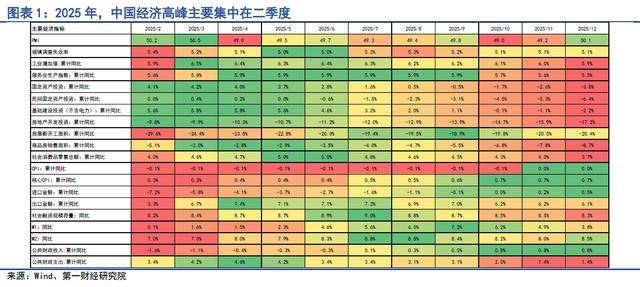
Economic Overview - In 2025, China's GDP grew by 5% year-on-year, meeting the government's target set at the beginning of the year [4][5] - The economic growth showed a "high first, low later" trend, with key indicators peaking in the second quarter [4] - The contribution of the tertiary industry to GDP growth surpassed that of the secondary industry, reflecting a shift towards service-oriented economic structure [4][5] Industry Performance - The manufacturing sector grew by 6.1%, while the information transmission, software, and IT services sector saw an impressive growth of 11.1% [5] - High-tech industries showed significant growth, with industrial robot production increasing by 14.7% and integrated circuit production by 12.9% in December [12][7] - The overall industrial output value increased by 5.9% year-on-year, although it showed a slight decline compared to November [7][9] Investment Trends - Fixed asset investment growth declined to -3.8% by the end of December 2025, with infrastructure investment experiencing its first negative growth in four years at -1.48% [2][11][14] - The decline in investment is attributed to a shift in fiscal policy focus towards social welfare and consumption rather than infrastructure [14] - New policy financial tools were introduced to stimulate investment in key sectors, potentially stabilizing fixed asset investment growth in 2026 [16] Real Estate Market - The real estate sector faced significant challenges, with development investment down by 17.2% and new housing starts down by 20.4% [17][19] - The inventory cycle for residential properties is stabilizing, with a narrow cycle of about 6 months and a broad cycle of 72.6 months [19] - Housing prices have generally declined, with second-hand home prices in major cities falling significantly [19][21] Consumer Behavior - Retail sales growth slowed to 3.7% year-on-year by December 2025, with automotive sales declining by 1.04% [3][22] - Certain consumer categories, such as food and jewelry, experienced high growth rates, indicating potential areas for market recovery [22][24] - Government initiatives aimed at boosting consumption include measures to enhance income and reduce restrictions in various service sectors [24][25]
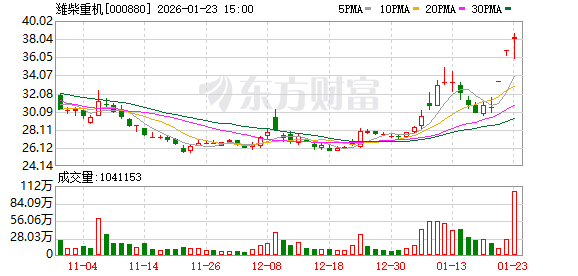
潍柴重机:2025年净利同比预增45%~75%
Mei Ri Jing Ji Xin Wen· 2026-01-23 09:24
Core Viewpoint - Weichai Heavy Machinery (000880) forecasts a net profit attributable to shareholders of 213 million to 257 million yuan for 2025, representing a year-on-year growth of 45% to 75% [2] Group 1: Financial Performance - The company aims to optimize its business structure and increase sales efforts around its two main sectors: shipping and power generation [2] - The full subsidiary, Changbo Company, is expected to achieve a reduction in losses compared to 2024 [2] Group 2: Strategic Initiatives - The company is implementing cost reduction and efficiency enhancement measures to support significant growth in performance [2]