
港股红利ETF

Search documents
再赚180万,2026年的投资计划~(周报328期)
Sou Hu Cai Jing· 2026-01-04 04:00
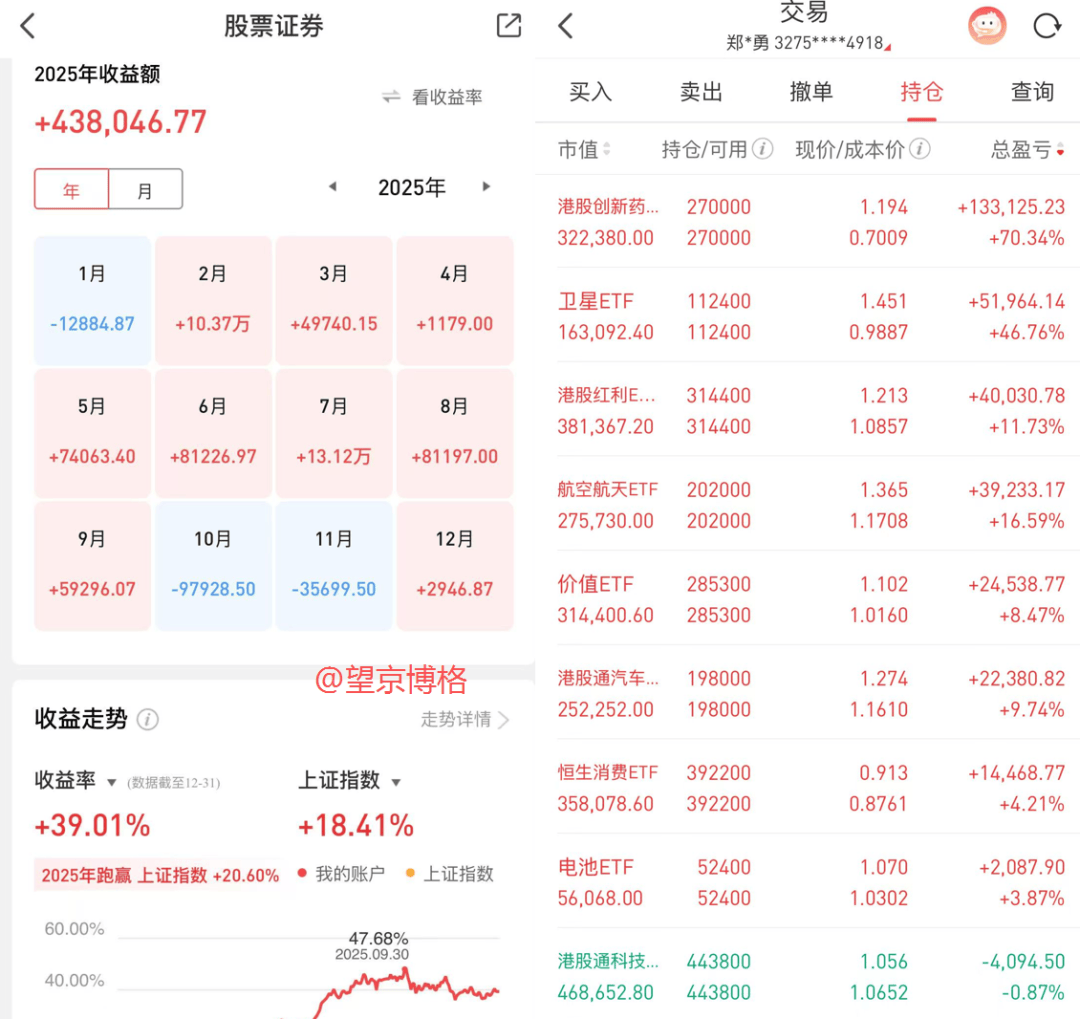
Core Insights - The company achieved a total profit of 1.843 million in 2025, with a return rate of 33.89% [1][14] - The company primarily operates three investment accounts: on-exchange ETF account, off-exchange fund account, and advisory portfolio account [1] On-Exchange ETF Account - The on-exchange ETF account reported a profit of 438,046.77, with a return rate of 39.01% for 2025 [4] - The account's core holdings include Hong Kong innovation drug ETF, Hong Kong technology ETF, and Hong Kong consumer ETF, focusing on the Hong Kong market [4][5] - The account has shown stability, with 9 out of 12 months being profitable, indicating a monthly win rate of 75% [4] Off-Exchange Fund Account - The off-exchange fund account has assets of 5.4 million, with a profit of 1.325 million and a return rate of 33.89% [3][8] - The account's main holdings are in resource and technology funds, with significant contributions from resource funds [9] - The account has also shown stability, with 8 out of 12 months being profitable, resulting in a monthly win rate of over 66% [9] Advisory Portfolio Account - The advisory portfolio account has assets exceeding 1.2 million, with a cumulative profit of around 80,000 [13] - The portfolio focuses on long-term investments, with holdings in various funds, including medical and consumer sectors [13] - The account's strategy includes maintaining a maximum position of 15% in any single sector to manage risk [12][13] Market Outlook for 2026 - The company plans to adopt a more defensive strategy in 2026 due to high valuations in the A-share market, while the Hong Kong market remains relatively reasonable [17][18] - The company aims to reduce its overall position to around 60% if the market continues to rise, focusing on undervalued sectors with potential [21] - Key sectors for 2026 include Hong Kong technology, defense industry, and innovative pharmaceuticals, which together represent 50% of the overall portfolio [26][27]

ETF基金周度跟踪:A股成长ETF表现强劲,资金流入A股大盘ETF-20251213
CMS· 2025-12-13 13:10
1. Report Industry Investment Rating - The document does not mention the industry investment rating. 2. Core Viewpoints of the Report - The report focuses on the performance and capital flow of the ETF fund market in the past week (December 08 - December 12, 2025), providing investors with a reference [1]. - During this period, the Shanghai Composite Index slightly declined, and most stock ETFs fell. A - share growth ETFs had the largest increase, with an average increase of 3.81% for funds above a certain scale, while Hong Kong - stock theme ETFs and Hong Kong - stock dividend ETFs had significant declines [2][5]. - Capital flowed into A - share large - cap ETFs, with a net inflow of 9.08 billion yuan for the whole week. In contrast, A - share TMT ETFs and A - share financial and real - estate ETFs experienced capital outflows, with net outflows of 7.139 billion yuan and 5.824 billion yuan respectively [3][5]. 3. Summary According to Related Catalogs 3.1 ETF Market Overall Performance - **Market Performance**: The Shanghai Composite Index slightly declined, and most stock ETFs fell. A - share growth ETFs had an average increase of 3.81% for funds above a certain scale, while Hong Kong - stock theme ETFs and Hong Kong - stock dividend ETFs had average declines of 3.03% and 2.82% respectively [2][5]. - **Capital Flow**: Capital flowed into A - share large - cap ETFs with a net inflow of 9.08 billion yuan, and A - share TMT ETFs and A - share financial and real - estate ETFs had net outflows of 7.139 billion yuan and 5.824 billion yuan respectively [3][5]. 3.2 Different Popular Sub - type ETF Fund Market Performance - **A - share ETFs**: Include various types such as broad - based index (full - market, large - cap/super - large - cap, mid - small - cap, science - innovation/growth enterprise board), industry (TMT, mid - stream manufacturing, consumption, pharmaceutical and biological, cycle, financial and real - estate), SmartBeta (value, growth, dividend, free cash flow), and theme. Each type has different performance in terms of weekly capital flow, weekly return, recent 1 - month return, and year - to - date return [13][14][15]. - **Hong Kong - stock ETFs**: Include broad - based index, industry (TMT, mid - stream manufacturing, consumption, pharmaceutical and biological, financial and real - estate), SmartBeta (dividend), and theme. Each type shows different performance in capital flow and return [28][29][30]. - **Shanghai - Hong Kong - Shenzhen ETFs**: Include industry and theme types, with different performance in capital flow and return [34][35][36]. - **US - stock ETFs**: Include broad - based index and industry types, with different performance in capital flow and return [37][38]. - **Other QDII - ETFs (excluding Hong Kong - stock/US - stock)**: Have different performance in capital flow and return [39]. - **Bond ETFs**: Have different performance in capital flow and return [40]. - **Commodity ETFs**: Have different performance in capital flow and return [41]. 3.3 Innovation Theme and Sub - industry ETF Fund Market Performance - **TMT Innovation Theme**: Indexes such as animation and games, cloud computing and big data, etc. have different weekly and year - to - date returns, and their representative funds also show corresponding performance [43]. - **Consumption Sub - industry**: Indexes such as liquor, food and beverage, etc. have different weekly and year - to - date returns, and their representative funds also show corresponding performance [44]. - **Pharmaceutical Sub - industry**: Indexes such as vaccine and biotechnology, innovative drugs, etc. have different weekly and year - to - date returns, and their representative funds also show corresponding performance [45]. - **New Energy Theme**: Indexes such as power utilities, photovoltaic industry, etc. have different weekly and year - to - date returns, and their representative funds also show corresponding performance [46]. - **Central and State - owned Enterprise Theme**: Indexes such as mainland state - owned enterprises, Hong Kong - stock central enterprise dividends, etc. have different weekly and year - to - date returns, and their representative funds also show corresponding performance [47][48]. - **Steady - growth Theme**: Indexes such as coal, real estate, etc. have different weekly and year - to - date returns, and their representative funds also show corresponding performance [49]. - **Shanghai - Hong Kong - Shenzhen/Hong Kong - Stock Connect Sub - industry**: Indexes such as Shanghai - Hong Kong - Shenzhen Internet, Hong Kong securities, etc. have different weekly and year - to - date returns, and their representative funds also show corresponding performance [50]. - **Dividend/Dividend Low - volatility Index Family**: Indexes such as CSI 300 Dividend, CSI Dividend Low - volatility, etc. have different weekly and year - to - date returns, and their representative funds also show corresponding performance [51]. - **Growth Enterprise Board Index Family**: Indexes such as science - innovation chips, growth enterprise board growth, etc. have different weekly and year - to - date returns, and their representative funds also show corresponding performance [52].
近百亿资金,净流出
Zhong Guo Zheng Quan Bao· 2025-12-02 12:19
Market Overview - After a week of low-volume rebound in the last trading week of November, the A-share market experienced a pullback on December 2, with ETF trading volumes in the ChiNext and STAR Market falling below the average levels of November [1][4] - On December 1, nearly 10 billion yuan of net outflow was observed in A-share ETFs, with broad-based theme ETFs experiencing the most significant outflows [3][9] Sector Performance - The A-share market saw declines, with the Shanghai Composite Index down 0.42%, the Shenzhen Component down 0.68%, and the ChiNext Index down 0.69%. Total trading volume across both markets was 1.6073 trillion yuan, a decrease from the previous trading day [4] - Defensive attributes of dividend-paying assets became prominent, as cash flow stable and high-dividend sectors attracted investor interest, leading to a general rise in Hong Kong dividend ETFs [2][4] Fund Flows - A total net outflow of approximately 95 billion yuan was recorded in A-share ETFs on December 1, with significant outflows from major index ETFs such as the SSE 50 ETF and CSI 300 ETF [9] - Conversely, certain products like gaming ETFs, consumer electronics ETFs, and communication ETFs attracted net inflows, indicating a shift in investor preferences [10][11] ETF Performance - As of December 2, several Hong Kong dividend-related ETFs have shown strong performance, with many increasing over 25% year-to-date. The Hong Kong dividend ETF (159691) reached a total share of 6.469 billion and a scale of 8.694 billion yuan, reflecting a year-to-date share growth of 42.96% and a scale growth of 75.78% [6] - The performance of various ETFs on December 1 showed that the Hong Kong dividend low-volatility ETFs rose by over 1%, while sectors like media, robotics, and rare metals faced declines [4][5] Investment Strategy - According to research from GF Securities, the current period may represent a critical window for year-end asset rebalancing, with some institutions likely to sell high-valuation growth stocks to invest in high-dividend, safer Hong Kong dividend assets [6][12] - The trend of seeking certainty in investments is expected to continue, with investors gravitating towards stable cash flow and high-dividend sectors as the year-end approaches [12]
近百亿资金,净流出!
Zhong Guo Zheng Quan Bao· 2025-12-02 12:08
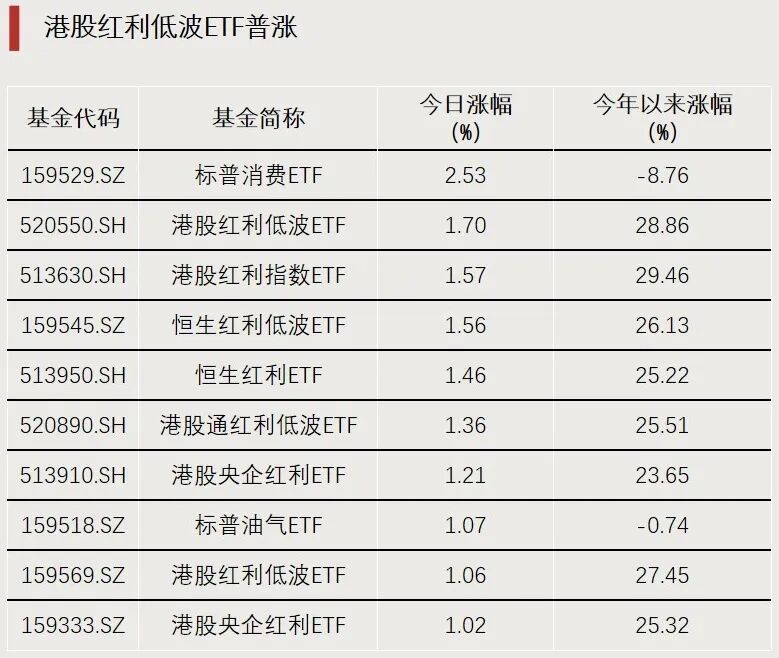
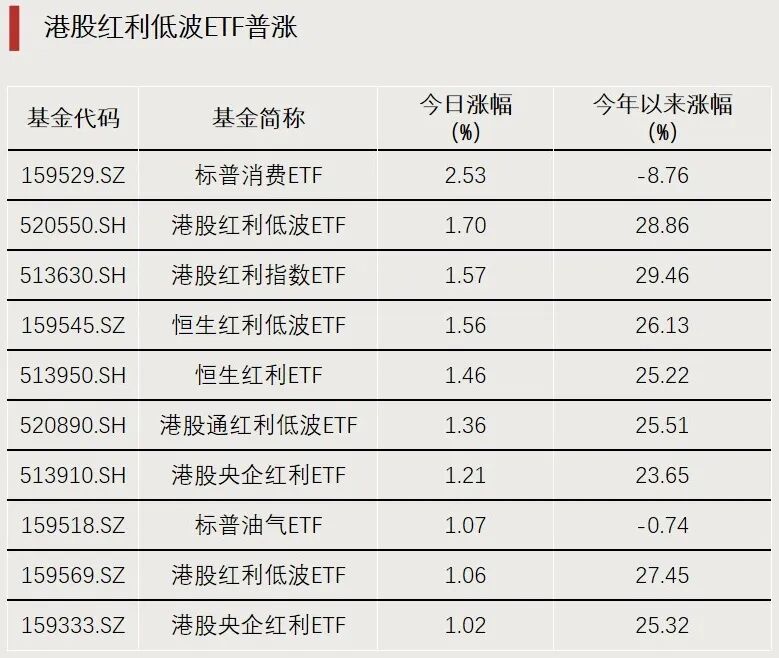
Market Overview - After a week of reduced trading volume and a rebound in late November, the A-share market experienced a pullback on December 2, with trading volumes for related ETFs in the ChiNext and STAR Market falling below the average levels of November [1][4]. Fund Flows - On December 1, nearly 10 billion yuan in net outflows were recorded for A-share ETFs, with broad-based theme ETFs experiencing the most significant outflows [3][9]. - The total trading volume for the A-share market was 1.6073 trillion yuan, a decrease compared to the previous trading day [4]. Performance of ETFs - Several Hong Kong dividend ETFs saw gains, with many increasing by over 1% on the same day [4]. - Year-to-date, multiple Hong Kong dividend-related ETFs have performed well, with some increasing by over 25% [6]. - As of December 1, the latest share count for the Hong Kong dividend ETF reached 6.469 billion shares, with a total scale of 8.694 billion yuan, reflecting a year-to-date share growth of 42.96% and a scale growth of 75.78% [6]. Sector Performance - The energy metals, CRO concepts, and medical services sectors saw the largest declines, while the road and railway transportation, as well as agriculture and forestry sectors, experienced gains [4]. - The trend of investors seeking stable cash flow and high-dividend assets is expected to continue as the year ends, driven by institutional investors locking in profits and a seasonal influx of insurance funds [6][11]. Specific ETF Data - The following ETFs showed notable performance on December 1: - The S&P Consumer ETF rose by 2.53% but is down 8.76% year-to-date - The Hong Kong Dividend Low Volatility ETF increased by 1.70% with a year-to-date gain of 28.86% [5]. - The A500 ETF maintained active trading, while other ETFs like the STAR 50 and ChiNext saw significant reductions in trading volumes compared to November's daily averages [7].
今年要被债基玩死了……
Sou Hu Cai Jing· 2025-12-02 10:02
Core Viewpoint - The article discusses the performance of various bond funds in 2023, highlighting significant losses in certain categories, particularly in government bond funds and long-term bond funds, due to rising yields and market conditions. Group 1: Index Bond Funds - The 30-year government bond ETF has declined by approximately 4%, while the benchmark market-making government bond ETF has dropped by 0.65% [2] - The main contributors to the decline are the rising yields of government bonds, with the 5-year government bond yield increasing from 1.41% to 1.61%, a rise of 19 basis points, and the national development bond yield increasing from 1.47% to 1.79%, a rise of 32 basis points [2] - The "Dacheng Interbank Certificate of Deposit Index 7-Day Holding" has a small scale of only 4 million yuan, leading to losses as investment returns do not cover fund expenses [2] Group 2: Short-term Bond Funds - Short-term bond funds have averaged a return of 1.4%, with two funds reporting losses and 16 funds yielding less than 0.5% [3] - The two funds that lost money are small in scale, and their low size has led to high expense ratios eating into profits [3] Group 3: Long-term Bond Funds - Among 2019 long-term bond funds, 257 have reported losses, accounting for 12.7% of the total [4] - Long-term bond funds have averaged a return of 0.97%, which is about 0.4% lower than short-term bond funds [4] - The primary reason for the losses is the heavy investment in long-duration government bonds and policy financial bonds [5] Group 4: Market Conditions - The yield on 30-year government bonds is currently at 2.2%, with a low of 1.8% earlier this year, resulting in an average annual coupon yield of around 2% [6] - The maximum drawdown for the 30-year government bond index has been 16.75%, with a maximum drawdown of 6.41% this year, indicating a low investment value for long-duration government bonds [6] - Fund managers have been increasing the duration of their bond funds, which is seen as a risky move given the current yield environment [6] Group 5: Overall Market Sentiment - The overall market is still in an adjustment phase, with recent weak rebounds not indicating an end to the adjustment [11] - There is a lack of excitement in the market, with many sectors experiencing declines after previous rebounds, suggesting a cooling of market sentiment [11] - Despite the potential for further declines, there may be limited downside due to external funds eyeing investment opportunities [12]
讲真!年底市场还能大涨吗?(周报323期)
Sou Hu Cai Jing· 2025-11-29 14:02
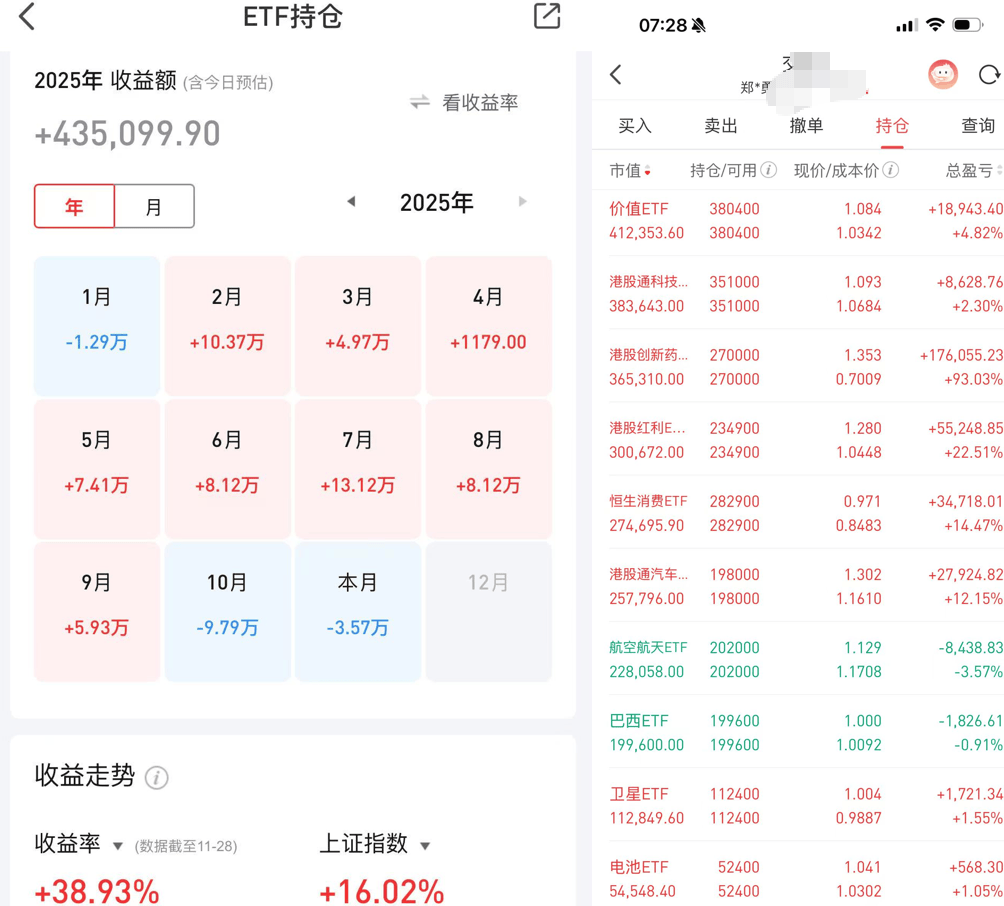
Group 1 - The company has three main accounts with total assets exceeding 10 million yuan, consisting of 2.6 million yuan in an ETF account, 5.5 million yuan in an off-market fund account, and 1.1 million yuan in an advisory portfolio [1] - The ETF account has shown strong performance with a cumulative profit of 435,000 yuan this year, despite a recent decline of 130,000 yuan over two months [1] - The off-market fund account has a diversified portfolio and has been profitable for seven out of the first nine months of the year, with a total profit of 1.238 million yuan and a return rate of 31.68% [2][3] Group 2 - The market experienced a significant net inflow of over 50 billion yuan during a recent downturn, followed by a net outflow of the same amount as the market stabilized [4][5] - Southbound capital has flowed into Hong Kong stocks, totaling nearly 14 billion Hong Kong dollars this year, indicating a complex dynamic where foreign capital may be selling while local investors are buying [5] - The current valuation of the CSI All Share Index is at a price-to-earnings ratio of 20.98, which is high compared to historical levels, suggesting limited market upside potential towards the end of the year [7][10] Group 3 - The company has made strategic adjustments in its portfolio, including reducing positions in value ETFs and increasing investments in Brazilian ETFs and technology ETFs focused on Hong Kong [10] - The outlook for the market towards the end of the year appears cautious, with expectations of limited significant movements based on both funding and valuation perspectives [10]
多只红利ETF规模刷新纪录
Zheng Quan Ri Bao· 2025-11-21 16:15
Core Viewpoint - The recent performance of dividend-themed ETFs has been remarkable, with significant net inflows and growth in scale, indicating strong investor interest in high-dividend assets in a low-interest-rate environment [1][2][3]. Group 1: Market Performance - As of November 21, the net inflow for dividend-themed ETFs reached 6.318 billion yuan in November alone, with a total net inflow of 35.623 billion yuan since the beginning of the year, marking a 49.31% increase in scale to 166.171 billion yuan [1]. - The largest dividend-themed ETF, the Huatai-PB Fund's Low Volatility ETF, set a record of 26.603 billion yuan in scale on November 14, leading the current dividend trend [2]. - Other notable ETFs, including the Morgan Stanley S&P Hong Kong Stock Connect Low Volatility Dividend ETF and the E Fund CSI Dividend ETF, also reached record sizes of 17.007 billion yuan and 11.166 billion yuan, respectively [2]. Group 2: Investment Insights - Analysts highlight that high-dividend assets offer both cash returns and potential for valuation recovery, making them attractive in a low-interest-rate environment [2][3]. - The average net value growth rate for Hong Kong dividend-themed ETFs has reached 18.41% this year, with a net inflow of 4.742 billion yuan in November [2]. - The overall valuation level of Hong Kong stocks enhances the allocation value of dividend-themed ETFs, particularly those with low volatility factors that select less volatile stocks [3]. Group 3: Future Outlook - Experts suggest that low-volatility dividend assets are a rare asset class in A-shares and can reduce portfolio volatility in the short term while being positively correlated with cash generation capacity in the long term [3]. - Investors are encouraged to pay attention to the tracking capabilities of fund managers in these products, especially given the potential for changes in the profitability and cash flow of underlying stocks affecting dividend payments [4].
红利ETF:穿越“十五五”周期的压舱石
Sou Hu Cai Jing· 2025-11-05 09:16
Core Viewpoint - The article emphasizes the growing importance of dividend investment strategies in the current economic environment characterized by low interest rates and a focus on high-quality development, positioning dividend assets as a stable choice for investors seeking reliable returns [1][2]. Economic Environment - The continuous decline in interest rates, with the ten-year government bond yield dropping to 1.76% and bank deposit rates falling below 1%, has diminished the appeal of traditional fixed-income products [2]. - The significant yield difference between government bonds and dividend indices, with the latter offering 6-8% dividend yields, is attracting low-risk capital towards dividend assets [2]. Policy Influence - The "14th Five-Year Plan" encourages the introduction of "patient capital," primarily from insurance funds, which favor dividend assets due to their stable cash flow characteristics [3]. - Regulatory policies, such as the "National Nine Articles," are pushing listed companies to increase dividend payouts, with state-owned enterprises' dividends exceeding 370 billion yuan, enhancing the long-term investment value of dividend assets [3]. Types of Dividend ETFs - The article categorizes various types of dividend ETFs, including the classic CSI Dividend ETF, which focuses on high-dividend stocks primarily in traditional sectors like banking and coal, maintaining a stable dividend yield around 6% [4]. - The low-volatility dividend ETF combines high dividend yields with low volatility, appealing to risk-sensitive investors [4]. - The dividend quality ETF emphasizes sustainable profitability and growth, featuring high-quality companies and sectors like consumer goods and pharmaceuticals, albeit with lower dividend yields [5]. Investment Strategy - Dividend ETFs are positioned as defensive assets rather than aggressive growth investments, suitable for turbulent or declining markets but potentially underperforming in bull markets [6]. - Long-term investors are encouraged to reinvest dividends to accumulate more shares, enhancing wealth through compound growth [6]. - The article advises on the importance of timing and valuation awareness, noting that current valuations for dividend indices are high, suggesting caution for new investors [7]. Conclusion - The article underscores the necessity of patience and strategic planning in investing in dividend ETFs, recommending a long-term holding approach and the use of systematic investment strategies to manage market fluctuations [8][9].

组合风险监控大升级!教你一招识破持仓“雷点”
Wind万得· 2025-10-20 22:41
Core Viewpoint - The article highlights significant regulatory penalties imposed on major financial institutions due to inadequate risk management and compliance failures, emphasizing the need for enhanced risk monitoring systems and processes [1][2]. Group 1: Regulatory Penalties - On September 12, the National Financial Regulatory Administration disclosed administrative penalties totaling nearly 140 million yuan against three large financial institutions for issues related to loan management, investment operations, and regulatory data reporting [1]. - The penalties reflect a broader trend of failures in post-loan management, investment risk control, and system monitoring across the financial sector [1]. Group 2: Risk Management Challenges - Many financial institutions face common pain points, including reliance on manual checks that often overlook risk warnings, necessitating an upgrade in risk control practices [3]. - The difficulty in dynamically monitoring holdings leads to an underestimation of actual risks, and the time-consuming nature of report writing results in delayed risk reporting [4]. Group 3: AI-Driven Solutions - The article introduces AliceRisk, an AI-powered tool designed to enhance risk monitoring and reporting, enabling real-time oversight of portfolio risks [6][10]. - AliceRisk integrates with Wind's risk knowledge base, allowing for dynamic risk alerts, automated report generation, and traceability of various risk events [7][10]. Group 4: Risk Event Analysis - The analysis of risk events indicates a concentration of issues within specific companies, with notable instances of negative sentiment and high-risk ratings for certain entities, such as 汇添富基金管理股份有限公司 [15][20]. - The report highlights the need for ongoing monitoring of regional credit environments and potential impacts from litigation and refinancing activities [29][31].

港股红利低波ETF、港股央企红利50ETF、红利港股ETF上涨,四季度资金的确偏好低估值
Ge Long Hui· 2025-10-16 05:09
Group 1 - The article highlights a preference for low-volatility dividend assets in the Hong Kong stock market, particularly during market fluctuations, with several dividend ETFs showing gains of over 1% [1] - Recent market dynamics indicate a shift in investor sentiment towards value and dividend sectors, as evidenced by significant net inflows into high-dividend sectors, particularly in the financial industry, which saw a net purchase of 783.81 billion HKD from southbound funds [1] - The technology sector, which had previously led the market, is experiencing a pullback, prompting a rotation towards more stable dividend-paying stocks [1] Group 2 - Historical data over the past 20 years shows that cyclical industries like white goods and food processing have seen an upward trend in the fourth quarter over 65% of the time, driven by year-end profit-taking and expectations surrounding macroeconomic policies [2][3] - According to CITIC Securities, the fourth quarter of 2025 may present a critical opportunity for positioning in dividend stocks, as pessimistic expectations may have been fully priced in, leading to a valuation bottom [3] - The yield on 10-year government bonds has remained low between 1.6% and 1.9%, while leading A/H shares in sectors like highways are projected to have dividend yields of 5% to 6% by 2025, enhancing their attractiveness [3]