
豆芽

Search documents
年夜饭放冰箱连吃好几天,老人突然头晕抽搐!紧急进ICU
Xin Lang Cai Jing· 2026-02-26 04:14
Core Viewpoint - The article highlights the risks associated with consuming leftover food stored in the refrigerator, particularly focusing on Listeria monocytogenes, which can lead to severe health issues such as meningitis, especially in vulnerable populations like the elderly and pregnant women [1][2]. Group 1: Health Risks - Listeria monocytogenes can survive and grow in cold environments, including refrigeration and freezing, making it a significant food safety concern [2][4]. - The infection can lead to severe conditions such as meningitis and sepsis, with a mortality rate ranging from 20% to 30% for affected individuals [2][4]. - Vulnerable groups, including the elderly, pregnant women, and immunocompromised individuals, are at a much higher risk, with pregnant women facing a risk 13 to 100 times greater than the general population [5][6]. Group 2: Food Safety Guidelines - Certain foods are particularly prone to Listeria contamination, including long-stored leftovers, unpasteurized dairy products, and undercooked meats [7]. - It is crucial to separate raw and cooked foods, thoroughly reheat leftovers, and regularly clean the refrigerator to minimize contamination risks [9]. - High-risk individuals should avoid unpasteurized dairy products and undercooked foods to prevent infection [9][10]. Group 3: Symptoms and Medical Attention - Symptoms of Listeria infection can range from mild flu-like symptoms to severe neurological issues, necessitating immediate medical attention if severe symptoms occur [10][11]. - Healthy adults may experience mild symptoms, but the infection can be life-threatening for vulnerable populations, emphasizing the need for careful dietary practices [11].


春意萌动雨水前 年夜饭这样吃更养生
Xin Hua She· 2026-02-16 02:32
Core Viewpoint - The articles provide expert advice on how to enjoy a healthy and balanced New Year's Eve dinner, emphasizing the importance of seasonal ingredients and nutritional balance in meal preparation [1][2]. Group 1: Seasonal and Nutritional Recommendations - During the transition from winter to spring, it is important to focus on warming foods that support Yang energy, such as lamb soup and medicinal chicken, while incorporating sprouted vegetables like bean sprouts and chives to promote liver health [1]. - A balanced meal should include high-quality proteins, vegetables, and mushrooms, with a preference for fish and shrimp due to their lower fat content and heart-healthy unsaturated fatty acids [1]. - Incorporating whole grains like brown rice, whole wheat, corn, and sweet potatoes can enhance dietary fiber and B vitamins, with a suggestion to steam a dish called "Five Grains Abundant" for both nutrition and symbolism [1]. Group 2: Cooking Methods and Dietary Tips - It is recommended to use natural seasonings such as scallions, ginger, garlic, vinegar, and lemon juice while reducing the use of salt and soy sauce, and to opt for plant oils rich in unsaturated fatty acids like olive oil [2]. - For digestion, a tea made from dried tangerine peel and rose can be beneficial, and traditional remedies using hawthorn, malt, and barley can aid in digestion if food stagnation occurs [2]. - Specific dietary advice is provided for different demographics: children should limit snacks and avoid excessive meat, the elderly should consume easily digestible foods, and individuals with high blood pressure should avoid spicy foods while increasing intake of celery and seaweed [2].
江苏太仓最新食品抽检结果出炉,这些不合格
Xin Lang Cai Jing· 2026-02-02 08:43
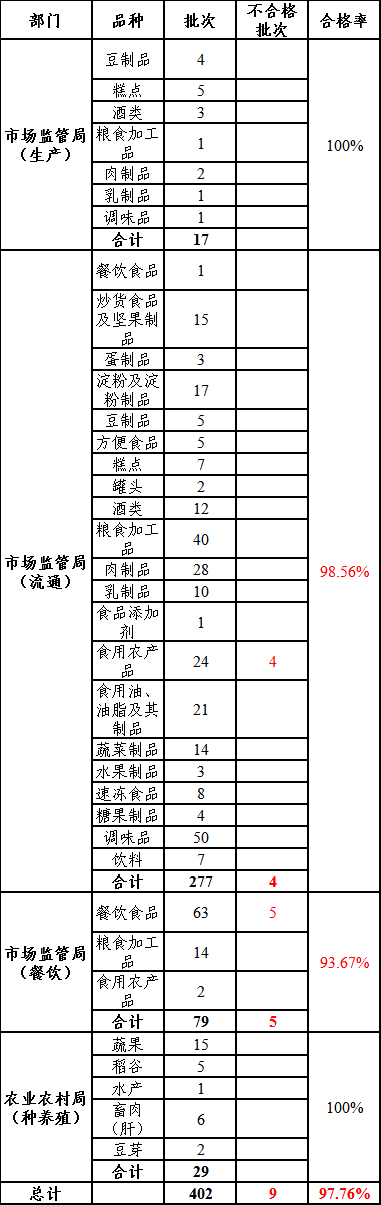
Core Insights - The food safety inspection results for December 2025 in Taicang show a high compliance rate of 97.76%, with 393 out of 402 food samples passing the tests [2][5] - Specific non-compliance issues were identified in 9 samples, including pesticide residues and bacterial contamination [3][6] Group 1: Inspection Results - A total of 402 food samples were tested, with 393 passing, resulting in a compliance rate of 97.76% [2][5] - The inspection covered various categories, including edible agricultural products, processed foods, and beverages [1] Group 2: Non-compliance Details - Non-compliant items included 4 batches of edible agricultural products and 5 batches of catering food, with issues related to pesticide residues such as bifenthrin and bacterial contamination [3][6] - Specific non-compliance cases included pesticide residues exceeding the maximum limits set by national food safety standards [8][9] Group 3: Compliance by Category - The compliance rates varied by category, with the highest being 100% for tofu products and 98.56% for meat products [4][5] - The inspection results indicate that while most categories performed well, certain food types like catering products had a lower compliance rate of 93.67% [5]
“缺钱时代”来了!这 5 个变化越来越明显,你中招了嘛?
Sou Hu Cai Jing· 2025-11-27 20:46
Group 1 - The core sentiment of the article highlights a shift in consumer behavior due to financial constraints, with a focus on practicality over luxury in spending habits [1][3] - The cigarette market is experiencing a shift from premium brands to more affordable options, indicating a move away from status-driven consumption towards value-driven choices [3] - Online shopping is becoming the primary method of purchasing, with over 65% of consumption expected to occur online by 2025, as consumers prioritize savings over convenience [3][4] Group 2 - There is a notable change in food purchasing habits, with consumers opting for basic staples over luxury items, reflecting a focus on cost-effectiveness and necessity [3] - The replacement cycle for electronics and appliances has extended to 5-8 years, driven by high prices and a lack of perceived value in new products, leading to a 30% growth in the repair market [4] - The second-hand market is thriving, particularly among younger consumers, as they seek cost-effective alternatives, indicating a significant shift towards value-oriented consumption [4]

超市最实惠蔬菜竟暗藏瘦身玄机?最新研究显示,豆芽中独特活性肽可阻断脂肪堆积、促进减重并调节代谢
GLP1减重宝典· 2025-11-23 04:24
Group 1: Core Insights - The article emphasizes the significance of soybean sprouts as a versatile and nutritious food that aids in weight management and brain health [5][6][15]. - Recent research highlights the anti-obesity potential of soybean peptides (SSP), which can regulate metabolic pathways and gut microbiota, thus promoting weight loss and improving metabolic disorders [8][10][11][14]. Group 2: Research Findings - A study from Zhejiang University revealed that SSP significantly reduced body weight by 8.7% and abdominal fat by 84% in high-fat diet-induced obese mice [11][12]. - SSP was shown to improve lipid metabolism, lowering total cholesterol, triglycerides, and LDL cholesterol levels in treated mice [11][12]. - The mechanism of SSP's action involves the activation of the PI3K-Akt pathway and modulation of the JAK-STAT signaling pathway, which helps in correcting metabolic imbalances [13][14]. Group 3: Broader Implications - The findings suggest that soybean sprouts could be a promising functional food or health supplement for individuals seeking natural weight management solutions [15][19]. - The article also discusses the potential of soybean sprouts in addressing cognitive decline, particularly in relation to Alzheimer's disease, due to their content of natural compounds that inhibit harmful protein phosphorylation [15][19]. Group 4: National Health Strategy - The article references China's "Healthy China 2030" initiative, which aims to enhance public awareness and skills in weight management, targeting a 10% annual reduction in obesity rates by 2026 [21][28]. - The initiative emphasizes the importance of establishing supportive environments for weight management and promoting healthy lifestyles across the population [28].

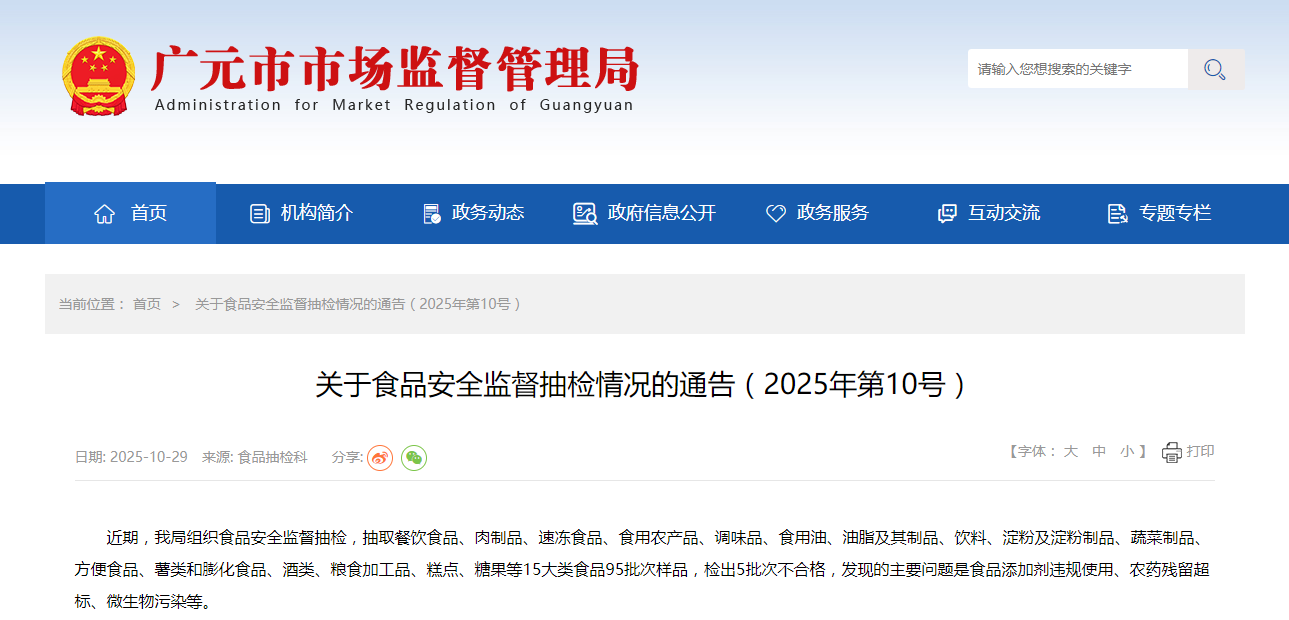
四川省广元市市场监督管理局发布关于食品安全监督抽检情况的通告(2025年第10号)
Zhong Guo Zhi Liang Xin Wen Wang· 2025-11-10 04:41
Summary of Food Safety Supervision Sampling Core Viewpoint The recent food safety supervision sampling conducted by the local authority revealed that out of 95 food samples tested across 15 categories, 5 batches were found to be non-compliant, primarily due to issues related to the illegal use of food additives, pesticide residue exceeding limits, and microbial contamination. The local market supervision departments have been instructed to investigate and address the non-compliant products [2]. Group 1: Non-compliance Details - A total of 95 food samples were collected from various categories including meat products, frozen foods, and beverages [2]. - 5 batches were identified as non-compliant, with major issues including illegal food additives, pesticide residues above permissible levels, and microbial contamination [2]. - The local market supervision departments are tasked with verifying and handling the non-compliant products [2]. Group 2: Consumer Guidance - Consumers are encouraged to report any non-compliant products they encounter in the market by calling the government service hotline at 12345 [2]. - Detailed information regarding the food safety supervision sampling results is available in the attached documents [2].
商务预报:10月20日-26日36个大中城市食用农产品零售价格情况
Shang Wu Bu Wang Zhan· 2025-10-31 06:45
Core Insights - The report provides a detailed analysis of retail prices for various food items, highlighting both month-on-month and year-on-year changes in prices [1] Price Trends - **Grains**: - Rice is priced at 6.56 yuan/kg, showing a slight decrease of 0.2% month-on-month and 0.3% year-on-year [1] - Flour is at 6.12 yuan/kg, with a month-on-month increase of 0.2% but a year-on-year decrease of 2.5% [1] - **Edible Oils**: - Soybean oil is priced at 12.86 yuan/kg, with a minor increase of 0.1% month-on-month and a decrease of 1.7% year-on-year [1] - Peanut oil remains at 28.55 yuan/kg, unchanged month-on-month and down 1.5% year-on-year [1] - Canola oil is at 16.70 yuan/kg, with a 0.1% increase month-on-month and a 2.3% decrease year-on-year [1] - Blended oil is priced at 15.57 yuan/kg, remaining stable month-on-month and down 1.8% year-on-year [1] - **Pork**: - The price of hind leg pork is 26.68 yuan/kg, reflecting a decrease of 1.3% month-on-month and a significant drop of 16.5% year-on-year [1] - **Poultry**: - Whole chicken is priced at 24.79 yuan/kg, remaining stable month-on-month and down 2.4% year-on-year [1] - **Eggs**: - Fresh eggs are priced at 10.11 yuan/kg, with a decrease of 0.6% month-on-month and a substantial drop of 15.8% year-on-year [1] - **Aquatic Products**: - Carp is priced at 21.48 yuan/kg, with an increase of 0.8% month-on-month and a decrease of 4.0% year-on-year [1] - Silver carp is at 22.21 yuan/kg, showing a decrease of 1.5% month-on-month and an increase of 3.5% year-on-year [1] - Grass carp is priced at 23.16 yuan/kg, with a slight decrease of 0.4% month-on-month and an increase of 6.3% year-on-year [1] - Crucian carp is at 29.05 yuan/kg, with a minor decrease of 0.1% month-on-month and a decrease of 1.7% year-on-year [1] - Large hairtail is priced at 47.50 yuan/kg, with a decrease of 0.3% month-on-month and an increase of 0.5% year-on-year [1] - Large yellow croaker is at 53.27 yuan/kg, remaining stable month-on-month and up 4.5% year-on-year [1] - **Vegetables**: - The average price for vegetables is 7.82 yuan/kg, with a month-on-month increase of 3.3% and a year-on-year decrease of 7.3% [1] - Notable month-on-month price increases include cucumber (8.74 yuan/kg, +8.0%), tomato (8.33 yuan/kg, +7.1%), bitter melon (11.28 yuan/kg, +6.8%), lettuce (8.39 yuan/kg, +6.5%), and rapeseed (7.45 yuan/kg, +6.0%) [1] - Decreases in prices include bean sprouts (4.45 yuan/kg, -1.1%) and green onions (6.36 yuan/kg, -0.6%) [1]

江西省宜春市市场监督管理局2025年第十六期食品安全监督抽检信息通告
Zhong Guo Zhi Liang Xin Wen Wang· 2025-10-13 07:37
Core Viewpoint - The report from Yichun Market Supervision Administration highlights the results of food safety inspections, revealing that out of 118 samples tested across 14 categories, 100 were found to be compliant, while 18 were deemed non-compliant, indicating a compliance rate of approximately 84.7% [4]. Summary by Category - **Overall Inspection Results** - Total samples tested: 118 - Compliant samples: 100 - Non-compliant samples: 18 - Compliance rate: 84.7% [4] - **Food Categories and Compliance** - **Catering Foods**: 9 samples tested, 8 compliant, 1 non-compliant - **Condiments**: 3 samples tested, 2 compliant, 1 non-compliant - **Convenience Foods**: 3 samples tested, all compliant - **Pastries**: 5 samples tested, all compliant - **Alcoholic Beverages**: 8 samples tested, all compliant - **Dairy Products**: 1 sample tested, compliant - **Edible Agricultural Products**: 57 samples tested, 47 compliant, 10 non-compliant - **Edible Oils and Fats**: 12 samples tested, all compliant - **Vegetable Products**: 1 sample tested, compliant - **Fruit Products**: 2 samples tested, all compliant - **Frozen Foods**: 1 sample tested, compliant - **Special Dietary Foods**: 1 sample tested, compliant - **Beverages**: 12 samples tested, 10 compliant, 2 non-compliant - **Health Foods**: 3 samples tested, all compliant [4]. - **Details of Non-Compliant Products** - Non-compliant products included items with excessive residues of harmful substances such as: - Restaurant utensils with a detected level of anionic synthetic detergent at 0.0218 mg/100 cm², which should not be detectable - Chili powder with a sulfur dioxide residue of 1.01 g/kg, exceeding permissible limits - Agricultural products with pesticide residues above acceptable levels, such as 0.81 mg/kg of pyraclostrobin in chili peppers [4].

湖南省湘乡市市场监督管理局食品监督抽检信息通告(2025年8月第2期)
Zhong Guo Zhi Liang Xin Wen Wang· 2025-08-22 07:38
Summary of Key Points Core Viewpoint - The Xiangxiang Market Supervision Administration announced that all 66 batches of food products sampled in the recent food safety supervision inspection met national food safety standards, indicating a positive trend in food safety compliance in the region [2]. Group 1: Food Safety Compliance - A total of 66 batches of food products were tested, and all were found to comply with national food safety standards [2]. - The announcement was made by the Xiangxiang Market Supervision Administration on August 15, 2025 [2]. Group 2: Sampled Products - The sampled products included various categories such as egg products, dairy products, edible agricultural products, and processed foods [2][3]. - Specific products sampled included flavored yogurt, preserved eggs, and various fruits like grapes and dragon fruit [2][3]. Group 3: Production and Distribution - The products were sourced from multiple producers across different provinces, including Jiangsu and Fujian, and were sold in local stores in Xiangxiang [2][3]. - Notable producers included Gaoyou Sanhu Egg Products Co., Ltd. and Taizhou Weigang Dairy Co., Ltd. [2][3].

市场监管总局发布对200余家网红餐厅抽检结果
Zhong Guo Xin Wen Wang· 2025-08-09 07:32
Core Viewpoint - The recent special inspection by the State Administration for Market Regulation (SAMR) on popular internet celebrity restaurants across 24 major cities in China indicates a stable overall food safety status, but highlights specific issues that require attention [1][2]. Group 1: Inspection Overview - The inspection covered over 200 popular restaurants, including various cuisines such as Chinese, Western, hot pot, and barbecue, with a total of 500 batches sampled [1]. - Key focus areas included pesticide residues in vegetables and meat, food additives in pickled vegetables and noodles, and quality indicators like peroxide values in oils and seasonings [1]. Group 2: Inspection Results - The overall food safety status of internet celebrity restaurants is stable, with no violations found in hot pot base materials, chili powder, or duck blood, and no pathogenic bacteria detected in self-made dishes [2]. - However, issues were found, including pesticide residues exceeding limits in ginger, scallions, and bean sprouts, with a banned pesticide detected in scallions from a restaurant in Hubei [2]. - Residues of veterinary drugs were found in freshwater fish, pig throat, and bullfrogs, with a banned drug detected in live fish from a restaurant in Guangdong [2]. Group 3: Compliance and Enforcement - Some restaurants were found to have mixed food and non-food items, staff not wearing masks or hats, and improper temperature control for refrigerated and frozen ingredients [2]. - A few restaurants had disinfected utensils with excessive levels of coliform bacteria and anionic synthetic detergents, likely due to insufficient disinfection temperature or time [2]. - The SAMR has urged local market regulation departments to investigate and address the non-compliant samples, emphasizing the importance of food safety responsibility for businesses [2].