
铁

Search documents
美国若新增印发2万亿美元用于全球采购 将引发多维度全球经济连锁影响 多国加速去美元化
Sou Hu Cai Jing· 2026-02-15 06:33
Group 1 - The core viewpoint is that if the U.S. prints an additional $2 trillion for global procurement, it will have multifaceted chain effects on the global economy [1] - The increase in dollar supply will lead to a dilution of purchasing power for ordinary workers, resulting in a decrease in real income [1] - Manufacturing countries will experience a surge in raw material prices, leading to increased costs for factories and ultimately higher prices for consumer goods [1] Group 2 - The influx of new dollars is expected to create a false sense of prosperity in emerging markets, which could collapse if the Federal Reserve tightens monetary policy [1] - Many countries are already taking measures against the risks of dollar overproduction, such as increasing gold reserves and accelerating local currency settlements [1] - If the U.S. engages in large-scale dollar issuance again, it may further undermine trust in the dollar and lead to significant reductions in its purchasing power [2]
走,一起去找矿!四川明确:激励最高可达5000万元
Xin Lang Cai Jing· 2026-02-06 12:40
Core Viewpoint - Sichuan Province has initiated a pilot project for social capital investment in strategic mineral surveys, aiming to diversify funding sources and enhance geological investigation efficiency [1][2]. Group 1: Project Overview - The Sichuan Natural Resources Department has announced the application process for social capital involvement in strategic mineral surveys, with a deadline for submissions set for March 31, 2026 [1]. - The pilot project will take place in nine cities and states within Sichuan, focusing on strategic metal minerals such as iron, copper, nickel, and gold [1]. - Two geological survey models will be employed: "order-based" where applicants fund their projects, and "crowdfunding" led by state-owned enterprises to address critical mineral shortages [1][2]. Group 2: Incentives and Compensation - A tiered incentive compensation mechanism will be established, allowing survey units to receive compensation up to 50 million yuan based on the sale price of mining rights [2]. - The traditional funding model primarily relied on government financing, making it difficult for private capital to enter; the new models provide opportunities for private investment in mineral exploration [2]. Group 3: Engagement and Support - The pilot project has garnered significant interest from mining companies and geological survey units, with numerous inquiries about the application process and funding incentives [2]. - The Sichuan Natural Resources Department plans to hold a consultation meeting to provide guidance and support for interested companies in the application process [3].
金银价暴跌,000426股价也崩了,公司董秘第三个跌停板精准抄底
Mei Ri Jing Ji Xin Wen· 2026-02-04 12:47
Core Viewpoint - The recent significant drop in international gold and silver prices has led to consecutive trading halts for A-share precious metal stocks, resulting in substantial losses for investors. However, the Secretary of the Board of Directors of Xinyi Silver Tin, Sun Kai, took a contrarian approach by increasing his stake in the company during this downturn, which has yielded him considerable returns [1][3]. Group 1: Stock Performance and Investment Actions - On January 30 and February 2, 2026, Xinyi Silver Tin's stock experienced two consecutive trading halts. On February 3, the stock hit a third trading halt, where Sun Kai made his sixth purchase of company shares at the limit price of 49.83 yuan, increasing his total holdings to 240,000 shares, valued at over 12 million yuan [1][4]. - Sun Kai's total investment in the company amounts to approximately 3.572 million yuan across six purchases, with a current floating profit of about 877.6 thousand yuan, reflecting a significant return on investment [7]. - The stock price of Xinyi Silver Tin closed at 53.40 yuan on February 4, 2026, with a market capitalization of 94.8 billion yuan [1]. Group 2: Company Financial Performance - Xinyi Silver Tin's main business includes the mining and smelting of non-ferrous and precious metals, with a strong reserve of mineral resources and leading production capabilities in its sector [8]. - The company's revenue has seen explosive growth, with reported revenues of 2.086 billion yuan, 3.706 billion yuan, and 4.270 billion yuan for the years 2022, 2023, and 2024, respectively. Net profits for the same years were 174 million yuan, 969 million yuan, and 1.530 billion yuan [8]. - In the first three quarters of 2025, the company achieved a revenue of 4.099 billion yuan, a year-on-year increase of 24.36%, while net profit grew by 4.94% [8]. Group 3: Information Disclosure and Governance - Despite strong financial performance, Xinyi Silver Tin has faced challenges in information disclosure, receiving a C rating for six consecutive years from 2019 to 2024. The company has been subject to regulatory scrutiny, including a warning related to inadequate risk disclosures [9][11]. - The company attributes its low information disclosure rating primarily to the high pledge rate of its controlling shareholder's equity, rather than deficiencies in its disclosure practices [11].


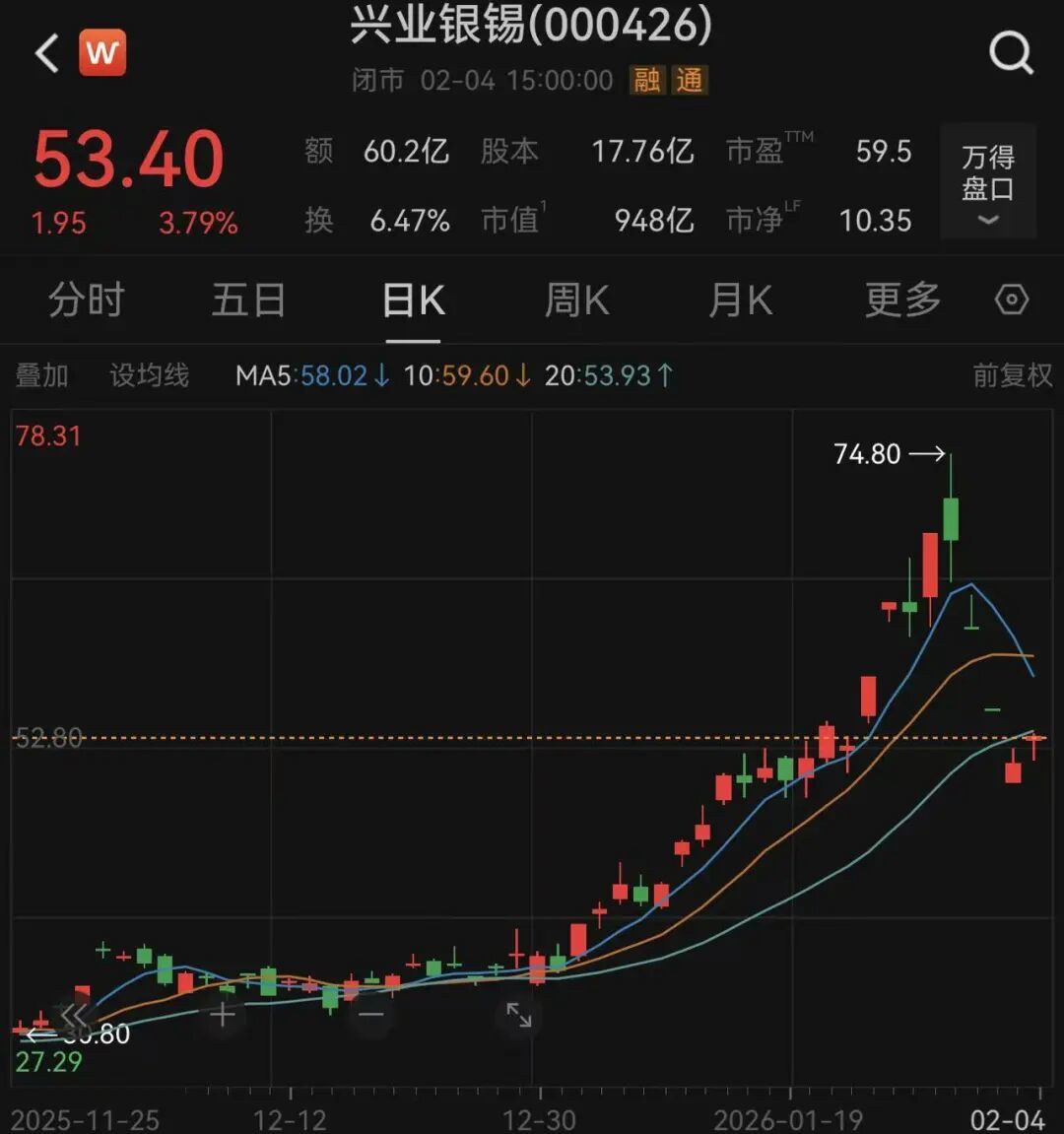
金银价暴跌,000426股价也崩了,公司董秘第三个跌停板精准抄底!他十多年来总计买了6次一股未卖,浮盈近900万元,等于10倍年薪
Mei Ri Jing Ji Xin Wen· 2026-02-04 11:53
Core Viewpoint - The recent significant drop in international gold and silver prices has led to consecutive trading halts for A-share precious metal stocks, resulting in substantial losses for investors. However, the Secretary of the Board of Directors of Xingye Yinxin, Sun Kai, took a contrarian approach by increasing his stake in the company during this downturn, achieving considerable returns [1][3]. Company Performance - Xingye Yinxin's stock price experienced consecutive trading halts on January 30 and February 2, 2026, and continued to decline on February 3, 2026, reaching a price of 49.83 yuan at the drop limit [3][4]. - As of February 4, 2026, Xingye Yinxin's stock closed at 53.40 yuan, with a market capitalization of 948 billion yuan [2]. Shareholding and Transactions - Sun Kai has increased his holdings six times since 2014, with the most recent purchase on February 3, 2026, where he bought 40,000 shares at an average price of 49.83 yuan, totaling 199.32 million yuan [3][4]. - After these transactions, Sun Kai's total shareholding reached 240,000 shares, with a market value exceeding 12 million yuan, resulting in a floating profit of nearly 9 million yuan [1][8]. Financial Performance - Xingye Yinxin's revenue has shown explosive growth over the past two years, with reported revenues of 2.086 billion yuan, 3.706 billion yuan, and 4.270 billion yuan for the years 2022, 2023, and 2024, respectively. Net profits for the same years were 174 million yuan, 969 million yuan, and 1.530 billion yuan [8]. - In the first three quarters of 2025, the company achieved a revenue of 4.099 billion yuan, a year-on-year increase of 24.36%, and a net profit of 1.364 billion yuan, a year-on-year increase of 4.94% [9]. Information Disclosure - Despite the company's strong financial performance, its information disclosure rating has been consistently low, receiving a C rating for the past six years. The company has faced regulatory scrutiny, including a warning related to inadequate risk disclosures [8][9]. - The company attributes its low rating primarily to the high pledge rate of its controlling shareholder's equity, rather than deficiencies in its information disclosure practices [11].

策略周度思考 20260201:中盘蓝筹系列:大宗涨价的两条主线-20260201
Orient Securities· 2026-02-01 07:02
Group 1: Historical Price Trends - Historical price trends of commodities follow a sequence: precious metals, industrial metals, petrochemicals, and agricultural products[9] - Since 1970, there have been five significant commodity bull markets, defined by a price increase of over 50%[10] - The typical price increase sequence occurs in less than one quarter for precious metals, about two quarters for petrochemicals, and approximately one quarter for agricultural products[12] Group 2: Current Market Dynamics - Current market dynamics are influenced by domestic industrial transformation and global political changes[28] - Commodities closely tied to traditional industries, such as real estate, are expected to perform poorly due to reduced demand elasticity[30] - Emerging economies are expected to drive future demand growth, with a decoupling from developed economies observed[30] Group 3: Price Increase Pathways - The current price increase is characterized by external rather than internal factors, focusing on two main lines: industrialization in emerging economies and geopolitical tensions affecting import prices[43] - The first main line involves price increases driven by industrialization in emerging economies, which is expected to continue due to China's support[44] - The second main line is influenced by geopolitical risks, which can directly threaten commodity prices and create cost transmission effects[44] Group 4: Investment Outlook - The report is optimistic about the price outlook for the chemical and agricultural sectors while being conservative about commodities closely related to the real estate chain[44] - Risks include market performance falling short of expectations, insufficient pricing of geopolitical risks, and potential underperformance in industry development[45]
黄金、白银、小金属、石化都成了主线?劝你们别太高调
Sou Hu Cai Jing· 2026-01-29 23:00
Group 1 - The core theme of the article highlights the resurgence of precious metals like gold and silver, which have outperformed sectors such as AI applications, becoming the new investment focus since 2025 [4] - Gold prices surged from $5,200 to $5,600 per ounce, with a two-day increase of $400, leading to price hikes in gold jewelry and significant stock price increases for related companies [4] - Silver also saw a remarkable rise, reaching a record high of $120 per ounce, with projections suggesting it could reach $160 per ounce [4][7] Group 2 - The macroeconomic environment, supply-demand dynamics, and market sentiment are driving forces behind the price increases in precious metals [7] - The weakening of the US dollar and expectations of interest rate cuts by the Federal Reserve are contributing to the rising costs of holding precious metals [8][9] - Geopolitical tensions and supply chain disruptions in major copper-producing countries are heightening market risk aversion and supply concerns [9] Group 3 - The overall non-ferrous metals sector is experiencing a boost, with prices of aluminum, copper, and tungsten rising alongside gold and silver [10] - Historical price trends indicate a sequence of price increases from gold to silver, then copper, aluminum, and iron, driven by financial attributes and industrial demand [10] - The demand for copper is significantly increasing due to the transition to renewable energy, with electric vehicles using 4-5 times more copper than traditional vehicles [11] Group 4 - The strategic competition for key mineral resources is intensifying, with the US investing $2.5 billion in the strategic reserve of 38 non-ferrous metals, while China is implementing regular reserves for critical strategic materials [11] - The chemical industry is showing signs of potential growth, with recent market movements indicating a possible recovery in oil prices due to OPEC+ production cuts [12][13] - The chemical sector is attempting to transition away from traditional real estate-driven economic cycles towards high-end applications in new energy and electronic information [13]

表里山河与晋商精神(经济地理杂谈)
Ren Min Ri Bao· 2026-01-28 00:56
Core Insights - The article highlights the historical significance of Shanxi merchants (Jin merchants) and their contributions to trade and finance in China, emphasizing their unique geographical advantages and innovative spirit [2][4][5]. Geographical Advantages - Shanxi's location serves as a natural hub for trade between northern pastoralists and central agricultural regions, facilitating the exchange of goods such as tea and livestock [3]. - The region's rich resources, including coal, iron, and salt, provided a solid foundation for commercial activities [3]. Historical Development - The rise of Jin merchants began in the early Ming Dynasty when the government allowed merchants to transport military supplies, leveraging Shanxi's proximity to the northern borders [4]. - The "走西口" (Zou Xikou) migration during the Qing Dynasty further stimulated the entrepreneurial spirit of Shanxi people, leading to the establishment of trade routes like the "万里茶道" (Ten Thousand Mile Tea Road) [4]. Financial Innovations - To address challenges in long-distance trade, Jin merchants developed a banking-like remittance system, with "日昇昌" (Ri Sheng Chang) being the first and most notable "票号" (piaohao) in China, which transformed them from mere traders to financial controllers [5]. - This innovation played a crucial role in the evolution of China's economic history, showcasing the adaptability and foresight of Jin merchants [5]. Modern Implications - The enduring spirit of Jin merchants continues to influence Shanxi's economic development, as the province seeks to transition from a resource-dependent economy to one that embraces new energy, new materials, and high-end manufacturing [5]. - The article suggests that the principles of openness and integrity inherent in Jin merchant culture remain relevant as Shanxi navigates its economic future [5].

新研究表明,全球采矿业已成为棕地产业
Wen Hua Cai Jing· 2026-01-23 11:04
Core Insights - The global mining industry faces a significant challenge due to a lack of new greenfield copper mines, with a growing reliance on brownfield expansions to meet increasing copper demand for energy transition and technology sectors [1][2] Group 1: Research Findings - A study by the Sustainable Minerals Institute highlights the severity of the issue and the industry's dependence on brownfield mining, indicating that existing mines cannot meet the rising demand for copper alone [1] - The study covers data from 366 brownfield projects across 58 countries from 1998 to 2024, revealing that capital expenditures for brownfield projects are primarily driven by copper, which accounts for nearly half of total expenditures [2][3] - The number of new copper mines peaked around 2015, while production continues to rise despite a decline in new mine development [2] Group 2: Geographic Insights - Chile leads global brownfield development, accounting for 25.2% of total capital investment, followed by the United States at 11.4% and Australia at 10.1% [3] - The trend of large companies increasing mine exploration is evident globally, with significant shifts in exploration patterns observed in the Pacific and Southeast Asia, where the share of exploration rose from 27.3% in 2010 to 76.8% by 2024 [4] Group 3: Environmental and Social Considerations - Nearly 80% of brownfield mines are located in areas facing high-risk conditions, including water scarcity and weak governance [4] - Over 20% of mines are situated within 50 kilometers of ecologically pristine or partially modified areas, and more than half are located within 20 kilometers of biodiversity hotspots or protected areas [5]
特朗普攻击委内瑞拉给世界带来新火种
日经中文网· 2026-01-04 07:50
Core Viewpoint - The article discusses the implications of U.S. military intervention in Venezuela, highlighting the geopolitical tensions it may create in Latin America and beyond, particularly in relation to oil interests and regional stability [2][5][11]. Group 1: U.S. Military Intervention - The Trump administration's military actions in Venezuela are framed as a means to combat drug trafficking, but they are criticized as a violation of international law by Latin American leaders [3][5]. - Critics argue that U.S. intervention could lead to further instability in the region, with potential for civil war in Venezuela affecting neighboring countries like Colombia [6][7]. Group 2: Regional Reactions - Latin American leaders, including Mexico's President and Brazil's President, have condemned U.S. military actions, viewing them as threats to regional stability and a step towards violence and chaos [5][6]. - The article notes that the Maduro regime in Venezuela lacks legitimacy, with ongoing allegations of electoral fraud and collusion with criminal organizations [5][6]. Group 3: Resource Interests - The U.S. is accused of pursuing military intervention to regain control over Venezuela's vast oil reserves, which are among the largest in the world [7][11]. - The article emphasizes that South America is rich in various resources, including iron, copper, and lithium, which further complicates the geopolitical landscape [7]. Group 4: Historical Context - The article references the Monroe Doctrine, suggesting that the U.S. is attempting to reassert its influence in the Americas while warning against the encroachment of China and Russia [11]. - It highlights the historical context of U.S. military interventions in Latin America, noting that past actions have often led to increased global military tensions [11].

招金黄金:西藏昌都江达县角日阿玛铜铁矿处于地质勘查阶段
Jin Rong Jie· 2025-12-30 14:31
Group 1 - The core viewpoint of the article is that the company, Zhaojin Gold, is currently focused on its Fiji Vatukoula gold mine project rather than developing its copper mine in Tibet, despite the high copper prices [1] - Zhaojin Gold holds exploration rights for the Jiarima copper-iron mine in Tibet, which is currently in the geological exploration stage [1] - The company will consider further actions based on the results of the geological exploration before proceeding with any development plans for the copper mine [1]
