
AI 助手

Search documents
专家解读-Clawdbot-Agent助理
2026-01-28 03:01
Summary of CloudBot Conference Call Company and Industry - The conference call discusses **CloudBot**, an AI assistant that operates through various chat platforms such as Discord, WhatsApp, Telegram, and Slack, enhancing the capabilities of AutoGPT models [1][4]. Core Points and Arguments - **Functionality and User Interface**: CloudBot improves user interaction by providing a more user-friendly interface and addressing issues where AI gets stuck in loops [1][4]. - **Memory Feature**: The AI assistant has a memory function that retains previous tasks, allowing it to execute commands like file organization and software installation through voice commands [1][5]. - **PPT Generation**: The assistant generates PowerPoint presentations using Python, but the process is slow. Future integration with models like Cloud in PowerPoint could enhance efficiency [1][7][8]. - **Automated Data Collection**: CloudBot can automate data collection tasks, such as fetching news articles at scheduled times, which is beneficial for users like tech bloggers [1][10][11]. - **Device Recommendations**: For stable long-term automation tasks, using devices like Mac mini or VPS is recommended due to their low power consumption and noise levels [1][12][13]. - **Token Consumption**: CloudBot has high token consumption, which raises operational costs, while CoWork offers a more user-friendly interface with lower token usage but lacks portability [2][23]. Additional Important Content - **AI Model Integration**: CloudBot supports multiple AI platforms, including OpenAI Codex and Google Gemini, but does not currently support Deepseek [3]. - **Task Execution and Performance**: The assistant can successfully execute tasks like file organization and PPT generation, although it may require appropriate permissions [6][10]. - **Future Software Development**: The efficiency of AI assistants is expected to improve with the development of software specifically designed for AI control [9]. - **User Experience and Cost Concerns**: While the AI project has gained popularity due to effective marketing and user testimonials, concerns about the high monthly costs (around $200) may limit long-term subscriptions [25]. A lower price point could attract more users [25]. - **Comparison with CoWork**: CloudBot is more suitable for remote control and multi-device tasks, while CoWork is better for single-device automation, making it more economical for users who do not require cross-device functionality [24]. This summary encapsulates the key insights from the conference call regarding CloudBot's capabilities, market positioning, and user considerations.
AI浪潮下-如何更好把握投资机会
2026-01-15 01:06
Summary of Key Points from Conference Call Records Industry Overview - The AI wave is creating significant investment opportunities, particularly in hardware and software sectors, with growth rates being critical indicators [1][2] - The AI assistant market is expected to see a tenfold increase in users over the next year, similar to the mobile gaming industry's growth in 2013 [1][2] - The impact of AI will extend from consumer (C-end) users to business (B-end) enterprises, with companies that have data accumulation advantages, such as Zhidingmai, People's Daily, and Zhihu, being particularly valuable [1][4] Core Insights and Arguments - 2026 is projected to be a pivotal year for AI assistant daily active users (DAU), with significant investment opportunities arising in both consumer and business sectors [1][5] - The AI hardware market has experienced a transition from indiscriminate growth to a focus on applications, with expectations for substantial growth in SaaS applications [2] - The storage sector is expected to benefit from an AI-driven super cycle, with QV9 contract prices anticipated to rise by over 30% and small-capacity NOR Flash prices potentially increasing by more than 50% [3][14] Company-Specific Insights - Key companies to watch include: - **Internet Companies**: Alibaba and Focus Technology, with the latter having a PE ratio of about 30 times [6] - **AI Chip Companies**: Cambricon, Haiguang, Xingyuan, Shengke, and Huafeng Technology, with Haiguang's GPU valuation not fully reflecting its potential [10] - **Storage Companies**: Zhangmulong, Baiwei Storage, and Zhaoyi Innovation, with a focus on niche storage and module sectors [14] - **PCB Companies**: Hupan, Jingqi Microelectronics, and Feilihua, with significant capital expenditure and production capacity expansion plans [12][13] Regulatory and Market Dynamics - Recent regulatory scrutiny on the H200 chip may limit its entry into the domestic market, with potential requirements for local AI GPU chip procurement [8] - The performance of leading GP companies is expected to improve significantly in Q1 2026, with a focus on tracking international leaders [9] Emerging Trends and Investment Opportunities - The communication industry is seeing growth in optical interconnect demand, driven by high investments in data center construction and next-generation computing chips [17][18] - The optical module market is projected to grow significantly in 2026, with a rapid increase in the 1.1T market and high demand for various optical products [19] - End-side AI is entering a "big tool era," creating investment opportunities in hardware device manufacturers and edge computing solutions [22] Strategic Recommendations - Focus on companies with strong industrial foundations and core R&D capabilities, particularly those with strategic partnerships with major players like Alibaba and ByteDance [23] - Data elements are crucial for AI development, with investment opportunities in data service providers and infrastructure companies [24] - Recommended stocks include Meiri Interactive, Huitian Ruisheng, and Xinghuan Technology, which are well-positioned to benefit from AI advancements [25]
申万宏源证券晨会报告-20260113
Shenwan Hongyuan Securities· 2026-01-13 00:42
Core Insights - The report highlights the significant growth potential in AI applications within the internet media sector, driven by both industry developments and market dynamics, including a surge in A-share trading volume and increased risk appetite among investors [2][11] - The service industry in China is evolving, integrating technology to enhance productivity and competitiveness, with government policies aimed at expanding service consumption and fostering innovation across various sectors [3][12] Summary by Sections AI Applications in Internet Media - The report identifies key drivers for AI application trends, including OpenAI's initiatives in advertising and health assistant technologies, and the growth of domestic AI user bases [2][11] - A-share media companies are advised to focus on marginal changes in the industry and to be mindful of market rotation, particularly in marketing and e-commerce services [2][11] - Specific recommendations include investing in companies like BlueFocus and 37 Interactive Entertainment, which are positioned to benefit from AI-driven changes in marketing and gaming sectors [2][11] Hong Kong Internet Sector - The report emphasizes the importance of fundamental analysis and valuation flexibility in identifying opportunities within the Hong Kong internet sector, particularly those that could become major AI application gateways [3][11] - The anticipated upgrade of AI assistants to agents is expected to reshape traffic patterns and monetization strategies in the sector [3][11] Service Industry Development - The report outlines the integration of technology in the service industry, highlighting sectors such as financial technology, healthcare, and cross-border retail as areas of significant growth potential [3][12] - Investment focus areas include productive services, lifestyle services, and emerging service sectors, with an emphasis on the fusion of traditional industries with new technologies [4][12] Emerging Service Sectors - The report notes the rapid development of AI technologies and their applications, particularly in programming and healthcare, which are expected to drive new productivity paradigms [13] - Cross-border e-commerce is highlighted as a new growth driver, leveraging China's supply chain advantages and supported by favorable policies [13]
美国11月通胀大幅低于预期:环球市场动态2025年12月19日
citic securities· 2025-12-19 03:55
Economic Indicators - The US November CPI increased by 2.7% year-on-year, significantly lower than the expected 3.1%, while the core CPI rose by 2.6%, also below the forecast of 3.0%[5] - The average monthly CPI increase from September to November was estimated at 0.10% for overall CPI and 0.08% for core CPI[5] Market Performance - US stock markets rebounded, with the Dow Jones up 0.14% to 47,951 points, the S&P 500 rising 0.79% to 6,774 points, and the Nasdaq increasing by 1.38% to 23,006 points, driven by strong earnings from Micron Technology[9] - European markets remained robust, with the Stoxx 600 index rising by 0.96%, supported by the Bank of England's interest rate cut of 25 basis points[9] Commodity and Currency Trends - International oil prices saw a slight increase, with NY crude oil rising by 0.38% to $56.15 per barrel, influenced by geopolitical risks surrounding Venezuela and Russia[26] - Gold prices experienced a minor decline following the US inflation data, while platinum continued its upward trend[26] Fixed Income Market - US Treasury yields fell by 2-4 basis points, with the 10-year yield at 4.12% and the 30-year yield at 4.80%[30] - The UK central bank's hawkish rate cut led to a reduction in expectations for future rate cuts, with the 2-year UK bond yield rising by 4.2 basis points to 3.74%[30] Sector Performance - In the US, six out of eleven S&P sectors rose, with the consumer discretionary sector leading with a gain of 1.78%, while the energy sector fell by 1.42%[9] - In the Hong Kong market, the Hang Seng Index rose by 0.12%, while the technology sector faced pressure, with major tech stocks declining[11]
美元“荒”与全球“慌”?
2025-11-11 01:01
Summary of Key Points from Conference Call Industry Overview - The discussion primarily revolves around the **U.S. liquidity crisis** and its impact on **global risk assets** and the **AI sector**. The focus is on the implications of the Federal Reserve's actions and market dynamics. Core Insights and Arguments 1. **Liquidity Crisis and Its Causes** The liquidity crisis is attributed to the Federal Reserve's balance sheet reduction, decreased bank reserves, and increased short-term liquidity demands, compounded by market sentiment fluctuations and concerns over AI bubbles [1][10][6]. 2. **Impact on Global Risk Assets** Tightening U.S. liquidity has negatively affected global risk assets, with the dollar index rising above 100. However, fundamental factors do not support a significant decline in the dollar [3][4]. 3. **Current Market Conditions** The market is experiencing a downturn, particularly in the tech sector, with the Nasdaq showing volatility. The Hong Kong stock market is also affected, fluctuating around 26,000 points [3][4][13]. 4. **AI Bubble Concerns** While there are concerns about an AI bubble, the valuation of major tech companies remains below 35 times earnings, which is not extreme compared to the internet bubble era. Key metrics such as demand, capability, leverage, and valuation do not indicate overheating [11][2]. 5. **Federal Reserve's Historical Context** The Fed's previous balance sheet reduction in 2019 led to a liquidity crisis, prompting a return to expansionary policies. Currently, the Fed has halted balance sheet reduction to prevent similar issues [9][10]. 6. **Future Dollar Trends** The dollar is expected to strengthen slightly in Q4 2023 to Q1 2024, influenced by potential aggressive policies from Trump and overall economic uncertainty [12]. 7. **E-commerce Performance** The performance of major e-commerce platforms during the Double Eleven shopping festival showed a slowdown, with Alibaba and JD.com experiencing single-digit growth, while Pinduoduo and Kuaishou saw double-digit growth [18][19]. 8. **AI Technology Integration** AI technology has been increasingly integrated into e-commerce platforms, enhancing user experience and operational efficiency. Companies like Alibaba are leveraging AI for various applications, indicating a growing trend in the sector [21][22]. 9. **Investment Outlook for Internet Sector** Caution is advised for the internet sector in Q4 due to consumer pressure and high base effects, but long-term optimism remains, particularly regarding technological advancements and AI investments [22][24]. 10. **Cloud Computing's Role in AI** Cloud computing is crucial for AI development, providing the necessary resources for model training and inference. The demand for AI is expected to benefit the cloud computing sector significantly [26]. Other Important Insights - **Market Sentiment and Investment Trends** The current market sentiment reflects a cautious approach, with investors advised to focus on dividend strategies and potential cyclical stock opportunities as the credit cycle peaks [13][17]. - **Future Capital Expenditure Projections** Capital expenditure growth expectations for major cloud service providers have been revised upward to 20%, indicating strong demand and backlog in orders [27]. - **Software Sector's Importance** A shift from hardware to software demand in the AI sector is anticipated, with strong performance in SaaS companies potentially supporting sustainable growth in AI investments [28][30]. This summary encapsulates the critical points discussed in the conference call, providing insights into the current market dynamics, challenges, and future outlooks within the relevant industries.
双十一大促:闪购与AI成为新变量
HTSC· 2025-10-23 11:17
Investment Rating - The report maintains an "Overweight" rating for the internet sector, specifically recommending "Buy" for JD Group and Alibaba [6]. Core Insights - The 2025 Double Eleven shopping festival is characterized by three key trends: extended promotional timelines, the introduction of flash sales as a new fulfillment method, and accelerated application of AI in e-commerce [1]. - The competition among platforms remains intense, with a focus on acquiring market share through early promotional activities and enhanced discount strategies [2][10]. - The integration of flash sales into the Double Eleven event marks a significant shift, combining local and distant e-commerce to create new consumption scenarios [3][16]. Summary by Sections Promotional Strategies - The promotional period for Double Eleven has been extended, with platforms like Taobao and JD increasing their event durations compared to 2024 [9][10]. - Discount strategies have evolved, with platforms moving from cross-store discounts to simpler direct discounts, aiming to enhance user experience and reduce return rates [12][13]. Flash Sales and AI Integration - Flash sales have been introduced for the first time in Double Eleven, with both Taobao and JD leveraging local retail partnerships to improve delivery efficiency [3][19]. - AI tools are being heavily invested in by platforms, with various applications aimed at enhancing user experience and operational efficiency for merchants [4][20]. User Engagement and Membership Benefits - Membership programs like Taobao's 88VIP and JD's PLUS have seen increased benefits, with significant discounts and exclusive offers aimed at retaining core users [14][15]. - The number of active users on both Taobao and JD has shown notable growth, attributed to the introduction of flash sales and enhanced promotional activities [20][26]. Merchant Support and Policy Changes - Platforms are lowering entry barriers for merchants, with initiatives to simplify the onboarding process and reduce operational costs [31][32]. - There has been a contraction in commission-free policies compared to previous years, indicating a shift towards a more balanced approach to profitability and merchant support [33].


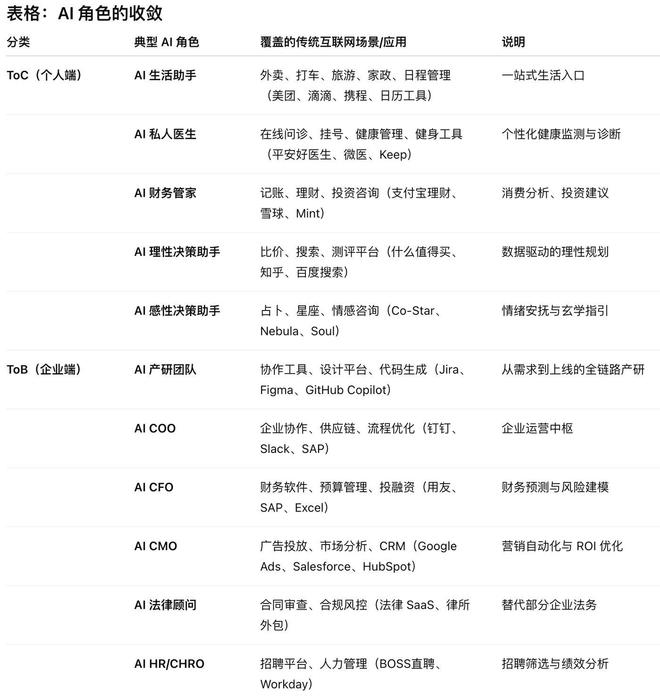
AI竞争的终局:12个高价值的AI角色
Tai Mei Ti A P P· 2025-09-16 01:43
Core Insights - The competition in the AI era is shifting from "scene mentality" to "role mentality," where AI roles will consolidate into a few core categories that meet high-frequency and essential user needs [1][10]. ToC: Consumer Roles - AI roles for consumers will converge into six main categories that cover various aspects of personal life, reducing the need for multiple apps to a few long-term AI companions [2][10]. - The AI assistant will emerge as the highest value super entry point, serving as a unified interface for all aspects of life and work, with competition occurring between hardware and software companies [2][10]. - Software companies, particularly those represented by large models like OpenAI, are likely to dominate due to their ability to understand and generate data, rapid iteration, and cross-platform capabilities [2][10]. ToB: Business Roles - In the business context, AI roles will reflect organizational needs, mapping directly to key positions within companies [3][10]. - AI roles will include: 1. AI Assistant: Replacing various applications like food delivery and ride-hailing, serving as a unified entry point [4]. 2. AI Personal Doctor: Covering health monitoring and basic diagnostics [4]. 3. AI Financial Manager: Acting as a personal accountant and investment advisor [4]. 4. AI Rational Decision Assistant: Providing data-driven choices for consumption and career planning [4]. 5. AI Emotional Decision Assistant: Offering emotional support and non-rational decision-making [4]. 6. AI Learning/Growth Partner: Supporting education and self-improvement [4]. Virtual Management Team - AI roles in businesses will create a virtual management team that includes: 1. AI Product Research Team: A virtual combination of product, design, and engineering roles [5]. 2. AI COO: Optimizing operations and enhancing inter-departmental collaboration [5]. 3. AI CFO: Providing financial forecasting and risk modeling [5][6]. 4. AI CMO: Automating marketing strategies and optimizing ROI [6]. 5. AI Legal Advisor: Handling contract reviews and compliance [7]. 6. AI HR/CHRO: Managing recruitment and performance [8]. Conclusion - The evolution of AI roles will follow a path from fragmentation to convergence, with a focus on high-frequency and essential needs leading to the establishment of stable, reliable core roles for both consumers and businesses [10][11]. - The future competition will center on the trustworthiness and irreplaceability of AI roles rather than the number of app functionalities [11].

这家国产大模型公司年收入破10 亿了?
Hu Xiu· 2025-07-26 13:56
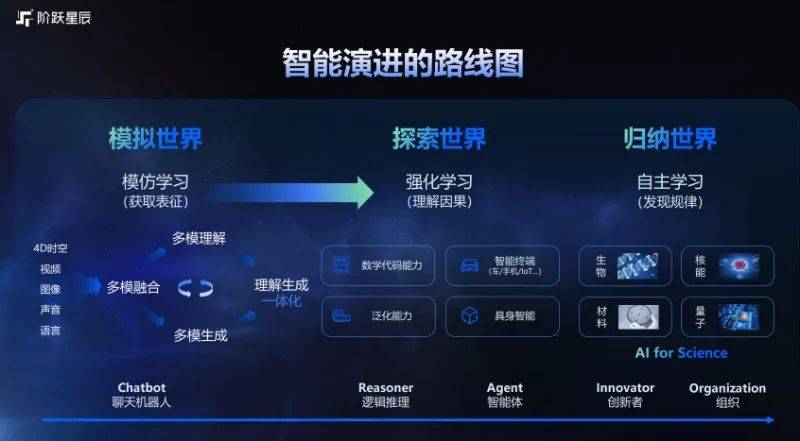
Core Viewpoint - The rapid revenue growth of domestic AI model company Jiyue Xingchen, which is projected to reach nearly 1 billion in 2025, indicates a significant shift in the commercialization capabilities of domestic large models, potentially marking a new threshold for revenue in the industry [5][12][52]. Group 1: Event Overview - The WAIC World Artificial Intelligence Conference is a major annual event in the AI industry, attracting significant attention from both the industry and investment circles, with high-profile attendees including the Prime Minister [2]. - The conference serves as a platform for many important announcements from AI companies [4]. Group 2: Company Performance - Jiyue Xingchen, established only two years ago, has shown remarkable revenue growth, with last year's figures reportedly only in the tens of millions [7]. - The company focuses on foundational model research rather than easily monetizable AI applications, which makes its revenue growth even more impressive [8]. Group 3: Market Comparison - Other domestic large model companies have not disclosed revenue figures, but it is noted that Zhiyu's revenue was around 200-300 million last year, primarily from customized private sector services [9]. - The previous generation of AI companies typically took 3-4 years to surpass 1 billion in revenue, often leveraging rapid adoption in sectors like security and finance [11]. Group 4: Technological Advancements - Jiyue Xingchen has positioned itself as a leader in multi-modal capabilities, with its latest model, Step 3, achieving state-of-the-art results across various benchmarks [24]. - The Step series encompasses a wide range of functionalities, including text, speech, image, video generation, and more, making it versatile for numerous applications [25]. Group 5: Industry Collaboration - The company has formed a "Model and Chip Ecological Innovation Alliance" with nearly ten chip and infrastructure manufacturers, enhancing collaboration and technology sharing [35]. - This collaboration aims to optimize the performance of domestic chips in supporting large models, addressing the current gap between domestic and international chip capabilities [38]. Group 6: Market Applications - Jiyue Xingchen's technology is being integrated into various sectors, including automotive, mobile devices, and smart consumer electronics, with notable partnerships with major manufacturers [42][43]. - The demand for multi-modal capabilities is increasing, as evidenced by an 800% increase in model calls from smart terminals in the first half of the year compared to the previous half [48].
老板电器(002508) - 2025年5月19日投资者关系活动记录表
2025-05-21 09:26
Group 1: Product and Market Strategy - The company is expanding its product matrix to provide comprehensive cooking solutions, covering a range of products from core items like range hoods and stoves to high-value categories such as dishwashers and water heaters, addressing diverse consumer needs [2] - The company is enhancing its e-commerce presence and reaching broader user groups through deeper market penetration strategies [2] - In the high-end market, the company is reinforcing its technological advantages and brand positioning to resist low-price competition, ensuring industry leadership [2] Group 2: Overseas Market Expansion - The company has a clear strategy for overseas market expansion, focusing on North America, Australia, New Zealand, and Southeast Asia [3] - Subsidiaries have been established in North America and Indonesia, with plans for strategic acquisitions of local quality targets to quickly increase market penetration [3] - Customized products will be developed based on local demands, leveraging the mature domestic supply chain to accelerate global expansion [3] Group 3: Dividend Policy - The company adheres to a "steady operation, win-win development" philosophy, maintaining a cash dividend policy of at least 50% annually [4] - Future dividend levels may be increased, reflecting confidence in business prospects and commitment to shareholder returns, contingent on sustained growth and ample cash flow [4] Group 4: Industry Structural Changes - The company views the shift from incremental to stock market adjustments as a strategic opportunity, aiming for breakthroughs through innovation and efficiency improvements [5] - Increased investment in e-commerce channels is intended to capture online traffic, while integrated and suite products will enhance competitive differentiation [5] - The company is actively integrating resources in the stock market to expand market share and solidify its leading position in the industry [5] Group 5: AI Technology Application - The company has initiated AI developments, launching an AI assistant in its app that recommends dishes based on user preferences and health conditions, integrating with smart appliances [6] - Future plans include the development of AI hardware products to enhance product intelligence [6] - AI technology will also play a crucial role in production processes, improving efficiency, reducing costs, and optimizing product quality, thereby enhancing brand technological leadership [6]
