
AI SSD

Search documents
解读AI存算加速系统大机遇
2026-03-26 13:20
解读 AI 存算加速系统大机遇 20260324 摘要 AI 存储已成为算力瓶颈,智算中心存储投资占比从 1%提升至 10%- 15%,中国市场 CAGR 超 40%。 风行智远定位 2.5 代智能存储,通过存算直通技术绕过 CPU,使数据吞 吐提升 2-4 倍,能耗降低 30%-40%。 硬件层面推行"以存代算",利用智能硬盘处理 KVCache 等中间数据, 访存成本可降至原方案的 1/50。 针对 DeepSeek 等 MoE 模型,该方案可将推理总成本降低约 30%,显 著减少对昂贵 HBM 和高算力 CPU 的依赖。 训练场景下,智能存储支持故障后增量更新,无需频繁写入全量 Checkpoint,可节省约 11%的训练总成本。 对标海外估值 300 亿美元的 VAST Data,公司已导入三大运营商及国 产 GPU 头部客户,切入存量中心改造与新建市场。 Q&A 在当前 AI 大模型时代,存储系统面临哪些瓶颈,以及由此带来了怎样的市场机 遇? 请介绍一下风行智远的公司定位、核心产品布局以及团队背景? 风行智远致力于成为国产 AI 算力与加速应用的领航者。当前大模型时代,存储 系统已成为关键瓶颈,公司 ...
未知机构:东吴计算机春节海内外AI催化不断聚焦最确定的AIinfra20260-20260224
未知机构· 2026-02-24 03:30
Summary of Conference Call Records Industry Overview - The conference call discusses the AI infrastructure industry, highlighting the rapid advancements and product launches from major players such as Alibaba, ByteDance, Zhiyu, Kimi, Minimax, and Google during the Spring Festival period [1][1]. - The demand for AI infrastructure is increasing, particularly in the context of new storage architectures due to ongoing storage shortages [1][1]. Key Points and Arguments - **Token Usage Surge**: OpenClaw's token usage increased to approximately 13% of all tokens on OpenRouter within two weeks, indicating a growing interest in this platform [1][1]. - **Storage Shortages**: Hynix reported that all customer demands cannot be met, with DRAM and NAND inventory levels only sufficient for about four weeks [2][2]. - **New Product Launches**: SanDisk is expected to launch new HBF products, while there is a recommendation for new storage GPU-native database directions, particularly highlighting Xinghuan Technology's rapid progress [2][2]. - **Pricing Trends**: Following the release of new models by Zhiyu, there has been a simultaneous increase in GLMCoding Plan and API prices, reflecting the strong demand for computing power [2][2]. - **Rising Rental Prices**: The rental prices for computing power in overseas markets (H, A, B cards) continue to rise, indicating a robust demand for computational resources [2][2]. Additional Important Content - **Domestic Model Success**: Four Chinese models ranked among the top five globally in terms of usage from February 16 to February 22, showcasing China's competitive position in the global AI landscape [3][3]. - **Impact on Domestic Computing Demand**: The success of Chinese large models is expected to drive demand for domestic computing power, with relevant companies including Haiguang Information, Zhongke Shuguang, Cambrian, and others identified as key players [4][4]. - **Risks**: Potential risks include the underdevelopment of AI technology and geopolitical tensions between China and the United States [4][4].
NAND闪存需求爆棚,“二线联盟”铠侠和闪迪的崛起
Hua Er Jie Jian Wen· 2026-01-29 04:04
Core Insights - NAND is transitioning from a cyclical commodity to a critical component of AI infrastructure, with structural changes in demand elevating prices and valuations, bringing companies like Kioxia and SanDisk into the spotlight [1][2] - The shift in AI workloads from training to inference is expanding the deployment of SSDs in AI data centers, significantly increasing the procurement scale of NAND flash memory [2] Group 1: Market Dynamics - The demand for NAND is no longer solely dependent on traditional consumer electronics but is increasingly tied to capital expenditures and architectural evolution on the data center side [2] - The rapid expansion of AI infrastructure has created a significant supply gap, prompting data center operators to actively seek a diversified supplier base [2] - According to TrendForce, by Q3 2025, Samsung leads the market with a 32.3% share, followed by SK Hynix at 19.3%, Kioxia at 15.3%, and SanDisk at 12.4%, indicating a rise in influence for Kioxia and SanDisk [2] Group 2: Strategic Alliances - Kioxia and SanDisk have maintained a deep collaboration for over 25 years, operating major NAND production sites in Japan, which are among the largest globally [3] - The companies jointly develop BiCS FLASH 3D NAND technology, currently at its 8th generation, with plans for the 10th generation, featuring over 300 layers, to begin production in 2026 [3] Group 3: Technological Focus - Kioxia primarily supplies large electronic manufacturers in Japan and globally, while SanDisk dominates the consumer storage market and has a strong presence in the enterprise SSD sector in North America and overseas [4] - SanDisk aims to integrate HBF (High Bandwidth Flash) into products from NVIDIA, AMD, and Google by late 2027 to early 2028, offering larger capacities at lower costs compared to HBM [4][5] - Kioxia is focusing on a performance leap in SSDs, planning to launch a new type of hard drive by 2027 that approaches 100 times the speed of current products, in collaboration with NVIDIA for generative AI servers [5] Group 4: Market Expectations - The ongoing demand for NAND driven by AI inference is a central narrative, with Kioxia's market capitalization surpassing 10 trillion yen and SanDisk's aggressive price increase plans reinforcing expectations for NAND's recovery in profitability [6] - Key variables for the next phase include the sustainability of price increases translating into profit improvements, the timely realization of technological advancements like BiCS10 and HBF, and the management of competitive boundaries between Kioxia and SanDisk to avoid internal conflicts [6]
AI需求推动,NAND与SSD供不应求有望持续
Orient Securities· 2026-01-11 02:15
Investment Rating - The report maintains a "Positive" investment rating for the electronic industry, specifically focusing on NAND and SSD sectors driven by AI demand [6]. Core Insights - AI applications are expected to drive a rapid increase in SSD usage, leading to a prolonged boom cycle for both SSD and NAND markets [3][10]. - The global data volume is projected to grow significantly, with active data becoming a larger portion due to AI model applications [19][31]. - The demand for SSDs is anticipated to rise sharply as they meet the high throughput requirements for active data in data centers, surpassing traditional HDDs [10][34]. Summary by Sections 1. AI - The application of AI models is expected to significantly increase the proportion of active data, transforming previously dormant data into frequently accessed data [21][22]. - By 2030, it is estimated that 100% of hot data will be stored on SSDs, reflecting a shift in data storage paradigms [22]. 2. SSD - SSDs are favored for their high read/write speeds and ability to handle high workloads, making them suitable for active data storage in data centers [34][40]. - The power efficiency of SSDs is a significant advantage, especially as data center power demands increase [48][51]. - AI training and inference are driving the development of AI SSDs, which require high performance, large capacity, and energy efficiency [54][56]. 3. NAND - The NAND market is expected to experience a prolonged period of supply-demand imbalance, with limited capital expenditure from leading manufacturers [10][11]. - The concentration of the global NAND market is high, with major players like Samsung, Micron, and SK Hynix focusing on high-bandwidth memory (HBM) rather than expanding NAND production [10][11]. 4. Enterprise SSD - The report highlights several key companies in the semiconductor and storage sectors that are well-positioned to benefit from the ongoing trends, including domestic semiconductor equipment manufacturers and storage module companies [3][13].


MTS2026集邦咨询存储产业趋势研讨会演讲精华汇总
Sou Hu Cai Jing· 2025-11-28 13:36
Core Insights - The "MTS2026 Storage Industry Trend Seminar" and the release of the "2026 Top Technology Market Trends Forecast" were successfully held in Shenzhen, gathering over a thousand industry elites and analysts, highlighting the industry's keen interest in future trends [1][37] - The impact of AI on the storage industry was emphasized, with a focus on real demand and significant changes in the high-tech manufacturing supply chain [1] Group 1: Industry Growth and Trends - TrendForce forecasts a 19% annual growth in the wafer foundry industry for 2026, with AI-related demand driving advanced process markets to a remarkable 28% growth [5] - The global data volume is expected to grow at a compound annual growth rate of approximately 40%, necessitating higher performance from data centers [7] - AI servers and general servers are driving a new super cycle in memory, with AI and server-related applications projected to account for 66% of DRAM total capacity by 2026 [17] Group 2: Technological Innovations - Intel's new Xeon 6 series processors are positioned as the preferred choice for global AI servers, featuring performance enhancements and innovative architectures to support AI workloads [7][8] - Solidigm is leading the QLC product market and has introduced high-performance PCIe 5.0 SSDs to meet the demands of AI workloads, enhancing storage efficiency and performance [20] - The introduction of HBF (High Bandwidth Flash) and AI SSDs is expected to reshape the NAND industry value, addressing storage bottlenecks caused by the explosion of LLM parameters [34] Group 3: Market Dynamics and Competitive Landscape - The competition in the AI server market is intensifying, with major players like NVIDIA and AMD leading the GPU AI market, while Chinese companies are increasingly focusing on self-developed ASICs [29] - The memory market is anticipated to face severe shortages, with DRAM ASP expected to rise by 36% in 2026, leading to a projected 56% increase in DRAM revenue [17] - The demand for advanced packaging technologies is growing, with companies like 时创意 adopting innovative processes to meet the requirements of AI-driven applications [13][14]

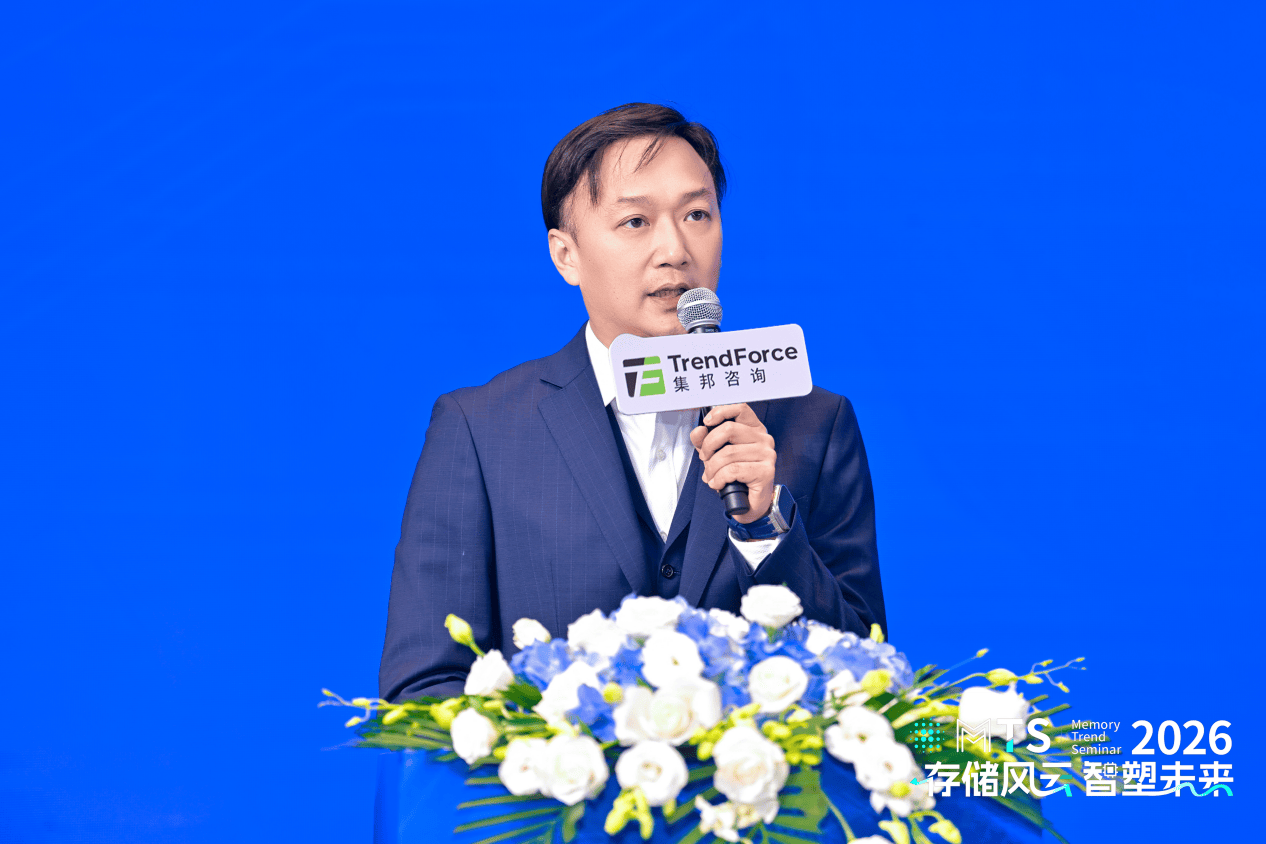
干货分享 | MTS2026 TrendForce存储产业趋势研讨会解码未来图景
TrendForce集邦· 2025-11-28 10:05
Core Insights - The article discusses the trends and predictions for the semiconductor and storage industries, emphasizing the impact of AI on market dynamics and technology advancements [4][10][17]. Group 1: AI and Semiconductor Industry Trends - The wafer foundry industry is expected to grow by 19% in revenue in 2026, with AI-related demand driving advanced process markets to a remarkable 28% growth [10]. - TSMC has begun production using 2nm technology and plans to advance to 1nm processes, indicating a significant technological shift in the semiconductor sector [10]. - The demand for AI chips is expected to surge, with major cloud providers launching their own AI chips, highlighting the competitive landscape in the semiconductor market [10]. Group 2: AR Glasses and AI Integration - AI and AR glasses are forming a symbiotic relationship, enhancing user interaction and accelerating data accumulation for large language models [12]. - The global shipment of AR glasses is projected to exceed 10 million units by 2030, driven by major brands like Google and Apple entering the market [13]. - China plays a crucial role in the AR glasses market, with significant contributions in manufacturing and supply chain integration [14]. Group 3: Memory Market Dynamics - AI servers and general servers are driving a new super cycle in the memory market, with AI applications expected to account for 66% of DRAM capacity by 2026 [17]. - The DRAM market is anticipated to face severe shortages, with prices expected to rise significantly, leading to a projected 56% increase in DRAM revenue in 2026 [17]. - The competition for limited DRAM capacity is intensifying, particularly as AI server demands begin to outstrip supply for consumer devices [17]. Group 4: Server Market Outlook - Global server shipments are expected to grow by over 9% in 2026, with AI servers leading this growth at over 20% [20]. - The competition in the AI server market is intensifying, with major players like NVIDIA and AMD dominating the GPU AI market while Chinese companies pursue self-developed ASIC solutions [20]. Group 5: Power Semiconductor Transformation - The demand for power semiconductors is shifting due to AI, with SiC and GaN technologies becoming critical for high-voltage power supply architectures [22]. - SiC technology is establishing a leadership position in high-voltage applications, while GaN is entering a rapid growth phase across multiple applications, including AI data centers [22][24]. Group 6: NAND Flash Market Innovations - The AI boom is creating storage bottlenecks, leading to a shift towards high-density QLC eSSD due to limited supply in traditional HDD markets [27]. - New NAND Flash technologies are emerging, such as HBF and AI SSD, which aim to enhance performance and address storage challenges in AI applications [27]. - The NAND Flash industry is expected to thrive amid ongoing supply shortages, with innovations reshaping its value proposition [27].
国泰海通|电子:打破内存墙限制,AI SSD迎来广阔成长空间
国泰海通证券研究· 2025-10-28 12:00
Core Viewpoint - The article discusses the challenges faced by large language models (LLMs) due to the "memory wall" issue and proposes SSD-based storage offloading technology as a new path for efficient AI model operation [1]. Group 1: Industry Insights and Investment Recommendations - The massive data generated by AI is impacting global data center storage facilities, leading to a focus on KV Cache caching that can offload from GPU memory to CPU and SSD [1]. - The traditional Nearline HDD, which has been a cornerstone for massive data storage, is experiencing supply shortages, prompting a shift towards high-performance, high-cost SSDs, resulting in an "overweight" rating for the industry [1]. Group 2: KV Cache Technology and Its Implications - The growth of KV Cache capacity is exceeding the capabilities of HBM, as it temporarily stores generated tokens to optimize computational efficiency and reduce redundant calculations [2]. - As the demand for larger models and longer sequences increases, the reliance on HBM is becoming a bottleneck, leading to frequent memory overflows and performance issues [2]. Group 3: Technological Developments in Storage Solutions - The industry is exploring tiered caching management technologies for KV Cache, with NVIDIA launching a distributed inference service framework called Dynamo to offload KV Cache from GPU memory to CPU, SSD, and even network storage [3]. - Samsung has proposed an SSD-based storage offloading solution to address the "memory wall" challenge, which can reduce the first token latency by up to 66% and inter-token latency by up to 42% when KV Cache size exceeds HBM or DRAM capacity [3]. Group 4: Market Trends and Supply Chain Dynamics - The demand for AI storage is driving a replacement effect for HDDs, with NAND Flash suppliers accelerating the production of large-capacity Nearline SSDs due to significant supply gaps in the HDD market [4]. - NAND Flash manufacturers are investing in the production of ultra-large capacity Nearline SSDs, such as 122TB and even 245TB models, to meet the growing demand from AI inference applications [4].
超级周期启动!谁是科技板块“最强风口”?丨每日研选
Shang Hai Zheng Quan Bao· 2025-10-28 00:49
Group 1: Semiconductor Sector Insights - The "14th Five-Year Plan" focuses on domestic key core technology areas, with equipment being a direct beneficiary. Short-term AI computing power demand is driving expansion among domestic and foreign logic and storage chip manufacturers, leading to strong demand for etching and thin film deposition equipment. Long-term, the localization process under the "14th Five-Year Plan" technology self-reliance strategy is more solid [1] - The semiconductor supercycle is expected to be driven by general artificial intelligence, with a forecast of a 100,000-fold increase in total computing power by 2035. Continuous optimism for AI driving the semiconductor supercycle across the entire industry chain, with key stocks including SMIC, Hua Hong Semiconductor, and Cambrian [2] - AI-generated massive data is impacting global data center storage facilities, leading to a significant supply shortage of Nearline HDDs. This is prompting flash memory manufacturers to accelerate the production of ultra-large capacity Nearline SSDs, making high-performance SSDs a market focus [3] Group 2: Storage Market Dynamics - AI demand is significantly increasing storage needs, resulting in a substantial rise in storage prices. The transition of storage manufacturers to HBM, DDR5, and large-capacity NAND is causing higher price increases for DDR4 and small-capacity NAND, further driving up storage prices due to downstream stockpiling demand. The storage market's favorable conditions are expected to persist due to strong growth in AI computing power demand [4] - The technology sector, represented by AI, is expected to continue leading the market. Companies like Haiguang Information and Cambrian have reported significant performance increases, with ample inventory reserves, indicating a sustained high growth trend for the year [5]


存力短板待补,英韧科技披露产品迭代计划
Di Yi Cai Jing· 2025-09-30 01:28
Core Insights - The performance of some GPUs is hindered by insufficient storage speed, leading to underwhelming application results and overall efficiency limitations [2][3] Group 1: Storage and GPU Performance - The main issue affecting GPU performance is the waiting time for storage data, which results in resource wastage and restricts efficiency improvements [2] - The demand for storage solutions is increasing as the pace of computational power development accelerates [2] - New AI scenarios will require SSDs to adopt GPU direct scheduling methods to achieve high throughput and performance [2] Group 2: Market Trends and Innovations - Companies like 英韧科技 are focusing on enterprise-level storage solutions tailored for AI applications, aligning with international trends [2] - Recent product launches include "AI SSD" by 铠侠 and ultra-high-speed products by 三星 and 海力士, designed to meet the demands of AI GPU data scheduling [2] Group 3: Technical Requirements for AI SSDs - Key performance indicators for storage in data centers include high IOPS, low latency, and QoS, which define storage capabilities from efficiency, response speed, and stability perspectives [3] - The construction of AI SSDs requires three main elements: media with low latency and high transfer efficiency, high-speed interfaces and protocols, and a simple yet efficient architecture [3] Group 4: Competitive Product Development - 英韧科技's latest Dongting-N3X series utilizes PCIe Gen5 interface and new XL-Flash media to meet current AI SSD application demands [4] - Future product iterations are planned, with expectations to reach 10M IOPS by 2026 and 25-50M IOPS by 2027, along with the integration of NVMe and CXL protocols [4]
AI周观察:AI驱动美光业绩高增长,阿里发布系列新模型
SINOLINK SECURITIES· 2025-09-28 11:48
Investment Rating - The report maintains a positive outlook on the industry, particularly highlighting the growth potential in AI-driven sectors and advanced memory technologies [12][22]. Core Insights - The report emphasizes the significant growth in the AI application landscape, with notable advancements from companies like Alibaba and DeepSeek, showcasing their competitive models [11][12]. - Micron Technology reported a record revenue of $11.3 billion for FY25Q4, driven by strong demand in data centers and a focus on high-value products like HBM and AI SSDs [12][22]. - OpenAI is expanding into the hardware sector, collaborating with key suppliers to develop consumer-grade AI devices, indicating a strategic shift towards integrated AI solutions [23]. Summary by Sections AI Application Growth - Gemini's activity has seen a substantial increase, while domestic applications like Doubao are also growing steadily [9][11]. - Alibaba's Qwen3-Omni and Qwen3-Max models have achieved significant benchmarks, outperforming competitors in various tests [11]. Micron Technology Performance - Micron's FY25Q4 revenue reached $11.3 billion, a 46% year-over-year increase, with data center revenue accounting for 56% of total sales [12][18]. - HBM has become a core growth driver, with Q4 HBM revenue nearing $2 billion, and the company is on track to maintain its market share in DRAM [15][22]. - The company plans to increase capital expenditures to $18 billion in FY26, focusing on DRAM and HBM production [18][22]. OpenAI's Hardware Strategy - OpenAI is developing a pocket-sized AI device in collaboration with key suppliers, aiming to create a new category of "AI companion" devices [23]. - The initiative reflects a broader strategy to reduce reliance on cloud services and enhance user privacy, although it faces challenges in energy efficiency and market acceptance [23].
