
Optimus 机器人

Search documents
高端制造行业周报2026年第12周(2026.3.16-2026.3.22):宇树科技IPO申请获受理,GTC大会释放PCB及液冷增量需求信号-20260323
EBSCN· 2026-03-23 09:21
Investment Rating - The report maintains a "Buy" rating for the high-end manufacturing industry [1] Core Insights - The humanoid robot industry is experiencing significant advancements, with companies like Galaxy General and Digua Robot making notable progress in autonomous capabilities and securing substantial funding [3][4] - Yushu Technology's IPO application has been accepted, aiming to raise approximately 4.202 billion yuan for various projects, with projected revenues and profits showing substantial growth in 2025 [5] - The report anticipates a shift in the robot industry towards mass production and capitalization, driven by technological advancements and market demand [6] Summary by Sections Humanoid Robots - Galaxy General launched the world's first fully autonomous tennis humanoid robot, showcasing advanced skills and high success rates in gameplay [3] - Digua Robot completed a $120 million Series B financing round, bringing total funding to $220 million [3] - Coconuts Group plans to procure 50 humanoid robots for coconut processing, indicating a growing market for humanoid robots in agriculture [4] Investment Recommendations - The report suggests focusing on companies involved in high-complexity dexterous hands, screw production, reducer supply chains, six-dimensional force sensors, and precision injection molding [6][7] North American AI Industry Chain - The demand for power in data centers is surging, with significant contracts being signed for steam turbines and power supply agreements, indicating a robust growth trajectory for the AI sector [8][9] - NVIDIA's GTC conference highlighted the importance of liquid cooling solutions for AI data centers, suggesting a shift in cooling technology [10][12] PCB Industry - The demand for high-end PCBs is expected to rise due to advancements in AI technology and the introduction of new products at NVIDIA's GTC conference [13][14] - Pengding Holdings announced a significant investment in a high-end PCB production base, reflecting the industry's growth potential [14] Solid-State Battery Equipment - Several companies are advancing in solid-state battery technology, with plans for mass production and significant improvements in energy density [15][17] - The report highlights the positive outlook for the solid-state battery industry, driven by technological advancements and supportive policies [17] General & Specialized Machinery - The global demand for mining machinery is expected to increase due to rising metal prices and the need for more equipment to maintain production levels [18] - The report notes a significant increase in exports of mining machinery and tools, indicating a strong international market presence [19][20]

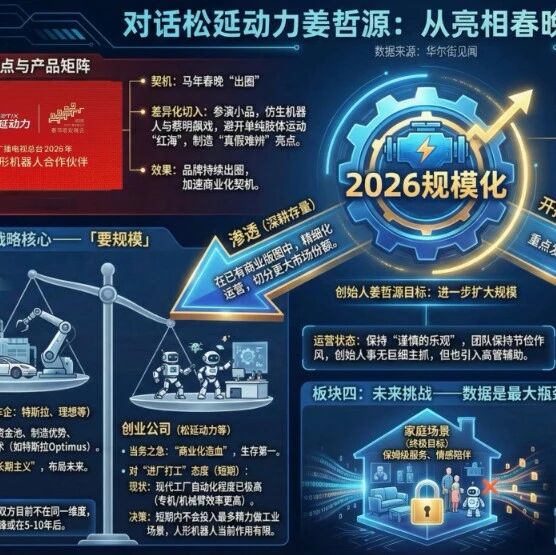
对话松延动力创始人姜哲源:从亮相春晚到「要规模」
华尔街见闻· 2026-02-17 11:30
Core Viewpoint - The article discusses the growth and challenges faced by Beijing Songyan Power Technology Group Co., Ltd. (Songyan Power) in the humanoid robot industry, highlighting its recent appearance on the Spring Festival Gala as a significant opportunity for brand exposure and commercialization [2][6][12]. Group 1: Company Overview and Strategy - Songyan Power's founder, Jiang Zheyuan, plans to expand the company's scale by 2026, focusing on two key strategies: "penetration" into existing markets and "exploration" of untapped markets, particularly in K12 education and consumer-grade robots [3][16][45]. - The humanoid robot "Xiao Bumi" is priced at around 10,000 yuan, aimed at making technology accessible to a broader range of educational institutions, especially those that cannot afford more expensive options [17][49]. Group 2: Market Competition and Challenges - The entry of automotive companies like Tesla and Li Auto into the humanoid robot market poses a challenge for startups, but Jiang remains cautiously optimistic, believing that the competition will not intensify for another five to ten years [5][24][60]. - The global demand for humanoid robots in industrial applications is projected to reach 30,000 units by 2026, indicating a growing market, although there are concerns about the actual suitability of humanoid robots for factory work due to existing automation technologies [25][28][31]. Group 3: Data and Technological Challenges - The article emphasizes that the biggest challenge for humanoid robots, especially in domestic settings, is the need for extensive and diverse data to enhance their capabilities, which is difficult to obtain due to privacy concerns [34][36][37]. - Jiang points out that while the technology for humanoid robots is advancing, the lack of high-quality data and effective data collection methods remains a significant barrier to achieving widespread adoption [56].

微醺的马斯克聊嗨了:盛赞中国、预言天上的 AI
Sou Hu Cai Jing· 2026-02-07 10:29
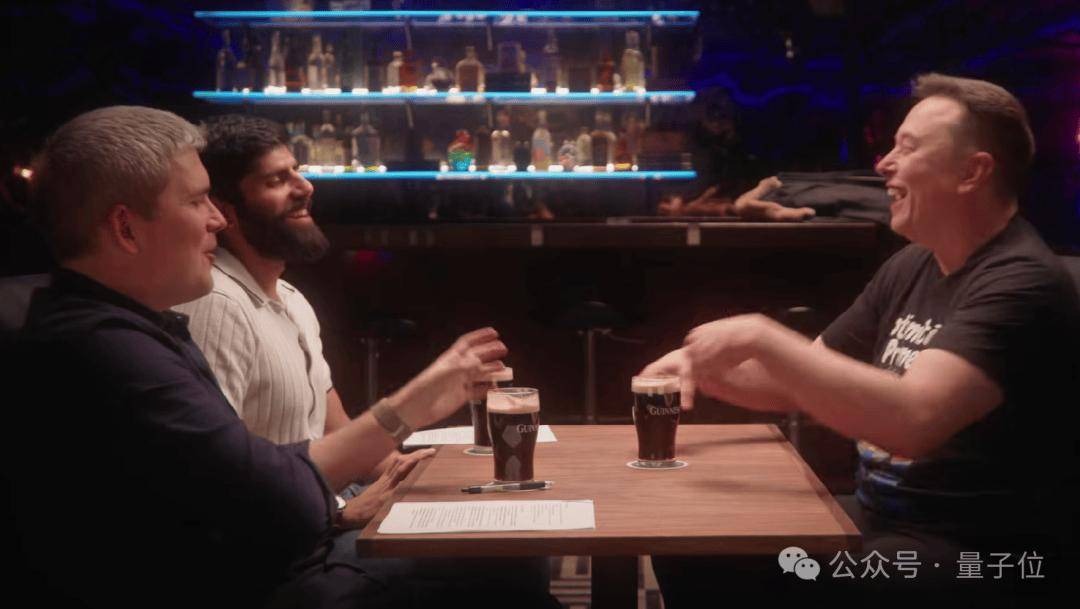
Core Insights - Elon Musk discussed the future of AI infrastructure in space, emphasizing that within 30 to 36 months, space will become the preferred location for AI data centers due to energy efficiency and scalability [4][10][27] - Musk highlighted the challenges of energy supply on Earth, stating that the growth of chip production is outpacing energy production, which could hinder AI development [4][45] - He predicted that in five years, the annual AI computing power launched and operated in space will exceed the cumulative total on Earth, potentially reaching 1 terawatt of power [4][27][74] Group 1: Space as AI Infrastructure - Musk believes that space will be the most economically attractive place for deploying AI due to the efficiency of solar panels in space, which can generate five times the power compared to Earth [8][21] - The construction of data centers in space is seen as a solution to the energy supply issues faced on Earth, where building new power plants is slow and complicated [11][24] - Musk stated that the average power consumption in the U.S. is currently 0.5 terawatts, and achieving 1 terawatt for data centers would require significant infrastructure [11][27] Group 2: Challenges and Innovations - The manufacturing of solar panels for space is expected to be cheaper and easier due to the lack of weather-related constraints, which eliminates the need for robust structures [21][23] - Musk pointed out that the bottleneck in scaling AI infrastructure will shift from energy to chip production once space operations begin [45][46] - He mentioned that the current global chip production capacity is insufficient to meet future demands, necessitating the establishment of large-scale chip manufacturing facilities [38][39] Group 3: Competitive Landscape - Musk warned that without breakthrough innovations in the U.S., China could dominate the AI and manufacturing sectors due to its advanced capabilities and larger workforce [74][75] - He emphasized the importance of addressing energy constraints to maintain competitiveness in the global market [66][67] - The discussion highlighted the need for the U.S. to innovate rapidly to avoid falling behind in AI and robotics, particularly in the context of manufacturing and energy production [75][70]


特斯拉的销量已经不重要了
投中网· 2026-02-06 06:53
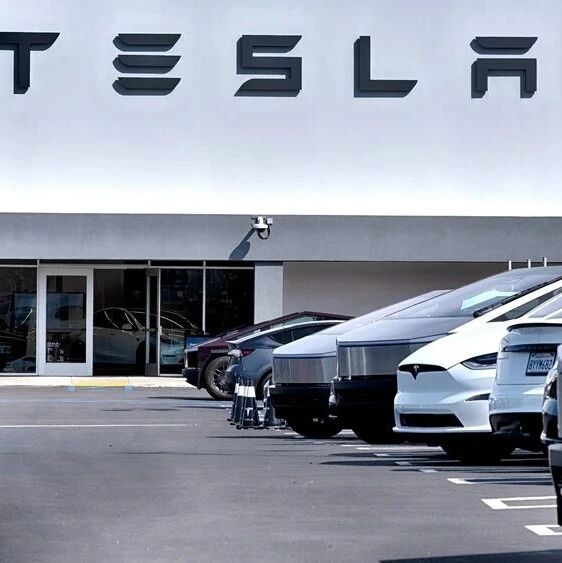
Core Viewpoint - Tesla's financial performance in 2025 shows a significant decline, marking the first annual revenue drop in its history, with total revenue down 3% year-over-year to $94.8 billion and a net income drop of 46% [7][22]. Financial Summary - In Q4 2025, Tesla reported total revenues of $24.9 billion, a 3% decrease year-over-year, with automotive revenues down 11% to $17.7 billion [8][10]. - The company's GAAP net profit for Q4 2025 was $840 million, a 61% decline compared to the previous year, while non-GAAP net profit was $1.76 billion, down 16% [8][10]. - Total gross profit for Q4 2025 was $5.0 billion, with a gross margin of 20.1%, reflecting a 386 basis point increase year-over-year [8]. Delivery and Production - Tesla's total vehicle deliveries in Q4 2025 were 418,227, a 16% decrease year-over-year, with annual deliveries totaling 1.636 million, down 9% [11][20]. - The production of Model 3/Y in Q4 2025 was 422,652 units, a 3% decrease year-over-year, while other models saw a 48% drop in production [12]. Market Response - Despite disappointing financial results, Tesla's stock price remained resilient, closing at $430.46, only a slight drop of 0.1% [14]. - Analysts noted that Tesla's market perception is shifting, viewing it more like a high-risk startup rather than a stable company [15]. Future Investments - Tesla announced a record capital expenditure plan of $20 billion for 2025, focusing on AI, autonomous driving, and robotics [16][29]. - The company plans to build six new factories, including those for battery production and humanoid robots [29]. Autonomous Driving Vision - Elon Musk emphasized that Tesla's future lies in autonomous driving, with plans to produce a new model, CyberCab, designed exclusively for self-driving [24][25]. - Tesla's Full Self-Driving (FSD) subscription model will replace the one-time purchase option, with nearly 1.1 million global paid users reported [26][27]. AI and Robotics - Tesla is investing heavily in AI and robotics, with plans for a new chip factory to support its autonomous driving and AI initiatives [31]. - The company aims to produce 1 million units of its Optimus humanoid robot annually, with the third generation expected to be released soon [29].

马斯克杀死特斯拉
虎嗅APP· 2026-02-04 10:14
Core Viewpoint - Elon Musk is fundamentally reshaping Tesla's identity, moving away from being merely an automotive company to focusing on AI and robotics, indicating a significant shift in business strategy [4][5][11]. Group 1: Tesla's Strategic Shift - During Tesla's 2025 Q4 earnings call, Musk announced the end of the Model S and Model X, symbolizing a departure from traditional automotive manufacturing [7][9]. - Tesla's capital expenditure for 2026 is projected to reach $20 billion, primarily directed towards AI, autonomous driving, and robotics rather than new vehicle development [9][12]. - The Fremont factory is undergoing a transformation to produce 1 million robots annually, indicating a complete shift in Tesla's operational focus [10][18]. Group 2: Market Dynamics and Challenges - The automotive market has become a zero-sum game, with consumers now prioritizing cost-effectiveness over novelty, diminishing the premium associated with electric vehicles [13][15]. - Musk's strategy aims to escape the competitive automotive landscape, where Tesla's valuation could plummet to levels comparable to traditional automakers if it remains focused solely on vehicle sales [14][15]. - The shift from automotive to AI and robotics is seen as a necessary evolution for maintaining Tesla's market value and relevance [15][29]. Group 3: Implications for Competitors - Chinese electric vehicle manufacturers like Xpeng and Li Auto are increasingly showcasing their advancements in robotics, reflecting a growing anxiety about Tesla's strategic direction [20][22]. - The competition is characterized by a fundamental difference in approach: Tesla is leveraging its existing automotive expertise to pivot towards robotics, while competitors are struggling to adapt [23][24]. - The ongoing resource allocation battle within companies highlights the tension between maintaining traditional automotive profitability and investing in future technologies [25][26]. Group 4: The Future of the Automotive Industry - The automotive industry is experiencing a paradigm shift, with traditional metrics like horsepower and range becoming less relevant as companies transition to AI-driven models [28][31]. - The end of the Model S signifies not just the retirement of a flagship model but also the decline of the traditional automotive company definition in the face of advancing AI technologies [29][30].

汽车行业周报:特斯拉举行2025Q4业绩财报会,比亚迪天神之眼5.0辅助驾驶发布-20260202
Guohai Securities· 2026-02-02 08:02
Investment Rating - The report maintains a "Recommended" rating for the automotive industry [1] Core Insights - Tesla's total revenue for 2025 was $94.827 billion, a 3% year-on-year decline, marking its first revenue drop. The net profit for the year was $3.794 billion, down 46% year-on-year. In Q4 2025, total revenue was $24.901 billion, also down 3%, with a net profit of $840 million, down 61% year-on-year. Tesla plans to focus on autonomous driving, robotics, and AI, with a new model, Cybercab, set to launch in April 2026 [5][13] - BYD launched its Tian Shen Zhi Yan 5.0 advanced driver assistance system, which incorporates enhanced learning capabilities and claims to improve driving stability and response times. As of December 31, 2025, BYD's assisted driving vehicle ownership exceeded 2.56 million, generating over 160 million kilometers of data daily [6][14] - The automotive industry is expected to face challenges in 2026 due to the reduction of new energy vehicle purchase tax incentives and trade-in subsidies. However, there are opportunities in the high-end upgrade of domestic brands and the acceleration of smart technology integration [15][16] Summary by Sections Recent Developments - Tesla held its Q4 2025 earnings call on January 29, 2026, announcing a strategic focus on autonomous driving and AI, with plans for significant capital expenditures exceeding $20 billion in 2026 [5][13] - BYD's Tian Shen Zhi Yan 5.0 was announced on January 28, 2026, featuring a new technology framework for enhanced learning capabilities [6][14] Market Performance - From January 26 to January 30, 2026, the automotive sector underperformed the Shanghai Composite Index, with the automotive index down 5.1% compared to a 0.4% decline in the Shanghai Composite [17][24] Industry Trends - The report highlights a shift towards high-end domestic brands and the integration of smart technologies in the automotive sector, recommending companies such as Jianghuai Automobile, Leap Motor, Great Wall Motors, and BYD for investment [15][16]

特斯拉的销量已经不重要了
虎嗅APP· 2026-01-29 14:10
Core Viewpoint - Tesla's delivery volume is no longer a key focus for the market, as confidence in the company remains high despite declining sales figures. The company reported its first annual revenue decline since its inception, with a 3% drop in revenue for both the fourth quarter and the full year of 2025 [6][11]. Financial Performance - In Q4 2025, Tesla's revenue was $24.9 billion, down 3% year-over-year, with a full-year revenue of $94.8 billion, also down 3% [6][8]. - Tesla's GAAP net profit for Q4 2025 was $840 million, a significant drop of 61% year-over-year, while the non-GAAP net profit was $1.76 billion, down 16% [6][8]. - The automotive revenue decreased by 11% year-over-year to $17.69 billion in Q4 2025, with a full-year automotive revenue of $69.5 billion, marking a 10% decline [8][11]. Delivery and Production - Tesla's total vehicle deliveries in Q4 2025 were 418,227, a 16% decrease year-over-year, with an annual total of 1.636 million vehicles delivered, down 9% [8][15]. - Production of Model 3/Y in Q4 2025 was 422,652 units, reflecting a 3% decrease year-over-year, while total production was down 5% [9][10]. Market Reaction - Despite disappointing financial results, Tesla's stock price remained resilient, closing at $430.46, only a slight drop of 0.1% [11]. - Analysts noted that Tesla is perceived more like a high-risk startup rather than a stable company, as it continues to attract investor interest despite declining revenues and profits [11][12]. Future Plans and Investments - Tesla announced a record capital expenditure plan of $20 billion for 2025, focusing on AI, autonomous driving, and robotics [11][26]. - The company plans to build six new factories, including those for lithium refining and battery production, and aims to produce 1 million units of its Optimus robot annually [26][29]. Autonomous Driving Vision - Elon Musk emphasized that Tesla's future lies in autonomous driving, with plans to produce vehicles designed solely for this purpose, such as the CyberCab [19][23]. - Tesla's Full Self-Driving (FSD) subscription model will replace the one-time purchase option, with nearly 1.1 million global paid users reported [24][23]. Competitive Landscape - Musk acknowledged that competition in the humanoid robot space is significant, particularly from Chinese companies, but asserted that Tesla's Optimus will outperform others [28][29]. - The company is also planning to establish its own semiconductor manufacturing facility to support its AI and autonomous driving initiatives, addressing potential supply chain constraints [29].
“机器人永不疲倦”:现代解释了为何其波士顿动力Atlas机器人准备接管工厂,却不愿接管你的家
Xin Lang Cai Jing· 2026-01-26 21:27
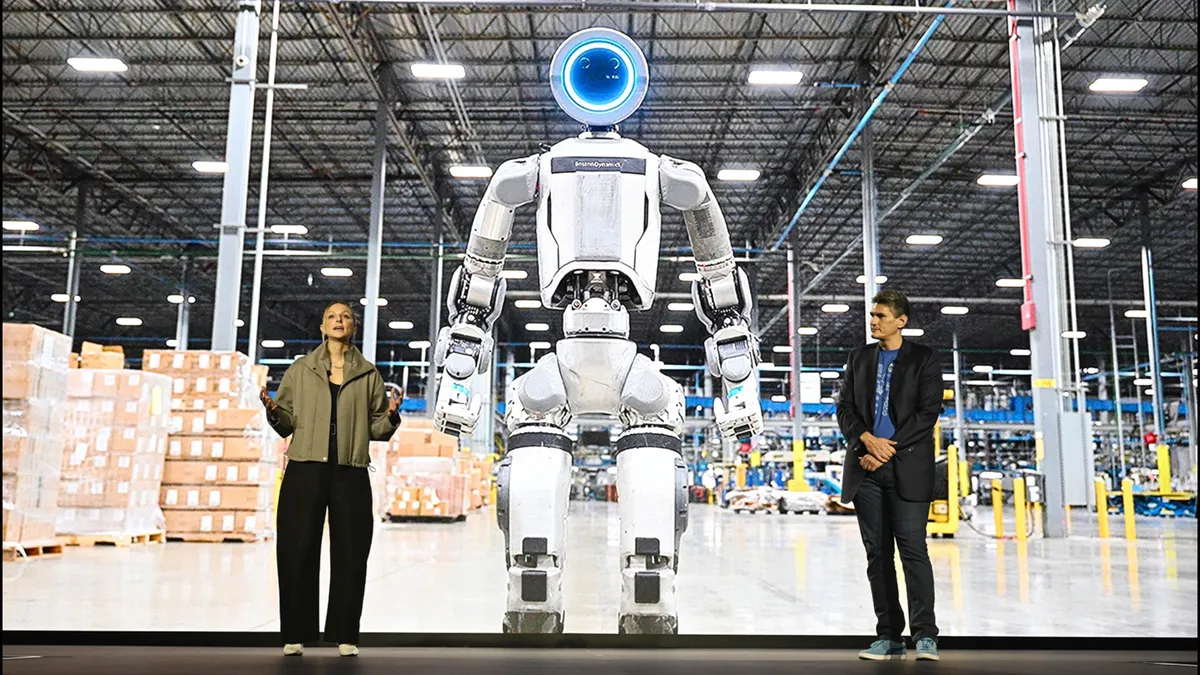
Core Insights - The CES 2026 showcased humanoid robots, with Hyundai's Atlas robot capturing significant attention, shifting perceptions from novelty to serious industrial application [1][4]. Group 1: Product Features and Capabilities - Atlas, developed by Boston Dynamics, weighs 90 kg and stands 1.5 meters tall, with a maximum reach of 2.29 meters [1]. - The robot features 56 degrees of freedom, allowing it to perform tasks such as moving automotive parts without walking, and it can handle delicate items with precision [4]. - Atlas is designed for outdoor use and can autonomously return to a charging dock when its battery is low [4]. Group 2: Production and Deployment Plans - Mass production of Atlas will begin at Hyundai's new Robotics Meta Factory Application Center (RMAC), with an expected cumulative output of 30,000 units by 2030 [2]. - The deployment of Atlas robots in Hyundai's smart factories is set to start in 2028 [2]. Group 3: Market Position and Competitive Advantage - Boston Dynamics, backed by Hyundai Motor Group, believes it has a competitive edge due to its established commercialization path and comprehensive service system [12]. - The company emphasizes the versatility of Atlas, which can perform various tasks, unlike other specialized robots [9]. Group 4: Industry Trends and Future Outlook - The industry is experiencing a competitive race in practical robot development, with players like Tesla and Chinese manufacturer Zoomlion also entering the market [12]. - The CEO of Boston Dynamics predicts that widespread deployment of robots in factories will occur between 2028 and 2030, while consumer market penetration may take until 2035 [16].

魔法原子、银河通用相继宣布为总台2026春晚机器人合作伙伴
GUOTAI HAITONG SECURITIES· 2026-01-26 13:25
Investment Rating - The report does not explicitly provide an investment rating for the industry Core Insights - The embodied intelligence industry is experiencing significant developments, particularly in the fields of embodied robots and smart vehicles, which are interrelated and mutually beneficial [8][11] - Major companies like Magic Atom and Galaxy General have been announced as partners for the 2026 Spring Festival Gala, highlighting the integration of technology into cultural events [11] - Elon Musk predicts that Tesla's Optimus robot will be publicly available by the end of 2027, indicating a strong future for humanoid robots [12] - OpenAI-backed 1X has released a world model to enhance robots' understanding and reasoning capabilities, marking a step towards self-learning abilities [13] - The humanoid robot shipment for 2025 is projected to exceed 5,500 units, showcasing growth in the sector [13] Summary by Sections 1. Embodied Robot Industry Dynamics - Magic Atom and Galaxy General have been announced as strategic partners for the 2026 Spring Festival Gala, focusing on general robotics and embodied intelligence technology [11] - Tesla's CEO Elon Musk forecasts the public sale of the Optimus robot by the end of 2027, with expectations for advanced capabilities by 2026 [12] - OpenAI's investment in 1X has led to the development of the 1X World Model, enhancing robots' physical world understanding [13] - Yushu Technology clarified that its humanoid robot shipments will exceed 5,500 units in 2025, indicating strong market demand [13] - Recent corporate changes have been made by Xinghai Map and Zhongqing Robotics, transitioning to joint-stock companies [14] 2. Smart Vehicle Industry Dynamics - NineSight has commenced regular operations of its RoboVan fleet in Abu Dhabi, marking a significant milestone in autonomous vehicle deployment [18] - A strategic partnership has been formed between NineSight, Malaysia Post, and ALS to launch Malaysia's first autonomous vehicle testing project [19] - Xijing Technology has won a bid for an autonomous driving project at one of the world's largest container terminals, showcasing advancements in smart logistics [20] - DeepWay has successfully delivered 100 units of its new energy heavy trucks to Shentong Express, indicating a shift towards large-scale operations in logistics [22] 3. Capital Market Dynamics - In the primary market, four significant financing events occurred from January 19 to January 25, 2026, including: - Juwei Technology completed nearly 100 million RMB in Series A financing, focusing on special four-legged robots [23] - Zhejiang Humanoid Robot Innovation Center raised 450 million RMB in Pre-A financing [24] - Zhi Ping Fang completed A+ round financing to accelerate the industrialization of general intelligent robots [25] - Yufan Intelligent raised 513 million RMB in Pre-IPO+ financing [26] - In the secondary market, the humanoid robot index rose by 1.38%, while the smart vehicle index fell by 1.06% during the same period [27][28]
【具身智能产业动态】魔法原子、银河通用相继宣布为总台2026春晚机器人合作伙伴
GUOTAI HAITONG SECURITIES· 2026-01-26 12:50
Investment Rating - The report does not explicitly provide an investment rating for the embodied intelligence industry Core Insights - The embodied intelligence industry is characterized by the development of humanoid robots and smart vehicles, which are interdependent and share technological advancements [8][11] - Recent partnerships and collaborations, such as Magic Atom and Galaxy General becoming partners for the 2026 Spring Festival Gala, highlight the growing integration of robotics in cultural events [11][12] - Significant advancements in humanoid robot production are expected, with companies like Yushu Technology projecting over 5,500 units of humanoid robots to be shipped in 2025 [13] Summary by Sections 1. Embodied Robot Industry Dynamics - Magic Atom and Galaxy General have been announced as the robot partners for the 2026 Spring Festival Gala [11] - Elon Musk forecasts the public sale of the Optimus robot by the end of 2027, indicating a significant milestone in humanoid robot commercialization [12] - OpenAI-backed 1X has released its world model, enhancing robots' understanding and interaction with the physical world [13] - Yushu Technology clarified that its humanoid robot shipments will exceed 5,500 units in 2025, with over 6,500 units expected to be produced [13] - Recent corporate changes have been made by Xinghai Map and Zhongqing Robotics, transitioning to joint-stock companies [14] - A strategic partnership between Rulamat and Yuejiang aims to promote the application of embodied intelligence in smart factories [15][16] 2. Smart Vehicle Industry Dynamics - The sales ranking for December shows new energy vehicle deliveries led by Hongmeng Zhixing (89,611 units), Leap Motor (60,423 units), and Fangcheng Leopard (50,868 units) [17] - Jiushi Intelligent has commenced regular operations of its RoboVan fleet in Abu Dhabi, marking a significant step in autonomous vehicle deployment [18] - A strategic collaboration has been established between Jiushi Intelligent, Malaysia Post, and ALS to launch Malaysia's first autonomous vehicle testing project [19] - Xijing Technology has won a bid for an autonomous driving project at one of the world's largest container terminals, showcasing advancements in smart logistics [20] - DeepWay has successfully delivered 100 units of its new energy heavy trucks to Shentong Express, indicating a move towards large-scale operations in logistics [22] 3. Capital Market Dynamics - From January 19 to January 25, 2026, there were four significant financing events in the embodied intelligence sector, including: - Juwei Technology completed nearly 100 million RMB in Series A financing, focusing on special four-legged robots [23] - Zhejiang Humanoid Robot Innovation Center raised 450 million RMB in Pre-A financing [24] - Zhi Ping Fang completed A+ round financing to accelerate the industrialization of general-purpose intelligent robots [25] - Yufan Intelligent secured 513 million RMB in Pre-IPO+ financing [26] - The humanoid robot index rose by 1.38% while the smart vehicle index fell by 1.06% during the same period [27][28]