
Zheng Quan Shi Bao

Search documents
2025年度产业经济十大热点事件: “科技叙事”重塑投资逻辑 “反内卷”再造产业生态
Zheng Quan Shi Bao· 2025-12-28 22:23
Group 1: AI and Technology Developments - The launch of DeepSeek-R1 in January 2025 has become a core investment theme, driving significant capital market momentum and shifting the focus from performance competition to cost, efficiency, and commercialization capabilities in the AI sector [2] - The AI industry has seen a concentration of funds towards leading companies, with notable stock performances such as the "Yi Zhong Tian" combination, which saw gains exceeding 450% [2] - The human-robotics sector has entered a commercialized phase, with over 46 billion yuan in total orders and more than 20,000 units sold, indicating a shift from conceptual collaborations to practical applications [4][5] Group 2: Film and Entertainment Industry - The film "Nezha 2" achieved a record-breaking box office of 15.4 billion yuan, marking a significant milestone for the Chinese animation industry and contributing to a total annual box office of over 50 billion yuan, a 75 billion yuan increase from 2024 [3] - The success of "Nezha 2" and other animated films reflects the growing market potential for domestic animation, providing a reference for future creative and investment strategies in the film industry [3] Group 3: Market Dynamics and Competition - The intense competition in the food delivery industry, initiated by JD's entry with a no-commission model, has led to significant market disruptions and a series of subsidy wars among major platforms, resulting in a 141 billion yuan loss for Meituan's core local business despite record user numbers [7] - Regulatory bodies have intervened to address the chaotic competition, leading to commitments from major platforms to improve service quality and return to rational development [7] Group 4: Capital Market Trends - The A-share market has seen a record high in cash dividends, totaling 2.61 trillion yuan, reflecting an increase in companies' willingness to return profits to shareholders and enhancing market resilience [11] - The emergence of "GPU dual heroes" in the capital market, with multiple domestic GPU companies going public, signifies a milestone for the domestic AI chip industry and a shift towards self-sufficiency [10] Group 5: Industry Regulation and Quality Improvement - The lithium battery supply chain has experienced a price recovery due to regulatory efforts to combat "involution" competition, with lithium carbonate futures seeing significant price increases [12] - The charging battery industry is transitioning to a more orderly development phase following regulatory changes and recalls by major brands, addressing issues of safety and compliance [13]






抓住A股核心机遇不放 二十强基金低配港股
Zheng Quan Shi Bao· 2025-12-28 18:13
Core Insights - In the context of the investment wave towards Hong Kong stocks in 2025, a group of fund managers focusing on core technology assets in the A-share market has achieved impressive performance, with returns ranging from 125% to 236% for the top 20 funds [1][2]. Group 1: Performance and Strategy - The top-performing A-share funds have maintained low exposure to Hong Kong stocks, with many keeping their allocation below 10% or at zero, allowing for a high concentration in A-share core assets [1][2]. - For instance, the Guangfa Growth Navigator fund reduced its Hong Kong stock allocation from approximately 28% in June to about 4% by the end of the third quarter, effectively avoiding volatility in the Hong Kong market [2]. - Other funds, such as the Yongying Technology Smart Selection fund, also maintained low Hong Kong stock allocations, focusing primarily on the A-share market [2]. Group 2: Market Dynamics and Investment Logic - A-share market pricing reacts more directly to local hot sectors, making it easier to capture market opportunities by maintaining a high allocation to core A-share assets [3]. - The difference in market characteristics between A-shares and Hong Kong stocks necessitates a tailored investment strategy, as A-share funds often struggle when applying their strategies to the Hong Kong market without proper adjustments [4]. - Funds that heavily invested in Hong Kong stocks without adapting their strategies have generally underperformed, highlighting the importance of understanding market dynamics [4]. Group 3: Investment Philosophy - A-share fund managers tend to focus on growth potential and sector performance, while professional Hong Kong funds prioritize financial quality, cash flow, and dividend potential [5][6]. - For example, the Hong Kong stock Jiangnan Buyi, valued at approximately HKD 10 billion, has been recognized for its strong cash flow and dividend history, which A-share funds have overlooked [6]. - The contrasting investment philosophies between A-share and Hong Kong funds illustrate the need for A-share managers to adapt their approaches when considering investments in the Hong Kong market [5][6]. Group 4: Challenges and Considerations - A-share fund managers need to approach Hong Kong investments with caution, recognizing the significant influence of global liquidity and market sentiment on pricing [7][8]. - Understanding the unique pricing mechanisms and investor structures in the Hong Kong market is crucial for A-share fund managers venturing into this space [7][8]. - The potential for long-term returns exists in the Hong Kong market, particularly through identifying high-dividend yielding assets, which can provide an alternative strategy for A-share fund managers [8].
时报观察 | 汇率没有单边走势 双向波动是常态
Zheng Quan Shi Bao· 2025-12-28 18:13
Core Viewpoint - The recent appreciation of the RMB against the USD has sparked market interest, but there is a divergence regarding whether this trend will continue, with expectations of two-way fluctuations becoming the norm [1][2]. Group 1: RMB Exchange Rate Trends - Since mid-October, the RMB has appreciated by nearly 1.7% against the USD, influenced by factors such as the Federal Reserve's interest rate cuts and seasonal demand for currency settlement [1]. - The exchange rate is currently at a critical point around 7.0, which is seen as a battleground for bullish and bearish sentiments [1]. - Despite the typical year-end surge in currency settlement, recent data shows that the foreign exchange market remains balanced, with stable bank settlement and sales volumes in November [1]. Group 2: Market Influences and Expectations - The RMB's performance is not only dependent on domestic supply and demand but also on the trends of the USD index [2]. - The upcoming pause in interest rate cuts by the Federal Reserve may alleviate downward pressure on the USD, despite the recent appreciation of the RMB [2]. - The CFETS RMB index has remained stable over the past two months, indicating that while the USD weakens, the RMB is maintaining a reasonable equilibrium against a basket of currencies [2]. Group 3: Risk Management and Regulatory Considerations - The central bank is vigilant about preventing one-sided expectations in the exchange rate market and may intervene if the RMB appreciates too quickly [2]. - Market participants, including enterprises and financial institutions, should adopt a risk-neutral approach and utilize foreign exchange derivatives for effective risk management [2].
全国财政工作会议召开 锚定明年六大任务 继续实施更加积极的财政政策 扩大财政支出盘子 促进居民就业增收
Zheng Quan Shi Bao· 2025-12-28 18:11
Core Viewpoint - The National Financial Work Conference emphasizes the continuation of a more proactive fiscal policy in 2026, focusing on six key tasks to enhance domestic demand and support economic growth [1][2]. Group 1: Key Tasks for Fiscal Work in 2026 - The first task is to prioritize domestic demand, support the construction of a strong domestic market, and implement actions to boost consumption [2]. - The second task involves supporting the deep integration of technological and industrial innovation, increasing fiscal investment in technology, and enhancing the role of enterprises in innovation [2]. - The third task focuses on promoting urban-rural integration and regional collaboration to expand development space [2]. - The fourth task is to strengthen basic social protections, enhance employment, education, healthcare, and social security systems to meet public needs [2]. - The fifth task aims to promote a comprehensive green transformation of economic and social development, focusing on pollution prevention and ecological protection [3]. - The sixth task is to enhance international financial cooperation and support high-level opening-up, including reforms in global economic governance [3]. Group 2: Fiscal Management and Strategy - The conference calls for comprehensive strengthening of fiscal management and adherence to frugality in government spending to promote high-quality fiscal development [3]. - It emphasizes the need to balance risk management with the establishment of long-term mechanisms, particularly in government debt management [3]. - The expansion of total expenditure will require optimization of expenditure structure and performance management, shifting focus from "investment in things" to "investment in people" [3].
2025证券业校准航向 并购、AI、出海驱动高质量发展
Zheng Quan Shi Bao· 2025-12-28 18:05
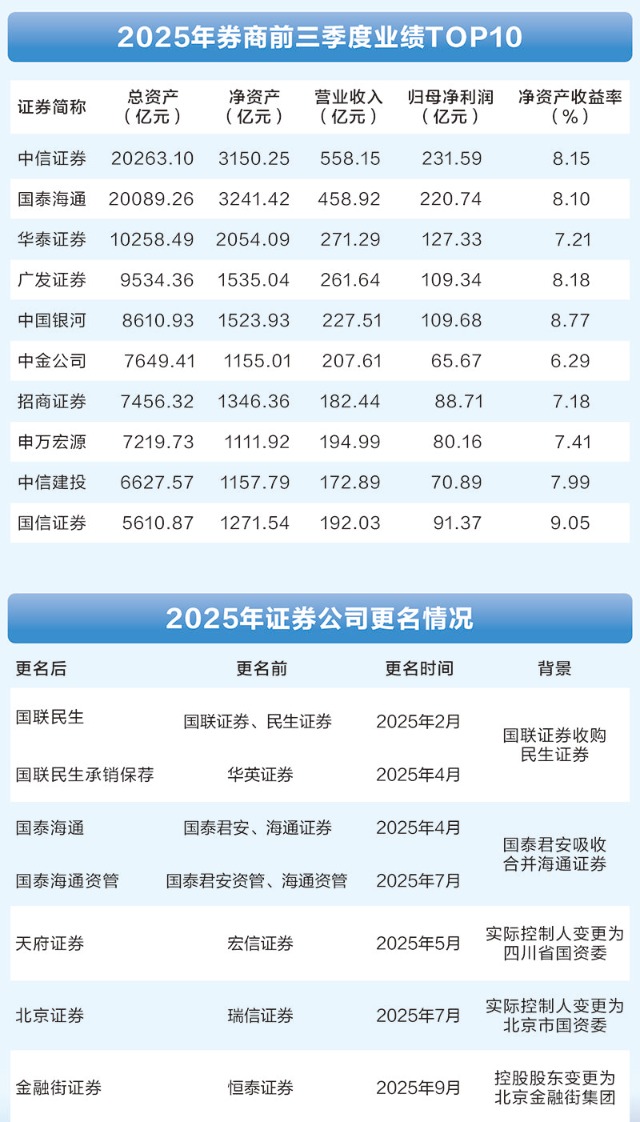
Core Viewpoint - The Chinese securities industry is undergoing significant transformation in 2025, focusing on mergers and acquisitions, high-quality development, and the integration of AI technology to enhance operational efficiency and service models [4][5][10]. Group 1: Industry Performance and Financial Metrics - Major securities firms like CITIC Securities and Guotai Junan have reported substantial total assets and net profits, with CITIC Securities leading at total assets of 2026.31 billion yuan and a net profit of 231.59 billion yuan [1]. - The net asset return rates for leading firms range from 7.21% to 9.05%, indicating competitive performance among top players [1]. Group 2: Mergers and Acquisitions - 2025 marks a pivotal year for mergers in the securities industry, with significant consolidations such as Guotai Junan merging with Haitong Securities and Guolian Securities merging with Minsheng Securities [5]. - The merger activities have reshaped the competitive landscape, with Guotai Haitong now leading in net profit rankings, and Guolian Minsheng's profit ranking improving significantly [5]. Group 3: Regulatory Changes - The classification evaluation for securities firms is undergoing a critical revision aimed at promoting high-quality development, emphasizing professional capabilities over mere revenue growth [6]. - New regulations will encourage firms to enhance their service capabilities and focus on long-term investment strategies [6]. Group 4: Market Trends and Innovations - The margin trading market has seen explosive growth, with a 36.6% increase in financing balance, reaching 2.54 trillion yuan by December 2025 [7]. - Firms are competing aggressively in this space, with some lowering financing rates to attract clients, indicating a shift towards long-term client retention strategies [7][8]. Group 5: Technological Advancements - The integration of AI technologies is transforming the securities industry, with firms adopting AI for wealth management, trading, and operational efficiency, leading to significant improvements in service delivery [10]. - The industry is moving towards an "AI-native" model, enhancing productivity and redefining business ecosystems [10]. Group 6: Internationalization Efforts - Chinese securities firms are deepening their international presence, expanding services beyond traditional offerings to include cross-border wealth management and derivatives trading [12]. - This internationalization is driven by increasing demand for comprehensive financial services from Chinese enterprises and global investors [12]. Group 7: Asset Management Trends - The public offering process for asset management is experiencing a slowdown, with firms reassessing their strategies in the context of regulatory changes and market conditions [13]. - The focus is shifting towards private equity and specialized asset management products as firms adapt to the evolving landscape [13]. Group 8: Fee Structure Reforms - The ongoing reforms in public fund fee structures are prompting securities firms to enhance their research and wealth management capabilities, shifting towards a more service-oriented model [14]. - Firms are increasingly focusing on providing tailored investment solutions rather than merely selling products [14]. Group 9: Capital Regulation Changes - Regulatory bodies are signaling a shift towards more flexible capital management for high-quality firms, aiming to improve capital efficiency while maintaining overall industry stability [15][16]. - This change is expected to enhance the return on equity (ROE) for securities firms, aligning them more closely with international standards [16]. Group 10: Rebranding Trends - A wave of rebranding among securities firms reflects strategic realignments following mergers and changes in ownership, indicating a shift in focus and resource allocation [17]. - These name changes are seen as signals of deeper strategic transformations within the firms, aimed at enhancing their market positioning [17].

科技金融服务如何创新?
Zheng Quan Shi Bao· 2025-12-28 18:05
Core Viewpoint - The article emphasizes the importance of innovation-driven financial services to support technological innovation and the growth of science and technology enterprises in China, highlighting recent achievements and ongoing challenges in the sector [1][2]. Group 1: Financial Support for Technological Innovation - The Central Economic Work Conference has called for strengthening innovation-driven growth and expanding new economic drivers, specifically mentioning "innovative financial services for technology" [1]. - China's financial support system for technological innovation has shown initial success, with loans to technology-based SMEs growing at over 20% year-on-year and accounting for nearly 30% of new loans [1]. - The scale of science and technology bonds has surpassed 1.7 trillion yuan, and the market capitalization of the A-share technology sector exceeds 25% [1]. Group 2: Challenges in Financial Services - Many science and technology enterprises still face difficulties in accessing financial services, particularly in different stages of their lifecycle, where the current financial system does not adequately match their needs [1][2]. - Start-up tech companies often lack operational data and credit history, making it challenging for financial institutions to assess their creditworthiness and repayment capacity [1][2]. Group 3: Innovation in Financial Services - There is a need for continuous innovation in financial services to enhance resource allocation efficiency and stimulate the vitality of tech enterprises [2]. - Financial institutions should optimize loan services for tech companies, focusing on evaluating innovation capabilities and potential for technology transfer rather than just company size [2]. - The promotion of an "innovation credit system" and the development of specialized financial products tailored to the needs of tech enterprises are essential [2]. Group 4: Capital Market Development - The capital market should enhance its inclusivity and adaptability to better support the growth of tech enterprises through improved listing and merger regulations [3]. - The implementation of the "merger six guidelines" has led to a wave of mergers in the A-share market, particularly in the hard tech sector, although some mergers have been terminated, raising investor concerns [3]. - There is a need for strong regulatory oversight to ensure transparency in the reasons behind failed mergers and to encourage companies to pursue innovation [3]. Group 5: Regulatory Framework and Market Stability - The rapid evolution of financial innovation necessitates the establishment of a corresponding regulatory framework to monitor and manage risks effectively [4]. - Strengthening risk monitoring and response mechanisms will enhance the stability and vibrancy of the capital market [4]. - Continuous institutional innovation is expected to drive product and model innovation, reducing financing costs for tech companies and facilitating the market entry of more "hard tech" products [4].
并购潮遇上涨价潮 锂电隔膜行业由扩规模转向调结构
Zheng Quan Shi Bao· 2025-12-28 18:04
Core Viewpoint - The lithium battery separator industry is experiencing a wave of mergers and acquisitions, with companies like Enjie and Fospower actively pursuing integration to enhance their market positions and profitability [1][2]. Group 1: Mergers and Acquisitions - Enjie plans to acquire 100% of Zhongke Hualian through a share issuance, aiming to leverage synergies across the supply chain and enhance its product matrix [2]. - Fospower's acquisition of Jinli has been approved by the Shenzhen Stock Exchange, allowing it to enter the lithium battery separator market and improve profitability [2]. - The current merger activity is driven by the industry's bottom position, allowing leading companies to acquire quality assets at lower costs [2][3]. Group 2: Price Increases and Demand - The separator industry has seen a tightening supply since late October, with leading companies operating at full capacity and orders spilling over to smaller manufacturers [4]. - The demand for separators is supported by the continuous growth in downstream markets, particularly in power batteries and energy storage [5]. - The average price of 5μm separators is significantly higher than that of 7μm products, indicating a strong market for high-performance separators [9]. Group 3: Supply and Demand Balance - The separator industry is expected to reach a supply-demand balance as the demand for power batteries is projected to grow significantly, with global demand reaching 1704 GWh by 2026 [5]. - The willingness to expand production in the separator industry is low due to high capital investment and long payback periods, leading to a scarcity of quality production capacity [6]. - The industry is shifting focus from expansion to optimizing existing capacity, with many companies halting expansion plans to avoid oversupply [7]. Group 4: Competitive Landscape and Differentiation - The competition in the separator industry is evolving from scale and price competition to a focus on technological innovation and product performance [8]. - The industry is moving towards ultra-thin and high-strength separators, with 5μm products becoming a key area of competition [9]. - Companies are increasingly looking to expand their overseas presence, as international markets offer higher margins and growth potential [10][11].


泰尔重工股份有限公司 股票交易异常波动公告
Zheng Quan Shi Bao· 2025-12-28 18:04
本公司及董事会全体成员保证公告内容真实、准确和完整,不存在虚假记载、误导性陈述或者重大遗 漏。 一、股票交易异常波动的情况介绍 泰尔重工股份有限公司(以下简称"公司")股票(证券简称:泰尔股份,证券代码:002347)于2025年 12月25日、12月26日连续2个交易日内收盘价格涨幅偏离值累计超过20%,根据《深圳证券交易所交易 规则》相关规定,属于股票交易异常波动情况。 3、公司已披露的经营情况、内外部经营环境未发生重大变化。 二、公司关注、核实的情况说明 针对公司股票异常波动,公司董事会对有关事项进行了核查,现就有关情况说明如下: 1、公司前期所披露的信息,不存在需要更改、补充之处。 2、公司未发现近期公共媒体报道了可能或已经对公司股票交易价格产生较大影响的未公开重大信息。 4、公司、控股股东和实际控制人不存在关于公司的应披露而未披露的重大事项,或处于筹划阶段的重 大事项。 5、经核查,控股股东、实际控制人在股票异常波动期间不存在买卖公司股票的情形。 三、是否存在应披露而未披露信息的说明 公司董事会确认,公司目前没有任何根据《深圳证券交易所股票上市规则》等有关规定应予以披露而未 披露的事项或与该事项有关 ...

超236%!主动权益基金年度收益或刷新历史纪录
Zheng Quan Shi Bao· 2025-12-28 18:03
Core Insights - The active equity funds in the public offering sector have achieved a remarkable annual return of 236.88% as of December 28, 2025, securing the top position for the year and potentially breaking historical performance records, becoming the highest yielding fund in public offering history [1][2] Group 1: Performance Highlights - A total of 4,378 active equity funds were included in the statistics, with the top performer, Yongying Technology Smart Selection A, achieving a cumulative return of 236.88%, significantly surpassing the second-place fund, Zhonghang Opportunity Navigation A, by over 60 percentage points [2] - The number of funds with returns exceeding 100% reached 72, ranking fourth in the historical context of major A-share market years since 2006 [3] - The average return for active equity funds exceeded 30%, with 3,455 funds outperforming their benchmarks, representing nearly 80% of the total [3][6] Group 2: Market Dynamics - The outstanding performance of active equity funds in 2025 is closely tied to the structural market conditions, particularly benefiting from sectors like AI technology, with many top-performing funds heavily invested in technology sub-sectors [5][6] - The concentration of holdings in top-performing funds is notably high, with average positions in the top ten holdings reaching 62.72%, significantly above the average of 46.2% [5] Group 3: Future Outlook - There is a call for more sustainable performance across a broader range of funds to benefit more investors, as the current high returns are not expected to be consistently replicated [8][9] - The investment community is encouraged to adopt a more measured approach to fund investments, focusing on quality and long-term value rather than chasing high returns [8][9] - The transformation in research and investment mechanisms within the public fund industry is seen as a positive development, moving towards a dual-driven model of data and industry insights [10]

“科技叙事”重塑投资逻辑 “反内卷”再造产业生态
Zheng Quan Shi Bao· 2025-12-28 18:03
Group 1: AI and Technology - The launch of DeepSeek-R1 in January 2025 has energized the capital market, establishing AI as the core investment theme for the year, with significant attention on the related industry chain including chips, devices, and applications [3] - The AI industry is shifting from a focus on performance to competition based on cost, efficiency, and commercialization capabilities, allowing small and medium enterprises to build applications quickly using open-source weights [3] - The stock prices of leading AI companies have surged, with notable increases such as the "Yizhongtian" combination exceeding 450% in annual growth, and the stock price of Cambrian Technology surpassing that of Kweichow Moutai at one point [3] Group 2: Film and Entertainment - The film "Nezha 2" released in early 2025 achieved a box office of 15.4 billion yuan, breaking domestic records and entering the global top five, leading to a significant stock price increase for its producer, Light Media [4] - The success of "Nezha 2" reflects the potential of the Chinese animation film industry, with several other animated films also performing well at the box office [4] - The overall domestic film box office reached over 50 billion yuan in 2025, a 75 billion yuan increase from 2024, with total viewership reaching 1.2 billion, indicating a recovery in the film industry [4] Group 3: Robotics - The humanoid robot industry entered a commercialized phase in 2025, with significant orders indicating a shift towards scalable applications, including over 46 billion yuan in total orders and more than 20,000 units sold [5] - The applications of humanoid robots are expanding from industrial settings to service sectors, creating a collaborative development environment across the entire industry chain [5] - The commercialization of humanoid robots has attracted substantial investment and resources, laying a solid foundation for the industry's long-term growth [5] Group 4: Stock Market Dynamics - The competition for the title of "stock king" in the A-share market saw Cambrian Technology and Kweichow Moutai vying for dominance, reflecting a shift in investor preference from traditional consumer sectors to high-growth technology sectors [7] - Cambrian Technology's stock price initially surpassed Kweichow Moutai's, indicating a recognition of the growth potential in tech innovation, but later fluctuations in stock prices highlighted the volatility of market preferences [7] Group 5: Food Delivery Industry - The food delivery industry experienced intense competition in 2025, initiated by JD's entry with a no-commission model, prompting other platforms to enhance rider benefits and engage in large-scale subsidies [8] - This subsidy war led to significant challenges for merchants and platforms, with Meituan reporting a 2% revenue growth despite record user numbers, indicating the pressure on profitability [8] - Regulatory bodies intervened to address the chaotic competition, leading to commitments from major platforms to curb harmful practices and signaling a transition to a more rational development phase in the industry [8] Group 6: Semiconductor and AI Chip Industry - The domestic GPU industry marked a significant milestone with the listing of multiple companies, including Moer Technology and Muxi Technology, indicating a collective movement towards self-sufficiency in AI chips [10] - The semiconductor sector is experiencing a wave of mergers and acquisitions, reflecting a strategic shift from "domestic substitution" to becoming "globally competitive" [10] - The introduction of new listing standards for the Sci-Tech Innovation Board has further supported the growth of emerging industries, enhancing the capital market's backing for innovation [11] Group 7: Dividend Trends - A-share companies have shown a significant increase in dividend payouts, with total cash dividends reaching 2.61 trillion yuan in 2025, surpassing the previous year's total and setting a new record [12] - The growing trend of companies participating in dividend distributions reflects an improvement in overall profitability and a commitment to shareholder returns [12] Group 8: Lithium Battery Industry - The lithium battery industry has seen a rebound in prices due to a collective effort to combat "involution" competition, with significant price increases in lithium carbonate and hexafluorophosphate [13] - The industry is undergoing a transformation towards more sustainable practices, with regulatory measures aimed at stabilizing prices and promoting orderly competition [13] Group 9: Charging Battery Industry - The charging battery industry is entering a new phase of orderly development following a series of recalls by major brands due to safety concerns, highlighting the consequences of intense competition [14] - Regulatory changes and new certification rules are being implemented to enhance oversight and ensure product safety, marking a shift towards more responsible industry practices [14]

