
Zheng Quan Shi Bao

Search documents
抢眼!净利大增超400% 上市券商业绩或全面爆发
Zheng Quan Shi Bao· 2026-01-18 18:43
近日,上市券商陆续披露2025年业绩预告或快报,"牛市旗手"上一年度的表现也逐一揭开谜底。 根据相关券商发布的公告,国联民生(601456)预计2025年实现归母净利润20.08亿元,同比大增约 406%;中信证券(600030)预计2025年实现归母净利润超300亿元,同比增长38.46%。 2025年,中国资本市场整体呈现上行趋势,市场交投活跃,A股主要指数均实现上涨,这无疑让投资者 对券商的整体业绩表现多了几分期待。有券商分析师预计,2025年43家上市券商扣非净利润合计或高达 2167亿元,同比增长55%。 净利大增逾4倍太抢眼 1月18日,国联民生公告称,经公司财务部门初步测算,预计2025年度实现归属于母公司所有者的净利 润20.08亿元,与上年同期(法定披露数据)相比,将增加人民币16.11亿元,同比增长406%左右。 招商证券(600999)非银首席分析师郑积沙预计,2025年43家上市券商扣非净利润合计或高达2167亿 元,同比增长55%。分业务来看,根据2025年全年日均股基成交额及两融成交额来看,预计经纪和信用 业务收入或分别同比增长50%、43%;投行方面,2025年A股IPO/再融资 ...


摩根士丹利基金吴慧文:债市双向波动加剧2026是“低利率、高波动”突围之年
Zheng Quan Shi Bao· 2026-01-18 18:43
"2026年债市双向波动,把握节奏机会大于捕捉趋势。"摩根士丹利基金固定收益投资部联席总监吴慧文 近日在接受证券时报记者采访时,对新一年的债券市场做出判断。在她看来,债市上半年核心运行逻辑 将围绕对基本面和走出通缩的强预期和弱现实之间的收敛展开,预计市场呈现双向波动的特征,投资需 聚焦波段机会与风险控制,兼顾中长期趋势和短期交易操作的节奏差异。 根据Wind数据,在2025年"债熊"环境下,吴慧文管理的大摩安盈稳固六个月持有债券A全年的收益率达 到5.47%,排名同类前8%;而在"债牛"的2024年,大摩安盈稳固全年收益率7.72%,排名同类前7%,连 续两年均位列前10%分位数。这位拥有券商自营利率衍生品研究、国债期货交易等十几年实战经验的固 收老将,以一套融合宏观、中观、微观的研判框架穿越牛熊市场。 2026年,她提出以"稳健打底、主动出击及动态适配"为核心的投资策略,试图在低利率、高波动的市场 环境中寻求突围。 三维印证下的高胜率法则 复盘2025年,吴慧文的月度策略胜率超过90%,这得益于她建立的严密投研系统。她表示:"我们的研 判框架融合了宏观、中观、微观三个维度,三者相互印证,力求提升决策胜率。" ...
从同质化窠臼走向“解决方案”竞争 ETF行业连创两个“万亿”
Zheng Quan Shi Bao· 2026-01-18 18:23
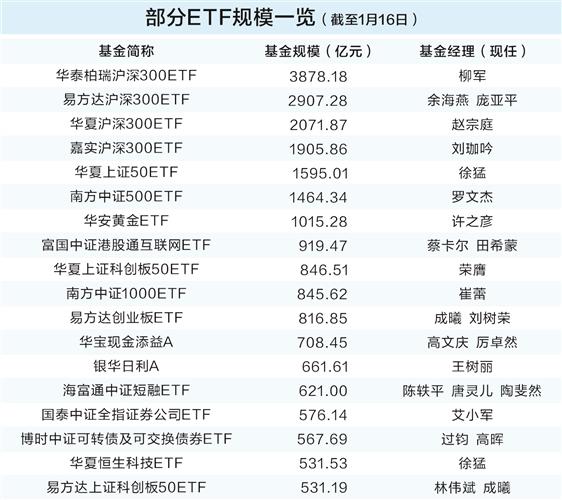
| 部分ETF规模一览(截至1月16日) | | | | --- | --- | --- | | 甚金简称 | 基金规模(亿元) | 基金经理(现任) | | 华泰柏瑞沪深300ETF | 3878.18 | 柳军 | | 易方达沪深300ETF | 2907.28 | 余海燕 庞亚平 | | 华夏沪深300ETF | 2071.87 | 赵宗庭 | | 嘉实沪深300ETF | 1905.86 | 刘珈吟 | | 华夏上证50ETF | 1595.01 | 徐猛 | | 南方中证500ETF | 1464.34 | 罗文杰 | | 华安黄金ETF | 1015.28 | 许之彦 | | 富国中证港股通互联网ETF | 919.47 | 蔡卡尔 田希蒙 | | 华夏上证科创板50ETF | 846.51 | 荣膺 | | 南方中证1000ETF | 845.62 | 崔容 | | 易方达创业板ETF | 816.85 | 成匾 刘树荣 | | 华宝现金添益A | 708.45 | 高文庆 厉卓然 | | 银华日利A | 661.61 | 王树丽 | | 海富通中证短融ETF | 621.00 | 陈轶平 唐灵 ...

泉果基金刚登峰——A股港股仍处宝贵布局时期 投资主战场聚焦三大领域
Zheng Quan Shi Bao· 2026-01-18 18:21
Core Viewpoint - The current equity market, particularly in A-shares and Hong Kong stocks, presents a favorable investment period despite a disconnect between market performance and investor sentiment [1] Economic Recovery and Structural Changes - The core variables that have caused market concerns in recent years, such as real estate, foreign trade structure, and manufacturing supply-demand relationships, are undergoing significant adjustments [2] - The real estate sector has experienced substantial adjustments since 2021, leading to a gradual reduction in its negative impact on consumer wealth and spending [2] - China's reliance on a single export market has decreased, with a more diversified export structure and an increase in high-value-added products, reducing overall external risk exposure [2] - The manufacturing sector is seeing a recovery as capital expenditures have declined, leading to clearer supply constraints and a correction of previous over-expansion impacts [2] - The capital market is also evolving, with a more restrained financing pace and increased emphasis on dividends and share buybacks, indicating a focus on investor returns [2] Industry Trends: Technology, New Energy, and Cycles - The investment framework emphasizes that technology, new energy, and cyclical industries are interconnected and reflect different stages of industrial logic [3] - In technology, the focus is on certainty and the ability to deliver results rather than short-term gains, with particular attention on sectors benefiting from the AI wave, such as internet and consumer electronics [3] - New energy investments are driven by supply-demand structural changes, with some sectors experiencing reduced capital expenditures while downstream demand continues to grow [3] - The cyclical sector is assessed based on structural judgments, focusing on industries with clear supply constraints and stable competitive landscapes, where supply-side changes can enhance profitability even with limited demand growth [3] Portfolio Structure - The core of the portfolio structure is not to bet on a single direction but to find value across different industrial cycles [4] - The current stage allows for a resonance among technology, new energy, and cyclical sectors in terms of industrial logic, valuation levels, and verifiability, enhancing the portfolio's adaptability in structural markets [4] Company Quality Focus - The emphasis is placed on company quality, with a preference for long-term holdings that possess clear competitive advantages and sustainable growth potential [5][6] - Companies must demonstrate the ability to navigate through cycles and consistently deliver performance, with dividends and buybacks seen as indicators of mature corporate governance [6] - A more cautious approach to left-side positioning is adopted, with a focus on participating during clearer industrial trends and balancing return potential with risk control over a 3 to 12-month horizon [6] - The importance of research collaboration is highlighted, with the goal of supporting real investment decisions and maintaining patience and discipline to achieve returns in structural markets [6]
西部利得基金董伟炜:保持理性、不亢奋、不恐慌 情绪稳定是A股盈利的重要来源
Zheng Quan Shi Bao· 2026-01-18 18:19
Core Insights - The article emphasizes the importance of a comprehensive investment experience through various market conditions for the growth of fund managers, highlighting the balance between offensive and defensive strategies in investment management [1] Group 1: Investment Philosophy - The investment philosophy of the fund manager is centered around a "first principles" approach, focusing on customer experience and the need for reasonable long-term returns and good process experiences [4] - The manager aims to provide a packaged investment solution that does not require clients to time the market or choose styles, ensuring a smoother investment experience [5] Group 2: Investment Framework - The fund manager has developed a "three-in-one" investment framework consisting of an investment decision system, a risk control system, and mindset, which are interdependent and essential for effective investment management [3] - The investment decision system combines top-down and bottom-up approaches to identify quality assets with good fundamentals and reasonable valuations, while the risk control system focuses on managing drawdowns through a combination of active and passive measures [3] Group 3: Market Outlook - The fund manager maintains a relatively optimistic outlook for the market in 2026, drawing parallels to the entrepreneurial market from 2013 to 2015, but notes that the current technological wave has higher intrinsic value [6] - Key investment areas include AI, which is seen as a long-cycle technological revolution, and sectors with rapid growth potential such as commercial aerospace, robotics, and high-quality consumer goods that cater to emerging demands [6]
工信部:科技型中小企业首次纳入梯度培育范围
Zheng Quan Shi Bao· 2026-01-18 18:18
Core Viewpoint - The Ministry of Industry and Information Technology has issued a revised management method for cultivating high-quality small and medium-sized enterprises (SMEs), expanding the scope to include technology-based SMEs and enhancing recognition standards for specialized and innovative enterprises [1][4]. Group 1: Expansion of Cultivation Framework - The revised method includes technology and innovation-based SMEs, specialized and innovative SMEs, and "little giant" enterprises in the cultivation framework [1]. - Since the start of the 14th Five-Year Plan, 17,600 specialized and innovative "little giant" enterprises have been cultivated, leading to over 140,000 specialized and innovative SMEs and more than 600,000 technology and innovation-based SMEs [1]. Group 2: Optimization of Recognition Standards - The recognition standards have been improved to include international market share for export-oriented enterprises and to standardize criteria nationwide by removing province-specific indicators [2]. - The thresholds for recognition have been raised, with "little giant" enterprises now required to have revenue exceeding 50 million yuan and R&D expenses totaling at least 12 million yuan over the past two years [2]. Group 3: Quality Evaluation and Management - A quality evaluation score has been introduced, requiring specialized and innovative SMEs to achieve a score above 50 and "little giant" enterprises to score above 60 [3]. - The revised method promotes a "double random" audit mechanism and includes measures to limit the number of recommended "little giant" enterprises from regions with low quality evaluation scores [3]. Group 4: Enhanced Support Services - The revised method emphasizes the integration of various support policies, including financial, technological, and talent resources, to provide tailored services for different types of enterprises [3][4]. - The aim is to enhance the demonstration and foundational strengthening roles of high-quality SMEs, making the cultivation process more scientific and standardized [4].
西贝关店再引预制菜争议 餐饮企业凛冬煎熬
Zheng Quan Shi Bao· 2026-01-18 18:17
在西贝计划关闭超百家门店曝光后,贾国龙和罗永浩的"论战"再受关注。 从行业角度看,多位餐饮公司高管对记者表示,近年来餐饮行业已处于"寒冬"之中,食材、人力、房租 等刚性成本持续攀升,多重压力叠加下,餐饮业经营压力持续加大。 争议"预制菜"定义 日前,贾国龙在微博上声称:"西贝要关102家门店,4000多名员工被迫失业,我仅仅在朋友圈里回复自 己的朋友一声,根本都没在网上说话。结果罗永浩再次在微博上掀起巨浪,发长文再次一口咬定西贝是 预制菜,让我和西贝员工遭到无数辱骂,让本已千疮百孔的西贝雪上加霜。" 对此,中国食品产业分析师朱丹蓬对证券时报记者表示,预制菜的核心争议在于行业、品牌方与消费端 三方对其认知不统一,且缺乏明确统一的标准。在预制菜国家标准尚未出台的背景下,各方对预制菜的 认知、理解与定义各不相同,这正是造成当前中国预制菜市场秩序较为混乱的根本原因。 16日晚间,"罗永浩的十字路口"以及"西贝贾国龙"两个账号均被禁言。罗永浩在朋友圈发文确认平台对 其禁言15天,并将这一举措解读为"对我的保护"。他表示,个人不会再回应此事,相信跟预制菜透明化 相关的法律法规也会尽快出台。 1月16日下午,记者探访西贝北 ...
全力营造“长钱长投”生态 公募基金改革新年再吹号角
Zheng Quan Shi Bao· 2026-01-18 18:17
Core Viewpoint - The public fund industry in China is set to deepen reforms in 2026, focusing on stabilizing the market and promoting long-term investments through various product offerings and risk management tools [1][5]. Group 1: Market Environment and Fund Role - The A-share market has shown a continuous upward trend, with the Shanghai Composite Index surpassing 4100 points and several equity funds achieving over 30% returns in just half a month [2]. - Amidst this market prosperity, irrational tendencies are emerging, particularly in sectors like commercial aerospace and AI applications, leading to inflated valuations [2]. - Public funds are urged to act as "stabilizers" in the market, maintaining professionalism and guiding rational investments rather than fueling speculative behavior [2][3]. Group 2: Reform Directions and Suggestions - The current assessment system encourages fund managers to chase hot trends for quick scale gains, which can amplify systemic risks and lead to significant market volatility [3]. - It is recommended that the public fund industry reform its evaluation metrics to focus on risk-adjusted returns, incorporating measures like the Sharpe ratio and maximum drawdown [3][6]. - Fund companies should diversify their product offerings to include stable value-oriented funds and absolute return strategies, especially during market exuberance [4][6]. Group 3: Long-term Investment Ecosystem - The China Securities Regulatory Commission emphasizes the need to broaden channels for long-term capital and develop products suitable for long-term investments [5][6]. - There is a call to enhance the inflow of long-term funds, such as pensions and insurance capital, into the market while creating products that meet their needs [6][7]. - Fund companies are encouraged to develop products that focus on absolute returns and risk management tools to cater to the lower risk appetite of long-term investors [7]. Group 4: Investor Experience and Transparency - Improving investor experience is crucial, with a shift needed from focusing solely on fund performance to also considering investor profitability [8][9]. - There is a proposal to include investor profit and loss data in fund disclosures to enhance transparency and accountability [8][9]. - Fund companies should prioritize customer-centric management, ensuring that the right products are matched with the appropriate investors and providing ongoing support [9][11]. Group 5: Sales Practices and Accountability - The sales practices within the public fund industry have been criticized for prioritizing asset management scale over responsible selling [11]. - A shift in the incentive structure is necessary, focusing on long-term client benefits rather than short-term sales metrics [11][12]. - Regulatory bodies are urged to enforce stricter penalties for misleading sales practices to protect investors and ensure ethical conduct in the industry [11][12].
数据要素价值加速释放 千亿蓝海迎来质变
Zheng Quan Shi Bao· 2026-01-18 18:15
Group 1 - The core viewpoint of the articles highlights the dual characteristics of "policy system improvement" and "local practice implementation" in the data factor market at the beginning of the year, with a clear national directive aiming for the "release of data factor value" by 2026 [1] - Multiple policy documents focusing on the value extraction of data factors have been issued, and local practices are advancing, such as the implementation plan for the comprehensive development of the digital economy in Shanxi and the first national transaction of "embodied intelligent data sets" in Jiangsu [1] - Experts predict that public data products, particularly in meteorology and statistical analysis, will mature rapidly due to compliance advantages, while data products in finance and healthcare will also form quickly under market-driven forces [1][2] Group 2 - The value of data factors is expected to accelerate, with public and enterprise data serving as the two main carriers, entering a phase of rapid value release, which is crucial for market transformation by 2026 [2] - By 2025, China's data infrastructure construction will enter a practical phase, achieving breakthroughs in resource registration, operational authorization, and pricing mechanisms [2] - Public data applications have already demonstrated effectiveness in various sectors, including smart agriculture and healthcare, with applications like precise medical insurance services and seamless entry to scenic spots [2] Group 3 - The analysis indicates that public data products not involving personal privacy are likely to achieve large-scale supply first, while commercially valuable data products in financial risk assessment and clinical diagnosis will accelerate their market entry [3] - Industrial internet data products are being developed through trusted data spaces established by leading enterprises, facilitating value sharing and circulation within the industry chain [3] Group 4 - The current market faces multiple collaborative obstacles that hinder the full release of data factor value, stemming from a lack of coordinated governance and resulting in fragmented rules and unclear responsibilities [4] - The existing management structure, with multiple departments overseeing data resources, complicates unified resource allocation and rule formulation [4] - Issues such as "products without demand" highlight the need for a vibrant data factor market, where demand is essential for realizing data value [4] Group 5 - To facilitate the smooth release of data factor value, addressing collaborative obstacles is crucial, focusing on resolving issues of coordination, fragmented rules, and unclear responsibilities [5] Group 6 - The national data work conference emphasizes accelerating the cultivation of a unified national data market, enhancing top-level design to promote cross-regional and cross-industry rule interoperability [6] - The focus of policies will shift from "establishing rules" to "implementing and promoting collaboration" as 2026 approaches, with a unified transaction rule and registration system expected to transform data holders' perspectives from "cost centers" to "profit centers" [6] Group 7 - Establishing standards for measuring data value is essential for the long-term development of the market, with a focus on quantifying data circulation and transaction scale [7] - The future assessment system should measure the actual benefits of data in digital transformation and its contribution to the core industries of the digital economy [7] - The data factor market in China is projected to exceed 200 billion yuan by 2025 and is expected to surpass 300 billion yuan by 2028, driven by institutional and technological advancements [7]