
Xin Hua Cai Jing

Search documents
2025年银行间市场共有超10万亿元债务融资工具发行
Xin Hua Cai Jing· 2026-01-22 23:11
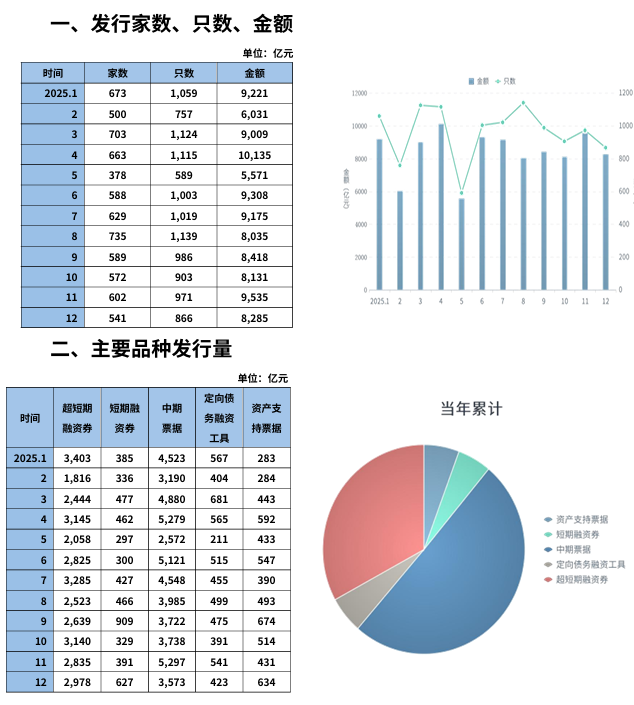
Group 1 - In December 2025, the interbank bond market issued a total of 866 debt financing instruments amounting to 828.5 billion yuan, including 297.8 billion yuan in super short-term financing, 62.7 billion yuan in short-term financing, 357.3 billion yuan in medium-term notes, 42.3 billion yuan in targeted debt financing instruments, and 63.4 billion yuan in asset-backed notes [1][2][3] - For the entire year of 2025, the interbank bond market issued a total of 11,531 debt financing instruments with a total value of 10.09 trillion yuan [1][2] Group 2 - The issuance of innovative products in December 2025 included 44.8 billion yuan in green debt financing instruments, 6.6 billion yuan in rural revitalization notes, 14.5 billion yuan in asset-backed commercial papers, 5.4 billion yuan in sustainable development-linked bonds, and 134.5 billion yuan in sci-tech notes [5] - The cumulative issuance of panda bonds reached 858.7 billion yuan by the end of December 2025, with 15.63 billion yuan issued in that year [7] Group 3 - The custody statistics for debt financing instruments showed that the total custody amount for super short-term financing bonds was 1.48 trillion yuan, short-term financing bonds at 521.3 billion yuan, medium-term notes at 1.32 trillion yuan, targeted debt financing instruments at 193.36 billion yuan, and asset-backed notes at 70.74 billion yuan [9][10] - The custody amount for innovative products included 318.8 billion yuan in panda bonds, 1.15 trillion yuan in sci-tech notes, 155 billion yuan in sustainable development-linked bonds, 585.4 billion yuan in green debt financing instruments, 123.7 billion yuan in rural revitalization notes, and 105.3 billion yuan in asset-backed commercial papers [11]

【读财报】上市猪企12月销量同比上升3.51% 金新农、正邦科技销量增速超过70%
Xin Hua Cai Jing· 2026-01-22 23:11
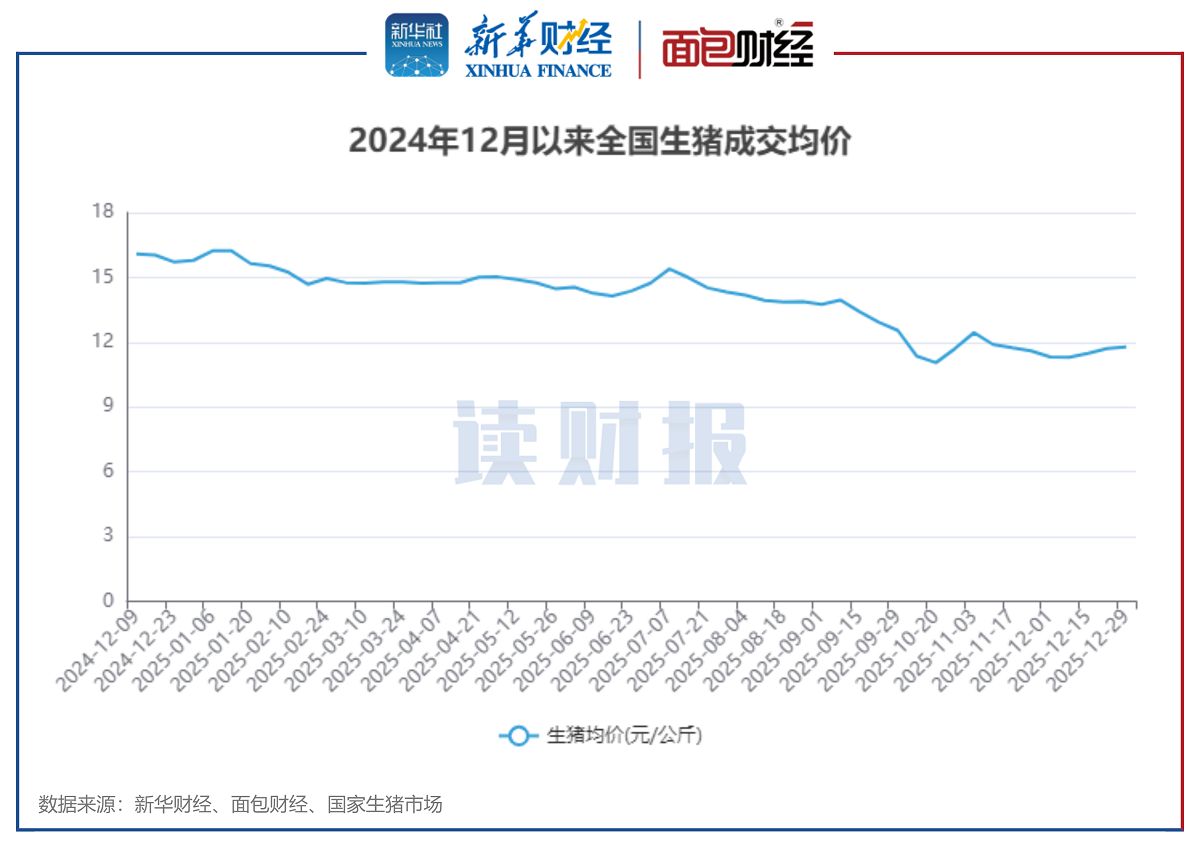
Core Insights - In December 2025, 16 major pig farming companies in China achieved a total sales volume of 17.72 million pigs, marking a year-on-year increase of 3.51% and a month-on-month increase of 7.15% [1][5][6] - The total revenue for these companies in December was 22.104 billion yuan, reflecting a year-on-year decline of 26.85% but a month-on-month increase of 4.87% [1][5][11] Sales Volume Analysis - The leading company, Muyuan Foods, sold 6.98 million pigs in December, while Wens Foodstuffs and New Hope reported sales of over 1.8 million pigs each [1][6] - Jin Xin Nong and Zhengbang Technology experienced significant sales growth, with increases exceeding 70% year-on-year, while four companies, including Muyuan Foods and Tangrenshen, saw declines of over 10% [1][6][10] Revenue Analysis - The revenue figures for December showed that Jin Xin Nong and Zhengbang Technology had revenue growth rates exceeding 20%, while four companies, including Zhenghong Technology and Tiankang Biological, reported revenue declines of over 30% [1][11] - Muyuan Foods generated 9.667 billion yuan in revenue for December, down 36.06% year-on-year, while Wens Foodstuffs and New Hope also reported declines of 11.38% and 10.75%, respectively [10][12] Price Trends - The average transaction price for pigs in the national market fluctuated around 15 yuan per kilogram in early 2025, dropping to a low of 11.05 yuan per kilogram in the latter half of the year [2]





【环球财经】投资者继续买入 纽约股市三大股指22日明显上涨
Xin Hua Cai Jing· 2026-01-22 23:10
Market Performance - On January 22, the New York stock market opened higher, with all three major indices showing significant gains by the close. The Dow Jones Industrial Average rose by 306.78 points to close at 49,384.01, a gain of 0.63%. The S&P 500 increased by 37.73 points to 6,913.35, up 0.55%. The Nasdaq Composite gained 211.195 points, closing at 23,436.02, a rise of 0.91% [1] Sector Performance - In the S&P 500, seven out of eleven sectors experienced gains, with the Communication Services and Consumer Discretionary sectors leading the way, rising by 1.57% and 1.22% respectively. Conversely, the Real Estate and Utilities sectors saw declines of 1.10% and 0.73% [1] Economic Data - The U.S. Department of Commerce reported that the Personal Consumption Expenditures (PCE) price index increased by 2.7% and 2.8% year-over-year for October and November 2025, respectively, compared to a 2.8% increase in September. The core PCE, excluding food and energy, also showed a year-over-year increase of 2.7% and 2.8% for the same months, nearing the 2.9% high seen in July and August [1] GDP Growth - Revised data from the U.S. Department of Commerce indicated that the GDP grew at an annualized rate of 4.4% in the third quarter of 2025, slightly above the initial estimate of 4.3% and an increase from the previous quarter's growth of 3.8% [2] Investor Sentiment - Market sentiment remains strong, with retail investors responding positively to geopolitical uncertainties by buying on dips. This behavior reflects a robust market foundation despite external challenges [3] Legal Issues - President Trump has filed a lawsuit against JPMorgan Chase and its CEO Jamie Dimon, claiming $5 billion in damages due to the bank's decision to stop providing services to him and his businesses following the January 6 Capitol riot. Despite this, JPMorgan's stock saw a slight increase of 0.53% by the close [3]
【环球财经】2025年阿塞拜疆对外货物贸易总额为494.23亿美元
Xin Hua Cai Jing· 2026-01-22 22:53
Core Insights - Azerbaijan's total foreign trade volume for 2025 is projected to be $49.423 billion, with exports amounting to $25.043 billion and imports at $24.38 billion [1] Trade Structure - In terms of export structure, the oil and gas sector is expected to contribute $21.415 billion, accounting for 85.51% of total exports [1] - The main imported goods in 2025 will include electromechanical products (15.18%), transportation vehicles and parts (12.73%), and food (10.63%) [1] Trade Partners - The top three trading partners for Azerbaijan in 2025 are Italy, Turkey, and Russia, with trade volumes of $11.86 billion, $5.721 billion, and $4.92 billion respectively [1]
美国2025年三季度GDP 增速上修至4.4% 消费与外需支撑经济扩张
Xin Hua Cai Jing· 2026-01-22 22:52
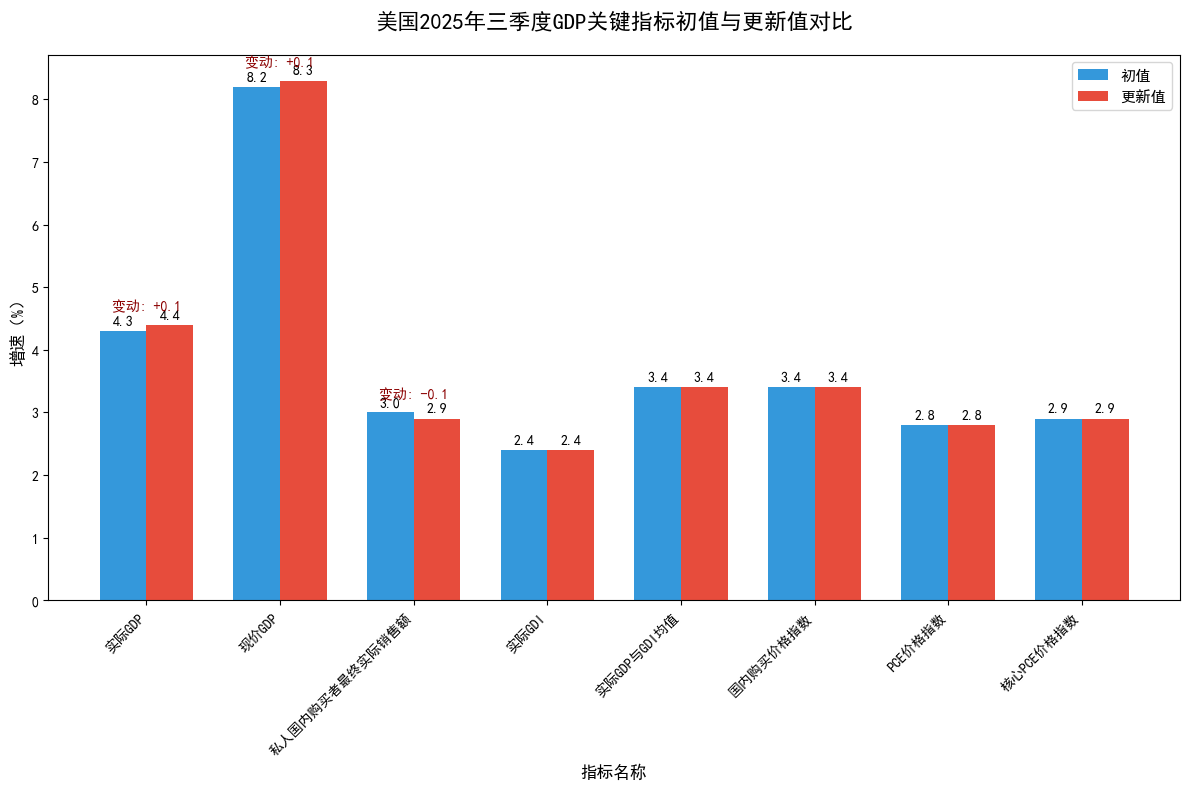
Core Viewpoint - The U.S. economy showed stronger-than-expected growth in Q3 2025, with GDP increasing at an annual rate of 4.4%, up from 3.8% in Q2, indicating robust internal economic momentum supported by consumption and external demand [1][3]. Group 1: Economic Growth - The actual GDP growth rate for Q3 2025 was revised upward by 0.1 percentage points from the initial estimate, reflecting a solid economic performance [1]. - Key drivers of growth included consumer spending, exports, government spending, and investment, while a decline in imports further boosted GDP growth [1]. Group 2: Sector Performance - The private services and manufacturing sectors performed notably well, with actual value added increasing by 5.3% and 3.6% respectively, offsetting a 0.3% decline in government sector value added [1]. Group 3: Data Adjustments - The upward revision of GDP was primarily due to adjustments in export and investment figures, although a downward revision in consumer spending partially offset this increase [2]. - The current-price GDP growth rate was adjusted from 8.2% to 8.3% [2]. Group 4: Inflation and Corporate Profits - Inflation remained stable in Q3, with the Personal Consumption Expenditures (PCE) price index rising by 2.8% year-on-year, and core PCE (excluding food and energy) increasing by 2.9%, consistent with initial estimates [2]. - Corporate profits for the period increased by $175.6 billion, with a revision upward of $9.5 billion from previous estimates, indicating steady improvement in corporate operating efficiency [2]. Group 5: Reporting Changes - The Bureau of Economic Analysis (BEA) announced enhancements to the GDP reporting system, including the introduction of online interactive data tables starting February 2026 and the discontinuation of PDF and Excel format attachments from April 2026 to improve data release efficiency [2].
【环球财经】美国个人消费支出价格指数上涨 通胀压力持续
Xin Hua Cai Jing· 2026-01-22 22:52
Core Insights - The U.S. personal consumption expenditure (PCE) price index increased by 2.7% and 2.8% year-on-year in October and November 2025, indicating persistent inflationary pressures [1] - The core PCE price index, excluding volatile food and energy prices, also rose by 2.7% and 2.8% year-on-year in the same months, approaching the previous high of 2.9% in July and August [1] - Month-on-month, both the overall and core PCE price indices increased by 0.2% in October and November [1] Economic Indicators - The PCE price index is a key inflation indicator closely monitored by the Federal Reserve, serving as a primary reference for monetary policy decisions [1] - The Federal Reserve aims to reduce inflation to a target of 2%, with the latest data being crucial for assessing progress towards this goal [1] - Despite the inflation data aligning with market expectations, ongoing inflationary pressures suggest that the Federal Reserve is likely to maintain interest rates during the monetary policy meeting concluding on January 28 [1]
每日机构分析:1月22日
Xin Hua Cai Jing· 2026-01-22 14:46
Group 1 - HSBC indicates that the US dollar may continue to lag due to geopolitical risks and attacks on the independence of the Federal Reserve, suggesting that this could be just the beginning of a trend [1] - Goldman Sachs raises its year-end gold price target to $5,400 per ounce, citing sustained demand from central banks and private investors, with expectations of central banks purchasing 60 tons of gold monthly [2] - A survey by Bloomberg shows Klaas Knot is the most likely candidate to succeed Christine Lagarde as head of the European Central Bank, despite other candidates having better qualifications [3] Group 2 - The Japanese central bank is expected to maintain interest rates at its upcoming policy meeting, with analysts suggesting there is no urgent reason to raise rates despite ongoing instability in government bond prices and a weakening yen [3] - Analysts from the Netherlands International Bank suggest that a decline in inflation could prompt the Bank of Japan to reassess its future rate hike plans, with strong wage growth expected to keep core inflation above 2% [3] - Francis Zhang from Singapore's OCBC Bank indicates that clearer communication from the Bank of Japan regarding expectations for significant wage increases could lead to an earlier rate hike, potentially as soon as March [3]
2025量化私募交出高分卷,头部机构领跑业绩赛道
Xin Hua Cai Jing· 2026-01-22 14:44
Core Insights - The quantitative private equity industry is expected to achieve nearly 100% positive returns by 2025, with significant performance disparities favoring larger firms [1][2] - The average return for quantitative private equity stock strategies in 2025 is projected to exceed 36%, with 98% of firms reporting positive returns [1] - The industry is experiencing a "Matthew Effect," where resources and returns are increasingly concentrated among leading firms [1] Performance by Scale - Firms with over 10 billion yuan in assets show the strongest performance, with 40 firms achieving an average return of 42.87% and 100% positive returns [1][2] - The 50-100 billion yuan tier has 23 firms with an average return of 35.51% and a 95.65% positive return rate [2] - The 20-50 billion yuan tier has 28 firms achieving 100% positive returns with an average return of 40.73% [2] - Smaller firms (0-5 billion yuan and 5-10 billion yuan) lag behind, with average returns of 34.57% and 32.87%, respectively [2] Factors Influencing Performance - Leading firms benefit from strong capital and research capabilities, allowing them to invest in factor exploration, model iteration, and technology upgrades [3] - Mid-sized firms are in a "golden development phase," balancing strategy capacity and return elasticity effectively [3] - Smaller firms face challenges in scaling and upgrading strategies, leading to performance volatility [3] Long-term Focus and Investor Guidance - The industry is increasingly focused on long-term shareholder interests, with many firms increasing dividend payouts [4] - Investment managers recommend that investors consider research capabilities, strategy stability, and scale adaptability when selecting quantitative private equity products [3]
新华财经晚报:2026年第一批936亿元超长期特别国债支持设备更新资金已下达
Xin Hua Cai Jing· 2026-01-22 14:44
【重点关注】 ·2026年第一批936亿元超长期特别国债支持设备更新资金已下达 ·商务部:坚决反对欧盟将部分中国企业列为高风险供应商 ·特朗普称已就格陵兰岛制定协议框架不会对欧洲加征关税 ·美国《华尔街日报》21日援引知情人士消息报道称,特朗普政府正在古巴政府内部寻找"内线",试图 于"今年年底前颠覆古巴政权"。 ·日本财务省22日公布的初步统计结果显示,2025年日本贸易逆差为2.65万亿日元(1美元约合149.69日 元),连续第五年出现逆差。其中,日本对美出口下降4.1%。 ·商务部等9部门关于促进药品零售行业高质量发展的意见1月22日发布,其中提出完善药事服务。通过 支持药店提升药学服务能力、优化购药体验、参加药品集中采购、构建支付保障体系等综合措施,驱动 药店从"药品销售终端"向"健康服务枢纽"转型。 ·商务部1月22日举行例行新闻发布会,商务部新闻发言人何咏前在回答有关提问时说,欧盟近日发布相 关文件,强制要求成员国在能源、交通、ICT服务管理等18个关键行业排除所谓"高风险供应商"。中方 对此表示严重关切。中国企业长期在欧洲依法合规经营,为欧洲民众提供了优质的产品和服务,有力促 进了欧洲电信和数 ...
行业洞察 | 京沪深杭领跑 中国大模型产业城市竞争力TOP50榜单发布
Xin Hua Cai Jing· 2026-01-22 14:38
Core Insights - The article highlights the rapid growth of China's large model industry, showcasing a competitive landscape with significant regional concentration and innovation hotspots emerging across the country [1] Industry Overview - The China Economic Information Agency released a ranking of the top 50 cities in the large model industry based on six core dimensions: industry scale, quality enterprises, innovation capability, financing ability, industry efficiency, and growth potential [1] - Beijing topped the list with a score of 98.22, followed by Shanghai (94.65), Shenzhen (92.24), and Hangzhou (91.87) [6][9] Regional Performance - The Yangtze River Delta region is particularly active, with 16 cities from Shanghai, Jiangsu, Zhejiang, and Anhui making the list, indicating strong regional collaboration [1] - Beijing's multifaceted advantages position it as a leader in overall industry competitiveness, while Guangdong has seven cities listed, forming a high-density industrial belt [1] - Central and western cities like Hefei, Wuhan, and Chengdu are also experiencing robust growth in the large model industry [1] City Rankings - The top ten cities in the ranking include: 1. Beijing - 98.22 2. Shanghai - 94.65 3. Shenzhen - 92.24 4. Hangzhou - 91.87 5. Hefei - 87.42 6. Wuhan - 86.37 7. Nanjing - 86.09 8. Chengdu - 85.09 9. Wuxi - 84.18 10. Xiamen - 83.69 [6][9] Innovation Initiatives - Beijing has announced nine special actions to accelerate the establishment of a global AI innovation hub, focusing on core technology breakthroughs and enhancing the density of innovation resources [9] - Shanghai has developed a dual layout in the large model sector, with the "Mosu Space" community attracting over 200 enterprises and plans for a dedicated AI innovation town [9] - Shenzhen continues to lead in R&D and innovation capabilities, with major tech companies like Tencent and Huawei driving advancements in the field [9] Sector Efficiency - Hangzhou excels in industry efficiency with a score of 98.70, surpassing Shanghai and Shenzhen, attributed to its strong foundations in e-commerce and cloud computing [10] - The industry is transitioning from a phase of technological competition to one focused on application and commercial viability, emphasizing the need for cities to enhance industry efficiency and convert computational advantages into productivity [11]
