
Guan Cha Zhe Wang

Search documents
首次赎回一座万达广场,万达债务“解套”了?
Guan Cha Zhe Wang· 2025-12-03 07:20
Core Insights - Wanda has initiated a core asset buyback, marking a significant shift from its previous asset disposal strategy [1][2] - The buyback involves the redemption of Yantai Zhifu Wanda Plaza, with Wanda's subsidiary, Wanda Ruichi, becoming the sole shareholder [1] - The company has significantly reduced its debt pressure through asset sales, with domestic debts cleared and only one overseas bond remaining [2] Group 1: Asset Transactions - Wanda's asset buyback is part of a broader strategy to recover funds and reduce liabilities, transitioning from a heavy asset model to a lighter one [1][2] - The company has engaged in multiple transactions with Kunhua, which is backed by New China Life Insurance and CICC Capital, facilitating the management of a 10 billion yuan real estate fund [2][3] - Since its establishment, Kunhua has acquired nine Wanda Plazas from Wanda, with a total subscribed capital exceeding 3 billion yuan [3] Group 2: Strategic Implications - The transactions between Wanda and Kunhua resemble a "strategic borrowing," allowing Wanda to quickly recover funds while retaining operational control over the assets [4] - This approach enables Wanda to alleviate financial pressure while maintaining business continuity and stability [4] - Industry experts speculate that if Wanda continues to redeem more Wanda Plazas, it would indicate a recovery from its financial difficulties [4]


朱雀三号验证的每一项技术,都是在给我国的商业航天探路
Guan Cha Zhe Wang· 2025-12-03 06:45
Core Viewpoint - The successful launch of the Zhuque-3 rocket by Blue Arrow Aerospace marks a significant step towards reusable rocket technology in China's commercial space sector, despite the failure of the first-stage rocket recovery [1][3]. Group 1: Launch Details - Zhuque-3 is China's first large liquid launch vehicle designed for reusability, with a total length of 76.6 meters and a payload capacity of 21.3 tons to low Earth orbit [3]. - The rocket's first-stage recovery was unsuccessful due to an anomaly during the landing phase, although the primary mission of delivering the payload to the designated orbit was achieved [1][3]. - The launch was initially scheduled for November 29 but was postponed to December 3 due to unspecified reasons [3]. Group 2: Technical Specifications - Zhuque-3 utilizes Blue Arrow's self-developed Tianque series liquid oxygen-methane engines, with the first stage powered by nine TQ-12B engines and the second stage by one TQ-15B vacuum engine [3]. - The rocket is designed for a minimum of 20 reuse cycles for its first stage, aiming to significantly reduce launch costs [3][19]. Group 3: Industry Insights - The launch is seen as a critical milestone in validating the future development path of the commercial space industry in China, particularly in the context of reusable rocket technology [4][5]. - The use of liquid oxygen-methane as fuel is highlighted for its cleanliness and low maintenance costs, which are essential for achieving operational efficiency in space transportation [17][19]. - The current gap between satellite launch demand and capacity in China is significant, with an estimated annual demand of 1500 to 2000 tons, indicating a strong market need for rockets like Zhuque-3 [20]. Group 4: Market Position and Future Prospects - Zhuque-3 is positioned as a competitive player in the global reusable rocket market, with its development reflecting a shift towards lower-cost, high-frequency access to space [9][11]. - The commercial space sector in China is expected to evolve with a focus on practical applications and market needs, particularly in low Earth orbit satellite constellations [22][24]. - The potential for cost reductions of 80%-90% through reusability and innovative materials like stainless steel is emphasized, transforming the economics of space launches [19][13].

中国平板季度出货:华为占比31%甩开苹果,联想增长71%
Guan Cha Zhe Wang· 2025-12-03 06:28
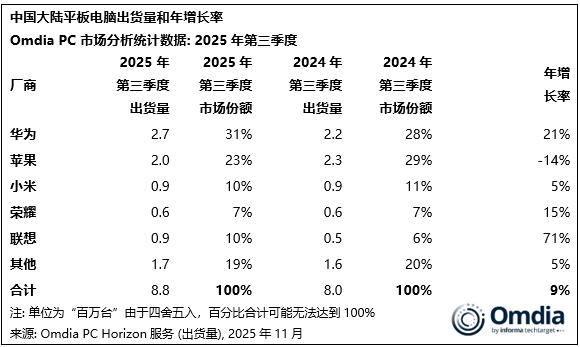
Group 1: Tablet Market Overview - The Chinese tablet market continues to show strong momentum, with Q3 2025 shipments increasing by 9% year-on-year to 8.8 million units, characterized by a split between domestic brands leading and Apple declining [1] - Huawei leads the market with a shipment of 2.7 million units and a 31% market share, growing 21% year-on-year, while Apple's iPad shipments fell 14% to 2 million units, reducing its market share from 29% to 23% [1] - Domestic manufacturers collectively hold 77% of the market share, up 5 percentage points from the previous year, with Xiaomi and Lenovo each shipping 900,000 units and Honor at 600,000 units [1] Group 2: Challenges for Apple - Apple's iPad faces multiple challenges in the domestic market, including competition from local tablets priced between 2,000-3,000 yuan that offer superior specifications [1] - The lack of product innovation and extended iteration cycles for the iPad, despite the strong performance of the M chip, make it difficult to compete with localized innovations from Huawei and Lenovo [1] Group 3: Future Market Projections - Omdia forecasts that the tablet market will grow by 12% to 35 million units by the end of 2025, driven by aggressive product launches and pricing strategies from domestic manufacturers [2] - However, a market adjustment is expected in 2026, with a projected decline of 9% to 32 million units [2] Group 4: PC Market Overview - In Q3 2025, the Chinese PC market saw a 2% year-on-year increase in shipments, reaching 11.3 million units, with desktop shipments growing by 8% to 3.3 million units, primarily driven by strong demand in the commercial sector [2][3] - Lenovo remains the market leader with a 39% share, shipping 4.4 million units, while Huawei's shipments declined by 7% to 1 million units, reducing its market share to 9% [3] Group 5: Future Projections for PC Market - Omdia anticipates a 5% year-on-year growth in the PC market by the end of 2025, reaching 41.5 million units, supported by robust commercial procurement and steady consumer demand [5] - The trend is expected to continue into 2026, although a slight decline of 2% is projected due to weakening consumer demand [5] - The adoption of AI is accelerating in both consumer and commercial markets, with 32% of PCs in Greater China expected to have AI capabilities by 2025, increasing to 46% by 2026 [5]


“美国拒绝中国天才,太蠢了”
Guan Cha Zhe Wang· 2025-12-03 06:10
Core Viewpoint - The article criticizes the Trump administration's hostile policies towards foreign talent, particularly Chinese researchers, which are driving them back to China and threatening the U.S.'s competitive edge in technology and innovation [1][2]. Group 1: Talent Flow Changes - The number of Chinese students studying in the U.S. grew sixfold from 2000 to 2019, peaking at over 372,000, but has since declined by nearly 30% due to the U.S. government's hostile attitude and the COVID-19 pandemic [4]. - The perception of overseas graduates in China has shifted, with local graduates now considered equally capable, diminishing the previous advantages of returning scholars [4]. - A significant trend of Chinese scientists returning to China has emerged, with approximately two-thirds of those leaving the U.S. in 2021 choosing to return home, compared to less than half in 2010 [6]. Group 2: Impact of U.S. Policies - The Trump administration's "China Initiative," launched in 2018, aimed at investigating researchers for alleged espionage, causing widespread fear among Chinese scientists, although only a quarter of cases resulted in convictions [5][6]. - The U.S. government has proposed measures such as a $100,000 fee for H1-B visa applications, which disproportionately affects Chinese and Indian applicants, further complicating the situation for foreign talent [2]. Group 3: AI Talent Migration - Despite the U.S. being a leading hub for AI talent, China is becoming a significant source of top talent, with nearly half of the world's leading AI researchers having received their undergraduate education in China [8]. - The proportion of foreign AI researchers in the U.S. who choose to return to China after graduation has increased from 4% in 2019 to 8% in 2022, indicating a potential trend of talent migration [9]. - The article highlights that the tightening of U.S. immigration policies and the perception of hostility towards Chinese nationals are influencing the decisions of talented individuals in the AI field [9][10].
全球折叠屏手机出货新高:三星独大,华为增长10%,vivo增长67%
Guan Cha Zhe Wang· 2025-12-03 05:57
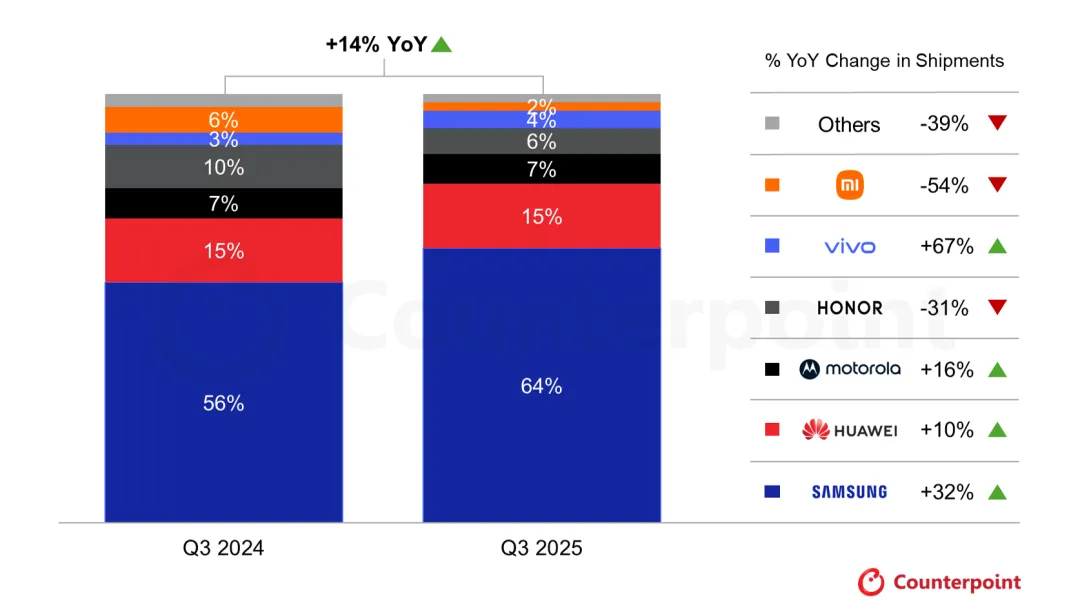
Core Insights - The global foldable smartphone market is projected to see a 14% year-on-year increase in shipments by Q3 2025, reaching a historical quarterly high for this category [1] - Samsung leads the market with a 64% share in Q3, experiencing a 32% increase in shipments compared to the previous year [1][3] - Huawei holds the second position with a 15% market share, growing by 10% year-on-year, while Motorola ranks third with a 7% share and a 16% increase [1][3] Market Performance - The foldable smartphone segment now accounts for 2.5% of global smartphone shipments, driven by the popularity of book-style models and the launch of Samsung's Galaxy Z Fold7 and Huawei's Mate series [3] - The Galaxy Z Fold7's features, such as a thinner body and improved durability, have significantly enhanced its appeal in the high-end market, contributing to unexpected growth [3] - Motorola's competitive pricing and strong channel partnerships have effectively expanded its user base in the foldable segment [3] Future Projections - Counterpoint Research anticipates a 16% year-on-year growth for the foldable market by the end of 2025, with high-end users increasingly favoring larger screens for productivity [4] - The market is expected to enter a significant expansion phase in 2026, driven by improvements in durability, thinner designs, and enhanced AI-driven software experiences [4] - Apple is expected to enter the foldable market in the second half of 2026, leveraging its large iPhone user base to initiate a new high-end product upgrade cycle [4] Competitive Landscape - The importance of technological innovation is increasing as existing manufacturers accelerate the development of multi-form factor products in anticipation of Apple's entry [5] - Companies are focusing on enhancing their technological leadership and product differentiation strategies, with foldable designs evolving beyond traditional book-style formats [5] - Samsung's upcoming tri-fold device is positioned as a pilot product to validate durability and software optimization before larger-scale commercialization [5]
全球折叠屏出货新高:三星独大,华为增长10%,vivo增长67%
Guan Cha Zhe Wang· 2025-12-03 05:56
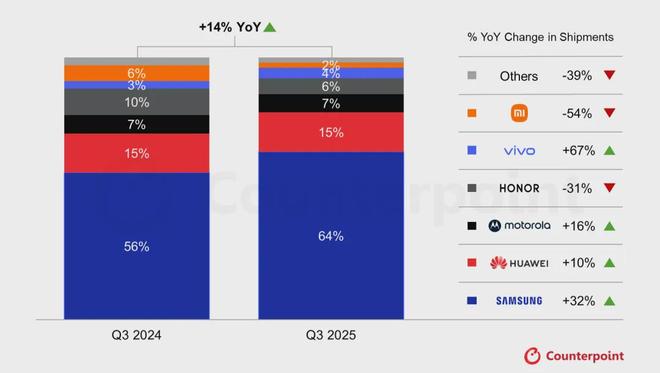
Core Insights - The global foldable smartphone market is projected to see a 14% year-on-year increase in shipments by Q3 2025, reaching a historical high for the category [1] - Samsung leads the market with a 64% share in Q3, showing a 32% increase compared to the same period last year [1] - Huawei holds the second position with a 15% market share, growing by 10% year-on-year [1] - Motorola ranks third with a 7% share, experiencing a 16% increase [1] - Vivo and Xiaomi follow in fourth and fifth places, with Vivo showing a significant growth of 67%, while Xiaomi's shipments declined by 54% year-on-year [1] Market Trends - Foldable smartphones now account for 2.5% of global smartphone shipments, driven by the popularity of book-style models and the launch of Samsung's Galaxy Z Fold7 and Huawei's Mate series [3] - The Galaxy Z series, particularly the Z Fold7, has enhanced its appeal in the high-end market due to its thinner design, lighter weight, and improved durability [3] - Motorola's competitive pricing and strong channel partnerships have effectively expanded its user base in the foldable segment [3] Future Projections - The foldable smartphone market is expected to close 2025 with a stable growth rate of around 16% year-on-year [4] - By 2026, the market is anticipated to enter a significant expansion phase, driven by improvements in durability, thinner designs, and enhanced AI-driven software experiences [4] - Apple is expected to enter the foldable market in the second half of 2026, potentially reshaping the competitive landscape [4][5] Technological Developments - Major smartphone brands are intensifying their focus on technological leadership and product differentiation, with foldable designs evolving beyond traditional book-style formats [5] - Samsung's new triple-foldable model is positioned as a pilot product to validate durability and software optimization before larger-scale commercialization [5] - The entry of Apple into the foldable market is anticipated to bring substantial changes to the competitive dynamics [5]

朱雀三号首飞成功入轨,一级火箭回收任务未能完成
Guan Cha Zhe Wang· 2025-12-03 05:49
12月3日,观察者网了解到,中国民营企业蓝箭航天自主研发的朱雀三号运载火箭成功实现首飞入轨,但一级火箭回收任务未能成功。 根据相关任务数据,火箭按预定时间点火升空,成功将有效载荷精准送入预定轨道,圆满达成本次飞行任务的核心目标。 朱雀三号是中国首款旨在实现可重复使用的大型液体运载火箭。本次发射被视为中国商业航天迈向可重复使用火箭技术的关键一步。此次发射原定于11月29 日进行,因故推迟至今日实施。 据官网披露,朱雀三号全箭总长76.6米,整流罩直径5.2米,采用蓝箭航天自研天鹊系列液氧甲烷发动机,一子级采用9台TQ-12B发动机,二子级配置1台TQ- 15B真空发动机。根据蓝箭航天的设计,朱雀三号一次性任务低轨运载能力达21.3吨,航区回收任务达18.3吨,返场回收任务达12.5吨,其未来火箭一子级可 重复使用次数可达20次。 朱雀三号蓝箭航天官网 2023年8月,朱雀三号项目立项,五个月后完成垂直起降回收百米级飞行试验。去年9月,朱雀三号完成垂直起降回收十公里飞行试验,这是实现回收复用最 为关键的节点之一。 本文系观察者网独家稿件,未经授权,不得转载。 相关图片 不过,后续开展的一级火箭回收过程中突发异常状 ...

美团发布骑手安全治理年度答卷:正向激励已有效引导降低闯红灯率
Guan Cha Zhe Wang· 2025-12-03 05:47
Core Insights - Meituan has reported a 15% year-on-year decrease in traffic accidents involving its delivery riders by 2025, attributed to systematic governance and behavioral guidance [1] - The company is launching a nationwide "no red light" safety incentive program starting December 2, aimed at rewarding riders who comply with traffic regulations, with an expected participation of millions [1] - Meituan is transitioning from negative penalties to positive incentives, having eliminated late delivery penalties and introduced a safety incentive pool of 100 million yuan [2] Group 1 - Meituan's traffic safety governance has shifted from "negative control" to "positive incentives," with the introduction of cash rewards for riders who do not run red lights [1][2] - The "no red light" safety incentive program has already benefited over 440,000 riders across nearly 200 cities [1] - The company has implemented the "Anzhun Card" system to encourage compliance with traffic rules, ensuring that user experience remains unaffected while providing riders with more flexibility [2] Group 2 - Meituan has conducted over 2000 safety awareness campaigns and organized 89,000 safety training sessions, reaching 2.41 million riders throughout the year [2] - The company has seen a 14% overall reduction in violation rates at 411 benchmark intersections in 50 key cities, with some areas experiencing a 20% drop in red light violations [2] - The initiative has also included a "Safety Star" award, with cash prizes ranging from 8,888 to 10,000 yuan for top-performing riders [1][3]


气笑,美专家当面呛:还大皮卡呢?中国都“农村包围城市”了!
Guan Cha Zhe Wang· 2025-12-03 05:29
Core Viewpoint - The article highlights a confrontation at an automotive forum where Senator Bernie Moreno criticized the push for electric vehicles (EVs) in the U.S., while industry experts argued for the necessity of competing in the EV market against China [1][3][4]. Group 1: Senator Moreno's Position - Senator Bernie Moreno advocates for U.S. automakers to focus on traditional internal combustion engine vehicles and not engage in the electric vehicle market dominated by China [3][4]. - Moreno claims that the U.S. was once significantly ahead in internal combustion engine technology but has fallen behind due to China's shift to electric vehicles [4]. - He criticizes the Biden administration's policies promoting electric vehicles and suggests that allowing Chinese cars into the U.S. market is detrimental to American industry [4][10]. Group 2: Industry Experts' Reactions - Industry leaders and analysts at the forum largely disagreed with Moreno, emphasizing the importance of U.S. manufacturers establishing a strong presence in the electric vehicle sector [7][8]. - Colin Langan from Wells Fargo acknowledged some of Moreno's points but insisted that electric vehicles possess innovation and that the U.S. must secure its position in this evolving market [8]. - Michael Dunne compared the current situation to a "rural encirclement of cities," indicating that Chinese automakers are expanding globally while the U.S. risks isolation [8][9]. Group 3: Implications of Policy Changes - The article notes that the Trump administration is expected to propose relaxing fuel efficiency standards, which were originally designed to promote electric vehicle sales [10][11]. - Environmental advocates warn that loosening these standards could hinder the U.S. automotive industry's ability to compete with China's growing dominance in the electric vehicle market [11].
单套1.35亿元!华为独家中标中移动超节点采购
Guan Cha Zhe Wang· 2025-12-03 03:53
Core Viewpoint - China Mobile has awarded a procurement project for a super node testing device to Huawei, with a bid of 135 million yuan, indicating a significant investment in advanced computing infrastructure [1] Group 1: Huawei's Innovations - Huawei's "Scale-up super large-scale super node computing platform" was recognized as its top invention, showcasing a new architecture that allows for flexible resource allocation among AI processors [1] - The Ascend 384 super node features 384 Ascend NPUs and 192 Kunpeng CPUs, achieving a total computing power of 300 Pflops, which is 1.7 times that of NVIDIA's NVL72 [2] - The total network bandwidth of the Ascend 384 super node reaches 269 TB/s, surpassing NVIDIA's NVL72 by 107% [2] Group 2: Industry Trends - The demand for computing power in large models is rapidly increasing, while traditional computing architectures face challenges such as low resource utilization and frequent failures [4] - Super nodes are emerging as a new norm in AI infrastructure, with several domestic manufacturers exploring super node systems [4] - Inspiring innovations include the launch of the world's first single-cabinet 640-card super node by Sugon, which enhances computing density by 20 times compared to traditional solutions [4][5] Group 3: Future Developments - Huawei plans to launch the Atlas 950 super node in Q4 2026, featuring 8192 Ascend 950DT chips and achieving FP8 computing power of 8 EFLOPS [12] - The Atlas 950 super node is projected to be significantly more powerful than NVIDIA's upcoming NVL144, with a total computing power 6.7 times greater and memory capacity 15 times larger [14] - Future plans include the Atlas 950 SuperCluster, which will consist of 64 Atlas 950 super nodes, achieving a total FP8 computing power of 524 EFLOPS, surpassing the current largest cluster, xAI Colossus [14]
