
Zhong Guo Neng Yuan Wang

Search documents
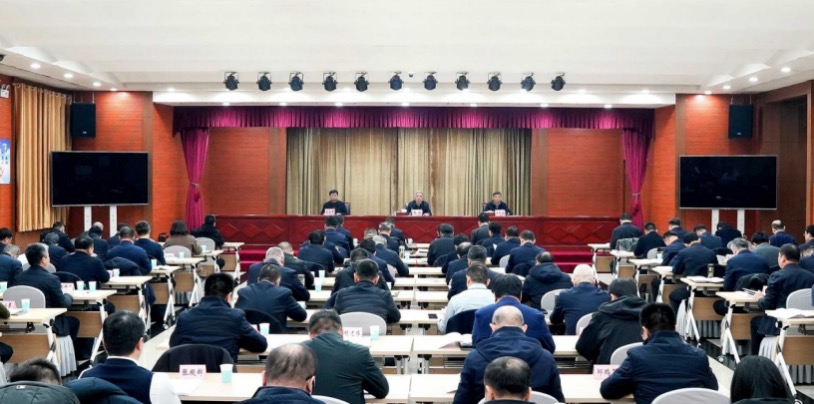
山西省能源工作会议:2026年锚定“能源强省”,八大任务擘画转型新蓝图
Zhong Guo Neng Yuan Wang· 2026-01-22 06:51
Core Viewpoint - The Shanxi Provincial Energy Work Conference outlined the strategic direction for the energy sector during the "14th Five-Year Plan" and set goals for the "15th Five-Year Plan" and 2026, emphasizing energy security, green transformation, and the transition from a coal-dominated economy to a diversified energy system [1][3][4]. Group 1: Energy Development Strategy - The conference highlighted the transition from "traditional coal mining" to "intelligent and green" coal production, and from "coal-dominated power" to a "diversified and complementary" power structure [3][4]. - By 2025, Shanxi aims to establish a new energy system with local characteristics, focusing on energy security, digital empowerment in coal production, and green low-carbon development [3][4]. - The energy sector is expected to shift from "individual energy solutions" to "integrated energy services," enhancing collaboration among various energy sources [4]. Group 2: Key Focus Areas for 2026 - Eight key areas of focus were identified for 2026, including the creation of new energy service models, promoting high-quality coal production, and advancing the transformation of the electricity sector [5][6]. - The development of a billion-dollar coalbed methane industry cluster is planned, alongside the promotion of unconventional gas production and the enhancement of gas utilization technologies [5][6]. - The conference emphasized the importance of energy technology innovation and the conversion of research achievements into practical applications [6]. Group 3: Implementation and Governance - The conference stressed the need for strong political leadership and effective management to ensure the successful implementation of energy plans and projects [6][7]. - It called for a collaborative approach among provincial, municipal, and county levels to manage energy resources effectively and ensure energy supply during peak demand periods [6].

中国联通、烽火通信等在湖北成立创业投资基金,出资额10亿
Zhong Guo Neng Yuan Wang· 2026-01-22 06:26
Core Viewpoint - The establishment of Hubei Fenghuo Venture Capital Fund Partnership (Limited Partnership) signifies a strategic move in the venture capital landscape, focusing on equity investment and asset management activities [1] Group 1: Company Formation - Hubei Fenghuo Venture Capital Fund Partnership has been recently established with a total investment of 1 billion RMB [1] - The executive partner is Wuhan Guanggu Fenghe Private Fund Management Co., Ltd [1] - The fund's operational scope includes venture capital, private equity investment, investment management, and asset management [1] Group 2: Investment Contributors - The fund is jointly funded by Fenghuo Communication, China Unicom's Union Innovation Private Equity Investment Fund (Wuhan) Partnership, and Hubei Provincial Investment Guidance Fund Co., Ltd [1]


华海清科在昆山成立半导体公司,注册资本4亿
Zhong Guo Neng Yuan Wang· 2026-01-22 06:23
Group 1 - The core point of the article is the establishment of Jinko QiYuan (Kunshan) Semiconductor Co., Ltd., which is fully owned by Huahai Qingke (688120) with a registered capital of 400 million RMB [1] - The company is involved in various sectors including the manufacturing of semiconductor discrete devices, specialized semiconductor equipment, and integrated circuits [1] - The legal representative of the newly established company is Pan Jigang, indicating a structured leadership for its operations [1] Group 2 - The business scope of the company includes the sales of semiconductor devices and electronic specialized equipment, as well as general equipment repair and maintenance [1] - The establishment of this company reflects the growing investment and focus on the semiconductor industry in China [1] - The registration of the company suggests potential opportunities for growth in the semiconductor market, which is critical for various technology sectors [1]

镍:反转在即 | 投研报告
Zhong Guo Neng Yuan Wang· 2026-01-22 04:03
Group 1: Nickel Supply - Indonesia holds significant nickel reserves of 55 million tons, accounting for 42% of global reserves, making it the most important nickel reserve country [1][2] - Global nickel production is projected to reach 3.52 million tons in 2024, with a year-over-year increase of 4.7%, and is expected to rise to 3.81 million tons in 2025, reflecting an 8.2% growth [1][2] - Indonesia's nickel production is anticipated to be around 2.2 million tons in 2024, representing approximately 60% of global supply, and is expected to increase to 67% by 2025 [1][2] Group 2: Nickel Smelting and Profitability - The analysis of Indonesia's nickel smelting indicates that the hydrometallurgical HPAL process is currently profitable due to high cobalt prices, while the pyrometallurgical RKEF process faces challenges due to high nickel ore prices and poor downstream nickel-iron prices [3] Group 3: Nickel Demand - Stainless steel remains the dominant demand driver for nickel, with a projected demand of around 2.3 million tons in 2025, accounting for 65% of total demand [5] - The demand for ternary batteries is expected to grow at a rate of about 7%, with an estimated total demand of 480,000 tons in 2025, representing 14% of the overall demand [5] - Global stainless steel production is forecasted to reach 62.62 million tons in 2024, showing a year-over-year increase of over 7% [5] Group 4: Policy Impact and Market Dynamics - Recent Indonesian government policies have tightened regulations on the development of strategic minerals, particularly nickel, reversing previous expectations of a relaxed market [6] - If Indonesia's quota policy of 250 million tons is implemented, nickel supply may decrease by approximately 8% in 2026, potentially leading to a market shortfall of around 100,000 tons [7] Group 5: Market Performance and Investment Opportunities - Nickel has been notably absent from the metal bull market from 2024 to the present, with a price increase of only 3% since 2024, significantly lower than other metals [8] - Should supply-demand gaps arise due to Indonesian policies, there may be potential for a significant price rebound, making companies like Likin Resources and Huayou Cobalt attractive investment opportunities [9]
江长项目(长寿段)主线15号桥首片梁成功架设
Zhong Guo Neng Yuan Wang· 2026-01-22 04:01
目前施工的连续刚构桥全长280米,采用单箱双室等变截面直腹式箱梁,跨径布置75+130+75米,采用 挂篮悬臂浇筑施工,箱梁变化段划分为19个节段,主梁设置纵、横和竖向三向预应力体系;现浇箱梁采 用单箱双室等截面直腹式箱梁,主梁设置纵向预应力,后张法施工;预制T梁长30米,采用架桥机架设。 主线15号桥是江长项目(长寿段)关键控制性工程之一,自施工以来,项目团队创新工艺工法,在大桥结 构设计上持续科研攻关,T型对称式悬臂梁不仅是力与美的结合,更是力学性能的优化体现,使材料效 能得以充分发挥。"单箱双室"的直腹板箱型结构赋予了桥梁强大的抗扭刚度,顶底板整体旋转形成桥面 横坡的创新设计,也省去了传统垫层的繁杂,展现出巧妙的构思。 1月17日,由重庆城投江长建设有限公司投资建设、中交路桥建设有限公司承建的重庆市两江新区-长寿 区快速通道项目(长寿段)主线15号桥首片预制T梁成功架设。 江长项目(长寿段)主线15号桥左幅全长673.145米,右幅全长659.484米。上部结构采用预应力混凝土变 截面连续刚构桥、现浇预应力混凝土简支箱梁、钢箱梁、预应力混凝土先简支后连续T梁,预制T梁共 计72片;下部结构为轻型桥台、重 ...
黄仁勋称最大遗憾是 27 年前为父母买奔驰而卖英伟达股票:这是世上最贵的车
Zhong Guo Neng Yuan Wang· 2026-01-22 03:50
Group 1 - The CEO of NVIDIA, Jensen Huang, humorously referred to a Mercedes S-Class car he bought for his parents after selling shares worth $300 million at the company's IPO as the "most expensive car in the world," given NVIDIA's current market valuation nearing $5 trillion [1] - Huang expressed regret over selling the stock too early, as the car, originally valued at approximately $80,000, would now be worth around $1.2 billion based on NVIDIA's current market value, representing a 15,000-fold increase [1] Group 2 - Huang emphasized that he is more focused on industry fundamentals rather than stock market fluctuations, noting that the world is undergoing the largest infrastructure build-out in human history, driven by hyperscale cloud computing companies [2] - He pointed out that current investments in the AI industry have reached hundreds of billions of dollars, with future demand expected to reach trillions of dollars, which is justified due to the need for AI models to process vast amounts of contextual information [2] - The rise of advanced models and agentic AI is expected to lead to a sustained explosion in demand for underlying computing power, although the challenge remains whether these large-scale investments can effectively translate into widespread and continuous technological applications [2]

武汉光谷创新投资公司登记成立,注册资本20亿
Zhong Guo Neng Yuan Wang· 2026-01-22 03:32
天眼查工商信息显示,近日,武汉光谷创新投资有限公司成立,法定代表人为杨少丹,注册资本20亿人 民币,经营范围为以自有资金从事投资活动,自有资金投资的资产管理服务、创业投资。股东信息显 示,该公司由武汉东湖新技术开发区管理委员会全资持股。 ...
赣锋锂业在上海成立全球能源科技公司,注册资本500万
Zhong Guo Neng Yuan Wang· 2026-01-22 03:10
Group 1 - The establishment of Ganfeng Global (Shanghai) Energy Technology Co., Ltd. has been officially registered, with a legal representative named Zhang Diyuan and a registered capital of 5 million RMB [1] - The company's business scope includes software development, import and export of goods and technology, research and development of emerging energy technologies, sales of battery components, energy storage technology services, information technology consulting services, and intelligent control system integration [1] - Ganfeng Global is wholly owned by Jiangxi Ganfeng Lithium Technology Co., Ltd., a subsidiary of Ganfeng Lithium (002460) [1]

国网王旭阳解读分布式新能源新规则:反送电约束放宽,安全边界划重点!
Zhong Guo Neng Yuan Wang· 2026-01-22 02:47
Core Viewpoint - The rapid growth of distributed renewable energy, particularly distributed photovoltaics in China, has significantly increased installed capacity, laying a solid foundation for the green energy transition, while also presenting challenges for grid absorption and safe operation [1][2]. Group 1: Growth of Distributed Photovoltaics - Since the 14th Five-Year Plan, China's distributed photovoltaic capacity has surged from 78 million kilowatts in 2021 to over 500 million kilowatts currently, making renewable energy the largest power source in the country [1]. - This growth is crucial for the green transformation of the energy structure, establishing a robust foundation for future developments [1]. Group 2: Challenges and Solutions - The reverse power flow from distributed energy sources poses challenges to the power system's absorption capacity and stable operation [1]. - To address these challenges, the development of distributed renewable energy must rely on an integrated grid resource platform, focusing on three key elements: system absorption capacity, peak regulation and flexibility, and regional load levels [1][2]. Group 3: Optimization of Assessment Methods - The optimization of the assessment methods for distributed power capacity includes two main dimensions: the introduction of system-level capacity calculations and a moderate relaxation of constraints on 220 kV grid reverse power flow [2]. - The new constraint standards are set to prevent reverse overload risks while accommodating the demand for renewable energy integration [2]. - The assessment method has evolved from a fixed capacity model to a dynamic range model, incorporating variables such as new energy storage and utilization rates, which enhances the potential for distributed photovoltaic absorption [2]. Group 4: Future Directions - The current power system exhibits tidal operational characteristics, necessitating new safety and stability mechanisms [3]. - Future strategies will focus on local absorption of distributed energy while achieving overall balance and optimization through the collaboration of main grids, distribution networks, and microgrids [3].
台积电2025Q4营收同比增长,DRAM价格持续上涨
Zhong Guo Neng Yuan Wang· 2026-01-22 01:38
Core Viewpoint - The data center sector is driving significant growth in the power equipment industry, with capital expenditures showing a high growth trend, particularly among major overseas players, while domestic giants like Alibaba and Tencent are experiencing a slowdown in their capital spending [1][3]. Demand Side - Overseas capital expenditures in Q3 2025 reached $99.617 billion, marking an 80.39% year-on-year increase and a 9.54% quarter-on-quarter rise [3]. - Alibaba's capital expenditure for Q3 2025 was 31.5 billion yuan, reflecting an 80.10% year-on-year increase but a decline of 18.55% quarter-on-quarter. The company reiterated its three-year investment framework of 380 billion yuan, indicating potential for further investment [3]. - Tencent's capital expenditure was 13 billion yuan in Q3 2025, down 24.05% year-on-year and 32.05% quarter-on-quarter, with a downward revision of its annual guidance, indicating spending below initial expectations [3]. Supply Chain - NVIDIA reported total revenue of $57.006 billion in Q3 2025, with data center product revenue reaching $51.215 billion, a historical peak, showing a 24.62% quarter-on-quarter increase and a 66.44% year-on-year increase, accounting for over 89% of total revenue [4]. - TSMC's revenue for December 2025 was 335 billion new Taiwan dollars, a 20.4% year-on-year increase but a 2.5% quarter-on-quarter decline, achieving a record high for the same period [4]. - The CPU price index in November 2025 was 99.04, slightly up from 98.20 in October, while DRAM spot prices surged from $27.14 on November 17, 2025, to $66.50 by January 16, 2026, reflecting a more than 145% increase over two months, indicating strong server demand [4]. Application Side - The number of models in use is steadily increasing, with application deployments becoming more frequent. Token usage from January 5 to January 12, 2026, reached 7.65 trillion, an 18.97% increase from the previous period [4]. - In Q3 2025, the release of models such as Grok4Fast, GPT-5nano, and gpt-oss-20B led to a decline of over 50% in the price of tokens for models scoring above 40 on the ArtificialAnalysis intelligence index [4]. Investment Recommendations - The construction of AI data centers is expected to drive demand for HVDC and SST technologies. The global data center installation capacity is projected to increase by approximately 14 GW in 2024, with major cloud providers maintaining high capital expenditures. TSMC's capital expenditure for 2026 is expected to reach $52-56 billion, a year-on-year increase of about 30% [5]. - The increasing power density of data center cabinets is likely to enhance the penetration of HVDC and SST technologies, with smart busbars expected to see widespread adoption [5]. - Recommended stocks include Zhongheng Electric (002364), Oulu Tong (300870), Weiteng Electric (688226), and Sunshine Power (300274). Stocks to watch include Kehua Data (002335), Keda (002518), Kelu Electronics (002121), Magmi Tech (688676), and Sifang Co. (601126) [5].
