
Zhong Guo Neng Yuan Wang

Search documents
北京这五年:从“用上电”到“用好电”“用绿电”
Zhong Guo Neng Yuan Wang· 2026-01-22 01:38
京华大地,文脉绵延;电力动脉,脉动强劲。 "十四五"时期,北京锚定"四个中心"战略定位、向着国际一流和谐宜居之都阔步前行。国网北京市电力 公司作为国家电网有限公司服务首都窗口单位和首都最大的公用事业企业,胸怀"国之大者",践行央企 担当,深入贯彻"四个革命、一个合作"能源安全新战略,以构建新型电力系统为核心,在电力保供、绿 色转型、为民服务等领域攻坚克难、砥砺前行,用澎湃电能为首都高质量发展注入不竭动力。 强网夯基筑牢首都能源安全屏障 能源安全是"国之大者",坚强电网是城市发展的"压舱石"。作为典型受端电网,北京七成用电依赖外 送。"十四五"期间,国网北京电力秉持"宁让电等发展,不让发展等电"理念,以"外强动脉、内优网 架"为核心,推动电网实现质的飞跃。 2025年12月,冬日的电网建设现场机械轰鸣、人影攒动。不久前,亦庄500千伏变电站工程竣工投产, 不仅有效增强了北京东南部地区供电可靠性和稳定性,而且标志着北京市"十四五"时期的电网建设任务 圆满收官。 五年间,国网北京电力32项220千伏及以上电网工程顺利投运,新增变电容量1698万千伏安。其中,以 京津冀特高压环网为支点,构建500千伏扩大双环网,13 ...

光伏出口退税将取消,电池片价格持续上涨
Zhong Guo Neng Yuan Wang· 2026-01-22 01:37
Core Viewpoint - The photovoltaic (PV) industry is experiencing a decline in production and demand, with significant decreases expected in December 2025, influenced by export tax policies and market conditions [1][2]. Production - PV module production in November 2025 decreased by 2.43% compared to October, with a further expected decline of 14.77% in December [2]. - Battery production for January 2026 is projected at 210 GWh in China, down 4.55% month-on-month, with significant reductions in second-tier companies, while energy storage battery production remains stable or slightly increases [2]. Prices - As of January 14, 2026, the price of polysilicon remained stable at 54.00 CNY/kg, while TOPCon dual-glass module prices increased by approximately 1.43% to 0.71 CNY/W [3]. - The average price for lithium iron phosphate battery storage systems in November 2025 was 0.5721 CNY/Wh, reflecting a 6.4% decrease [3]. Demand - In November 2025, the export value of PV modules was approximately $2.412 billion, a year-on-year increase of 34.08% and a month-on-month increase of 6.84% [4]. - Domestic PV installations in November 2025 reached 22.02 GW, a 74.76% increase month-on-month but an 11.92% decrease year-on-year [4]. Investment Recommendations - The expected cancellation of the export tax rebate for certain products in April 2026 may temporarily boost domestic PV product shipments, while also promoting the elimination of outdated production capacity [5]. - Companies to watch include Sungrow Power Supply (300274.SZ), Narada Power Source (300068.SZ), Tongrun Equipment (002150.SZ), Huashengchang (002980.SZ), and Shouhang New Energy (301658.SZ) [5].



风雪来袭 电力护航
Zhong Guo Neng Yuan Wang· 2026-01-22 01:21
自1月18日起,陕西省迎来2026年首场大范围寒潮和雨雪冰冻天气,本次过程雨雪范围广、强度大、相 态复杂、局地伴有冻雨。国网陕西电力提前启动应急响应,统筹分析研判寒潮雨雪影响范围和电网运行 特点,针对性制定防御应对措施,切实做好雨雪冰冻、降温天气防范应对,统筹做好电网安全、电力保 供工作。 ...
2025年12月国内电池产量和装车量同比高增,六氟磷酸锂价格下降
Zhong Guo Neng Yuan Wang· 2026-01-22 01:21
Core Viewpoint - The lithium battery industry is expected to see significant growth in production and demand in 2025, with domestic battery and lithium iron phosphate (LFP) cathode material output notably higher than in 2024 [1][2] Production - In December 2025, domestic battery production is projected to reach 201.7 GWh, representing a year-on-year increase of approximately 62% and a month-on-month increase of about 14% [1][2] - The output of domestic lithium iron phosphate cathode materials in December 2025 is expected to be 26.93 million tons, showing a year-on-year growth of 32.48% and a month-on-month increase of 0.16%, with a capacity utilization rate of 59.85% [1][2] Pricing - As of January 16, 2026, the price of industrial-grade lithium carbonate has risen to 153,000 yuan per ton, with a weekly increase of 10.87% [3] - The price of lithium iron phosphate (power type) was reported at 47,100 yuan per ton on January 9, 2026, up 4.43% from January 4 [3] - The average price of square lithium iron phosphate energy storage cells remained stable, with specific capacities showing slight increases in price [3] Demand - In December 2025, the monthly loading volume of lithium iron phosphate batteries reached 79.8 GWh, a year-on-year increase of 30.82% and a month-on-month increase of 5.98%, marking a new high for the year [4] - The monthly loading volume of ternary power batteries was 18.2 GWh, remaining stable compared to November and showing a year-on-year increase of 27.27% [4] - In November 2025, global sales of new energy vehicles reached 2 million units, reflecting a year-on-year growth of 8.53% and a month-on-month increase of 4.63% [4] Investment Recommendations - The report suggests focusing on companies involved in the production of lithium batteries and related materials, particularly those with strong positions in both domestic and overseas markets [5] - Recommended companies include CATL (300750.SZ), EVE Energy (300014.SZ), Xinwangda (300207.SZ), Hunan Youneng (301358.SZ), Tianci Materials (002709.SZ), and Dofluorid (002407.SZ) [5]






12月非挖产品整体保持增长
Zhong Guo Neng Yuan Wang· 2026-01-22 01:13
Group 1: Equipment Manufacturing Industry - The excavator market continues to grow, while the automotive crane market also shows a positive growth trend, with domestic sales of 886 units in December 2025, a year-on-year increase of 39.1%, and exports of 1,025 units, a year-on-year increase of 37.2% [1][3] - The automotive crane has achieved six consecutive months of year-on-year positive growth, driven by factors such as policy support, equipment upgrades, new energy infrastructure, and export demand [1][3] - Other non-excavator products, excluding tower cranes affected by the real estate market, also maintain a growth trend, suggesting continued investment opportunities in the engineering machinery sector [3] Group 2: Solar Industry - The cancellation of export tax rebates is forcing the industry to clear out excess capacity, leading to a surge in component prices as companies accelerate overseas shipments to avoid rising costs [4] - Component manufacturers are entering a "grab export" mode, with distributors and project parties hoarding low-priced orders, resulting in a rapid transfer of inventory from factories to overseas and distribution channels [4] - The solar industry is currently in a phase of "cost-push price increases" versus "weak terminal demand," and future recovery will depend on the penetration of efficient battery technologies and the resilience of overseas demand [4] Group 3: Automotive Industry - In the first week of January 2026, the retail market for passenger vehicles saw significant declines both year-on-year and month-on-month, with daily wholesale figures dropping to 35,000 units, a 40% decrease compared to January of the previous year and a 30% decrease from the previous month [5] - The weak performance in the automotive market is influenced by holiday factors, reduced purchase tax incentives, and changes in subsidy methods, which may impact short-term sales [5] - Long-term prospects for the new energy vehicle market remain positive, with significant potential for penetration and increased consumption driven by advancements in automotive intelligence [5]
动力煤先强后弱震荡运行,降温能否救场?
Zhong Guo Neng Yuan Wang· 2026-01-21 11:35
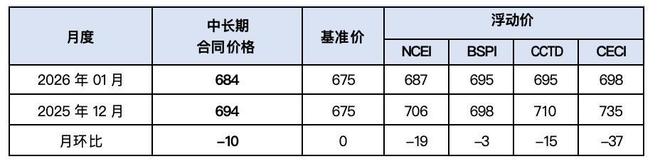
Group 1 - The core viewpoint of the article indicates that the thermal coal market is characterized by a mix of bullish and bearish factors, with overall supply stability, slow logistics, ongoing inventory reduction in intermediate links, and weak demand suppressing prices [1] - The price trend for thermal coal shows a clear divergence, with long-term contract prices declining month-on-month while spot prices have slightly increased but with narrowing gains [2][3] - The long-term contract price for 5500 kcal thermal coal is reported at 684 RMB/ton, a decrease of 10 RMB/ton from the previous month, with various floating price indicators also showing declines [2][3] Group 2 - Domestic coal supply remains stable, with major production areas continuing to resume operations, leading to a steady increase in output, while imports have become a significant supplement to supply [6][7] - In December 2025, coal imports reached 58.597 million tons, a year-on-year increase of 11.9%, marking a significant recovery and contributing to market supply during the peak winter demand season [7] - The logistics segment is under pressure, with port operation efficiency limited by adverse weather conditions, resulting in a decrease in coal outflow [10] Group 3 - Weak demand is identified as the primary factor suppressing coal prices, with reduced operating rates in downstream industries and lower demand for residential heating due to warmer temperatures [11] - The outlook for the market suggests that upcoming cold weather and increased heating demand may provide temporary support for thermal coal prices [11]
临沧凤庆供电局:电暖村歌赛场 声传振兴新章
Zhong Guo Neng Yuan Wang· 2026-01-21 10:40
夜幕降临,鲁史古镇四方街燃起熊熊篝火,村唱大赛海选在欢快的歌舞中落下帷幕。当最后一批观众散 去,保电队员们并未立刻撤离,而是再次对所有供电设备、线路进行全面检查,确认无异常后,才有序 拆除临时供电设施,圆满完成本次保电任务。从赛前筹备到现场值守,从隐患排查到应急备勤,凤庆供 电局以"时时放心不下"的责任感,将每一项保电举措落到实处,用零故障、零中断的可靠供电,让古镇 赛事顺利开展,让乡村群众尽享文化盛宴。 "栖心凤庆,古道乡愁",1月19日的鲁史古镇四方街人声鼎沸、歌声悠扬,凤庆县村唱大赛海选在此隆 重开赛。青石板路映着古镇风貌,村民们用质朴歌声传递乡土情怀,这场热闹赛事的背后,离不开南方 电网云南临沧凤庆供电局的坚实护航。作为本次活动的供电保障单位,该局以周密部署、精细举措与全 程坚守,为赛事筑牢电力防线,用可靠供电彰显服务乡村振兴的国企担当。 此次村唱大赛海选的圆满举办,是乡村文化振兴的生动实践,而可靠的电力保障则是这场文化盛宴的重 要支撑。凤庆供电局始终立足服务地方发展大局,将保障各类乡村活动用电作为践行乡村振兴战略的重 要举措,以专业、高效、贴心的供电服务,为乡村文化建设、民生改善注入电力动能。未来, ...
替代能源持续发力挤占需求 2025年12月柴油出口小幅增量
Zhong Guo Neng Yuan Wang· 2026-01-21 10:06
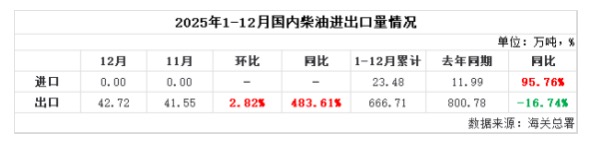
Core Viewpoint - In December 2025, China's diesel exports showed a significant increase both month-on-month and year-on-year, while the cumulative annual export volume experienced a decline. The market dynamics indicate a shift towards alternative energy sources impacting diesel demand, despite a temporary rebound in exports due to stable logistics and construction activities [1][2][3]. Group 1: Export Data - In December 2025, diesel export volume reached 427,200 tons, marking a month-on-month increase of 2.82% and a year-on-year increase of 483.61% [1][2]. - The cumulative diesel export volume for the year 2025 was 6,667,100 tons, reflecting a year-on-year decline of 16.74% [1][2]. - The export destinations expanded from 18 to 26 countries, with Bangladesh, the Philippines, and Singapore being the top three destinations [3]. Group 2: Import Data - There were no diesel imports recorded in December 2025, while the cumulative import volume for the year was 234,800 tons, representing a year-on-year increase of 95.76% [1][2]. Group 3: Market Dynamics - The logistics and construction industry showed stable performance, contributing to the slight rebound in diesel exports [2]. - The penetration of alternative energy vehicles, particularly in the logistics sector, is increasingly suppressing diesel demand, with new energy heavy truck sales rising by 198% year-on-year in December [2]. - The current export quota remains similar to the previous year, with no significant easing of export policies, which may limit future diesel export volumes [3].
东方日升HJT闪耀大马加速东南亚布局
Zhong Guo Neng Yuan Wang· 2026-01-21 09:21
Core Insights - The strategic partnership between Dongfang Risen and Eco Persona aims to develop commercial rooftop photovoltaic projects in four states of Malaysia, focusing on technological upgrades [1][2] - Dongfang Risen's HJT (Heterojunction) solar modules have achieved a mass production power output exceeding 740Wp, positioning them among the highest power photovoltaic modules globally [1] - The collaboration leverages Dongfang Risen's advanced technology to enhance energy efficiency and reduce electricity costs in commercial rooftop applications [1][2] Company Overview - Dongfang Risen is recognized for its cutting-edge HJT technology, which not only excels in ground applications but also shows potential in space energy solutions, such as low Earth orbit satellite internet and deep space exploration [1] - Eco Persona, established in 2019, specializes in providing comprehensive photovoltaic system services for commercial and residential sectors in Malaysia, particularly in customized rooftop solutions [1] Market Context - The Southeast Asian photovoltaic market is experiencing explosive growth due to the acceleration of global carbon neutrality efforts [2] - The partnership strengthens both companies' positions in the Malaysian photovoltaic market and aims to provide more efficient and reliable green energy solutions to global customers [2]

交银投资等在成都成立股权投资基金,出资额10亿
Zhong Guo Neng Yuan Wang· 2026-01-21 09:17
Group 1 - The Chengdu Jiazi Jiaorong Equity Investment Fund Partnership (Limited Partnership) has been established with a total investment of 1 billion RMB [1] - The executive partner is Chengdu Jiazi Industrial Fund Management Co., Ltd., along with Jiao Yin Capital Management Co., Ltd. [1] - The fund's business scope includes private equity investment, investment management, and asset management activities [1] Group 2 - The fund management services include private equity fund management and venture capital fund management [1] - The fund is co-invested by Jiao Yin Financial Asset Investment Co., Ltd., Chengdu Juan Cheng Jin Kong Holding Co., Ltd., and Jiao Yin Capital Management Co., Ltd. [1]