
Zhong Guo Jing Ying Bao

Search documents
证监会严肃查处长药控股严重财务造假案 拟罚4100万元
Zhong Guo Jing Ying Bao· 2025-12-26 11:06
经查,*ST长药连续三年虚增收入和利润,违反证券法律法规。证监会拟对上市公司罚款1000万元,对 14名责任人合计罚款3100万元,对公司原总经理罗明采取终身证券市场禁入措施。 证监会表示,*ST长药涉嫌触及重大违法强制退市情形,深交所将依法启动退市程序。 中经记者 孙汝祥 夏欣 北京报道 此外,证监会对中介机构执业情况同步开展核查,一旦发现违法违规情形,将依法予以惩处。对于可能 涉及的犯罪线索,证监会将坚持应移尽移的工作原则,严格按照《刑法》《最高人民检察院 公安部关 于公安机关管辖的刑事案件立案追诉标准的规定(二)》的规定移送公安机关。 证监会网站12月26日公布,近日,证监会对上市公司长江医药控股股份有限公司(以下简称"*ST长药 (维权)")涉嫌定期报告等财务数据存在虚假记载作出行政处罚事先告知。 (编辑:罗辑 审核:夏欣 校对:颜京宁) ...

AI钉钉加速落地 牵手上海金山制造业转型
Zhong Guo Jing Ying Bao· 2025-12-26 09:59
Group 1 - The core viewpoint of the articles highlights the acceleration of DingTalk's AI strategy with the launch of AI DingTalk 1.1 and over 20 new AI products, transforming it from a traditional office collaboration platform to an intelligent operating system for future work [1] - DingTalk's CTO, Zhu Hong, stated that the application of artificial intelligence in enterprises has evolved from being an auxiliary tool to becoming an executor, aligning with national strategies for AI empowerment in industrialization [1] - The initiative in Jinshan District aims to create a regional AI development hub characterized by active technological innovation, deep application empowerment, and a robust industrial ecosystem [1] Group 2 - Domestic GPU leader Mu Xi Co. and Li Xing Industrial have partnered with DingTalk, leveraging its digital capabilities to enhance organizational collaboration and information security [2] - Mu Xi Co. has implemented DingTalk as its core digital foundation since 2021, focusing on organizational collaboration and information security through private deployment and data management [2] - Li Xing Industrial, which specializes in intelligent assembly products for high-end manufacturing, began using DingTalk in 2023 to address collaboration needs and enhance security and AI capabilities [2]
东风汽车“绝地反击” 2025年度新能源销量百万辆目标达成
Zhong Guo Jing Ying Bao· 2025-12-26 09:47
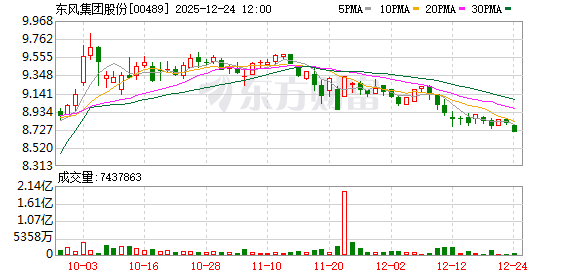
Core Insights - Dongfeng Motor Group has achieved significant milestones by reaching a target of 1 million new energy vehicle sales for 2025 and celebrating the production of the 10,000th M817 vehicle, marking a structural shift towards self-owned brands and new energy vehicles as key growth drivers [2][4] Group 1: Sales and Production Achievements - Dongfeng Motor's new energy vehicle sales for 2025 exceeded 1 million units, representing a 22% year-on-year increase [4] - The company’s self-owned brand sales are projected to surpass 1.5 million units in 2025, with a 12% year-on-year growth [4] - The M817 model, launched just four months prior, has seen its 10,000th unit roll off the production line, highlighting the rapid market acceptance of this vehicle [2][4] Group 2: Strategic Initiatives and Technological Advancements - Dongfeng has implemented the "Oriental Wind Rising" plan and a three-year action plan for transformation, focusing on optimizing its business layout and enhancing core technologies [4][5] - The company has established a comprehensive brand portfolio covering luxury, high-end, and mainstream segments, with significant advancements in its new energy vehicle offerings [8][9] - Dongfeng has led in patent innovation, holding 28,083 effective patents as of November 2025, with 6,872 patents in the fields of new energy and intelligent networking [4] Group 3: Market Position and Future Outlook - Dongfeng's self-owned brands now account for over 60% of total sales, achieving a 1:1 sales ratio with joint ventures, thus becoming the mainstay of the company's overall sales [8] - The company is set to continue its focus on innovation and reform, aiming to establish itself as a benchmark enterprise with international competitiveness by 2035 [9]


杭衢高铁开通运营,长三角再添城际快线
Zhong Guo Jing Ying Bao· 2025-12-26 08:34
Core Viewpoint - The opening of the Hangzhou to Quzhou high-speed railway (Hangzhou-Quzhou High-speed Railway) on December 26, 2025, enhances the rapid transportation network in the Yangtze River Delta, creating a dual high-speed rail corridor between Hangzhou and Quzhou [1][2]. Group 1: High-speed Railway Developments - The Hangzhou-Quzhou High-speed Railway will operate at a maximum speed of 350 km/h, with 12 daily train services initially [1]. - The railway connects Hangzhou and Quzhou, forming a dual high-speed rail corridor with the existing Shanghai-Kunming high-speed railway [1][2]. - On the same day as the Hangzhou-Quzhou High-speed Railway's opening, two other high-speed rail lines were inaugurated: the Xi'an to Yan'an high-speed railway (299 km) and the Wuhan to Yichang section of the Hubei-Chongqing high-speed railway (314 km) [2]. Group 2: Future Plans and Investments - Several high-speed rail projects are expected to open by the end of 2025, including the Hefei West to Sixian East section of the Hefei-Xinjiang high-speed railway (208 km) and the Beijing-Tangshan intercity railway (150 km) [3]. - The "14th Five-Year Plan" aims for China's railway operating mileage to reach 165,000 km by the end of 2025, with high-speed rail mileage reaching 50,000 km [3]. - Railway fixed asset investment has reached historical highs, with 3,559 billion yuan invested in the first half of the year and 7,538 billion yuan in the first eleven months, marking a year-on-year increase of 5.9% [3].

首批52个国家级零碳园区名单正式公布
Zhong Guo Jing Ying Bao· 2025-12-26 07:31
Core Viewpoint - The National Development and Reform Commission, the Ministry of Industry and Information Technology, and the National Energy Administration have jointly issued a notice regarding the first batch of national-level zero-carbon parks, with 52 parks selected for development [1] Group 1: Overview of Selected Parks - Among the 52 national-level zero-carbon parks, 15 parks, including Beijing Economic-Technological Development Area, are required to be completed between 2025 and 2028 [1] - Six parks, such as Cangdong Economic Development Zone in Cangzhou, Hebei, are to be completed between 2025 and 2027 [1] - Another six parks, including Siping New Industrialization Economic Development Zone in Jilin, are set for completion between 2025 and 2029 [1] - The remaining 25 parks, including Tianjin Economic-Technological Development Area, are expected to be completed between 2025 and 2030 [1] Group 2: Responsibilities and Support - The notice emphasizes that these parks will serve as demonstration models for national-level zero-carbon parks, with plans to promote successful practices nationwide [1] - Local governments and relevant units are tasked with the primary responsibility for constructing these parks, ensuring compliance with national zero-carbon indicators [1] - Support will be provided in terms of funding, resource allocation, technical assistance, and financial services to facilitate the implementation of green electricity supply models in these parks [1]
捕捉绿色理财新风口 “绿色算力+转型金融”打开增量空间
Zhong Guo Jing Ying Bao· 2025-12-26 07:10
Core Insights - The issuance of green and ESG-themed financial products is rapidly increasing, with a projected 18.5% growth in actual fundraising scale for these products in 2025 compared to 2024 [1][2] - The rise in green and ESG investments aligns with national strategies for sustainable development, making them attractive options for conservative investors [1][4] Group 1: Market Trends - Multiple institutions, including Huayin Wealth and China Post Wealth, have launched green or ESG-themed financial products, with China Post Wealth reporting a 216% increase in the scale of its green/ESG products to approximately 23.7 billion yuan by the end of 2025 [2] - By December 24, 2025, a total of 261 green and ESG-themed financial products were issued, marking a 22.6% increase in issuance compared to 2024 [2] - The market for ESG-themed bank wealth management products has gained prominence, surpassing ESG public funds in both fundraising scale and quantity since Q1 2025 [3] Group 2: Product Characteristics - Green and ESG-themed financial products offer advantages over traditional products in risk identification, yield stability, and social value [4] - These products incorporate non-financial factors such as environmental and social responsibility into investment evaluations, enhancing the ability to identify potential risks [4] - The majority of ESG financial products are fixed-income, catering to conservative investors' needs in volatile market conditions [4] Group 3: Investment Performance - Green and ESG-themed financial products have shown higher long-term returns, with annualized yields of 2.67% and 2.62% since 2025 and inception, respectively, outperforming other financial products by 26 basis points and 3 basis points [5] - These products focus on high-quality projects supported by national strategies, particularly in renewable energy and other green industries, aligning with the "dual carbon" goals [5] Group 4: Future Opportunities - The maturation of market education is expected to release latent demand for ESG investments, as investor awareness and acceptance grow [7] - The integration of ESG factors into investment strategies is anticipated to deepen, moving beyond basic screening to enhance investment decision-making processes [7] - New opportunities in green computing and transformation finance are emerging, driven by the demand for energy-efficient AI and the transition to low-carbon projects [8][9] Group 5: Institutional Capabilities - Financial institutions must develop strong capabilities in identifying green and ESG opportunities to avoid "greenwashing" and maintain investor trust [9][10] - The ability to incorporate ESG factors into investment strategies and models is crucial for optimizing risk and return, distinguishing institutional investors from retail investors [10] - Effective investor education and communication are essential for clarifying the risk-return characteristics of green and ESG products, fostering a long-term investment mindset among retail investors [11]
金价“高位震荡” 黄金产业链企业加紧避险
Zhong Guo Jing Ying Bao· 2025-12-26 06:49
Core Viewpoint - The significant increase in gold prices, reaching over $4500 per ounce, has prompted many companies to engage in hedging activities to mitigate price volatility risks, with a notable 70% increase in gold prices projected for 2025 [1][2]. Group 1: Impact of Gold Price Fluctuations - The surge in gold prices has led to various companies announcing their participation in futures markets to hedge against price volatility risks [1]. - A total of 1737 listed companies announced plans to participate in the futures market from January to October 2025, marking a 10.8% year-on-year increase [1]. - Companies are advised to adopt flexible and diversified inventory management and procurement strategies to optimize capital efficiency in response to price fluctuations [1][7]. Group 2: Company Strategies for Hedging - Companies like Zhongjin Lingnan and Shanjin International are actively engaging in hedging activities related to their production and raw materials to stabilize their operational performance [2]. - The hedging strategies include futures and options for various commodities such as copper, lead, zinc, aluminum, gold, and silver [2]. - Different segments of the gold industry are adopting tailored hedging strategies: upstream mining companies focus on selling hedges to protect against price drops, while downstream jewelry retailers may use buying hedges to manage rising procurement costs [6][8]. Group 3: Risks Associated with Gold Price Volatility - The volatility in gold prices poses multiple risks across the industry, including profit stability, inventory management, and demand decline risks [4]. - Companies face challenges in balancing inventory value preservation with capital occupation, as high gold prices can suppress end-consumer demand [4][5]. - The fluctuation in gold prices can lead to uncertainties in operational rhythms and financial reporting, potentially affecting stock performance [3]. Group 4: Recommendations for Inventory and Procurement Management - Companies are encouraged to dynamically adjust inventory levels to mitigate risks, such as reducing inventory during high price periods to lock in profits [7]. - Utilizing options tools, such as purchasing put options, can help protect inventory value against price declines [7]. - Engaging in gold borrowing can provide a cost-effective alternative to traditional loans, allowing companies to manage financial impacts from price volatility [7].


小米推出手机、中央空调、手表等多款新品
Zhong Guo Jing Ying Bao· 2025-12-26 06:48
Core Viewpoint - Xiaomi has upgraded its strategic partnership with Leica, launching the Xiaomi 17 Ultra, which marks a significant advancement in mobile imaging technology, particularly in optical zoom capabilities [1][2]. Group 1: Product Launch - The Xiaomi 17 Ultra features a new 1-inch sensor combined with a 200 million pixel configuration, transitioning from multi-lens digital cropping to single-lens optical zoom, thus initiating the "optical zoom era" in mobile imaging [2]. - The launch event also introduced five high-end products, including the Xiaomi 17 Ultra Leica version, marking Xiaomi's 15th anniversary and Leica's 100th anniversary [1]. Group 2: Strategic Partnership - The upgraded partnership with Leica moves from a "joint research" model to a "strategic co-creation model," integrating Leica's expertise in optical manufacturing, design aesthetics, and interaction concepts into Xiaomi's products [1].

历史第二!2025年新发基金数累计1498只
Zhong Guo Jing Ying Bao· 2025-12-26 06:45
从年内新成立的基金构成来看,指数基金数量可观。依据Wind数据统计显示,指数基金自2002年首次 亮相以来,截至12月25日,总数已达3435只。其中,多达863只为2025年成立的新品,占比高达 25.12%。这意味着,基金公司仅用一年时间发行的指数基金数量,就占到了总量的1/4。 (编辑:罗辑 审核:夏欣 校对:颜京宁) 中经实习记者 孙小琴 记者 夏欣 北京报道 2025年堪称公募基金行业蓬勃发展的关键年份。据wind数据统计,截至12月25日,全年新发基金数量累 计达1498只,跃升至历史第二高位。 ...
专访|国家金融与发展实验室主任张晓晶:制定实施城乡居民增收计划,政策重心转向城乡共享与结构优化
Zhong Guo Jing Ying Bao· 2025-12-26 06:45
Core Viewpoint - The "Urban and Rural Residents Income Increase Plan" emphasizes a systematic approach to income growth, focusing on reducing urban-rural disparities and improving income distribution through institutional arrangements, responding to the current demand for expanding domestic consumption and promoting spending [1][2]. Policy Signals - The shift from "promoting resident income growth" to a concrete "income increase plan" indicates a transition from abstract goals to actionable policies, highlighting a stronger execution orientation and accountability [2]. - The explicit mention of "urban and rural residents" reflects a comprehensive consideration of income structure, moving the focus from merely increasing average income to addressing income inequality and ensuring shared development outcomes [2]. Relationship Between Income Increase and Domestic Demand - There is an intrinsic consistency between "resident income increase" and "expanding domestic demand," where income levels directly influence consumption patterns and willingness [3]. - Enhancing income is fundamental for sustainable domestic demand, as it creates a self-reinforcing cycle of income, consumption, employment, and further income [3][4]. Implementation Strategies - The income increase plan requires a coordinated approach across various policies, including employment, income distribution, fiscal, social security, financial, and regional policies [6][7]. - Employment policies should focus on stabilizing and expanding job opportunities, particularly in labor-intensive and modern service sectors, while ensuring job stability through regular support measures [6]. - Income distribution policies must enhance labor remuneration's share in initial distribution, improve minimum wage standards, and ensure that wage growth aligns with productivity [6][7]. Pathways for Income Increase - Increasing wage income through targeted industrial policies that direct resources to sectors with high employment potential, while ensuring wage growth mechanisms are in place [8]. - Enhancing human capital returns through vocational training aligned with industry needs, particularly for low-skilled workers and those in transition [9]. - Improving operational and property income by reforming land use policies and optimizing the business environment for small enterprises [9]. - Strengthening social security systems to provide a safety net for low-income groups, thereby indirectly increasing disposable income and consumption capacity [10].